Tuesday, 31 December 2024

BIOLUMINESCENCE: CHEMICAL POETRY

Light in the oceans? It is chemistry, my friends. 

In the inky blackness of the deep sea, more than 90% of the animals are luminescent. It is quite a startling number but makes good sense when you think of the edge bioluminescence provides. 

The ability to generate light helps umpteen animals find mates, attract prey and avoid predation. Handy stuff, light. 

What you know about light above the surface does not hold true for the light you see as bioluminescence. Its energy and luminosity come from a chemical reaction. 

In a luminescent reaction, two types of chemicals — luciferin and luciferase — combine together. Together, they produce cold light — light that generates less than 20% thermal radiation or heat. 

The light you see is produced by a compound called Luciferin. It is the shiny, showy bit in this chemical show. Luciferase acts as an enzyme, the substance that acts as a catalyst controlling the rate of chemical reactions, allowing the luciferin to release energy as it is oxidized. The colour of the light depends on the chemical structures of the chemicals. There are more than a dozen known chemical luminescent systems, meaning that bioluminescence evolved independently in different groups of organisms.

Coelenterazine is the type of luciferin we find in shrimp, fish and jellyfish. Dinoflagellates and krill share another class of unique luciferins, while ostracods or firefleas and some fish have a completely different luciferin. 

The luciferase found in dinoflagellates is related to the green chemical chlorophyll found in plants. Bioluminescent dinoflagellates are a type of plankton — teensy marine organisms that make the seaways shimmer like the Milky Way as you swim through them. 

Their twinkling lights are brief, each containing about 100 million photons that shine for a tenth of a second. While each individual flicker is here and gone in the wink of an eye, en masse they are awe-inspiring. I have spent many wondrous evenings scuba diving amongst these glittering denizens off our shores. 

Cotylorhiza Tuberculata Jellyfish
In this close up of a Cotylorhiza Tuberculata Jellyfish, you can see the luminosity of her blue and white tentacles. The occurrence of identical luciferins for different types of organisms may suggest a dietary source for some groups strengthening the adage, you are what you eat, or perhaps you glow how you eat

Bacteria and fireflies have unique luminescent chemistries. Fireflies light up when oxygen combines with calcium, adenosine triphosphate (ATP) and luciferin in the presence of luciferase. 

For bacteria, the world stage of luminosity is quite small — and a bit gormless. Just how much light they emit and when is a free-for-all. Not so for the rest of our bioluminescent friends who have very precise control over when they shine and just how bright. 

Bioluminescence comes in a variety of colours, from blue through red. The colour is based on the chemistry, which involves a substrate molecule called luciferin, the source of energy that goes into light, and an enzyme called luciferase or photoprotein. 

Most of this lighting up of our world happens on land or in saltwater. There are almost no bioluminescent organisms native to freshwater.

In terrestrial plants and animals — fireflies, beetles and fungi like this Ghost Fungus, Omphalotus nidiformis, a gilled basidiomycete mushroom — we commonly find green, yellow, and sometimes red. 

In the ocean, bioluminescence is mostly blue-green or green. You would think that blues and green would not show up all that well in our seas but, surprisingly, they do. While sound travels better through saltwater than air, it is the reverse for light. 

Various colours of light do not transmit equally through saltwater. Once we move deeper than the top layer of the ocean warmed by the sun and brimming with nutrients, the epipelagic zone, and move deeper through the mesopelagic, deeper and deeper still to the bathypelagic, frigid abyssalpelagic and finally the deep trenches of the icy pressure and all but inhospitable hadalpelagic, less and less light — until no light — gets through.

It is the twilight of the mesopelagic, 200 - 1000 metres below the surface, that is the sweet spot for most of our bioluminescent friends. Here, only very faint sunlight gets through. The water pressure is higher than at the surface but still lacks the crushing intensity of the lower zones. It is here that bioluminescence becomes a real advantage — good real estate and the showmanship of light pays gold.

We know that the deeper you go in our oceans, less and less sunlight gets through, so if the purpose of bioluminescence is to provide a signal that is noticed by prey, potential mates and predators alike, it is important that the light moves through the seawater, and not be absorbed or scattered — and this plays out in the colours evolved to be seen here. 

If you have spent any time underwater, you will know that blue-green light transmits best through seawater. The deeper you go, the colours fade. Gone are the reds and yellows until everything looks brown or blue-green. Because of this, it is no surprise that blue-green is the most common colouring of bioluminescence in our oceans. 

There are some exceptions to the blue-green/green colour rule — minuscule planktonic polychaete worms, Tomopteris helgolandica, emit yellow light, and deep-sea fish Malacosteus niger in the family Stomiidae, the barbeled dragonfishes, produce both red and blue. 

Malacosteus niger's unique adaptation of producing red bioluminescence is only found in two other deep-sea dwelling creatures, Aristostomias and Pachystomias

This rare form of bioluminescence can reach up to 700 nm in the deep-sea and cannot be perceived by green and blue bioluminescent organisms — granting M. niger a considerable advantage while hunting at depth.

The red light may function as an invisible searchlight of sorts because most animals in the ocean cannot see red light, while the eyes of M. niger are red-sensitive. It is much easier to find and eat something that cannot see you, particularly if it is lit up like a tasty red holiday snack.

Reference: https://latzlab.ucsd.edu/bioluminescence/

Monday, 30 December 2024

VANCOUVER'S HISTORIC STANLEY PARK

Totem, Welcome & Mortuary Poles at Stanley Park
If you visit Brockton Point in Stanley Park, there are many carved red cedar First Nation poles for you to admire.  

What you are viewing are replicas of First Nation welcome and totem poles that once stood in the park but have been returned to their homes within the province's diverse First Nation communities — or held within museum collections. 

Some of the original totems came from Alert Bay on Cormorant Island, near the Port McNeill on the north coast of Vancouver Island. 

Others came from communities in Haida Gwaii — and still more from the Wuikinuxv First Nations at Rivers Inlet on British Columbia's central west coast — home of the Great Bear Rainforest with her Spirit Bears.

The exception is the most recent addition carved by Robert Yelton in 2009. Robert is a First Nation carver from the Squamish Nation and his original welcome pole graces Brockton Point, the original settlement site of a group of Squamish-Portuguese settlers.  

If you look at the photo above, the lovely chocolate, red and turquoise pole on the right is a replica of the mortuary pole raised to honour the Raven Chief of Skedans or Gida'nsta, the Haida phrase for from his daughter, the title of respect used when addressing a person of high rank. Early fur traders often took the name of the local Chief and used it synonymously as the place names for the sites they visited — hence Skedans from Gida'nsta.

Chief Skedans Mortuary Pole
Chief Skedans, or Qa'gials qe'gawa-i, to his children, lived in Ḵ’uuna Llnagaay, or village at the edge, in Xaayda Kil — a village on the exposed coast of Louise Island — now a Haida Heritage Site.  

There are some paintings you may have seen by Emily Carr of her visits to the site in 1912, She used the phonetic Q'una from Q:o'na to describe both the place name and title of her work. 

Carr's paintings of the totems have always looked to me to be a mash-up — imagine if painter Tamara de Lempicka and photographer Edward Curtis had a baby — not pretty, but interesting.

Some called this area, Huadju-lanas or Xu'adji la'nas, which means Grizzly-Bear-Town, in reference to resident grizzly bear population and their adornment of many totems and artwork by the local artists.

Upon Chief Skedan's death, the mortuary pole was carved both to honour him and provide his final resting place. Dates are a bit fuzzy, but local accounts have this as sometime between 1870-1878 — and at a cost of 290 blankets or roughly $600 in today's currency. 

The great artistry of the pole was much admired by those in the community and those organizing the celebrations for the 1936 Vancouver Golden Jubilee — witnessed by  350,000 newly arrived residents.

Negotiations were pursued and the pole made its way down from Haida Gwaii to Stanley Park in time for the celebrations. The original totem graced Stanley Park for a little over twenty years before eventually making its way back to Haida Gwaii. It was returned to the community with bits of plaster and shoddy paint marring the original. These bits were scraped off and the pole welcomed back with due ceremony. 

In 1964, respected and renowned Northwest Coast master carver, Bill Reid, from the Kaadaas gaah Kiiguwaay, Raven/Wolf Clan of T'anuu, Haida Gwaii and Scottish-German descent, was asked to carve this colourful replica. 

Mountain Goat Detail, Skedans Mortuary Pole
Reid carved the totem onsite in Stanley Park with the help of German carver Werner True. Interestingly, though I looked at length for information on Werner True, all I can find is that he aided Bill Reid on the carving for a payment of $1000.

Don Yeomans, Haida master carver, meticulously recarved the moon crest in 1998. If you have admired the totem pole in the Vancouver Airport, you will have seen some of Yeoman's incredible work. 

The crest is Moon with the face, wings, legs and claws of a mighty and proud Thunderbird with a fairly smallish hooked beak in a split design. We have Moon to thank for the tides and for illuminating our darkest nights. As a crest, Moon is associated with transformation and acts as both guardian and protector.

The original pole had a mortuary box that held the Chief's remains. The crest sits atop a very charming mountain goat. I have included a nice close-up here of the replica for you to enjoy. 

Mountain Goats live in the high peaks of British Columbia and being so close to the sky, they have the supernatural ability to cross over to the sky world. They are also credited as being spirit guardians and guides to First Nation shamans.

I love his horns and tucked-in cloven hooves. There is another pole being carved on Vancouver Island that I hope to see during its creation that also depicts a Mountain Goat. With permission and in time, I hope to share some of those photos with you. 

Mountain Goat is sitting atop Grizzly Bear or Huaji or Xhuwaji’ with little human figures placed in his ears to represent the Chief's daughter and son-in-law, who raised the pole and held a potlatch in his honour. 

Beneath the great bear is Seal or Killer Whale in his grasp. The inscription in the park says it is a Killer Whale but I am not sure about that interpretation — both the look and lore make Seal more likely. Perhaps if Killer Whale were within Thunderbird's grasp — maybe

Though it is always a pleasure to see Killer Whale carved in red cedar, as the first whales came into being when they were carved in wood by a human — or by Raven — then magically infused with the gift of life.

Siwash Rock on the northern end of Third Beach, Stanley Park
The ground these totems sit upon is composed of plutonic, volcanic and sedimentary layers of rock and exhibits the profound influences of glaciation and glacial retreat from the last ice age. 

Glacial deposits sit atop a mix of clay, sand, cobbles and larger boulders of glacial till. 

There are a few areas of exposed volcanics within the park that speak to the scraping of the glaciers as they retreated about 12,500 years ago. 

The iconic moss and lichen-coated Siwash Rock on the northern end of Third Beach is one of the more picturesque of these. It is a basaltic and andesitic volcanic rock — a blend of black phenocrysts of augite cemented together with plagioclase, hornblende and volcanic glass that holds a special place in the oral history of the First Nations of this area. The Squamish First Nation, or Sḵwx̱wú7mesh sníchim, hold the word Slhx̱i7lsh for this rock. 

They tell a story of a man fishing by the shore who was transformed by the spirit-being X̱áays into this iconic rock near the northern end of Third Beach of Stanley Park. At the time, a permanent First Nation settlement was just a short walk away. The man had his fishing gear with him when he was transformed as he had been fishing near the shore. The hole in the rock is not from the erosion of the tides but the cubby hole where Slhx̱i7lsh, now a rocky sentinel, kept his fishing tackle. And as you know, fishing tackle is valuable. One does not simply throw it away simply because you have been turned to stone.

Images not shown: 

Do check out the work of Emily Carr and her paintings of Q:o'na from the 1940s. I'll share a link here but do not have permission to post her works. http://www.emilycarr.org/totems/exhibit/haida/ssintro.htm

Thursday, 26 December 2024

LA BREA TAR PITS: DIRE WOLVES, MAMMOTHS, HORSE, BISON AND MORE

Smilodon Skull at La Brea Tar Pits
In the heart of Los Angeles, surrounded by traffic, office towers and people carrying coffees of improbable complexity, the Earth is still bubbling. 

Dark pools of natural asphalt rise through the ground at Hancock Park, methane breaks at the surface and the air carries the unmistakable scent of petroleum. 

Beneath the lawns and walkways lies one of the richest Late Pleistocene fossil deposits on Earth.

Mammoths are here. Dire wolves are here. Sabre-toothed cats, enormous bison, ancient horses, camels, ground sloths, coyotes, birds, beetles, seeds, pollen and the delicate bones of tiny rodents are all here. 

Not alive, mercifully, but preserved in extraordinary numbers beneath modern Los Angeles, where natural asphalt seeps have been trapping plants and animals for tens of thousands of years.

The La Brea Tar Pits do not record one terrible day. They contain the accumulated evidence of countless separate accidents repeated across millennia. One animal became trapped, another arrived to investigate and several more approached because the Ice Age had not yet developed adequate warning signage.

FIRST, THEY ARE NOT ACTUALLY TAR PITS

The substance at La Brea is more accurately called natural asphalt, asphaltum or bitumen. Tar is generally produced by heating organic materials such as wood or coal, while asphalt is a naturally occurring petroleum substance. The familiar name has nevertheless stuck, which seems appropriate under the circumstances.

There is also a pleasing redundancy in “La Brea Tar Pits.” La brea means “the tar” in Spanish, making the full name roughly “the Tar Tar Pits.” We could insist upon calling them the La Brea Asphalt Seeps, but that would deprive palaeontology of a perfectly good geological tongue-twister.

Beneath the Los Angeles Basin are thick, oil-rich marine deposits laid down millions of years ago. Petroleum migrated upward through faults and fractures until it reached the surface. There, lighter components evaporated or were degraded by microorganisms, leaving the heavier and remarkably sticky asphalt behind.

This material did not necessarily form the enormous open pools often depicted in paintings and museum dioramas. Asphalt could seep into shallow depressions and spread across the ground, sometimes hidden beneath water, dust, leaves or sediment. To an approaching animal, the surface may have looked like ordinary damp soil or a harmless watering place.

The mistake would become apparent with the first step.

THE MAKING OF A PREDATOR TRAP

An asphalt seep did not need to be deep enough to swallow a mammoth whole. It needed only to be sticky enough to hold a foot. Once a hoof sank into the asphalt, the animal’s attempts to pull free could trap another limb. Struggling pressed the feet deeper, spread asphalt across hair and skin and rapidly exhausted the victim.

Large herbivores such as bison, horses, camels, mammoths and ground sloths occasionally became immobilized in this way. Their distress calls and movements attracted predators and scavengers. 

A trapped bison represented a large meal that had already been thoughtfully restrained, and predators approached the opportunity with understandable enthusiasm and insufficient caution.

Dire wolves gathered. Sabre-toothed cats moved closer. Coyotes and scavenging birds arrived. Some fed from firmer ground, while others stepped onto the same deceptive surface and became trapped themselves.

This process is known as the predator-trap hypothesis, and it helps explain the remarkable abundance of carnivores in the La Brea deposits. One struggling herbivore could attract several predators and scavengers, producing a fossil assemblage in which carnivores greatly outnumber herbivores.

Roughly 70 to 80 per cent of the site’s larger mammal specimens are carnivores. That is almost the reverse of what we would expect in a living ecosystem, where herbivores generally outnumber large predators. The Natural History Museums of Los Angeles County notes that this carnivore-heavy composition distinguishes La Brea from most other fossil deposits.

This does not mean Ice Age Los Angeles was carpeted in dire wolves with the occasional bison squeezed between them. It means the asphalt seeps selectively trapped animals attracted to struggling prey. The deposit records not only which species lived in the region, but also how their behaviour influenced their likelihood of preservation.

The fossil record is rarely an impartial census. At La Brea, it is closer to a list of everyone who approached the buffet without first inspecting the floor.

DIRE WOLVES, SABRE-TOOTHED CATS AND ANCIENT COYOTES

Dire wolves were among the most frequently trapped large mammals. Known scientifically as Aenocyon dirus, they were heavily built canids that lived across the Americas during the Late Pleistocene. They had robust jaws and teeth suited to feeding on large prey, although, like living wolves, they probably scavenged when a meal presented itself.

Their abundance at La Brea may provide indirect evidence of social behaviour. If dire wolves hunted or scavenged in groups, one trapped herbivore might attract several pack members. A single incident could therefore add multiple wolves to the deposit. One meal, several hopeful carnivores and a deeply regrettable group decision.

The large collection allows researchers to study dire wolves as a population rather than as a scattering of isolated specimens. Individual animals can be compared for age, body size, tooth wear, injury and disease. Changes in anatomy and diet can also be tracked through time.

The most famous predator at La Brea is Smilodon fatalis, the sabre-toothed cat. If you have seen the skull and teeth of this kitty, you will agree the name is apt. 

A fun fact and wee aside, Canada's first Smilodon was found in a drawer in a museum by Dr. Rufus Churcher when he was poking about an old collection in Alberta. A wonderful storyteller with a keen eye, we owe that man a lot.

It was not a tiger, despite the enduring popularity of the name “sabre-toothed tiger.” Smilodon belonged to an extinct branch of the cat family and had a body built quite differently from that of modern lions or tigers.

It possessed enormous upper canine teeth, exceptionally powerful forelimbs, a deep chest and a relatively short tail. Its jaw could open extraordinarily wide, allowing those elongated canines to be used without colliding with the lower jaw. Rather than pursuing prey over long distances, Smilodon was likely an ambush predator. Its muscular forelimbs may have helped restrain large prey while it delivered a carefully positioned bite.

This was important because the famous canine teeth, though formidable, were not indestructible. They were effective weapons but poor candidates for being driven casually into struggling bone. Even the Ice Age’s most dramatic dental arrangement required responsible handling.

La Brea specimens preserve evidence of arthritis, fractures, tooth damage and healing. Some animals survived serious injuries long enough for their bones to repair. This has raised intriguing questions about whether sabre-toothed cats lived socially and whether impaired individuals may have received food or protection from others.

Healing proves survival, but it does not automatically prove social care. An injured animal might have scavenged, selected smaller prey or simply endured. We must distinguish what a bone demonstrates from what it merely suggests. Still, the injuries reveal that these cats had individual histories. They aged, suffered accidents, recovered and continued living in a landscape filled with large prey, competing carnivores and treacherously sticky patches of ground.

Coyotes, Canis latrans, also occur abundantly at La Brea, but unlike dire wolves and sabre-toothed cats, they survived the end-Pleistocene extinction. Their ecological flexibility may have given them an advantage. Coyotes can eat mammals, insects, fruit, carrion and an impressive assortment of whatever else becomes available. They can occupy deserts, grasslands, woodlands, agricultural areas and cities.

Large specialists often thrive when their preferred prey and habitats are stable, but they can struggle when ecosystems change rapidly. Coyotes appear to have regarded climatic upheaval, megafaunal extinction and the eventual construction of Los Angeles as challenges requiring only minor adjustments.

They still live in the city today.

MAMMOTHS, MASTODONS AND CAMELS IN CALIFORNIA

The herbivores preserved at La Brea include ancient bison, horses, camels, deer, pronghorn, mammoths and mastodons. Together, they reveal a Southern California landscape quite different from the one we know today.

Columbian mammoths, Mammuthus columbi, were enormous members of the elephant family. They possessed long, curving tusks and high-crowned ridged teeth suited to processing abrasive vegetation. Their diets varied across environments and could include both grasses and other plants.

American mastodons, Mammut americanum, were shorter and more heavily built, with molar teeth bearing rounded cusps. These teeth were better suited to crushing leaves, twigs and branches. Mammoths and mastodons were related, but they were not interchangeable shaggy elephants wandering through identical habitats.

Their teeth record the difference rather elegantly. Mammoth molars resemble enormous washboards. Mastodon molars carry prominent rounded cusps, which gave the animal its name: “mastodon” refers to the breast-like shape of the tooth projections. Palaeontology occasionally arrives at terminology by routes we might not choose today.

One of the site’s remarkable discoveries is a largely complete Columbian mammoth nicknamed Zed. His remains were uncovered in 2006 during the construction of an underground parking facility beside the Los Angeles County Museum of Art. Zed is a reminder that major palaeontological discoveries do not always require an expedition to a distant desert. Sometimes they require a construction crew, a parking proposal and someone sensible enough to stop digging.

Ancient camels also lived in Ice Age California. The western camel, Camelops hesternus, was a large North American member of the camel family. This seems surprising only because we associate camels with Africa and Asia today. Camels actually evolved in North America and lived on the continent for tens of millions of years. Some migrated into Eurasia across Beringia, while others moved into South America and eventually gave rise to llamas, alpacas, guanacos and vicuñas.

The disappearance of camels from North America is the unusual part. Their presence at La Brea was perfectly ordinary at the time.

PROJECT 23: PALAEONTOLOGY BY WOODEN BOX

When construction near the Tar Pits encountered fossil deposits in 2006, excavating every specimen individually would have delayed work for an extremely long time. Instead, palaeontologists and engineers built large wooden crates around 23 fossil-bearing deposits. The blocks were lifted intact and moved to La Brea Tar Pits, where they could be excavated under controlled conditions.

The operation became known as Project 23.

Along with the boxed deposits came 327 buckets of fossil-rich sediment. The material contains large mammal bones, but also turtles, fish, snails, insects, seeds, leaves, small vertebrates and other remains essential to reconstructing the wider ecosystem. The museum’s Project 23 overview notes that researchers will be processing this enormous collection for years.

Project 23 demonstrates an important reality of modern palaeontology: fossil discovery frequently occurs during construction. Roads, foundations, mines and parking structures expose geological layers that would otherwise remain hidden. When scientific teams and developers work together, these unexpected discoveries can be recovered without sacrificing either the fossils or the project.

It also proves that if you place 23 enormous crates of asphalt-soaked Ice Age sediment in front of palaeontologists, they will be happily occupied for the foreseeable future.

THE TINY FOSSILS THAT RECONSTRUCT A LANDSCAPE

Mammoths and sabre-toothed cats attract attention, but some of La Brea’s most informative fossils are less than a centimetre long.

The asphalt and surrounding sediments preserve insects, spiders, seeds, leaves, pollen, molluscs, fish, frogs, lizards, bird bones, rodent teeth and tiny skeletal fragments. These remains are recovered from the excavated sediment, or matrix, which is carefully processed and examined under microscopes.

Staff and volunteers sort through it grain by grain. It is patient, meticulous work requiring steady hands and an ability to become sincerely delighted by something resembling a burnt sesame seed.

Microfossils allow researchers to reconstruct details that large mammal bones cannot provide. Pollen and seeds identify ancient vegetation. Beetles and other insects can indicate temperature, moisture and local habitat. Frogs and salamanders reveal the presence of freshwater or damp environments. Rodents can be sensitive indicators of particular ecological conditions.

The La Brea Fossil Lab emphasizes the importance of these small fossils for understanding environmental and climatic change during the Late Pleistocene.

Large mammals tell us who occupied the landscape. Microfossils tell us what the landscape was like.

Ice Age Los Angeles was not buried beneath a continental glacier. The region was generally cooler and wetter than it is today, with streams, grasslands, scrub and woodlands of oak and juniper. Mammoths, bison, horses and camels moved through these habitats while predators followed them.

It was recognizably Southern California, but with more water, fewer freeways and a substantial increase in large mammals capable of overturning your vehicle.

HOW ASPHALT PRESERVED THE FOSSILS

When animals became trapped, their bodies decayed and their bones sank into asphalt-rich sediment. Petroleum entered the pores of the bones, staining them dark brown or black and helping protect them from weathering and some forms of microbial destruction.

The asphalt also preserved delicate biological materials rarely retained at other fossil sites. These include bone collagen, plant cellulose and chitin from insect exoskeletons. Such materials can be used for radiocarbon dating, stable-isotope analysis and other forms of biochemical research.

La Brea is an exceptional Late Quaternary fossil deposit created by petroleum seepage over approximately the past 60,000 years. Its geoheritage profile notes that the site preserves millions of fossils representing hundreds of species.

The preservative, however, is also a contaminant. Petroleum contains ancient carbon that can distort radiocarbon dates. Researchers must therefore remove the asphalt carefully and isolate original organic material from the fossil.

The substance that protected the bone for tens of thousands of years must be persuaded to leave before the bone will surrender its age.

La Brea likes to keep its secrets sticky.

DATING EXTINCTION

Specialized methods for removing petroleum contamination have allowed researchers to obtain increasingly reliable radiocarbon dates from La Brea specimens.

In a major study of Ice Age extinction, scientists produced approximately 170 new dates for coyotes, horses, camels, bison, sabre-toothed cats, giant ground sloths, American lions and dire wolves. These dates helped establish when each species disappeared from Southern California.

The results suggest that the regional extinction did not occur in one sudden event. Large mammals vanished as the climate warmed, drought intensified, vegetation changed and fire activity increased. Human populations were also becoming established in the region, adding another ecological influence.

These pressures interacted. A warming climate altered habitats. Drought dried vegetation. Fire transformed plant communities. Large herbivores lost forage, while predators lost prey. Species able to change their diets or behaviour had an advantage over those dependent on a narrower range of conditions.

The Natural History Museums of Los Angeles County describes La Brea as an exceptional record because some species are represented by hundreds or thousands of individuals. This makes it possible to study not simply their existence, but their decline and disappearance through time.

The Tar Pits preserve extinct animals, but more importantly, they preserve the approach of extinction.

GIANT GROUND SLOTHS AND OTHER UNEXPECTED RESIDENTS

Among the more impressive herbivores at La Brea was Harlan’s ground sloth, Paramylodon harlani. Unlike modern tree sloths, it lived on the ground and possessed a heavily built body, powerful limbs and long claws. Small bony plates called osteoderms were embedded within its skin, providing an additional layer of protection.

It may have used its claws to pull down vegetation, dig for roots or defend itself from predators. When standing partly upright and supported by its tail, it could reach vegetation well above the ground.

Modern sloths give the impression that they would apologize for occupying your chair. Giant ground sloths look as though they might take the chair, the dining table and the adjacent shrubbery.

The deposits also preserve American lions, short-faced bears, pronghorn, peccaries and native horses, alongside reptiles, amphibians and an extraordinary diversity of birds. Asphalt is particularly effective at preserving delicate hollow bird bones, which are easily destroyed at other sites. As a result, La Brea holds one of the world’s largest fossil bird collections.

The birds are not merely background characters. Eagles, vultures, owls, ravens, waterbirds and songbirds occupied different parts of the ecosystem. Their remains help reconstruct habitats and food webs, while changes in bird communities can reflect broader environmental change.

ASPHALT AS A CULTURAL RESOURCE

The La Brea landscape has a human history as well as a palaeontological one. Indigenous peoples knew and used natural asphalt long before scientific excavation or commercial extraction began.

Tongva and Chumash peoples used asphalt to waterproof baskets and canoes, improve tools and create decorative objects. The material was also traded across the region. Educational material from La Brea Tar Pits recognizes this long history of Indigenous knowledge and use.

The asphalt was therefore not simply a dangerous geological substance. In knowledgeable hands, it was a valuable technology.

Commercial mining and extraction followed much later. Asphalt from Rancho La Brea was used for roofing and road construction before the area became protected for its fossils.

The site cannot be understood only as a trap for Ice Age animals. It is a cultural landscape where people observed, understood and worked with a distinctive natural resource for thousands of years.

A COLLECTION OF MILLIONS

Scientific excavation at La Brea began in earnest in 1913, although fossil bones had been encountered earlier. More than 100 excavations have since been conducted.

At the collection’s last comprehensive census in 1992, it already contained more than 3.5 million specimens. That number includes everything from large mammal bones to insects, seeds and tiny vertebrate remains. The La Brea collections include more than 60 mammal species, along with birds, reptiles, amphibians, fishes, molluscs, arthropods and plants.

The site remains scientifically active. Asphalt continues to seep, methane continues to bubble and fossil-bearing deposits continue to be excavated. La Brea is not a completed quarry whose discoveries are safely finished and catalogued. It is an active research site in the middle of a major city.

Beneath the lawns, streets and buildings, the Ice Age is still present.

A FOSSIL RECORD WITH A TRAP BUILT INTO IT

La Brea offers a particularly useful lesson in how fossil deposits must be interpreted.

The asphalt did not collect organisms fairly. Large animals were more likely to become immobilized than very small ones. Carnivores and scavengers were disproportionately drawn to trapped herbivores. Birds, insects and plants entered the deposits through different pathways. Individual seeps may also have accumulated remains over hundreds or thousands of years rather than during a single event.

We cannot simply count the fossils and assume the resulting proportions mirror the living community. More dire wolf bones do not prove that dire wolves vastly outnumbered bison across the landscape. 

They may demonstrate that dire wolves were social, attracted to distressed prey and willing to step onto suspicious ground when meat was involved.

Understanding how remains accumulated is the work of taphonomy—the study of everything that happens between an organism’s death and its discovery as a fossil.

La Brea is both a window and a filter. It reveals the Ice Age, but it reveals it through asphalt.

THE STICKY ARCHIVE OF LOS ANGELES

There is something wonderfully improbable about La Brea. A city famous for reinvention sits above an archive of extinction. Traffic moves along Wilshire Boulevard while methane rises from petroleum formed by ancient marine organisms. 

People walk through Hancock Park above the remains of mammoths, dire wolves and sabre-toothed cats. The past is not somewhere else. It is directly beneath the picnic blanket. Oh, how I would love to dig a little but they frown on that sort of thing in parks. Shame. Yes, we can see wonderful examples in the museum, but it is sheer pleasure to excavate yourself.

The Tar Pits preserve death in overwhelming abundance, but their scientific value lies in what they reveal about life. Their fossils tell us what animals ate, how they were injured, which plants grew around them and how ecosystems responded as the climate changed. Tiny seeds document shifting vegetation. Tooth enamel preserves chemical evidence of diet. Bones record growth, disease and survival.

Even the strange abundance of carnivores tells a story. One trapped herbivore could attract several predators. One tempting meal could produce fossils studied tens of thousands of years later.

The asphalt waited. The animals approached, encouraged by hunger and betrayed by optimism.

And the Earth kept every receipt.

Image Credit: Asset id: 2278428163. Prehistoric bones and the skull of saber-tooth cat, Smilodon fatalis, in a block of resin at the La Brea Tar Pits, Los Angeles, California

Wednesday, 25 December 2024

SVALBARD: ICE, SNOW AND ICHTHYOSAURS

Reindeer, Rangifer tarandus 
Ho Ho Ho. Ice, Snow, Reindeer & Ichthyosaurs — Svalbard is just what I imagine my version of Valhalla to be like, without all the mead, murder and mayhem. 

This Norwegian archipelago sits between mainland Norway and the North Pole. 

One of the world’s northernmost inhabited areas, it is known for its rugged, remote terrain of glaciers and frozen tundra sheltering polar bears, reindeer and Arctic fox. 

It is also known for reindeer. The lovelies you see here are all females as the males lose their antlers in the winter. So Rudolf and the rest of Santa's crew who pull his sleigh for him would have all been females as they are pictured with antlers. They are also shown flying across the sky, so the science gets a bit creative.

The Northern Lights or Nordlys are visible during winter, and summer brings the Midnight Sun — sunlight 24 hours a day. Norway or Norge is one of the very few locations where sunset merges into the sunrise, with no darkness in between, creating a soft, captivating twilight in which to view the world. 

The Botneheia Formation is made up of dark grey, laminated shales coarsening upwards to laminated siltstones and sandstones. South of the type area, the formation shows four coarsening-upward units. 

The formation is named for Botneheia Mountain, a mountain in Nordenskiöld Land at Spitsbergen, Svalbard. It has a height of 522 m.a.s.l., and is located south of Sassenfjorden, east of the valley of De Geerdalen. 

Svalbard, Norway
I was asked recently if folk head out in the torrential rain or ice and snow to fossil collect. I would generally say yes for those where the potential prize always outweighs the weather. For Svalbard, it is a resounding yes. 

You have to remove the snow cover — or ice if you are impatient or unlucky — to get to the outcrops here. It is well worth the effort. Beneath the icy cover, you find lovely ammonoids and bivalves. 

Tastier still, ichthyosaur remains are found here. The first Triassic ichthyosaurs from Svalbard were found in the early 20th century. Now there are quite a few Triassic and Jurassic ichthyosaur species from this archipelago.

Two ichthyosaur specimens have been recovered that are of particular interest. They comprise part of the trunk and the caudal vertebral column respectively. 

Some features, such as the very high and narrow caudal and posterior thoracic neural spines, the relatively elongate posterior thoracic vertebrae and the long and slender haemapophyses indicate that they probably represent a member of the family Toretocnemidae. 

Ichthyosaur Bones
Numerous ichthyosaur finds are known from the underlying Lower Triassic Vikinghøgda Formation and the overlying Middle to Upper Triassic Tschermakfjellet Formation, the new specimens help to close a huge gap in the fossil record of the Triassic ichthyosaurs from Svalbard. 

There is a resident research group working on the Triassic ichthyosaur fauna, the Spitsbergen Mesozoic Research Group. 

Lucky for them, they often find the fossil remains fully articulated — the bones having retained their spatial relationship to one another. 

Most of their finds are of the tail sections of primitive Triassic ichthyosaurs. In later ichthyosaurs, the tail vertebrae bend steeply downwards and have more of a fish-like look. 

In these primitive ancestors, the tail looks more eel-like — bending slightly so that the spines on the vertebrae form more of the tail. 

Maisch, Michael W. and Blomeier, Dierk published on these finds back in 2009: Neues Jahrbuch für Geologie und Paläontologie - Abhandlungen Band 254 Heft 3 (2009), p. 379 - 384. Nov 1, 2009.

Svalbard, Norway (Norge)
Svalbard was so remote that there were no Inuit or First Nation settlements. It is certainly possible an earlier people came through these islands, but they did not leave any trace of their travels. 

The first documented travellers to explore Spitsbergen arrived in 1795 as part of a hunting expedition. They included people from the arctic town of Hammerfest in Norway's far north. They were an excellent choice as they were used to barren, inhospitable lands and sailed to discover more. 

We know them as the Coast Sámi — a hearty, rugged people probably best known in history for their chieftain, Ottar. He left Hammerfest in the 9th century to visit then join King Alfred the Great's court in a newly forming England. 

Expeditions to the remote islands of Svalbard continued into the early 1800s and finally, a settlement was eked out of the cold landscape and slowly expanded to the rest of the islands. While today the islands are called Svalbard, I would have named them for the Norwegian word for remote — fjernkontroll.

Aristoptychites euglyphus and Daonella sp.
This marvellous block is filled with Aristoptychites (syn = Arctoptychites) euglyphus (Mojsisovics, 1886) and Daonella sp., oyster-like clams or bivalves from the Middle Triassic, Ladinian, rugged windswept outcrops at the top of the Daonella Shales, Botneheia Formation, Spitzbergen, Edgeøya and Barentsøya, eastern Svalbard, Norway. 

Daonella and Monotis are important species for our understanding of biostratigraphy in the Triassic and are useful as Index fossils. 

Index fossils are fossils used to define and identify geologic periods or faunal stages. To be truly useful, they need to have a short vertical range, wide geographic distribution and rapid evolutionary development.

Daonellids preferred soft, soupy substrates and we tend to find them in massive shell beds. Generally, if you find one, you find a whole bunch cemented together in coquina. The lovely block you see here is in the collections of the deeply awesome John Fam. 

Learning Languages

The Sámi languages (/ˈsɑːmi/ SAH-mee), Sami or Saami, are a group of Uralic languages spoken by the Sámi people in Northern Europe in parts of northern Finland, Norway, Sweden, and extreme northwestern Russia. Of the world's languages, I find them the most difficult for my mind and tongue to wrap around. The Uralic languages will be familiar to you as Hungarian (Magyar nyelv), Finnish and Estonian. 

Since my Sámi is terrible, I will share a few words of Norwegian that may come in handy if you visit Svalbard and have a hankering for their tasty fossils or fossiler. To say, ice, snow, reindeer and ichthyosaurs in Norwegian, you would say: is, snø, reinsdyr og ikthyosaurer

To say, "hello, where can I find fossils?" Use, "Hei, hvor kan jeg finne fossiler?" An expression you may not need but circumstances being what they are, "That is a big polar bear," is "Det er en stor isbjørn." A solid follow-up would be, "nice bear, run..." as "Fin bjørn, løp..." Good luck with that.

Wishing you and yours the very best of the holidays however you celebrate. 

Tuesday, 24 December 2024

LOWER LIAS LYTOCERAS

A superbly prepped and extremely rare Lytoceras (Suess, 1865) ammonite found as a green ammonite nodule by Matt Cape in the Lower Lias of Dorset. 

Lytoceras are rare in the Lower Lias of Dorset — apart from the Belemnite Stone horizon — so much so that Paul Davis, whose skilled prep work you see here, initially thought it might be a Becheiceras hidden within the large, lumpy nodule. 

One of the reasons these lovelies are rarely found from here is that they are a Mediterranean Tethyian genus. The fossil fauna we find in the United Kingdom are dominated by Boreal Tethyian genera. 

We do find Lytoceras sp. in the Luridum subzone of the Pliensbachian showing that there was an influx of species from the Mediterranean realm during this time. This is the first occurrence of a Lytoceras that he has ever seen in a green nodule and Paul's seen quite a few. 

This absolutely cracking specimen was found and is in the collections of the awesome Matt Cape. Matt recognized that whatever was hidden in the nodule would take skilled and careful preparation using air scribes. Indeed it did. It took more than five hours of time and skill to unveil the lovely museum-worthy specimen you see here. 

We find Lytoceras in more than 1,000 outcrops around the globe ranging from the Jurassic through to the Cretaceous, some 189.6 to 109.00 million years ago. Once this specimen is fully prepped with the nodule material cut or scraped away, you can see the detailed crinkly growth lines or riblets on the shell and none of the expected coarse ribbing. 

Lytoceras sp. Photo: Craig Chivers
If you imagine running your finger along these, you would be tracing the work of decades of growth of these cephalopods. 

While we cannot know their actual lifespans, but we can make a healthy guess. 

The nautilus, their closest living cousins live upwards of 20 years — gods be good — and less than three years if conditions are poor.

The flanges, projecting flat ribs or collars, develop at the edge of the mouth border on the animal's mantle as they grow each new chamber. 

Each delicate flange grows over the course of the ammonites life, marking various points in time and life stages as the ammonite grew. There is a large variation within Lytoceras with regards to flanges. They provide both ornamentation and strength to the shell to protect it from water pressure as they moved into deeper seas.

The concretion prior to prep
This distinctive genus with its evolute shells are found in the Cretaceous marine deposits of: 

Antarctica (5 collections), Austria (19), Colombia (1), the Czech Republic (3), Egypt (2), France (194), Greenland (16), Hungary (25), Italy (11), Madagascar (2), Mexico (1), Morocco (4), Mozambique (1), Poland (2), Portugal (1), Romania (1), the Russian Federation (2), Slovakia (3), South Africa (1), Spain (24), Tanzania (1), Trinidad and Tobago (1), Tunisia (25); and the United States of America (17: Alaska, California, North Carolina, Oregon).

We also find them in Jurassic marine outcrops in:

Austria (15), Canada (9: British Columbia), Chile (6), France (181), Germany (11), Greenland (1), Hungary (189), India (1), Indonesia (1), Iran (1), Italy (50), Japan (14), Kenya (2), Luxembourg (4), Madagascar (2), Mexico (1), Morocco (43), New Zealand (15), Portugal (1), Romania (5), the Russian Federation (1), Slovakia (1), Spain (6), Switzerland (2), Tunisia (11), Turkey (12), Turkmenistan (1), Ukraine (5), the United Kingdom (12), United States (11: Alaska, California) — in at least 977 known collections. 

References:

Sepkoski, Jack (2002). "A compendium of fossil marine animal genera (Cephalopoda entry)". Bulletins of American Paleontology. 363: 1–560. Archived from the original on 2008-05-07. Retrieved 2017-10-18.

Paleobiology Database - Lytoceras. 2017-10-19.

Systematic descriptions, Mesozoic Ammonoidea, by W.J Arkell, Bernhard Kummel, and C.W. Wright. 1957. Treatise on Invertebrate Paleontology, Part L. Geological Society of America and University of Kansas press.

Monday, 23 December 2024

FOSSIL HUNTRESS PODCAST: DEAD SEXY SCIENCE

Geeky goodness from the Fossil Huntress. If you love paleontology, you will love this stream. Dinosaurs, trilobites, ammonites—you'll find them all here!

Close your eyes & fly with me as we head out together to explore Earth's rich history written in her rock. Travel to extraordinary places, sacred sites & unearth mysteries millions of years old on the Fossil Huntress Podcast.

This stream is for those who share an enduring passion for our world's hidden treasures, its wild places & want to uncover her beauty stone by stone.

This is the story of the making of our Earth and the many wonderful creatures who have called it home.

Join in the exploration of the fascinating science of paleontology — that lens that examines ancient animals, plants & ecosystems from wee single-celled organisms to big & mighty dinosaurs. Save the stream to your favorites to listen while you drive, head out fossil collecting or snuggle in for the night!

​To listen now, visit: https://open.spotify.com/show/1hH1wpDFFIlYC9ZW5uTYVL

Sunday, 22 December 2024

ANCIENT ARAGONITE: FOSSIL PEARLS

One of my favourite pairs of earrings are a simple set of pearls. I have worn them pretty much every day since 2016 when I received them as a gift. What is it about pearls that makes them so appealing? I am certainly not alone in this. 

A simple search will show you a vast array of pearls being used for their ornamental value in cultures from all over the world. I suppose the best answer to why they are appealing is just that they are

If you make your way to Paris, France and happen to visit the Louvre's Persian Gallery, do take a boo at one of the oldest pearl necklaces in existence — the Susa necklace. It hails from a 2,400-year-old tomb of long lost Syrian Queen. It is a showy piece with three rows of 72 pearls per strand strung upon a bronze wire. 

A queen who truly knew how to accessorize

I imagine her putting the final touches of her outfit together, donning the pearls and making an entrance to wow the elite of ancient Damascus. The workmanship is superb, intermixing pure gold to offset the lustre of the pearls. It is precious and ancient, crafted one to two hundred years before Christ. Perhaps a gift from an Egyptian Pharaoh or from one of the Sumerians, Eblaites, Akkadians, Assyrians, Hittites, Hurrians, Mitanni, Amorites or Babylonian dignitaries who sued for peace but brought war instead. 

Questions, good questions, but questions without answers. So, what can we say of pearls? We do know what they are and it is not glamorous. Pearls form in shelled molluscs when a wee bit of sand or some other irritant gets trapped inside the shell, injuring the flesh. As a defensive and self-healing tactic, the mollusc wraps it in layer upon layer of mother-of-pearl — that glorious shiny nacre that forms pearls. 

They come in all shapes and sizes from minute to a massive 32 kilograms or 70 pounds. While a wide variety of our mollusc friends respond to injury or irritation by coating the offending intruder with nacre, there are only a few who make the truly gem-y pearls. 

These are the marine pearl oysters, Pteriidae and a few freshwater mussels. Aside from Pteriidae and freshwater mussels, we sometimes find less gem-y pearls inside conchs, scallops, clams, abalone, giant clams and large marine gastropods.

Pearls are made up mostly of the carbonate mineral aragonite, a polymorphous mineral — the same chemical formula but different crystal structure — to calcite and vaterite, sometimes called mu-calcium carbonate. These polymorphous carbonates are a bit like Mexican food where it is the same ingredients mixed in different ways. Visually, they are easy to tell apart — vaterite has a hexagonal crystal system, calcite is trigonal and aragonite is orthorhombic.

As pearls fossilize, the aragonite usually gets replaced by calcite, though sometimes by vaterite or another mineral. When we are very lucky, that aragonite is preserved with its nacreous lustre — that shimmery mother-of-pearl we know and love.  

Molluscs have likely been making pearls since they first evolved 530 million years ago. The oldest known fossil pearls found to date, however, are 230-210 million years old. 

This was the time when our world's landmass was concentrated into the C-shaped supercontinent of Pangaea and the first dinosaurs were calling it home. In the giant ancient ocean of Panthalassa, ecosystems were recovering from the high carbon dioxide levels that fueled the Permian extinction. Death begets life. With 95% of marine life wiped out, new species evolved to fill each niche.  

While this is where we found the oldest pearl on record, I suspect we will one day find one much older and hopefully with its lovely great-great grandmother-of-pearl intact. 

Saturday, 21 December 2024

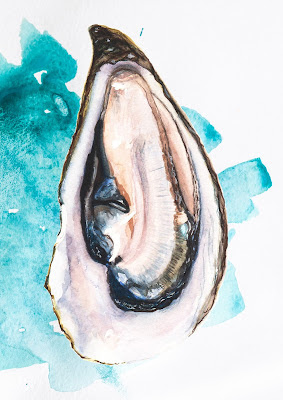
MIDDENS AND WEST COAST OYSTERS: T'LOXT'LOX

One of the now rare species of oysters in the Pacific Northwest is the Olympia oyster, Ostrea lurida, (Carpenter, 1864).  

While rare today, these are British Columbia’s only native oyster. 

Had you been dining on their brethren in the 1800s or earlier, it would have been this species you were consuming. Middens from Port Hardy to California are built from Ostrea lurida.

These wonderful invertebrates bare their souls with every bite. Have they lived in cold water, deep beneath the sea, protected from the sun's rays and heat? Are they the rough and tumble beach denizens whose thick shells tell us of a life spent withstanding the relentless pounding of the sea? Is the oyster in your mouth thin and slimy having just done the nasty—spurred by the warming waters of Spring? 

Is this oyster a local or was it shipped to your current local and, if asked, would greet you with "Kon'nichiwa?" Not if the beauty on your plate is indeed Ostrea lurida

Oyster in Kwak'wala is t̕łox̱t̕łox̱
We have been cultivating, indeed maximizing the influx of invasive species to the cold waters of the Salish Sea for many years. 

But in the wild waters off the coast of British Columbia is the last natural abundant habitat of the tasty Ostrea lurida in the pristine waters of  Nootka Sound. 

The area is home to the Nuu-chah-nulth First Nations who have consumed this species boiled or steamed for thousands of years. Here these ancient oysters not only survive but thrive — building reefs and providing habitat for crab, anemones and small marine animals. 

Oysters are in the family Ostreidae — the true oysters. Their lineage evolved in the Early Triassic — 251 - 247 million years ago. 

In the Kwak̓wala language of the Kwakwaka'wakw, speakers of Kwak'wala, of the Pacific Northwest and my family, an oyster is known as t̕łox̱t̕łox̱

I am curious to learn if any of the Nuu-chah-nulth have a different word for an oyster. If you happen to know, I would be grateful to learn.

Thursday, 19 December 2024

ASK THE FOSSIL HUNTRESS: WHAT IS A FOSSIL

Pick up a fossil and you are holding evidence of a life.

Not merely an old rock. Not an attractive geological paperweight. Not something the Earth made solely to tempt us into climbing unstable slopes in inappropriate footwear.

A fossil is a message from the past.

It may be a bone, tooth, shell or leaf. It may be the delicate impression of a feather, the tunnel left by a burrowing animal or the footprints of a creature that crossed a muddy shoreline hundreds of millions of years ago.

It may even be fossilized dung.

The fossil record has never been overly concerned with dignity.

Together, fossils preserve the history of life on Earth: its astonishing experiments, spectacular successes, evolutionary detours and occasional catastrophes. They introduce us to organisms no human ever saw alive and to ecosystems that vanished long before our own species appeared.

But what exactly qualifies as a fossil—and how can something as fleeting as a footprint survive for millions of years?

Let us begin at the beginning.

SO, WHAT IS A FOSSIL?

Dinosaur Footprints near Tumbler Ridge, BC
A fossil is naturally preserved evidence of past life. That definition is deliberately broad because life leaves evidence in many different ways.

A fossil can be part of an organism’s body, such as a bone, tooth, shell, leaf or piece of wood. It can also be a mark made by an organism while it was alive: a footprint, burrow, feeding trail, nest or bite mark.

The organism itself does not necessarily need to be present.

This is one of the most important things to understand about fossils. We often picture a magnificent dinosaur skeleton standing in a museum, every rib neatly arranged and every tooth poised for drama. Yet complete skeletons are extraordinarily rare. Most fossils are fragments: a single tooth, part of a shell, a scrap of leaf, one vertebra or a dark smudge of carbon in the rock.

Some fossils are so small that thousands could sit comfortably on the head of a pin. Others belong to animals that stretched longer than a city bus.

All of them are evidence.

We divide fossils into two major categories: body fossils and trace fossils. The distinction is simple, but it opens the door to an astonishing variety of preservation.

BODY FOSSILS: WHEN PART OF THE ORGANISM REMAINS

A body fossil preserves part of the organism itself—or a direct impression, mould or cast of its remains.

The most familiar body fossils include:

  • Bones
  • Teeth
  • Shells
  • Exoskeletons
  • Scales
  • Wood
  • Leaves
  • Seeds
  • Pollen
  • Spores

Cenoceras Fossilized Shell Material
Hard parts are much more likely to enter the fossil record because they resist decay longer than soft tissues. Teeth are especially durable. A vertebrate animal may lose and replace thousands of teeth during its lifetime, greatly improving the odds that at least a few will survive long enough to become fossils.

This is one reason isolated fossil teeth are much more common than complete fossil animals. Nature produces teeth generously and skeletons only once per customer.

Shells also have an excellent chance of preservation. Ancient seafloors could accumulate the remains of countless brachiopods, molluscs, corals and other marine organisms. Over time, those shells became part of the sediment and, eventually, part of the rock itself.

The most durable portions of an organism dominate the fossil record. According to the National Park Service overview of body fossils, bones, teeth, shells, mineralized plates and wood are preserved far more frequently than skin, organs, flowers or fruit.

This creates an immediate problem.

The fossil record is not a complete census of everything that ever lived. It has a built-in preference for organisms with hard parts, those living in places where burial could occur and those fortunate enough to die under favourable conditions.

A clam living on a muddy seafloor has a better chance of becoming a fossil than a soft-bodied creature living on a windswept mountain. This does not mean the mountain creature was less important. It was simply less likely to leave us its forwarding address. We find many more of the durable creatures than we do the squishy. 

TRACE FOSSILS: WHEN BEHAVIOUR BECOMES STONE

Theropod Track, Thailand
Trace fossils preserve evidence of what an organism did rather than the organism’s actual body.

They are also called ichnofossils, from the Greek word ichnos, meaning track or trace. Scientists who specialize in studying them are called ichnologists.

Trace fossils include:

  • Footprints and trackways
  • Burrows and tunnels
  • Trails
  • Resting impressions
  • Nests
  • Root traces
  • Feeding marks
  • Bite marks
  • Borings in shells or wood
  • Coprolites, or fossilized dung
  • Regurgitated material
  • Gastroliths associated with an animal

A body fossil can tell us that an organism existed. A trace fossil may reveal what it was doing.

A line of footprints can show whether an animal walked on two legs or four. The distance between prints can help researchers estimate speed. Several parallel trackways may suggest that animals moved together, although such interpretations must be made carefully.

A burrow can reveal how an animal moved through sediment, searched for food or protected itself. Bite marks can document interactions between predator and prey. A resting impression can preserve the outline of an animal settling momentarily onto a soft surface.

Trace fossils often remain in the substrate where the behaviour originally occurred. Unlike bones, which may be carried away by water, scavengers or gravity, a burrow generally records activity at that exact location.

This gives trace fossils an extraordinary quality. They preserve moments. An animal stepped here. A worm burrowed here. Something bit this shell.

A dinosaur crossed this stretch of wet sediment, placing one foot after another beneath a sky no human would ever see. The animal continued on. The moment passed. But the ground remembered.

YES, FOSSILIZED POO IS A REAL FOSSIL

Coprolites are fossilized faeces, and they are among some of our most personal treasures.

They vary enormously in size and appearance. Some resemble pellets, spirals or lumpy stones. Others are difficult to distinguish from ordinary rock without examining their shape, contents or chemical composition.

Coprolites can preserve:

  • Bone fragments
  • Fish scales
  • Plant fibres
  • Seeds
  • Pollen
  • Insect remains
  • Parasite eggs
  • Chemical evidence of diet

They can help researchers determine whether an animal ate meat, plants, insects, fish—or almost anything unfortunate enough to fit inside it.

The difficulty lies in identifying the producer. Unless a coprolite is found directly associated with a particular animal, assigning it to a species can be challenging. Size, shape, contents and geological context may narrow the possibilities, but we must resist the temptation to point dramatically at every ancient dropping and declare, “Tyrannosaurus!”

Not every large coprolite came from the most famous carnivore available.

Still, fossilized dung offers something bones alone cannot: evidence of a meal passing through an animal’s digestive system. Coprolites are trace fossils that can provide direct clues about ancient diets.

One creature’s private moment has become everyone’s scientific business. Deep time can be terribly indiscreet.

DOES A FOSSIL HAVE TO BE TURNED TO STONE?

No. “Fossil” describes evidence of past life, not one particular style of preservation.

Some fossils are petrified or mineralized. Others preserve original material. Fossils can occur as impressions, carbon films, moulds, casts or remains trapped in substances such as amber, tar or ice.

Let us look at a few possibilities.

Permineralized Fossils

Bones and wood contain microscopic spaces. After burial, mineral-rich water may move through the sediment and deposit minerals inside those spaces.

This process is called permineralization.

The original structure may remain while its pores become filled with minerals such as silica, calcite or iron compounds. The result is denser and heavier than the original material but can preserve remarkable internal detail.

Petrified wood is a beautiful example. Its tissues may become mineralized so precisely that growth rings and cellular structures remain visible.

Replacement Fossils

In some fossils, the original biological material dissolves and is gradually replaced by minerals. The new mineral preserves the form—and sometimes even the microscopic structure—of the original organism.

It is rather like replacing a building one brick at a time while somehow retaining its shape.

Moulds and Casts

Imagine a shell buried in sediment.

The sediment hardens around it, but the shell later dissolves, leaving an empty impression. This cavity is a mould. If minerals or sediment later fill that mould and harden, they create a cast: a three-dimensional replica of the original shell.

An internal mould can form when sediment fills the inside of a shell and hardens before the shell disappears. Such fossils are sometimes called steinkerns, a German term meaning “stone kernel.”

Nothing of the original shell may remain, yet its shape survives. The body is gone. The absence has become the fossil. 

Compression and Carbon Films

McAbee Fossil Plants
Plants and soft-bodied organisms may be buried and flattened beneath accumulating sediment. Pressure drives away liquids and gases, sometimes leaving a thin film rich in carbon.

These fossils can appear as dark, delicate outlines on the rock. Leaves may preserve their veins. 

Fish may retain the shapes of scales and fins. Soft-bodied animals can sometimes be recorded in astonishing detail.

They are the geological equivalent of silhouettes—life pressed into stone. Some of the lovely specimens we find at the Eocene McAbee Fossil Beds near Cache Creek, British Columbia, are a great example.

Amber Preservation

Amber begins as sticky resin produced by ancient trees. Small organisms such as insects, spiders, mites and fragments of plants can become trapped in the resin. As the resin is buried and chemically altered over time, it becomes amber.

Amber can preserve extraordinary detail: hairs, wings, compound eyes and delicate structures that would normally decay rapidly.

It can even preserve tiny moments of behaviour. Organisms have been found trapped while feeding, mating, carrying pollen or interacting with parasites.

Amber is not a perfect time capsule, however, and it has not provided usable dinosaur DNA. The mosquitoes of Jurassic Park remain unemployed. If you are looking for some superb examples of amber preservation, check out the collection of Harry Tabiner in the UK. He has a remarkable eye and enviable collection, which he shares online.

Ice, Dryness and Natural Tar 

Cold, arid or oxygen-poor conditions can dramatically slow decay. Mammoths preserved in frozen ground may retain hair, skin, muscle and stomach contents. Natural tar deposits can preserve vast collections of bones, although the remains themselves may be stained, altered or compressed.

These forms of preservation remind us that a fossil does not need to resemble a traditional stone skeleton. Fossilization is not a single recipe. It is a vast collection of unlikely outcomes.

WHAT ABOUT FOOTPRINTS? HOW CAN A HOLE BECOME A FOSSIL?

A footprint fossil begins with a perfectly ordinary step.

An animal walks across a surface soft enough to receive an impression but firm enough to retain its shape. Mud and damp sand are excellent candidates.

The track must then be buried before wind, waves, rain, other animals or enthusiastic members of the herd destroy it. A new layer of sediment settles over the surface, filling and protecting the impression.

With continued burial, both layers may harden into rock. Millions of years later, erosion separates them again. One surface may preserve the original footprint as a depression. The layer that filled the print may preserve a raised natural cast.

Tracks are not simply stamps of the foot. The animal’s weight can deform layers beneath the surface, producing structures known as undertracks. These may be less anatomically precise than the original print but can still record the passage of the animal.

Interpreting tracks requires caution. Wetness, sediment texture, erosion and the animal’s movement can all alter a footprint’s appearance. The same animal could leave surprisingly different tracks after walking only a short distance.

We must study the track, the sediment and the entire trackway—not merely find three vaguely pointed marks and immediately summon the media.

HOW OLD DOES SOMETHING HAVE TO BE BEFORE IT BECOMES A FOSSIL?

You may have heard that a fossil must be at least 10,000 years old.

That figure is commonly used as a practical dividing line in educational materials and some regulatory contexts, but nature has not installed an official fossil clock that rings at midnight on an organism’s ten-thousandth birthday.

We may use terms such as subfossil for relatively recent remains that are not fully fossilized or that retain considerable original material. The terminology can vary depending on the field, material and legal jurisdiction.

Age alone is not the only consideration. Geological context, preservation and scientific usage all matter.

An ammonite shell 100 million years old is unquestionably a fossil. A mammoth tusk 30,000 years old is also a fossil, even if some of its original material remains. Very recent bones from an archaeological site may be described as remains rather than fossils.

The boundary is useful, but it is not a magical transformation.

ARE ALL FOSSILS VISIBLE?

Not remotely. Some of the most important fossils on Earth are microscopic.

Microfossils include fossilized pollen, spores, algae, bacteria, protists and the tiny shells or skeletal elements of marine organisms.

They may be smaller than a grain of sand, yet they occur in enormous numbers and can be tremendously useful. Because some microscopic organisms evolved rapidly and lived across wide geographic areas, their fossils can help scientists date and correlate rock layers.

Microfossils also reveal ancient environments. Different species lived under different conditions, so their presence can provide clues about water depth, temperature, salinity, oxygen levels and climate.

Oil and gas exploration has long relied on micropalaeontology to interpret underground rock layers. A microscopic fossil no larger than a speck of dust may help identify the age and environment of rocks buried kilometres beneath the surface.

Dinosaurs receive the posters. Microfossils quietly organize geological time. Alas, always the bridesmaid, never the bride... Dinos get all the love.

CAN MOLECULES BE FOSSILS?

Ancient life can sometimes leave chemical evidence even when no recognizable body or trace remains.

These signals are often called chemical fossils or biomarkers.

Certain molecules are associated with particular groups of organisms or biological processes. Modified versions of those compounds may survive in ancient rocks, providing evidence that particular kinds of life were present.

Stable isotope patterns can also carry biological information. Living organisms use elements in ways that can leave characteristic chemical signatures in their tissues or surrounding sediments.

Chemical fossils require careful interpretation because geological heat, pressure and contamination can alter molecular evidence. But when combined with other data, they can help scientists investigate some of the earliest chapters in the history of life.

Sometimes life leaves a bone. Sometimes it leaves a footprint. Sometimes it leaves little more than chemistry.

IS A DINOSAUR SKELETON IN A MUSEUM MADE OF REAL FOSSILS?

Sometimes entirely. Sometimes partly. Sometimes hardly at all.

Complete dinosaur skeletons are rare. Museum mounts are often composites, combining fossil bones from more than one individual of the same species. Missing elements may be reconstructed as casts.

In some displays, the original fossils are too heavy, fragile or scientifically valuable to suspend in a dramatic pose. Museums may mount lightweight replicas while keeping the genuine fossils safely stored for research.

This does not make the display fake. A high-quality cast reproduces the shape and surface detail of the original fossil while protecting irreplaceable material. Casts can also be shared with museums, schools and researchers around the world.

Labels generally explain which elements are original fossils and which are reconstructed. It is always worth looking.

The glamorous skeleton towering over the gallery may be a carefully assembled ambassador for a far more fragmentary animal.

IS EVERY OLD BONE A FOSSIL?

No. Sometimes an old bone is just that, an old bone. Not a fossil. Age and appearance alone do not prove that something is fossilized. Modern bones can become stained by soil and minerals, making them look ancient. Conversely, genuine fossils do not always appear dramatically different from ordinary bone.

Identification may involve examining:

  • Geological context
  • Colour and density
  • Surface texture
  • Internal structure
  • Mineral composition
  • Associated fossils
  • Degree of mineralization
  • Evidence of recent organic material

And no, licking it is not the preferred scientific method but, I confess, it is helpful in the field. Not fully diagnostic, but helpful. I have a good friend Skippy who swears by it.

There is an old field trick based on the idea that porous fossil bone may stick slightly to the tongue, but modern bone can do the same, as can many ordinary rocks. The technique is unhygienic, unreliable and particularly regrettable when the mystery specimen is not bone at all.

Use a hand lens. Use comparative anatomy. Use laboratory analysis. Leave your tongue out of the peer-reviewed methodology.

WHY ARE FOSSILS SO RARE?

To become a fossil, an organism must pass through a series of improbable filters. Fossils are not rare per se, as I can think of localities with hundreds spread across the surface and more beneath, but they are rare in the sense that only a small percentage of the organisms that have lived have been preserved this way. To become a fossil is a bit of a process, as you might expect. 

First, the organism, dino, plant, or what have you, must die in a place where preservation is possible.

Then its remains must escape scavengers, decay, trampling, weather and destruction. They must be buried. The sediment must remain intact as it becomes rock. The fossil must survive heat, pressure, chemical alteration, faulting, erosion and the slow recycling of Earth’s crust.

Finally, it must become exposed—or be reached by excavation—at precisely the right time for someone to recognize it. Too early, and it remains buried. Too late, and erosion destroys it.

The fossil record is therefore both magnificent and profoundly incomplete.

Most organisms that ever lived left no known fossil. Entire species may have appeared, flourished and vanished without preserving a trace that we have yet discovered.

Soft-bodied organisms are especially underrepresented. Environments such as mountains, forests and tropical soils generally offer fewer opportunities for long-term preservation than lakes, river floodplains and marine sediments.

When we reconstruct ancient ecosystems, we are working with survivors of a second kind—not organisms that survived extinction, but evidence that survived geology.

IS A FOSSIL THE SAME THING AS A ROCK?

A fossil is preserved within a geological material, and many fossils have been heavily mineralized, but “fossil” and “rock” are not interchangeable terms.

A rock forms through geological processes and may contain fossils. A fossil is evidence of past life preserved within rock, sediment, amber, ice or another natural context.

The distinction can become wonderfully complicated.

A fossil shell may retain original shell material. A petrified log may be almost entirely mineral. A mould contains none of the organism but preserves its shape. A trace fossil may consist entirely of disturbed sediment.

So, is a fossil a rock? Sometimes it has effectively become one. But what makes it a fossil is not simply its material. It is the biological information it carries.

WHAT CAN ONE FOSSIL TELL US?

Far more than its name. A fossil’s anatomy may reveal how an organism moved, fed or defended itself. Growth rings can record seasons or age. Microscopic wear on teeth may reveal diet. Bone injuries can preserve evidence of accidents, disease, combat and healing.

The surrounding sediment can tell us whether the organism lived in a river, desert, forest, lake or sea. Associated fossils help reconstruct the plants, animals and microorganisms sharing that environment.

Chemical analysis may reveal temperature, water conditions, migration or food-web relationships. Footprints may preserve speed and direction. Burrows can reveal oxygen levels in ancient sediments. Coprolites can contain the remains of a final meal.

Even the way a body was buried matters. Were the bones scattered by a river? Gnawed by scavengers? Transported by waves? Buried in a sudden flood?

The study of what happens to an organism between death, burial and discovery is called taphonomy. It helps palaeontologists separate evidence of how an animal lived from evidence of what happened after it died. A fossil is not simply an object. It is a scene containing clues.

WHAT IS NOT A FOSSIL?

Not every interesting pattern in rock was created by life.

Mineral crystals, concretions, sedimentary structures and weathered rocks can resemble eggs, shells, bones, skin, feathers or entire mysterious creatures. These geological look-alikes are sometimes called pseudofossils. Or, leaverits, as in leave it right there. 

Manganese minerals can grow in branching patterns resembling ferns. Concretions can look remarkably like eggs. Layered rocks may split into shapes suggesting shells or leaves. Some rocks possess suspiciously skull-like features and an unreasonable amount of charisma.

The human brain excels at recognizing familiar forms. This tendency, called pareidolia, helps us see faces in clouds, animals in tree bark and dinosaurs in the landscaping gravel.

None of this makes an unusual rock uninteresting. A pseudofossil can still be geologically beautiful.

It simply tells a different story.

THE FOSSIL RECORD IS BIASED

The fossil record is sometimes imagined as a great stone library containing the complete history of life.

It is more like a library after fire, flood, renovation, several lost catalogues and four billion years of questionable management.

Some chapters are richly detailed. Others contain a few scattered sentences. Entire volumes are missing.

Organisms with shells, bones or teeth are more likely to be preserved than soft-bodied organisms. Aquatic environments are generally better represented than upland habitats. Abundant and widespread species have a greater chance of discovery than rare, geographically restricted ones.

Even human activity introduces bias. Fossils are more likely to be discovered where rocks are exposed, where researchers can travel and where scientific work has been funded.

Palaeontologists must account for these biases when interpreting patterns of diversity, evolution and extinction. An absence of fossils does not necessarily prove that an organism was absent. It may mean that the right rocks were not deposited, did not survive or have not yet been explored.

The fossil record is incomplete. But incomplete does not mean useless. It means we must read it carefully.

A FOSSIL IS A RELATIONSHIP

There is another way to think about fossils. A fossil is not merely a thing that was once alive. It is the relationship between life and the Earth that preserved it. The organism contributed its body or behaviour. The environment supplied mud, sand, ash, resin, ice or minerals. Time transformed the evidence. Erosion returned it to the light. Then someone noticed.

That final part matters. A fossil can lie exposed among a thousand ordinary stones and remain silent until a curious person stops, looks closely and asks a question.

What made this shape? Why is this shell inside a mountain? Who walked here? What kind of world once existed beneath my feet? Every fossil discovery begins with attention. And many great specimens have been found by folk of all ages (many of them too young to vote) who take notice of the world around them.

A MESSAGE THAT SURVIVED

To hold a fossil is to hold a contradiction. It is evidence of death that teaches us about life. It is a motionless object that may record movement. It is a fragment capable of revealing an ecosystem.

It is ancient, yet newly discovered.

The animal, plant or microorganism did not set out to leave us a message. The footprint was not made for our benefit. The shell did not settle onto the seafloor hoping to appear one day in a museum drawer.

And yet the evidence survived.

Across burial, mineralization, shifting continents, rising mountains and relentless erosion, something remained.

A tooth.

A leaf.

A burrow.

A trail across the mud.

A tiny, stubborn piece of deep time waiting for someone to recognize it.

That is a fossil.