Thursday, 14 November 2024
SPINY HETEROMORPH: AMMONITE INDEX FOSSILS
Wednesday, 6 November 2024
LIVING FOSSILS: MASTERS OF MASS EXTINCTION EVENTS
Much like (slow) Water Striders (Aquarius remigis), (relatively sluggish) Coelacanth (Latimeria chalumnae) and (the current winner on really slow evolution) Elephant Sharks (Callorhinchus milii), these fellows have a long history in the fossil record with very few anatomical changes.
But slow change provides loads of great information. It makes our new friend, Yunnanolimulus luoingensis, an especially interesting and excellent reference point for how this group evolved.
We can examine their genome today and make comparisons all the way back to the Middle Triassic (with this new find) and other specimens from further back in the Ordovician — 445 million years ago.
These living fossils have survived all five mass extinction events. They are generalists who can live in shallow or deep water and will eat pretty much anything they can find on the seafloor.
The oldest horseshoe crab fossil, Lunataspis aurora, is found in outcrops in Manitoba, Canada. Charmingly, the name means crescent moon shield of the dawn. It was palaeontologist Dave Rudkin and team who chose that romantic name. Finding them as fossils is quite remarkable as their shells are made of protein which does not mineralized like typical fossils.
Even so, the evolution of their exoskeleton is well-documented by fossils, but appendage and soft-tissue preservation are extremely rare.
A new study analyzes details of the appendage and soft-tissue preservation in Yunnanolimulus luoingensis, a Middle Triassic (ca. 244 million years old) horseshoe crab from Yunnan Province, SW China. The remarkable anatomical preservation includes the chelicerae, five pairs of walking appendages, opisthosomal appendages with book gills, muscles, and fine setae permits comparison with extant horseshoe crabs.
![]() |
The occurrence of Carcinoscorpius-type claspers on the first and second walking legs in male individuals of Y. luoingensis tells us that simple chelate claspers in males are plesiomorphic for horseshoe crabs, and the bulbous claspers in Tachypleus and Limulus are derived.
As an aside, if you hadn't seen an elephant shark before and were shown a photo, you would likely say, "that's no freaking shark." You would be wrong, of course, but it would be a very clever observation.
Callorhinchus milii look nothing like our Great White friends and they are not true sharks at all. Rather, they are ghost sharks that belong to the subclass Holocephali (chimaera), a group lovingly known as ratfish. They diverged from the shark lineage about 400 million years ago.
If you have a moment, do a search for Callorhinchus milii. The odd-looking fellow with the ironic name, kallos, which means beautiful in Greek, sports black blotches on a pale silver elongate body. And their special feature? It is the fishy equivalent of business in the front, party in the back, with a dangling trunk-like projection at the tip of their snout and well-developed rectal glands near the tail.
As another small point of interest with regards to horseshoe crabs, John McAllister collected several of these while working on his MSc to see if they had microstructures similar to trilobites (they do) and whether their cuticles were likewise calcified. He found no real calcification in their cuticles, in fact, he had a rather frustrating time getting anything measurable to dissolve in acid in his hunt for trace elements.
Likewise, when looking at oxygen isotopes (16/18) to get a handle on water salinity and temperature, his contacts at the University of Waterloo had tons of fun getting anything at all to analyze. It made for some interesting findings. Sadly, for a number of reasons, he abandoned the work, but you can read his very interesting thesis here: https://dr.library.brocku.ca/handle/10464/1959
Ref: Hu, Shixue & Zhang, Qiyue & Feldmann, Rodney & Benton, Michael & Schweitzer, Carrie & Huang, Jinyuan & Wen, Wen & Zhou, Changyong & Xie, Tao & Lü, Tao & Hong, Shuigen. (2017). Exceptional appendage and soft-tissue preservation in a Middle Triassic horseshoe crab from SW China. Scientific Reports. 7. 10.1038/s41598-017-13319-x.
Tuesday, 5 November 2024
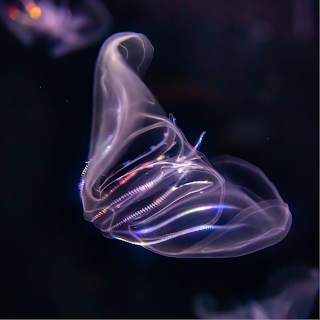
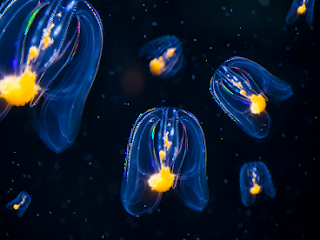
CTENOPHORES: COMB JELLIES
| Cannibalistic Comb Jellies |
Ctenophores or comb jellies are one of the phylogenetically most important and controversial metazoan groups. They are not jellyfish and are not closely related, though they do share some characteristics with the gelatinous members of the subphylum Medusozoa.
Comb jellies are not picky eaters. Their tastes range to what is at hand, including cannibalizing other comb jellies. They will feast on their kin along with tasty plankton, zooplankton, crustaceans and wee fish.
Interest in their fossil record has been catalysed by spectacularly preserved soft-bodied specimens from Cambrian Lagerstätten of the 518-million-years-old Chengjiang Biota, the 505-million-years-old Burgess Shale and other Burgess Shale-like deposits.
We find them in the Late Devonian Escuminac Formation at Miguasha National Park, Quebec, Canada — a UNESCO world heritage site famous for its abundance of well-preserved vertebrate fossils including most major evolutionary groups of Devonian lower vertebrates from jawless fish to stem-tetrapods.
Based on morphological similarities of this Canadian fossil with stem-ctenophore fossils from the Cambrian Lagerstätte of the Chinese locality Chengjiang, they have been assessed for their affinity to stem-group ctenophores (dinomischids, Siphusauctum, scleroctenophorans) and early crown-group ctenophores. Modern ctenophores and many fossil forms lack mineralized hard parts, which renders the rare fossils that have been extracted from several Lagerstätten quite remarkable.
Like the soft bodies of jellyfish and the polyps of hydrozoans and anthozoans, the probability for such soft bodies (or body regions) to become fossilized is extremely low. In spite of this low preservation potential, remains of stem-ctenophores have become known from several Cambrian and younger conservation deposits, and with even older candidate ctenophores in the Ediacaran.
While Cambrian Lagerstätten have yielded several genera, ctenophore remains are much rarer in the Devonian; in particular, two studies, describing material from the German Hunsrück Slate.
| Bioluminescent Comb Jellies |
The most basal stem ctenophores are the dinomischids: sessile benthic petaloid invertebrates, many of which are equipped with a stalk. This group first was described from the Middle Cambrian Burgess Shale. Based on the genus Dinomischus, these early stalked forms were commonly called ‘dinomischids’.
Zhao et al. shared that dinomischids "form a grade in the lower part of the ctenophore stem group” and include taxa such as Xianguangia, Daihua, and Dinomischus that have hexaradiate-based symmetry (e.g., sixfold, 18-fold).
Some later, skeletonised stem-ctenophores were termed ‘Scleroctenophora’; ‘scleroctenophorans’ have a shorter stalk, lack the ‘petals’ and have no bracts and might be monophyletic.
To date, all known dinomischids and scleroctenophorans are Cambrian. Remarkably, analysis of the material described here suggests it is a very late-surviving member of this part of the ctenophore tree, occurring in strata over a hundred million years younger with no intervening known record, thus making it a Lazarus taxon with an extensive ghost lineage.
Palaeozoic sediments yield a growing number of fossil invertebrates with radial symmetries, some being quite enigmatic with body plans differing radically from those of extant organisms.
The morphological similarities to Cambrian forms and the mix of characters regarding overall shape and symmetries render this discovery important. The aims of this study are to describe the only known specimen of this Devonian ctenophore, discuss its phylogenetic and systematic position, and the impact of fossil data for ctenophore affinities, and assess its palaeoecological role.
Monday, 28 October 2024
SMILODON NORTH OF THE 49TH PARALLEL
Smilodon is a genus of the extinct machairodont subfamily of the felids. It is one of the most famous prehistoric mammals and the best known saber-toothed cat. Although commonly known as the saber-toothed tiger, it was not closely related to the tiger or other modern cats.
Up until a few years ago, all the great fossil specimens of this apex predator were found south of us in the United States. That was until some interesting bones from Medicine Hat, Alberta got a second look.
A few years ago, a fossil specimen caught the eye of researcher Ashley Reynolds as she was rummaging through the collections at the Royal Ontario Museum in Toronto.
Back in the 1960s, University of Toronto palaeontologist C.S. Churcher and his team had collected and donated more than 1,200 specimens from their many field seasons scouring the bluffs of the South Saskatchewan River near Medicine Hat, Alberta.
Churcher is a delightful storyteller and a palaeontologist with a keen eye. I had the very great pleasure of listening to many of his talks out at the University of British Columbia and a few Vancouver Paleontological Society meetings in the mid-2000s.
"Rufus" was a thoroughly charming storyteller and shared many of his adventures from the field.
He moved out to the West Coast for his retirement, first to Gabriola Island then to Victoria, but his keen love of the science kept him giving talks to enthralled listeners keen to hear about his survey of the Dakhleh Oasis in the Western Desert of Egypt, geomorphology, stratigraphy, recent biology, Pleistocene and Holocene lithic cultures, insights learned from Neolithic Islamic pottery to Roman settlements.
The specimens he had collected had been roughly sorted but never examined in detail. Reynolds, who was researching the growth patterns and life histories of extinct cats saw a familiar-looking bone from an ancient cat's right front paw. That tiny paw bone had reached through time and was positively identified as Canada's first Smilodon.
These Apex Predators used their exceptionally long upper canine teeth to hunt large mammals.
Isotopes preserved in the bones of S. fatalis in the La Brea Tar Pits in California tell us that they liked to dine on bison (Bison antiquus) and camels (Camelops) along with deer and tapirs. Smilodon is thought to have killed its prey by holding it still with its forelimbs and biting it. And that was quite the bite!
Their razor-sharp incisors were arranged in an arch. Once they bit down, the teeth would hold their prey still and stabilize it while the canine bite was delivered — and what a bite that was. They could open their mouths a full 120 degrees.
Smilodon died out at the same time that most North and South American megafauna disappeared, about 10,000 years ago. Its reliance on large animals has been proposed as the cause of its extinction, along with climate change and competition with other species.
Thursday, 24 October 2024
BRONZE BEAUTY: EIFELIAN PARALEJURUS
It was the colour of this amazing trilobite that captured the eye of David Appleton in whose collection it now resides. He is an avid collector and coming into his own as a macro photographer. I have shared three of his delightful photos for you here.
It initially thought that the gold we see here was added during prep, particularly considering the colouration of the matrix, but macro views of the surface show mineralization and the veins running right through the specimen into the matrix. There is certainly some repairs but that is common in the restoration of these specimens. Many of the trilobites I have seen from Morocco have bronze on black colouring but not usually this pronounced. Even so, there is a tremendous amount of fine anatomy to explore and enjoy in this wonderfully preserved specimen.
Paralejurus is a genus of trilobite in the phylum Arthropoda from the Late Silurian to the Middle Devonian of Africa and Europe. These lovelies grew to be up to nine centimetres, though the fellow you see here is a wee bit over half that size at 5.3 cm.
Paralejurus specimens are very pleasing to the eye with their long, oval outline and arched exoskeletons.
Their cephalon or head is a domed half circle with a smooth surface. The large facet eyes have very pleasing crescent-shaped lids. You can see this rather well in the first of the photos here. The detail is quite remarkable.
As you move down from his head towards the body, there is an almost inconspicuous occipital bone behind the glabella in the transition to his burnt bronze thorax.
The body or thorax has ten narrow segments with a clearly arched and broad axial lobe or rhachis. The pygidium is broad, smooth and strongly fused in contrast to the genus Scutellum in the family Styginidae, which has a pygidium with very attractive distinct furrows that I liken to the look of icing ridges on something sweet — though that may just be me and my sweet tooth talking. In Paralejurus, they look distinctly fused — or able to fuse — to add posterior protection against predators with both the look and function of Roman armour.
In Paralejurus, the axillary lobe is rounded off and arched upwards. It is here that twelve to fourteen fine furrows extend radially to complete the poetry of his body design.
Trilobites were amongst the earliest fossils with hard skeletons and they come in many beautiful forms. While they are extinct today, they were the dominant life form at the beginning of the Cambrian.As a whole, they were amongst some of the most successful of all early animals — thriving and diversifying in our ancient oceans for almost 300 million years. The last of their brethren disappeared at the end of the Permian — 252 million years ago. Now, we enjoy their beauty and the scientific mysteries they reveal about our Earth's ancient history.
Photos and collection of the deeply awesome David Appleton. Specimen: 5.3 cm.
Sunday, 20 October 2024
ALCIDS AUKS: PUFFLINGS AND DUTIFUL PARENTS
Their sexy orange beaks shift from a dull grey to bright orange when it is time to attract a mate. While not strictly monogamous, most Puffins choose the same mate year upon year producing adorable chicks or pufflings (awe) from their mating efforts.
Female Puffins produce one single white egg which the parents take turns to incubate over a course of about six weeks. Their dutiful parents share the honour of feeding the wee pufflings five to eight times a day until the chick is ready to fly. Towards the end of July, the fledgeling Puffins begin to venture from the safety of their parents and dry land. Once they take to the seas, mom and dad are released from duty and the newest members of the colony are left to hunt and survive on their own.
These are pelagic seabirds that feed primarily by diving in the water. They breed in large colonies on coastal cliffs or offshore islands, nesting in crevices among rocks or in burrows in the soil. Two species, the tufted puffin and horned puffin are found in the North Pacific Ocean, while the Atlantic puffin is found in the North Atlantic Ocean.
These Atlantic Puffins are one of the most famous of all the seabirds and form the largest colony in Southern Britain. They live about 25 years making a living in our cold seas dining on herring, hake and sand eels. Some have been known to live to almost 40 years of age. They are good little swimmers as you might expect, but surprisingly they are great flyers, too! They are hindered by short wings, which makes flight challenging but still possible with effort. Once they get some speed on board, they can fly up to 88 km an hour.
The oldest alcid fossil is Hydrotherikornis from Oregon dating to the Late Eocene while fossils of Aethia and Uria go back to the Late Miocene. Molecular clocks have been used to suggest an origin in the Pacific in the Paleocene. Fossils from North Carolina were originally thought to have been of two Fratercula species but were later reassigned to one Fratercula, the tufted puffin, and a Cerorhinca species. Another extinct species, Dow's puffin, Fratercula dowi, was found on the Channel Islands of California until the Late Pleistocene or early Holocene.
The Fraterculini are thought to have originated in the Pacific primarily because of their greater diversity in the region. There is only one extant species in the Atlantic, compared to two in the Pacific. The Fraterculini fossil record in the Pacific extends at least as far back as the middle Miocene, with three fossil species of Cerorhinca, and material tentatively referred to that genus, in the middle Miocene to late Pliocene of southern California and northern Mexico.
Although there no records from the Miocene in the Atlantic, a re-examination of the North Carolina material indicated that the diversity of puffins in the early Pliocene was as great in the Atlantic as it is in the Pacific today. This diversity was achieved through influxes of puffins from the Pacific; the later loss of species was due to major oceanographic changes in the late Pliocene due to closure of the Panamanian Seaway and the onset of severe glacial cycles in the North Atlantic.
Wednesday, 16 October 2024
NEVADA: AMMONOIDS AND CONODONTS
Exposures of the Upper Triassic, Early Norian, Kerri zone, Luning formation, West Union Canyon, just outside Berlin-Ichthyosaur State Park, Nevada.
The Berlin-Ichthyosaur State Park in central Nevada is a very important locality for the understanding of the Carnian-Norian boundary (CNB) in North America.
Rich ammonoid faunas from this site within the Luning Formation were studied by Silberling (1959) and provided support for the definition of the Schucherti and Macrolobatus zones of the latest Carnian, which are here overlain by well-preserved faunas of the earliest Norian Kerri Zone. Despite its importance, no further investigations have been done at this site during the last 50 years.
Jim Haggart, Mike Orchard and Paul Smith collaborated on a project that took them down to Nevada to look at the conodonts and ammonoids; the group then published a paper, "Towards the definition of the Carnian/Norian Boundary: New data on Ammonoids and Conodonts from central Nevada," which you can find in the proceedings of the 21st Canadian Paleontology Conference; by Haggart, J W (ed.); Smith, P L (ed.); Canadian Paleontology Conference Proceedings no. 9, 2011 p. 9-10.
They conducted a bed-by-bed sampling of ammonoids and conodonts in West Union Canyon during October 2010. The eastern side of the canyon provides the best record of the Macrolobatus Zone, which is represented by several beds yielding ammonoids of the Tropites group, together with Anatropites div. sp. conodont faunas from both these and higher beds are dominated by ornate 'metapolygnthids' that would formerly have been collectively referred to Metapolygnathus primitius, a species long known to straddle the CNB. Within this lower part of the section, they resemble forms that have been separated as Metapolygnathus mersinensis. Slightly higher, forms close to 'Epigondolella' orchardi and a single 'Orchardella' n. sp. occur. This association can be correlated with the latest Carnian in British Columbia.
![]() |
| Ammonoids of the Luning Formation |
The best exposure of the Kerri Zone is on the western side of the West Union Canyon. Ammonoids, dominated by Guembelites and Stikinoceras div. sp., have been collected from several fossil-bearing levels. Conodont faunas replicate those of the east section. The collected ammonoids fit perfectly well with the faunas described by Silberling in 1959, but they differ somewhat from the coeval faunas of the Tethys and Canada.
The genus Gonionotites, very common in the Tethys and British Columbia, is for the moment unknown in Nevada. More in general, the Upper Carnian faunas are dominated by Tropitidae, while Juvavitidae are lacking.
After years of reading about the correlation between British Columbia and Nevada, I had the very great pleasure of walking through these same sections in October 2019 with members of the Vancouver Paleontological Society and Vancouver Island Palaeontological Society. It was with that same crew that I had originally explored fossil sites in the Canadian Rockies in the early 2000s. Those early trips led to paper after paper and the exciting revelations that inspired our Nevada adventure.
Saturday, 12 October 2024
NATURAL DYES: INDIGO
Archaeologists have found evidence of textile dyeing dating back to the Neolithic period.
The essential process of dyeing changed little over time. Typically, the dye material is put in a pot of water and then the textiles to be dyed are added to the pot, which is heated and stirred until the colour is transferred. Sometimes, we use workers with stout marching legs to mix this up.
Traditional dye works still operate in many parts of the world. There is a revival of using natural indigo in modern Egypt — although their indigo dye is mostly imported. The same is true further south in Sudan. They've been importing cloth from Upper Egypt as far back as we have written records and continue the practice of the cloth and dye imports today. Clean white cotton is more the style of western Sudan and Chad, but they still like to throw in a bit of colour.
![]() |
| Traditional Dye Vats |
My guide took me to the top of a building so I could look down on rows and rows of coloured vats. In every other one was a man marching in place to work the dye into the wool. Their legs took on the colour from their daily march in place in huge tubs of liquid dye and sheared wool.
Many natural dyes require the use of chemicals called mordants to bind the dye to the textile fibres; tannin from oak galls, salt, natural alum, vinegar, and ammonia from stale urine were staples of the early dyers.
Many mordants and some dyes themselves produce strong odours. Urine is a bit stinky. Not surprisingly, large-scale dyeworks were often isolated in their own districts.
![]() |
| Woad, Isatis tinctoria |
Dyes such as cochineal and logwood, Haematoxylum campechianum, were brought to Europe by the Spanish treasure fleets, and the dyestuffs of Europe were carried by colonists to America.
Throughout history, people have dyed their textiles using common, locally available materials, but scarce dyestuffs that produced brilliant and permanent colours such as the natural invertebrate dyes. Crimson kermes became highly prized luxury items in the ancient and medieval world. Red, yellow and orange shades were fairly easy to procure as they exist as common colourants of plants. It was blue that people sought most of all and purple even more so.
Indigofera tinctoria, a member of the legume or bean family proved just the trick. This lovely plant — named by the famous Swedish botanist Carl Linneaus, the father of formalized binomial nomenclature — grows in tropical to temperate Asia and subtropical regions, including parts of Africa.
The plants contain the glycoside indican, a molecule that contains a nitrogenous indoxyl molecule with some glucose playing piggyback.
To make the lovely blue and purple dyes, we harvest the plants and ferment them in vats with urine and ash. The fermentation splits off the glucose, a wee bit of oxygen mixes in with the air (with those sturdy legs helping) and we get indigotin — the happy luxury dye of royalty, emperors and kings.
While much of our early dye came from plants — now it is mostly synthesized — other critters played a role. Members of the large and varied taxonomic family of predatory sea snails, marine gastropod mollusks, commonly known as murex snails were harvested by the Phoenicians for the vivid dye known as Tyrian purple.
While the extant specimens maintained their royal lineage for quite some time; at least until we were able to manufacture synthetic dyes, it was their fossil brethren that first captured my attention. There are about 1,200 fossil species in the family Muricidae.
George E. Radwin and Anthony D'Attilio: The Murex shells of the World, Stanford University press, 1976, ISBN 0-8047-0897-5
Pappalardo P., Rodríguez-Serrano E. & Fernández M. (2014). "Correlated Evolution between Mode of Larval Development and Habitat in Muricid Gastropods". PLoS ONE 9(4): e94104. doi:10.1371/journal.pone.0094104
Miocene Gastropods and Biostratigraphy of the Kern River Area, California; United States Geological Survey Professional Paper 642
Thursday, 3 October 2024
WASHINGTON STATE PALEONTOLOGY
![]() |
| North Cascades National Park, Washington State, USA |
Washington is home to a wide variety of fossils—from new species of fossil crabs to marine mollusks and the fossil palm fronds that symbolize the Chuckanut formation.
We also find fossil whales, bird trackways, fossil sockeye salmon, mammal footprints, mammoth bones & the trace fossil remains of ancient rhino. In the time expanse in which we live our very short human lives, the Earth's crust appears permanent.
A fixed outer shell – terra firma. Aside from the rare event of an earthquake or the eruption of Mount St. Helen’s in 1980, our world seems unchanging, the landscape constant. In fact, it has been on the move for billions of years and continues to shift each day. As the earth’s core began cooling, some 4.5 billion years ago, plates, small bits of continental crust, have become larger and smaller as they are swept up in or swept under their neighbouring plates. Large chunks of the ocean floor have been uplifted, shifted and now find themselves thousands of miles in the air, part of mountain chains far from the ocean today or carved by glacial ice into valleys and basins.
Two hundred million years ago, Washington was two large islands, bits of the continent on the move westward, eventually bumping up against the North American continent and calling it home. Even with their new fixed address, the shifting continues; the more extreme movement has subsided laterally and continues vertically. The upthrusting of plates continue to move our mountain ranges skyward, the path of least resistance.
| Fossil Palm Front, Washington State |
The fossils found there lived and died some 40-55 million years ago, very close to where they are now, but in a much warmer, swampy setting. The exposures of the Chuckanut Formation were once part of a vast river delta; imagine, if you will, the bayou country of the Lower Mississippi.
The siltstones, sandstones, mudstones and conglomerates of this formation were laid down about 40-54 million years ago during the Eocene epoch, a time of luxuriant plant growth in the subtropical flood plain that covered much of the Pacific Northwest.
This ancient wetland provided ideal conditions to preserve the many trees, shrubs, and plants that thrived here. Plants are important in the fossil record because they are more abundant and can give us a lot of information about climate, temperature, the water cycle, and humidity of the region. The Chuckanut flora is made up predominantly of plants whose modern relatives live in tropical areas such as Mexico and Central America.
| Shore Bird Trackway, Washington State |
Tracks of a type of archaic mammal of the Orders Pantodonta or Dinocerata (blunt foot herbivores), footprints from a small shorebird, and tracks from an early equid or webbed bird track give evidence to the vertebrates that inhabited the swamps, lakes and riverways of the Pacific Northwest 50 million years ago.
Fossil mammals from Washington do get most of the press. The movement of these celebrity vertebrates captured in the soft mud on the banks of a river, one of the depositional environments favourable for track preservation.
The bone record is actually far less abundant than the plant record, except near shell middens, given the preserving qualities of calcium and an alkaline environment. While calcium-rich bones and teeth fossilize well, they often do not get laid down in a situation that makes this possible. Hence the terrestrial paleontological record of Washington State at sites like Chuckanut is primarily made up of plant material.
Wednesday, 2 October 2024
SERENE HUMPBACK WHALES OF THE WEST COAST
Baleen whales, the Mysticetes, split from toothed whales, the Odontoceti, around 34 million years ago. The split allowed our toothless friends to enjoy a new feeding niche and make their way in a sea with limited food resources.
Humpback whales are rorquals, members of the Balaenopteridae family that includes the blue, fin, Bryde's, sei and minke whales. The rorquals are believed to have diverged from the other families of the suborder Mysticeti during the middle Miocene.
It is one of the larger rorqual species, with adults ranging in length from 12–16 m (39–52 ft) and weighing around 25–30 metric tons (28–33 short tons). The humpback has a distinctive body shape, with long pectoral fins and a knobbly head. It is known for breaching and other distinctive surface behaviours, making it popular with whale watchers and the lucky few who see them from the decks of our local ferries.
Both male and female humpback whales vocalize, but only males produce the long, loud, complex "song" for which the species is famous. Males produce a complex soulful song lasting 10 to 20 minutes, which they repeat for hours at a time. I imagine Gregorian Monks vocalizing their chant with each individual melody strengthening and complimenting that of their peers. All the males in a group produce the same song, which differed in each season. Its purpose is not clear, though it may help induce estrus in females and bonding amongst the males.
![]() |
| Humpback Whale, Megaptera novaeangliae |
Humpbacks are a friendly species that interact with other cetaceans such as bottlenose dolphins. They are also friendly and oddly protective of humans. You may recall hearing about an incident off the Cook Islands a few years back. Nan Hauser was snorkelling and ran into a tiger shark. Two adult humpback whales rushed to her aid, blocking the shark from reaching her and pushing her back towards the shore. We could learn a thing or two from their kindness. We have not been as good to them as they have been to us.
Like other large whales, the humpback was a tasty and profitable target for the whaling industry. My grandfather and uncle participated in that industry out of Coal Harbour on northern Vancouver Island back in the 1950s. So did many of my First Nation cousins. My cousin John Lyon has told me tales of those days and the slippery stench of that work.
Tuesday, 1 October 2024
CANADA'S GREAT BEARS
![]() |
| Kermode or Spirit Bear, Ursus americanus kermodei |
Monday, 23 September 2024
BOENY REGION OF MADAGASCAR
![]() |
| Aioloceras besairiei (Collingnon, 1949) |
Madagascar has some of the most spectacular of all the fossil specimens I have ever seen. This beauty is no exception. The shell has a generally small umbilicus, arched to acute venter, and typically at some growth stage, falcoid ribs that spring in pairs from umbilical tubercles, usually disappearing on the outer whorls. I had originally had this specimen marked as a Cleoniceras besairiei, except Cleoniceras and Grycia are not present in Madagascar.
The beauty you see here measures in at a whopping 22 cm, so quite a handful. This specimen is from the youngest or uppermost subdivision of the Lower Cretaceous. I'd originally thought this locality was older, but dating reveals it to be from the Lower Albian, so approximately 113.0 ± 1.0 Ma to 100.5 ± 0.9 Ma.
Aioloceras are found in the Cretaceous of Madagascar at geo coordinates 16.5° S, 45.9° E: paleo-coordinates 40.5° S, 29.3° E.; and in four localities in South Africa: at locality 36, near the Mzinene River at 28.0° S, 32.3° E: paleo-coordinates 48.6° S, 7.6° E.
If you happen to be trekking to Madagascar, know that it's big. It’s 592,800 square kilometres (or 226,917 square miles), making it the fourth-largest island on the planet — bigger than Spain, Thailand, Sweden and Germany. The island has an interesting geologic history.
Plate tectonic theory had its beginnings in 1915 when Alfred Wegener proposed his theory of "continental drift."
There have been few attempts apart from McKinley’s (1960) comparison of the Karoo succession of southwestern Tanzania with that of Madagascar to follow the famous geological precept of “going to sea.” One critical reason is that although there may be a bibliography of several thousand items dealing with Madagascan geology as Besairie (1971) claims, they are items not generally available to the general public. The vital information gained of the geology of the offshore area by post-World War II petroleum exploration has remained largely proprietary.
We do know that Madagascar was carved off from the African-South American landmass early on. The prehistoric breakup of the supercontinent Gondwana separated the Madagascar–Antarctica–India landmass from the Africa–South America landmass around 135 million years ago. Madagascar later split from India about 88 million years ago, during the Late Cretaceous, so the native plants and animals on the island evolved in relative isolation.
![]() |
| Red-Tailed Lemurs, Waiwai & Hedgehog |
Today, beautiful outcrops of wonderfully preserved fossil marine fauna hold appeal for me. The material you see from Madagascar is distinctive — and prolific.
Culturally, you'll see a French influence permeating the language, architecture and legal process. There is a part of me that pictures these lovely Lemurs chatting away in French. "Ah, la vache! Regarde le beau fossile, Hérissonne!"
We see the French influence because good 'ol France invaded sleepy Madagascar back in 1883, during the first Franco-Hova War. Malagasy (the local Madagascarian residents) were enlisted as troops, fighting for France in World War I. During the Second World War, the island was the site of the Battle of Madagascar between the Vichy government and the British. By then, the Malagasy had had quite enough of colonization and after many hiccuping attempts, reached full independence in 1960. Colonization had ended but the tourist barrage had just begun. You can't stop progress.
If you're interested in learning more about this species, check out the Treatise on Invertebrate Paleontology, Part L (Ammonoidea). R.C. Moore (ed). Geological Soc of America and Univ. Kansas Press (1957), p L394. Or head over to look at the 2002 paper from Riccardi and Medina. 2002. Riccardi, A., C. & Medina, F., A. The Beudanticeratinae and Cleoniceratinae (Ammonitina) from the Lower Albian of Patagonia in Revue de Paléobiologie - 21(1) - Muséum d’Histoire Naturelle de la ville de Genève, p 313-314 (=Aioloceras besairiei (COLLIGNON, 1949). You have Bertrand Matrion to thank for the naming correction. Good to have friends in geeky places!
Collignon, M., 1933, Fossiles cenomaniens d’Antmahavelona (Province d’ Analalave, Madagascar), Ann. Geol. Serv. Min. Madagascar, III, 1934 Les Cephalopods du Trias inferieur de Madagascar, Ann. Paleont. XXII 3 and 4, XXII 1.
Besairie, H., 1971, Geologie de Madagascar, 1. Les terrains sedimentaires, Ann. Geol. Madagascar, 35, p. 463.
J. Boast A. and E. M. Nairn collaborated on a chapter in An Outline of the Geology of Madagascar, that is very readable and cites most of the available geologic research papers. It is an excellent place to begin a paleo exploration of the island.
If you happen to parle français, check out: Madagascar ammonites: http://www.ammonites.fr/Geo/Madagascar.htm
Sunday, 22 September 2024
ANAHOPLITES PLANUS OF VILLEMOYENNE QUARRY
Anahoplites is now included in the subfamily Anahoplitinae and separated from the Hoplitinae where it was placed in the older in the 1957 edition of the Treatise on Invertebrate Paleontology, Part L (Ammonoidea). Genera of the Hoplitinae tend to be more robust, with broader whorls and stronger ribs.
Anahoplites is found in Cretaceous (Middle to the Late Albian) deposits from England, through Europe, all the way to the Transcaspian Oblast region in Russia to the east of the Caspian Sea. The Aube department, named after the local river, is the type locality of the Albian stage (d'ORBIGNY, 1842).
![]() |
| A. planus from the French Coast |
This involute (113 mm) specimen shows evidence of cohabitation by some of his marine peers.
We see two different bryozoa, an oyster and some serpulids making a living and leaving trace fossils on her flat sides. The top specimen was prepared with potase by José Juárez Ruiz of Spain.
The lovely Anahoplites planus you see here to the lower right was found by Bertus op den Dries on the French coast in Albian deposits near Wissant, P5 and measures in at 8 cm. This on edge view gives you a very good sense of the keel.
Saturday, 14 September 2024
ANCIENT OCTOPUS: KEUPPIA
This cutie is in the family Palaeoctopodidae, and one of the earliest representatives of the order Octopoda — and perhaps my favourite fossil. It was this perfect specimen that inspired the logo for the Fossil Huntress brand.
These ancient marine beauties are in the class Cephalopoda making them relatives of our modern octopus, squid and cuttlefish.
There are two species of Keuppia, Keuppia hyperbolaris and Keuppia levante, both of which we find as fossils. We find their remains, along with those of the genus Styletoctopus, in Cretaceous-age Hâqel and Hjoula localities in Lebanon.
For many years, Palaeoctopus newboldi (Woodward, 1896) from the Santonian limestones at Sâhel Aalma, Lebanon, was the only known pre‐Cenozoic coleoid cephalopod believed to have an unambiguous stem‐lineage representative of Octobrachia fioroni.
With the unearthing of some extraordinary specimens with exquisite soft‐part preservation in the Lebanon limestones, our understanding of ancient octopus morphology has blossomed. The specimens are from the sub‐lithographical limestones of Hâqel and Hâdjoula, in northwestern Lebanon. These localities are about 15 km apart, 45 km away from Beirut and 15 km away from the coastal city of Jbail. Fuchs et al. put a nice little map in their 2009 paper that I've included and referenced here.
Palaeoctopus newboldi had a spherical mantle sac, a head‐mantle fusion, eight equal arms armed with suckers, an ink sac, a medially isolated shell vestige, and a pair of (sub‐) terminal fins. The bipartite shell vestige suggests that Palaeoctopus belongs to the octopod stem‐lineage, as the sister taxon of the Octopoda, the Cirroctopoda, is characterized by an unpaired clasp‐like shell vestige (Engeser 1988; Haas 2002; Bizikov 2004).
It is from the comparisons of Canadian fauna combined with those from Lebanon and Japan that things really started to get interesting with Octobrachia. Working with fossil specimens from the Campanian of Canada, Fuchs et al. (2007a ) published on the first record of an unpaired, saddle‐shaped shell vestige that might have belonged to a cirroctopod.Again from the Santonian–Campanian of Canada and Japan, Tanabe et al. (2008) reported on at least four different jaw morphotypes. Two of them — Paleocirroteuthis haggarti (Tanabe et al., 2008) and Paleocirroteuthis Pacifica (Tanabe et al ., 2008) — have been interpreted as being of cirroctopod type, one of octopod type, and one of uncertain octobrachiate type.
Interestingly Fuchs et al. have gone on to describe the second species of Palaeoctopus, the Turonian Palaeoctopus pelagicus from limestones at Vallecillo, Mexico. While more of this fauna will likely be recovered in time, their work is based solely on a medially isolated shell vestige.
Five new specimens have been found in the well-known Upper Cenomanian limestones at Hâqel and Hâdjoula in Lebanon that can be reliably placed within the Octopoda. Fuchs et al. described these exceptionally well‐preserved specimens and discuss their morphology in the context of phylogeny and evolution in their 2008 paper (2009 publishing) in the Palaeontology Association Journal, Volume 51, Issue 1.
The presence of a gladius vestige in this genus shows a transition from squid to octopus in which the inner shell has divided into two parts in early forms to eventually be reduced to lateralized stylets, as can be seen in Styletoctopus.
The adorable fellow you see here with his remarkable soft-bodied preservation and inks sack and beak clearly visible is Keuppia levante. He hails from Late Cretaceous (Upper Cenomanian) limestone deposits near Hâdjoula, northwestern Lebanon. The vampyropod coleoid, Glyphiteuthis abisaadiorum n. sp. is also found at this locality. This specimen is about 5 cm long.
Fuchs, D.; Bracchi, G.; Weis, R. (2009). "New octopods (Cephalopoda: Coleoidea) from the Late Cretaceous (Upper Cenomanian) of Hâkel and Hâdjoula, Lebanon". Palaeontology. 52: 65–81. doi:10.1111/j.1475-4983.2008.00828.x.
Photo one: Fossil Huntress. Figure Two: Topographic map of north‐western Lebanon with the outcrop area in the upper right-hand corner. Fuchs et al, 2009.
Tuesday, 3 September 2024
GINKO: THE MAIDENHAIR TREE
![]() |
| Living and Fossil Ginko biloba |
Ginko are Living Fossils native to China. We find them in the fossil record as far back as the Permian, 270 million years, rising with cycads, seed ferns and early conifers. They were part of the low, open, shrubby canopy covering our world well before the first flowering plants arrived.
Ginko grew when Weigeltisaurus jaekeli, the oldest gliding vertebrates first soared our ancient skies and the first wee beetles munched on decaying wood on our forest floors. It is the long history of predation by beetles and their friends that have made Ginko what they are today — hardy, stinky and weaponized.
These trees are truly a wonder. Consider that they have lasted since the Permian, living through multiple extinction events that wiped out millions of species on the planet. They are one of the few living things to survive a recent human-made extinction event — the atomic bomb blast in Hiroshima, Japan on August 6, 1945 — weathering one of the most horrifying moments in human history.
![]() |
| 170 Ginko Survived the Atomic Bombing of Hiroshima |
Somehow 170 resident Gingko trees withstood the ferocity and heat of that blast — and they are still standing to this day, 76 years later. Seemingly impossible, and yet quite true. It is because of their hardy nature that we began looking closely at their genetic make-up.
Plants with seeds are either angiosperms, our showy flowering plants, or gymnosperms, the naked seed plants. Ginkgo are gymnosperms but in their own subclass, Ginkgoidae. The ginkgos we see growing today are the last remaining member of that subclass.
We see Ginko's rise and diversify in the Permian. By the Jurassic, they had spread across Laurasia, the lands that would become modern Asia. It is this lucky foothold in a young Asia that would eventually save their species.
From the Jurassic to the Pleistocene their numbers slowly dwindled. We have some great Eocene fossils from outcrops at Quilchena, Tranquille and the McAbee Fossil Beds that show them doing quite well in the interior of British Columbia some 50 million years ago, but this pocket of lush growth seems the exception and not the norm.
By the Pleistocene, just 2.5 million years ago, glaciation threatened to kill off the last of the ginkgo lineages. Their last stand and platform for global distribution once again was rooted in the forests of central China. Every Ginko you see today originated from that small foothold in China.
While beautiful, Ginkgo are stinky. I was out for a late stroll the night before last to try and catch a glimpse of the Aurora Borealis up at Queen Elizabeth Park. As I walked along one of the darkened pathways, my nose caught a whiff of something smelly. Think vomit mixed with decaying leaf matter. I looked up to confirm the culprit, a gorgeous bright yellow Ginko backlit from above.
![]() |
| Ginko in Dan & Lena Bowen's Garden |
Ginko boast a massive genome comprising some 10.6 billion DNA letters within each strand. You and I boast only three billion letters in our human genome.
Written within this vast genetic code are 41,840 genes or templates that the tree’s cells use to make complex protein molecules that build and maintain each tree and give these stinky lovelies an enviable anti-insect arsenal.
The photo at the top shows the yellow lobed leaves of a Ginko biloba against an Eocene partial lobe from the McAbee Fossil Beds up near Cache Creek, British Columbia, Canada. The bright yellow is this tree's Autumn colour palette. The bright green leaves you see in the bottom photo are the summer colour palette of this same species. The photo was taken in the summer in Dan and Lena Bowen's garden during the VIPS Saber-toothed Salmon Barbeque. This year, Dan-the-Man is saving some of those lovely lobed leaves to make up some tea from one of the oldest living species in the world. I am excited to give it a try.
Sunday, 4 August 2024
FOSSILS OF CANADA'S EASTERN SHORES
![]() |
| Pennsylvanian Coal Age Ecosystem, 300-Million-Years-Old |
References & further reading:
Joggins Fossil Cliffs: https://jogginsfossilcliffs.net/cliffs/history/
Image: Hylonomus lyelli, Una ricostruzione di ilonomo by Matteo De Stefano/MUSEThis file was uploaded by MUSE - Science Museum of Trento in cooperation with Wikimedia Italia., CC BY-SA 3.0, https://commons.wikimedia.org/w/index.php?curid=48143186
Image: Arthropleura: Par Tim Bertelink — Travail personnel, CC BY-SA 4.0, https://commons.wikimedia.org/w/index.php?curid=48915156
Joggins Map: Joggins Fossil Cliffs: https://jogginsfossilcliffs.net/cliffs/history/


.png)