Showing posts with label archea. Show all posts

Friday, 13 May 2022

ROCK LOBSTER: HOMARUS

An artfully enhanced example of Homarus hakelensis, an extinct genus of fossil lobster belonging to the family Nephrophidae. Homarus is a genus of lobsters, which include the common and commercially significant species Homarus americanus (the American lobster) and Homarus gammarus (the European lobster).

The Cape lobster, which was formerly in this genus as H. capensis, was moved in 1995 to the new genus Homarinus.

Lobsters have long bodies with muscular tails and live in crevices or burrows on the seafloor. Three of their five pairs of legs have claws, including the first pair, which are usually much larger than the others.

Highly prized as seafood, lobsters are economically important and are often one of the most profitable commodities in coastal areas they populate. Commercially important species include two species of Homarus — which looks more like the stereotypical lobster — from the northern Atlantic Ocean, and scampi — which looks more like a shrimp — the Northern Hemisphere genus Nephrops and the Southern Hemisphere genus Metanephrops. Although several other groups of crustaceans have the word "lobster" in their names, the unqualified term lobster generally refers to the clawed lobsters of the family Nephropidae.

Clawed lobsters are not closely related to spiny lobsters or slipper lobsters, which have no claws or chelae, or to squat lobsters. The closest living relatives of clawed lobsters are the reef lobsters and the three families of freshwater crayfish. 

This cutie was found in Cretaceous outcrops at Hâdjoula. The sub‐lithographical limestones of Hâqel and Hâdjoula, in northwest Lebanon, produce beautifully preserved shrimp, fish, and octopus. The localities are about 15 km apart, 45 km away from Beirut and 15 km away from the coastal city of Jbail. 

Thursday, 12 May 2022

NEVADA FOSSILS: CARNIAN-NORIAN BOUNDARY

Time Slows at Berlin-Ichthyosaur State Park
High on the hillside up a long entry road sits the entrance to Berlin-Ichthyosaur State Park in central Nevada.

A worn American flag and sun bleached outbuildings greet you on your way to the outcrops. Away from the hustle and bustle that define the rest of Nevada this place feels remarkably serene. Your eyes squint against the sun as you search for ammonoids and other marine fossil fauna while your nose tends to the assault from the bracing smell of sage brush.

This site holds many stories. The interpretive centre displays wonderful marine reptiles, ichthyosaurs in situ, as you might expect from the name of the park — but it also showcases years of history lovingly tended. This stretch of dry golden low hills dappled with the yellow of creosote and desert grasses is an important locality for our understanding of the Carnian-Norian boundary (CNB) in North America.

The area is known worldwide as one of the most important ichthyosaur Fossil-Lagerstätte because of the sheer volume of remarkably well-preserved, fully articulated (all the sweet bones laid out all in a row...) specimens of Shonisaurus popularis.

Rich ammonoid faunas outcrop in the barren hills of the Upper Triassic (Early Norian, Kerri zone), Luning Formation, West Union Canyon, Nevada. They were studied by N. J. Silberling (1959) and provide support for the definition of the Schucherti and Macrolobatus zones of the latest Carnian — which are here overlain by well-preserved faunas of the earliest Norian Kerri Zone. 

The genus Gonionotites, very common in the Tethys and British Columbia, is for the moment, unknown in Nevada. The Upper Carnian faunas are dominated by Tropitidae, while Juvavitidae are conspicuously lacking. 

Middle Triassic Ammonoids
Despite its importance, no further investigations had been done at this site for a good 50 years. That changed in 2010 when Jim Haggart, Mike Orchard and Paul Smith — all local Vancouverites — collaborated on a project that took them down to Nevada to look at the conodonts and ammonoids. They did a bed-by-bed sampling of ammonoids and conodonts in West Union Canyon during October of that year.

October is an ideal time to do fieldwork in this area. There are a few good weeks between screaming hot and frigid cold. It is also tarantula breeding season so keep your eyes peeled. Those sweet little burrows you see are not from rodents but rather largish arachnids. 

The eastern side of the canyon provides the best record of the Macrolobatus Zone, which is represented by several beds yielding ammonoids of the Tropites group, together with Anatropites div. sp. 

Conodont faunas from both these and higher beds are dominated by ornate metapolygnthids that would formerly have been collectively referred to Metapolygnathus primitius, a species long known to straddle the CNB. Within this lower part of the section, they resemble forms that have been separated as Metapolygnathus mersinensis. Slightly higher, forms close to Epigondolella' orchardi and a single Orchardella n. sp. occur. This association can be correlated with the latest Carnian in British Columbia.

Higher in the section, the ammonoid fauna shows a sudden change and is dominated by Tropithisbites. Few tens of metres above, but slightly below the first occurrence of Norian ammonoids Guembelites jandianus and Stikinoceras, two new species of conodonts (Gen et sp. nov. A and B) appear that also occur close to the favoured Carnian/Norian boundary at Black Bear Ridge, British Columbia. Stratigraphically higher collections continue to be dominated by forms close to M. mersinensis and E. orchardi after BC's own Mike Orchard.

The best exposure of the Kerri Zone is on the western side of the West Union Canyon. Ammonoids, dominated by Guembelites and Stikinoceras div. sp., have been collected from several fossil-bearing levels. Conodont faunas replicate those of the east section. The collected ammonoids fit perfectly well with the faunas described by Silberling in 1959, but they differ somewhat from coeval faunas of the Tethys and Canada. 

The ammonoid fauna paints a compelling picture of Tethyan influence with a series of smoking guns. We see an abundance of Tropitidae in the Carnian, a lack of Pterosirenites in the Norian, copious Guembelites, the Tethyan species G. philostrati, the stratigraphic position of G. clavatus and the rare occurrence of Gonionotites. Their hallelujah moment was likely finding an undescribed species of the thin-shelled bivalve Halobia similar to Halobia beyrichi — the clincher that perhaps seals this deal on Tethyan influence. 

I'll take a boo to see what Christopher McRoberts published on the find. A jolly good idea to have him on this expedition as it would have been easy to overlook if the focus remained solely on the conodonts and ammonoids. McRoberts has published on the much-studied Pardonet Formation up in the Willison Lake Area of Northeastern, British Columbia. He knows a thing or two about Upper Triassic Bivalvia and the correlation to coeval faunas elsewhere in the North American Cordillera, and to the Boreal, Panthalassan and Tethyan faunal realms. 

If you fancy a read, they published a paper: "Towards the definition of the Carnian/Norian Boundary: New data on Ammonoids and Conodonts from central Nevada," which you can find in the proceedings of the 21st Canadian Paleontology Conference; by Haggart, J W (ed.); Smith, P L (ed.); Canadian Paleontology Conference Proceedings no. 9, 2011 p. 9-10.

Fig. 1. Location map of Berlin-Ichthyosaur State Park

Marco Balini, James Jenks, Riccardo Martin, Christopher McRoberts, along with Mike Orchard and Norman Siberling, did a bed by bed sampling in 2013 and published on The Carnian/Norian boundary succession at Berlin-Ichthyosaur State Park (Upper Triassic, central Nevada, USA) and published in January 2014 in Paläontologische Zeitschrift 89:399–433. That work is available for download from ResearchGate. The original is in German, but there is a translation available.

After years of reading about the correlation between British Columbia and Nevada, I had the very great pleasure of walking through these same sections in October 2019 with members of the Vancouver Paleontological Society and Vancouver Island Palaeontological Society. It was with that same crew that I'd originally explored fossil sites in the Canadian Rockies in the early 2000s. Those early trips led to paper after paper and the exciting revelations that inspired our Nevada adventure.

If you plan your own adventure, you'll want to keep an eye out for some of the other modern fauna — mountain lions, snakes, lizards, scorpions, wolves, coyotes, foxes, ground squirrels, rabbits, falcons, hawks, eagles, bobcats, sheep, deer and pronghorns.

Figure One: Location map of Berlin-Ichthyosaur State Park. A detailed road log with access information for this locality is provided in Lucas et al. (2007).

Saturday, 7 May 2022

BELEMNITES: INTERNAL CONE STRUCTURE

Lower Jurassic Belemnites, Photo: Georg Laki
Belemnitida is an extinct order of squid-like cephalopods that swam our ancient seas from the Late Triassic to Late Cretaceous. 

Unlike squid, belemnites had an internal skeleton that made up the cone and it is this hard part that we often find fossilized. 

The parts are, from arms to tip: the tongue-shaped pro-ostracum, the conical phragmocone, and the pointy guard.  

When you find these as fossils, it is not intuitive as to what kind of animal they came from. This is the internal hard part of a rather soft, squishy squid-like fellow. 

Because the softer bits are often scavenged and decay, we rarely see them fossilized. Instead, we get what looks like a pointy selection of cigar-shaped goodies that are all that is left of these marine cephalopods. 

We find this fossil in many places around the world. Some friends shared where they have personally found them which I thought might be of interest to you. Arno Martini has found them in northern California, Anne Glenn finds them in Wyoming, Marco Valentin has an enviable collection from Hannover, Misburg, Germany, Juanjo Ugalde Robledo finds them in La Rioja, Spain, Barbara Hnb finds them in Normandy, Patrick Buster finds them in the Navesink Formation of New Jersey, Kim Pervis shared a monograph on Mississippian Belemnites by Rousseau. 

Georg Laki has collected many of their number in the Early Jurassic (Sinemurian/Pliensbachian) of South Luxembourg at Gasperich. I included a photo of Georg's belemnites (with permission) here for you to enjoy. He has a lovely collection that shows the variety of these fossils. 

Anatomy of a Belemnite Fossil

Other notable finds are from Scott Carpenter and his daughter who collect them on the Jurassic Coast, Gabriel Santos who collects them in Peniche, Portugal and Rossi Franco shared a belemnite he found in the building materials used to construct the Bank of Italy in Genoa. 

There are also some wonderfully preserved plates of multiple Jurassic belemnites from Mistelgau, Germany you may want to take a boo at. Imagine slate grey to honey brown Youngibelus and Paxillosus clusters on a beige matrix. Quite stunning. 

I have found them around British Columbia, as has Lloyd Rempel, including at Harrison Lake, British Columbia, Canada. 

Wednesday, 23 March 2022

PROSAUROLOPHUS: TRUMPET CALLS FROM THE CRETACEOUS

Reconstruction of Prosaurolophus maximus
When this good looking fellow was originally described by Brown, Prosaurolophus maximus was known only from a skull and jaw. Half of the skull was badly weathered at the time of examination, and the level of the parietal was distorted and crushed upwards to the side. 

You can imagine that these deformations in preservation created some grief in the final description.

Prosaurolophus maximus was a large-headed duckbill dinosaur, or hadrosaurid, in the ornithischian family Hadrosauridae.

The most complete Prosaurolophus maximus specimen had a massive skull an impressive 0.9 metres (3.0 ft) long that graced a skeleton about 8.5 metres (28 ft) long. 

He had a small, stout, triangular crest in front of his eyes. The sides of the crest are concave, forming depressions. 

The crest grew isometrically — without changing in proportion — throughout the lifetime of each individual, leading one to wonder if Prosaurolophus had had a soft tissue display structure such as inflatable nasal sacs. We see this feature in hooded seals, Cystophora cristata, who live in the central and western North Atlantic today. Prosaurolophus maximus may have used their inflatable nasal sac for a display to warn a predator or to entice the ladies, attracting the attention of a female.

The different bones of the skull are easily defined with the exception of the parietal and nasal bones. Brown found that the skull of the already described genus Saurolophus was very similar overall, just smaller than the skull of Prosaurolophus maximus. The unique feature of a shortened frontal in lambeosaurines is also found in Prosaurolophus maximus, and the other horned hadrosaurines Brachylophosaurus, Maiasaura, and Saurolophus. Although they lack a shorter frontal, the genera Edmontosaurus and Shantungosaurus share an elongated dentary structure.

Prosaurolophus maximus, Ottawa Museum of Nature
Patches of preserved skin are known from two juvenile specimens, TMP 1998.50.1 and TMP 2016.37.1; these pertain to the ventral extremity of the ninth through fourteenth dorsal ribs, the caudal margin of the scapular blade, and the pelvic region. 

Small basement scales (scales that make up the majority of the skin surface), 3–7 millimetres (0.12–0.28 in) in diameter, are preserved on these patches - this is similar to the condition seen in other saurolophine hadrosaurs.

More uniquely, feature scales (larger, less numerous scales which are interspersed within the basement scales) around 5 millimetres (0.20 in) wide and 29 millimetres (1.1 in) long are found interspersed in the smaller scales in the patches from the ribs and scapula (they are absent from the pelvic patches). 

Similar scales are known from the tail of the related Saurolophus angustirostris (on which they have been speculated to indicate pattern), and it is considered likely adult Prosaurolophus would've retained the feature scales on their flanks like the juveniles.

Image: Three-dimensional reconstruction of Prosaurolophus maximus. Created using the skull reconstructions in the original description as reference. (Fig. 1 and 3 in Brown 1916). According to Lull and Wright (1942), the muzzle was restored too long in its original description. The colours and/or patterns, as with nearly all reconstructions of prehistoric creatures, are speculative. Created & uploaded to Wikipedia by Steveoc 86.

Wednesday, 16 February 2022

THE MIGHTY MARINE REPTILES

This well-preserved partial ichthyosaur was found in the Blue Lias shales by Lewis Winchester-Ellis in 2018. The vertebrae you see are from the tail section of this marine reptile.

The find includes stomach contents that tell us a little about how this particular fellow liked to dine.

As with most of his brethren, he enjoyed fish and cephalopods. Lewis found fishbone and squid tentacle hooklets in his belly. 

Oh yes, these ancient cephies had grasping hooklets on their tentacles. I am picturing them wiggling all ominously. The hooklets were the only hard parts of the animal preserved in this case as the softer parts of this ancient calamari were fully or partially digested before this ichthyosaur met his end.

Ichthyosaurus was an extinct marine reptile first described from fossil fragments found in 1699 in Wales. Shortly thereafter, fossil vertebrae were published in 1708 from the Lower Jurassic and the first member of the order Ichthyosauria to be discovered.

To give that a bit of historical significance, this was the age of James Stuart, Jacobite hopeful to the British throne. While scientific journals of the day were publishing the first vertebrae ichthyosaur finds, he was avoiding the French fleet in the Firth of Forth off Scotland. This wasn’t Bonnie Prince Charlie, this was his Dad. Yes, that far back.

Though not often referenced in the literature, the very first well-articulated ichthyosaur skeleton was discovered in 1749 by the German physician, Albert Mohr. Mohr found the fossil specimen near Bad Boll in Upper Swabia, a municipality in the district of Göppingen in Baden-Württemberg, Germany. 

But at the time, Mohr did not realize exactly what he had found. He thought the bones to be those of a fish — possibly a shark or ray. Georg Friedrich Jaeger wrote up a monograph in 1824 celebrating — and slightly inflating the interpretation of Mohr's work — though Jaeger's manuscript was produced in Latin so not often referenced in an ever Anglicized field of science.

Not long after Mohr's discovery, another fairly well-articulated skeleton was discovered by Mary Anning & her brother Joseph along the Dorset Jurassic Coast. Joseph had mistakenly, but quite reasonably, taken the find for an ancient crocodile. 

Mary excavated the specimen a year later and it was this and others that she found that would supply the research base others would publish on.

Mohr does not often get credited — those accolades usually go to Mary Anning. Mary's find was described by a British surgeon, Sir Everard Home, an elected Fellow of the Royal Society, in 1814. The specimen is now on display at the Natural History Museum in London bearing the name Temnodontosaurus platyodon, or “cutting-tooth lizard.”

In 1821, William Conybeare and Henry De La Beche, a friend of Mary's, published a paper describing three new species of unknown marine reptiles based on Anning's finds.

The Rev. William Buckland would go on to describe two small ichthyosaurs from the Lias of Lyme Regis, Ichthyosaurus communis and Ichthyosaurus intermedius, in 1837.

Lithography from William Buckland's 1824 Paper
Remarkable, you'll recall that he was a theologian, geologist, palaeontologist AND Dean of Westminster. It was Buckland who published the first full account of a dinosaur in 1824, coining the name, Megalosaurus

Here is an image from that 1824 publication showing a lithograph of the anterior extremity of the right lower jaw of the Megalosaurus from Stonesfield near Oxford. 

The Age of Dinosaurs—and the reign of the mighty marine reptiles—had begun. Ichthyosaurs have long been known from the Blue Lias near Lyme Regis and the Black Ven Marls, with more recent finds emerging from the higher beds near Seatown. 

A few years ago, Paddy Howe, the Lyme Regis Museum geologist, uncovered a beautiful Ichthyosaurus breviceps skull. Then, in 2008, a landslip on the Church Cliffs exposed a few ribs. A careful excavation revealed something extraordinary: only the ninth breviceps skull ever discovered, complete with teeth and paddles.

Beyond Britain, ichthyosaur remains have been recovered across Europe—in Belgium, England, Germany, and Switzerland—as well as in Indonesia. Some of the most spectacularly preserved specimens come from the limestone quarries of Holzmaden in southern Germany, where entire skeletons lie frozen in exquisite detail.

Ichthyosaurs themselves spanned a remarkable size range, from tiny species just a foot or two long to true leviathans exceeding twenty-six metres. Streamlined and powerful, they bore a striking resemblance to modern fish and dolphins—a classic case of convergent evolution.

Vertebrate palaeontologists Dean Lomax and Sven Sachs—both prolific researchers and genuinely delightful humans—have described one such giant: Shonisaurus sikanniensis, from the Upper Triassic (Norian) Pardonet Formation of northeastern British Columbia. Reaching an astonishing 30–35 metres in length, this colossal marine reptile now dominates the galleries of the Royal Tyrrell Museum of Palaeontology in Alberta. 

The significance of this discovery ultimately tipped the vote in favour of designating Shonisaurus as British Columbia’s Official Fossil.

Other ichthyosaur remains are known from Vancouver Island, Haida Gwaii, and additional sites across British Columbia, but it was Shonisaurus that captured the province’s imagination. Interestingly, the very first specimens of Shonisaurus were found not in Canada but in the 1990s by Peter Langham at Doniford Bay on the Somerset coast of England.

Roy Chapman Andrews, AMNH 1928 Expedition to the Gobi Desert
Dr. Betsy Nicholls—Rolex Laureate and renowned vertebrate palaeontologist at the Royal Tyrrell Museum—led one of the most ambitious fossil excavations ever undertaken when she uncovered the type specimen of Shonisaurus sikanniensis. 

Over three intense field seasons from 1999 to 2001, she poured everything she had into the project, both in the field and through determined advocacy at home.

Her perseverance was rewarded. In 2004, she formally published the description of this new species—a landmark contribution that stands as the culmination of her life’s work. Heartbreakingly, it was also her final paper; Betsy passed away from cancer later that autumn.

I connected with the ever-excellent John-Paul (JP) Zonneveld—Professor, palaeontologist, sedimentary geologist, and field scientist at the University of Alberta—who worked alongside Betsy at the original Shonisaurus sikanniensis site. “She was an awesome person, a dear friend, and an outstanding field scientist,” he told me. I could not agree more. Betsy was pure delight.

In a wonderfully charming footnote to her life, Betsy maintained a correspondence with Roy Chapman Andrews, the former director of the American Museum of Natural History, beginning in the late 1950s as she explored a potential career in palaeontology. 

If you’ve ever seen the AMNH’s iconic expedition photographs from the early-20th-century Gobi Desert campaigns in what is now southern Mongolia, you’ll know how unforgettable they are. Andrews led those expeditions, and those images helped ignite my own lifelong passion for palaeontology.

Shonisaurus popularise
We have found at least 37 specimens of Shonisaurus in Triassic outcrops of the Luning Formation in the Shoshone Mountains in northwestern Nye County of Nevada, USA. 

The finds go back to the 1920s. They were later brought back into the spotlight by the collecting efforts of Margaret Wheat of Fallon and Dr C. L. Camp, UCMP, in the 1950s.  

The aptly named Shonisaurus popularis became the Nevada State Fossil in 1977. Our Shoni got around. 

Isolated remains have been found in a section of sandstone in Belluno, in the Eastern Dolomites, Veneto region of northeastern Italy. The specimens were published by Vecchia et al. in 2002. 

And for a time, Shonisaurus was the largest ichthyosaurus known.

Move over, Shoni, as a new marine reptile find competes with the Green Anaconda, Eunectes murinus, and the Blue Whale, Balaenoptera musculus, for size at a whopping twenty-six (26) metres. The find is the prize of fossil collector turned co-author, Paul de la Salle, who — you guessed it — found it in the lower part of the intertidal area that outcrops strata from the latest Triassic Westbury Mudstone Formation of Lilstock on the Somerset coast. He contacted Dean Lomax and Judy Massare who became co-authors on the paper.

The find and conclusions from their paper put the dinosaur bones from the historic Westbury Mudstone Formation of Aust Cliff, Gloucestershire, UK site into full reinterpretation.

And remember the Ichthyosaur communis the good Reverend Buckland described back in 1837? Dean Lomax was the first to describe a wee baby. A wee baby ichthyosaur! Awe. I know, right? He and palaeontologist Nigel Larkin published this adorable first in the journal of Historical Biology in 2017.

They had teamed up previously on another first back in 2014 when they completed the reconstruction of an entire large marine reptile skull and mandible in 3D, then graciously making it available to fellow researchers and the public. The skull and braincase in question were from an Early Jurassic, and relatively rare, Protoichthyosaurus prostaxalis. The specimen had been unearthed in Warwickshire back in the 1950s. Unlike most ichthyosaur finds of this age, it was not compressed and allowed the team to look at a 3D specimen through the lens of computerized tomography (CT) scanning. 

Another superb three-dimensional ichthyosaur skull was found near Lyme Regis by fossil hunter-turned-entrepreneur-local David Sole and prepped by the late David Costain. I am rather hoping it went into a museum collection as it would be wonderful to see the specimen studied, imaged, scanned and 3D printed for all to share. 

Lomax and Sven Sachs also published on an embryo from one of the largest ichthyosaurs known, a new species named Ichthyosaurus somersetensis. Their paper in the ACTA Palaeontologica Polonica from 2017, describes the third embryo known for Ichthyosaurus and the first to be positively identified to species level. The specimen was collected from the Lower Jurassic strata (lower Hettangian, Blue Lias Formation) of Doniford Bay, Somerset, UK and is housed in the collection of the Niedersächsisches Landesmuseum (Lower Saxony State Museum) in Hannover, Germany.

We have learned a lot about them in the time we've been studying them. We now have thousands of specimens, some whole, some as bits and pieces. Many specimens that have been collected are only just now being studied and the tools we are using to study them are getting better and better.

While they resembled fish and dolphins, Ichthyosaurs were large marine reptiles belonging to the order known as Ichthyosauria or Ichthyopterygia. In 2018, Benjamin Kear and his team were able to study ichthyosaur remains at the molecular level, Their findings suggest ichthyosaurs had skin and blubber quite similar to our modern dolphins.

While ichthyosaurs evolved from land-dwelling, lung-breathing reptiles, they returned to our ancient seas and evolved into the fish-shaped creatures we find in the fossil record today.

Their limbs fully transformed into flippers, sometimes containing a very large number of digits and phalanges. Their flippers tell us they were entirely aquatic as they were not well-designed for use on land. And it was their flippers that first gave us the clue that they gave birth to live young; a find later confirmed by fossil embryo and wee baby ichy finds.

They thrived during much of the Mesozoic era; based on fossil evidence, they first appeared around 250 million years ago (Ma) and at least one species survived until about 90 million years ago into the Late Cretaceous.

During the early Triassic period, ichthyosaurs evolved from a group of unidentified land reptiles that returned to the sea. They were particularly abundant in the Late Triassic and Early Jurassic before being replaced as a premier aquatic predator by another marine reptilian group, the Plesiosauria, in the later Jurassic and Cretaceous periods.

In the Late Cretaceous, ichthyosaurs were hard hit by the Cenomanian-Turonian anoxic event. As the deepest benthos layers of the seas became anoxic, poisoned by hydrogen sulphide, deep water marine life died off. This caused a cascade that wreaked havoc all the way up the food chain. At the end of that chain were our mighty predaceous marine reptiles. Bounty turned to scarcity and a race for survival began. The ichthyosaurs lost that race as the last lineage became extinct. It may have been their conservative evolution as a genus when faced with a need for adaptation to the world in which they found themselves and/or being outcompeted by early mosasaurs.

There are promising discoveries coming out of strata from the Cretaceous epeiric seas of Texas, USA from Nathan E. Van Vranken. His published paper from 2017, "An overview of ichthyosaurian remains from the Cretaceous of Texas, USA," looks at ichthyosaurian taxa from the mid-Cretaceous (Albian–Cenomanian) time interval in North America with an eye to ichthyosaurian distribution and demise.

Image One: The find and photos are all credited to Lewis Winchester-Ellis. Thank you for sharing your tremendous specimen with us. Lewis did much of the preparation of the specimen, removing the majority of the matrix. The spectacular final prep is credited to Lizzie Hingley, Stonebarrow Fossils, Oxfordshire. Her skill with an air scribe is unparalleled.

Link to Lomax Paper: https://journals.plos.org/plosone/article…

Link to Nathan's Paper: https://www.tandfonline.com/…/10.1080/03115518.2018.1523462…

Nicholls Paper: E. L. Nicholls and M. Manabe. 2004. Giant ichthyosaurs of the Triassic - a new species of Shonisaurus from the Pardonet Formation (Norian: Late Triassic) of British Columbia. Journal of Vertebrate Paleontology 24(4):838-849 [M. Carrano/H. Street]

Image Two: Lithography from William Buckland's "Notice on the Megalosaurus or great Fossil Lizard of Stonesfield", 1824. Anterior extremity of the right lower jaw of the Megalosaurus from Stonesfield near Oxford. Mary Morland (later Buckland; 1797–1857) - Plate 40 (XL) of William Buckland: Notice on the Megalosaurus or great Fossil Lizard of Stonesfield. Transactions of the Geological Society of London. Series 2, vol. 1, no. 2, 1824, S. 390–396 (digital copy at geolsoc.org.uk).

HOME, E. (1814) Some Account of the Fossil Remains of an Animal more nearly allied to Fishes than any of the Other Classes of Animals. Phil. Trans. R. Soc. Lond. 104, 571- 577.

JAEGER, G.F. (1824) De Ichthyosauri sive Proteosauri fossils speciminibus in Agro Bollensi in Wurtembergia repertis. Stuttgart.

LHUYD, E. (1699) Lithophylacii Britannici Ichnographia. London.


Monday, 14 February 2022

NO GOOD DEED GOES UNPUBLISHED

In 1987, Wesley Wehr, a paleobotanist (and dear friend) who specialized in the fossil plants of the Okanagan Highlands of British Columbia and Republic, Washington published a paper with Jack Wolfe on Middle Eocene dicotyledonous plants from Republic. 

In it, they named a new species of early Eocene fossil linden leaf for Kirk Johnson, now Director of the Smithsonian National Museum of Natural History, but then a young man with a keen eye for fossils. 

The species is Tilia johnsoni and it lives now at the Burke Museum in Seattle, Washington.

Kirk had found the leaf at the corner lot fossil site in Republic, Washington and generously given it to Wehr and Wolfe. 

The duo named the specimen for Kirk both because of his generosity and because he was someone they much admired. Me, too!

Palaeontological Lecture Series:  

Kirk Johnson is one of the speakers we will be hosting via Zoom later this year. Visit www.fossiltalksandfieldtrips.com

In the early 2000s, Wes Wehr was working on his last book, The Accidental Collector: Art, Fossils, and Friendship. In it, he weaves together all of the polite mentions briefly noted in his published papers into their larger stories and contexts. His tale in meeting Kirk is included. 

Wes was an extraordinary human being and delightful orator who knew how to tell a good story. Ours were over dinner and in the field, cherished because they are now lost in time. He could thrill you with a tale or tidbit about art, history, music or fossils.  

Photo: A single leaf from the extinct Tilia johnsoni. 49 million years old, Klondike Mountain Formation, Republic, Washington. Stonerose Interpretive Center Collections; Kevmin.

Saturday, 12 February 2022

MEGATHERIUM: SLOTH

In 1788, this magnificent specimen of a Megatherium sloth was sent to the Royal Cabinet of Natural History from the Viceroyalty of Rio de la Plata.

The megaterios were large terrestrial sloths belonging to the group, Xenarthra. These herbivores inhabited large areas of land on the American continent. Their powerful skeleton enabled them to stand on their hind legs to reach leaves high in the trees, a huge advantage given the calories needed to be consumed each day to maintain their large size.

Avocados were one of the food preferences of our dear Giant ground sloths. They ate then pooped them out, spreading the pits far and wide. The next time you enjoy avocado toast, thank this large beastie. One of his ancestors may have had a hand (or butt) in your meal.

In 1788, Bru assembled the skeleton as you see it here. It is exhibited at the Museo Nacional De Ciencias Naturales in Madrid, Spain, in its original configuration for historic value. If you look closely, you can see it is not anatomically correct. But all good palaeontology is teamwork. Based upon the drawings of Juan Bautista Bru, George Cuvier used this specimen to describe the species for the very first time.

Wednesday, 26 January 2022

TRENT RIVER FOSSIL TURTLE

The Trent River near Courtenay, British Columbia is a hotbed of 85-million-year-old fossil fauna immortalized in stone. 

The bedrock of the Trent River has yielded both marine and terrestrial fossils. 

While you might just gloss over that tidbit of information with a casual nod, consider how unlikely this particular fossil site is. We find fossils of species that lived on the land just metres from those who lived in our ancient oceans — remarkable!

We have found a nearly complete terrestrial helochelydrid turtle, the bones of a juvenile elasmosaur marine reptile and the caudal vertebrae of a Hadrosauroid dinosaur who munched on plants, all within spitting distance of one another.

If you stroll along the Trent solo or as part of a guided tour through the Courtenay Museum, you can walk right up to the Hadrosaur site. It was here many years ago that Mike Trask (whose name may ring a bell as he found the first elasmosaur on the Puntledge River) found bones from a duck-bill dinosaur. Now in Alberta, the province just east of British Columbia, there are areas where if you throw a rock, you'll hit a duck-bill bone, but in British Columbia, they were unheard of. This was not just the first duck-billed dinosaur, it was also the first dinosaur found on Vancouver Island — ever.   

Let's park that little bit of goodness for now and hold your awe and applause for the bounty of the Trent and walk just a wee bit down from the hadrosaur site where you come to the greyish bedrock that looks so plain it seems hardly worth noting, but it was once the resting place of a fossil ratfish, one of the ocean's oddest fish.  

If you head a wee bit upriver, you come to the delineation zone marking the contact between the dark grey marine shales and mudstones of the Haslam Formation where they meet the sandstones of the Comox Formation. 

Fossilized material in the Comox sandstones is less abundant but still well worth a look. If you look closely you begin to see fossilized wood and identifiable fossil plant material. So, hadrosaur, terrestrial, ratfish, marine, then terrestrial plant material. This river just keeps on giving.

Further upstream, there is a small tributary, Idle Creek, where you can find more of this terrestrial material in the sandy shales. A little further up the river, you see more identifiable fossil plants beneath your feet and jungle-like, overgrown snarly trees all around you.

Mesopuzosia sp.; Collection of Rick Ross
If you started your journey at the Trent River Falls and walked west, you pass the infamous Ammonite Alley, where you can find Mesopuzosia sp. and Kitchinites sp. of the Upper Cretaceous (Santonian), Haslam Formation. 

I have included one of the yummy, chocolate coloured Mesopuzosia sp. ammonite found, prepped and photographed by the deeply awesome Rick Ross of the Vancouver Island Palaeontological Society for you to enjoy. 

You are now in the Polytychoceras vancouverense zone. Continuing west, we reach the first of two fossil turtle sites on the river — one terrestrial and one marine. I thought I would share a bit about the terrestrial turtle found here as it is one of my favourite discoveries — after the excitement of the elasmosaur excavated last summer.   

Helochelydrids are a group of poorly known turtles from Late Jurassic to Late Cretaceous deposits in North America and Europe. It is the only known North American member of Helochelydridae.

Naomichelys is known from numerous specimens throughout western North America, most notably the holotype partial shell from the Early Cretaceous Cloverly Formation of Montana and a complete skeleton from the Antlers Formation of Texas. The Cloverly Formation includes a number of vertebrate fossils including a diverse assemblage of dinosaur fossils. the site was designated as a National Natural Landmark by the National Park Service in 1973.

Naomichelys is a member of the family Helochelydridae. We find their fossilized remains in Late Jurassic to Late Cretaceous deposits in North America and Europe. Within North America, only the species Naomichelys speciosa is known from relatively complete material which makes comparisons between specimens from other localities challenging. The delightful Phil Currie along with co-authors Matthew J. Vavrek, Derek W. Larson, Donald B. Brinkman and Courtenay's own Joe Morin described the new species of Helochelydrid terrestrial turtle and put the Trent River near Courtenay, British Columbia on the palaeontological map once again.

The new genus and species of helochelydrid turtle were based on the relatively complete shell from the bedrock of the Trent. This area is a section of the marine Haslam Formation (Santonian) of Vancouver Island, British Columbia, Canada.

The new species is characterized by several distinctive shell features, notably a forward curving process on the anterior portion of the hyoplastra, strongly distinguishing it from N. speciosa

The shell is relatively small — and much smaller than one might expect — but does appear to be from a fully grown individual and not a juvenile, suggesting that the species was generally much smaller than other known helochelydrids.

Previously most records of helochelydrids in North America had been assigned to N. speciosa, regardless of actual diagnosable characters. 

The presence of an additional species of helochelydrid from North America tells us that a greater diversity of the taxon was present than was previously recognized. While the interspecific relationships of helochelydrids remain difficult to fully assess, due to the lack of well-preserved specimens, this new species provides additional geographic and phylogenetic data that aids our understanding of this enigmatic group.

As the rock of the Trent River slowly erodes away, it will be interesting to see what it reveals next. We have now found both marine and terrestrial reptiles along with plants, ammonites and other fossil goodies. Tis a story — and river — to keep an eye on!

What to Know Before You Go — Trent River Walk

The full Trent River Walk is 14.8 kilometres of moderate hiking on a well-maintained trail. You may choose to enjoy the wide, flat beginning section of the loop and leave off the narrower sections of the trail where you need to navigate roots and rock. Dogs on leash are welcome. 

You can do this as a family year-round. The trail provides access to the many collecting areas of the river. Be mindful of slippery rocks and keep your eyes peeled for fossils. To enter the trail and find parking, set 375 Hatton Road, Courtenay, British Columbia, into your GPS. Enjoy!   

Thursday, 30 December 2021

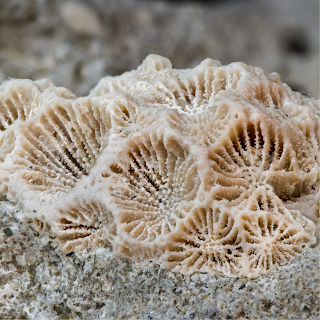
FRAGILE BEAUTY: FOSSILIZED SCLERACTINIAN CORAL

Scleractinian Fossil Coral, Florida
The delicate wintery beauty you see here is a Scleractinian coral we find first in the fossil record in the Mesozoic. 

Corals first appeared in the Cambrian about 535 million years ago. Fossils are extremely rare until the Ordovician period, 100 million years later, when rugose and tabulate corals became widespread. 

Palaeozoic corals seem to make friends wherever they live and often contain numerous endobiotic symbionts.

Tabulate corals occur in limestones and calcareous shales of the Ordovician and Silurian periods, and often form low cushions or branching masses of calcite alongside rugose corals. 

Their numbers began to decline during the middle of the Silurian period, and they became extinct at the end of the Permian period, 250 million years ago.

Rugose or horn corals became dominant by the middle of the Silurian and became extinct early in the Triassic period. The rugose corals existed in solitary and colonial forms and were also composed of calcite.

The famous Great Barrier Reef is thought to have been laid down about two million years ago. If you have had the pleasure of scuba diving near it to take in its modern wonders, perhaps you will be interested to learn how it was formed. Over long expanses of time, the corals here have broken up, fragmented and died. Sand and rubble accumulate between the corals, and the shells of clams and other molluscs decay to form a gradually evolving calcium carbonate structure to what you view today. 

Coral reefs are extremely diverse marine ecosystems hosting over 4,000 species of fish, massive numbers of cnidarians, molluscs, crustaceans, and many other animals.

Wednesday, 29 December 2021

JURASSIC SEA URCHIN: AM'DA'MA

This lovely little biscuit is a Holectypus sea urchin from 120 million-year-old deposits from the Lagniro Formation of Madagascar.

The specimen you see here is in the collections of my beautiful friend Ileana. She and I were blessed to meet in China many years ago and formed an unbreakable bond that happens so few times in one's life. 

Holectypus are a genus of extinct echinoids related to modern sea urchins and sand dollars. They were abundant from the Jurassic to the Cretaceous (between 200 million and 65.5 million years ago).

This specimen is typical of Holectypus with his delicate five-star pattern adorning a slightly rounded test and flattened bottom. The specimen has been polished and was harvested both for its scientific and aesthetic value. 

I have many wonderful memories of collecting their modern cousins that live on the north end of Vancouver Island and along the beaches of Balaklava Island. In the Kwak̓wala language of the Kwakiutl or Kwakwaka'wakw, speakers of Kwak'wala, of the Pacific Northwest, sea urchins are known as a̱m'da̱'ma and it is this name that I hear in my head when I think of them.

In echinoids, the skeleton is almost always made up of tightly interlocking plates that form a rigid structure or test — in contrast with the more flexible skeletal arrangements of starfish, brittle stars, and sea cucumbers. Test shapes range from nearly globular, as in some sea urchins, to highly flattened, as in sand dollars. 

Sea Urchin Detail
Living echinoids are covered with spines, which are movable and anchored in sockets in the test. These spines may be long and prominent, as in typical sea urchins and most have lovely raised patterns on their surface. 

In sand dollars and heart urchins, however, the spines are very short and form an almost felt-like covering. The mouth of most echinoids is provided with five hard teeth arranged in a circle, forming an apparatus known as Aristotle’s lantern.

Echinoids are classified by the symmetry of the test, the number and arrangement of plate rows making up the test, and the number and arrangement of respiratory pore rows called petals. Echinoids are divided into two subgroups: regular echinoids, with nearly perfect pentameral (five-part) symmetry; and irregular echinoids with altered symmetry.

Because most echinoids have rigid tests, their ability to fossilize is greater than that of more delicate echinoderms such as starfish, and they are common fossils in many deposits. The oldest echinoids belong to an extinct regular taxon called the Echinocystitoidea. 

They first appeared in the fossil record in the Late Ordovician. Cidaroids or pencil urchins appear in the Mississippian (Early Carboniferous) and were the only echinoids to survive the mass extinction at the Permo-Triassic boundary. Echinoids did not become particularly diverse until well after the Permo-Triassic mass extinction event, evolving the diverse forms we find them in today. 

True sea urchins first appear in the Late Triassic, cassiduloids in the Jurassic, and spatangoids or heart urchins in the Cretaceous. Sand dollars, a common and diverse group today, do not make an appearance in the fossil record until the Paleocene. They remain one of my favourite echinoderms and stand tall amongst the most pleasing of the invertebrates.

Tuesday, 28 December 2021

LEMURS OF MADAGASCAR

These lovelies are lemurs. They are very social and like to live in groups of half a dozen to up to 30 individuals. A female leads the group, or troop, and will likely have mated with the stinkiest — think sexiest — male. 

Once they breed, mamma will give birth to one to a half dozen pups after a gestation period of about 100 to 107 days. The wee pups cling to mamma's belly for the first few weeks of life then crawl up to live on her back for the next few months. By three to six months, the wee ones are weaned and a year to three years later, this pup will be mature and ready to mate. If all goes well, some species can live up to 30 years — rather a long life in the wild.

Lemurs are mammals of the order Primates, divided into 8 families and consisting of 15 genera and around 100 highly diverse species — 105 to be exact. They are native only to the island of Madagascar.

Most lemurs are relatively small, have a pointed snout, large eyes, and a long tail. They are arboreal, living primarily in trees and nocturnal, preferring to be active at night, snacking on leaves, shoots, fruit, flowers, tree bark, nectar and sap.

Phylogenetic, genetic, and anatomical evidence all suggest that lemurs split from other primates on Africa around 62 million years ago and that the ancestral lemur lineage had dispersed to Madagascar by around 54 million years ago. They must have come over to the island clinging to floating vegetation.

Once on the island, the lemur lineage diversified. Now there are at least 105 species of lemur, all endemic to Madagascar. They range in size from just an ounce and just 9 to 11 cm in the case of the Madame Berthe's mouse lemurs to up to 15 to 22 lbs or 7 to 10 kilograms, in the case of the Indri.

The evolutionary and biogeographic processes experienced by the lemurs are not unusual. Madagascar is home to many groups of endemic organisms with close within-group relationships. The simplest — or most parsimonious — explanation for this pattern is that, like the lemurs, the groups first arrived on the island by dispersal as a single lineage and then rapidly diversified. This diversification was likely spurred on by other geologic and geographic characteristics of Madagascar.

The east coast of the island is lined with a mountain range — and this causes different parts of the island to get drastically different amounts of rain. Hence, the island is made of many different habitat types — from deserts to rainforests — that have shifted and changed over the past 88 million years. This likely provided many opportunities for subpopulations to become isolated and evolve traits for specializing in different niches. And that likely encouraged lineages to diversify.

Today, Madagascar is one of the most diverse places on Earth. Understanding where that diversity comes from requires understanding, not just the living world, but the geologic, geographic, and climactic histories that have shaped the evolution of lineages on the island. Now, human history in the making threatens to undo tens of millions of years of evolution in just a few years of political turmoil — unless safeguards can be put in place to protect Madagascar's unique biota from the instabilities of human institutions.

Cooper, A., Lalueza-Fox, C., Anderson, S., Rambaut, A., Austin, J., and Ward, R. (2001). Complete mitochondrial genome sequences of two extinct moas clarify ratite evolution. Nature 409:704-707.

Goodman, S. M., and Benstead, J. P. (2005). Updated estimates of biotic diversity and endemism for Madagascar. Oryx 39(1):73-77.

Evolution Berkeley: https://evolution.berkeley.edu/evolibrary/news/091001_madagascar

Vences, M., Wollenberg, K. C., Vieites, D. R., and Lees, D. C. (2009). Madagascar as a model region of species diversification. Trends in Ecology and Evolution 24(8):456-465.

Saturday, 25 December 2021

GOD JUL: TRILACINOCERAS NORVEGICUM

Trilacinoceras norvegicum
A lovely example of Trilacinoceras norvegicum (Sweet, 1958), a nektonic carnivorous cephalopod from Ordovician outcrops on Helgö Island, Hovindsholm, Helgøya, Lake Mjosa, Norway.

This has been a site of human habitation for more than 5,000 years. Vikings, kings, traders, farmers —  and geologists have walked these fields.

To give that timeframe a bit of context, that's about the age of Skara Brae, the Neolithic settlement in Orkney, Scotland — and older than Stonehenge which clocks in at 3000 BC to 2000 BC and the Great Pyramids — built around 2560 BC.

For my friend, Gale Bishop, that's about 469 km west or a good 7-hour drive from your ancestral home in Ask, just north of Bergen and just south of Knarvik where many of my relatives live — Hei du!

The fossils found here are part of the Engervik Member, Elnes Formation, Aseri, and date back to the Middle Ordovician, 463.5 - 460.9 million years ago. W. C. Sweet did fossil fieldwork here in the 1950s and published a paper on the Middle Ordovician of the Oslo Region, Norway 10. Nautiloid Cephalopods. Norsk Geologisk Tidsskrift 38:1-178.

Deservedly, Sweetoceras boreale is named for him and is one of the most delightful species names of all time. In the 1960s, Yochelson picked up where Sweet left off, continuing the survey of the Middle Ordovician of the Oslo region. I chose this Trilacinoceras for a holiday post because their curly tops remind me of a wee Norwegian gnome, or Nisse from the Norse niðsi, a dear little relative. My Swedish relatives call them Tomte, a throwback to Saint Birgitta of Sweden in the 1300s.

Helgøya is an island in Mjøsa located in the Ringsaker municipality of Hedmark county, Norway. It was formerly a part of the Nes municipality. 

Long before that, it was the ruling centre for the Kings in Hedmark, where bold men and women held great blót celebrations to Odin and planned raids and expansion into Europe and Russia — roughly A.D. 793 — the beginning of the Viking Age.

Today, it is lush and green and easy to explore — or fish. Mjøsa is Norway's largest lake, as well as one of the deepest lakes in Norway and in Europe. 

Battles have been fought on its waters and its depths hold interesting archaeological and paleontological secrets. They also hold a goodly amount of large and tasty trout, pike, perch, burbot and graylings.

Helgøya is the largest freshwater island in Norway at 18.3 km². The island is delightful to explore and home to 32 farms. One of the most beautiful of these is the Hovinsholm manor. You can visit the farm in both summer and winter — both equally beautiful — and enjoy a café, workshop or their Christmas market. They have lush gardens and some very friendly horses you can pet — or spoil with apples, as you do. The property is massive at 2012 acres, divided into grain, potatoes and forest. It has been home to kings and court. It was a monastery in the Middle Ages from the 5th to the 15th century. Today, Tolle Hoel Slotnæs and his wife, Charlotte Holberg Sveinsen own and run the manor with their three daughters.

Hovinsholm, Helgøya, Lake Mjosa, Norway
Helgøya means holy island, in Norwegian. There is a lovely double meaning here and such layered history. The manor, in its various iterations, has been on this site since the 1500s. They had their own Christian manor church until 1612.

On the southern tip of the island, there is an old pagan temple to the Norse Gods, Thor, Frigg, Loki, Hod, Heimdall, Tyr, and Baldur.

Here, farmers of the area would gather at four blót sacrifices a year that followed the seasons — one for each of the winter solstice, spring equinox, summer solstice and autumn equinox. Animals would be sacrificed, their blood splattered on altars, walls and folk around them. Toasts were made. The first was in honour of Thor or Odin, “to the king and victory.” 

Odin, although nominally chief of the gods, was more the god of aristocrats. If a king were toasting, particularly a Danish King, it would be for Odin. If you look at place names in Scandinavia, you'll see him conspicuously absent in favour of Thor, the god of the common man.

When the farmers at Helgøya were shouting Skål, it was likely for Thor. The toasting and drinking continued with cups emptied for Njörd and Freyr and Freyja in the hope of securing a prosperous future. 

Finally, personal pledges (and beer-soaked boasts) would be made to undertake great exploits, Valknut — to die well in battle — and finally to kinsmen laid to rest now drinking with the gods in Valhalla. Weapons, jewellery and tools were thrown into the lake as offerings.

If they were gathering for Jol (Old Norse), Jul (Norwegian) or the Yule blót, they'd also make a large sun wheel (picture a circle with a cross in the middle), carve it up with runes, set it on fire and roll it down a hill. 

It was quite a celebration with the festivities going on for three days and nights. With the formalities over, people did as people do  — drink, sing, boast, play games and find someone to bed down with — Gods be good.

Thor and Odin are still going strong nearly 1,000 years after the end of the Viking Age. You'd think that the old Nordic religion — the belief in the Norse gods — disappeared with the introduction of Christianity. That is not the case. There are still folk in Denmark (Odin-lovers) and Norway (Thor's their guy) who follow the old Norse religion and worship its ancient gods — right down to the splatter.

If you visit Norway at Christmas, Jul (Yule), you'll find much more of the pagan than the Christian in the festivities. King Haakon, old Haakon the Good, Hákon Góði or Håkon den Gode,  moved the Winter Solstice or Yule, Jul, Jol blót over to match up with the Christian holiday on December 25th in his attempts to introduce Christianity in the 10th century. Both traditions are still celebrated but without an overtly religious tone.

Old traditions run deep, animals are still sacrificed (but without all the splatter), bread is baked, houses cleaned, beer is abundant and fires warmth the hearth.

After all the drinking, toasting and feasting at the Jul blót, leftover food was not cleaned up but left overnight for the little relatives. Though shy, Nisse like a good feast and failing to offer them their tithe brings ill-fortune.

But we started this journey together admiring a lovely (and oddly festive) Ordovician cephalopod. Go on, picture him in red and white with a little beard. If you fancy a visit to the Ordovician outcrops, you can find them at Nes-Hamar, Norway. 60.0° N, 11.2° E: paleo-coordinates 33.7° S, 10.3° W. Look for gastropods (five known species) and cephalopods (at least 15 species).

If you'd like to visit the burial mound of Haakon the Good, you'll want to head to Seim, Hordaland, about 10 km north of Knarvik. Good 'ol Haakon may have tried to bring Christianity to Norway but he died full Viking — taking an arrow at the Battle of Fitjar. Many of my rellies live in Knarvik. 

We have enjoyed many a sunny afternoon feasting at the Håkonarspelet summer festivals and exploring Haakon's burial mound at Håkonhaugen in Seim.

If you're more of the manor type, you can stop by Hovinsholm gård, Helgøyvegen 850, 2350 Nes på Hedmarken, Norway. 

If you're curious and want to see the farmstead, head on over to: https://www.skafferiet.no/about. 

If you need to square things up with Odin, you're on your own.

E. L. Yochelson. 1963. The Middle Ordovician of the Oslo Region, Norway. 15. Monoplacophora and Gastropoda. Norsk Geologisk Tidsskrift 43 (2):133-213.

Thursday, 23 December 2021

DINOFLAGELLATES: TEENSY OCEAN STARS

This showy Christmas Cracker is a Dinoflagellate

The showy royal blue Christmas cracker looking fellow you see here is a dinoflagellate. 

Bioluminescent dinoflagellates are a type of plankton — teensy marine organisms that make the seaways shimmer as you swim through them or the tide crashes them against the shore. 

The first modern dinoflagellate was described by Baker in 1753, the first species was formally named by Muller in 1773. 

The first fossil forms were described by Ehrenberg in the 1830s from Cretaceous outcrops. More dinoflagellates have lived, died and gone extinct than there are living today. We know them mainly from fossil dinocysts dating back to the Triassic. They are one of the most primitive of the eukaryotic group with a fossil record that may extend into the Precambrian. They combine primitive characteristics of prokaryotes and advanced eukaryotic features.

The luciferase found in dinoflagellates is related to the green chemical chlorophyll found in plants. Their twinkling lights are brief, each containing about 100 million photons that shine for only a tenth of a second. While each individual flicker is here and gone in the wink of an eye, en masse they are breathtaking. I have spent several wondrous evenings scuba diving amongst these glittering denizens off our shores. What you know about light above the surface does not hold true for the light you see as bioluminescence. Its energy and luminosity come from a chemical reaction. 

In a luminescent reaction, two types of chemicals — luciferin and luciferase — combine together. Together, they produce cold light — light that generates less than 20% thermal radiation or heat. 

The light you see is produced by a compound called Luciferin. It is the shiny, showy bit in this chemical show. Luciferase acts as an enzyme, the substance that acts as a catalyst controlling the rate of chemical reactions, allowing the luciferin to release energy as it is oxidized. 

The colour of the light depends on the chemical structures of the chemicals. There are more than a dozen known chemical luminescent systems, indicating that bioluminescence evolved independently in different groups of organisms.

Coelenterazine is the type of luciferin we find in shrimp, fish and jellyfish. Dinoflagellates and krill share another class of unique luciferins, while ostracods or firefleas and some fish have a completely different luciferin — but all produce lights of various colours to great effect.  

Wednesday, 8 December 2021

ORTHOCONE: STRAIGHT-SHELLED NAUTILOIDS

Orthocone Nautiloid Fossil
An orthocone is an unusually long, straight shell of a nautiloid cephalopod. You have likely seen them from Ontario or Morocco. These straight-shelled nautiloids rules our seas during the Ordovician, nothing else was even close in size to them. 

To put that into context, they would have been more than two times longer than the tallest person you know. 

During the 18th and 19th centuries, all shells of this type were named Orthoceras, creating a wastebasket taxon, but it is now known that many groups of nautiloids developed or retained this type of shell.

An orthocone can be thought of as a nautilus but with a pencil-straight, uncoiled shell. You have likely seen living nautilus in the sea if you are very lucky or on social media, if your curiosity has you streaming cephalopod posts. Living nautilus are chunky and coiled with a wee squid-like body living within their shells that they use for protection and the air within for buoyancy to move through the water. Their ancestors were not dissimilar. For a long while, we thought that these marine lovelies represented the most primitive form of nautiloid, but we now know that the earliest nautiloids had shells that were slightly curved. 

An orthoconic form evolved several times amongst cephalopods. Amongst nautiloid cephalopods, we 
see this in the primitive ellesmerocerids, the endocerids — apex predators of the Ordovician who dined on trilobites, molluscs and brachiopods, in the generally straight-shelled actinocerids, the orthoceratoids (perhaps the last unexplored wilderness in the Cephalopoda).

Orthocone Fossil
We see this form again in the rather smallish order bactritids (relatively speaking within the vast array of the Class Cephalopoda).

These lovely straight-shelled fossils are found in Late Cambrian to Late Triassic outcrops but they were most common in the early Paleozoic. Revivals of the orthocone design later occurred in other cephalopod groups, notably baculitid ammonites in the Cretaceous Period. 

Orthocone nautiloids range in size from wee little fellas less than 25 mm (1 in) to a massive 5.2 metres or 17 feet long in the case of the giant endocerids of the Ordovician. Never underestimate just how large a cephalopod can get. If our oceans remain fertile, I expect we'd see one larger than a city block one day.


Saturday, 4 December 2021

DRIFTWOOD CANYON FOSSIL BEDS / KUNGAX

White Eared Puffbird, Nystalus chacuru
Driftwood Canyon Provincial Park 

Driftwood Canyon Provincial Park covers 23 hectares of the Bulkley River Valley, on the east side of Driftwood Creek, a tributary of the Bulkley River, 10 km northeast of the town of Smithers in northern British Columbia. 

Wet'suwet'en First Nation

The parklands are part of the asserted traditional territory of the Wet'suwet'en First Nation which includes lands around the Bulkley River, Burns Lake, Broman Lake, and François Lake in the northwestern Central Interior of British Columbia. 

The Wetʼsuwetʼen are part of the Dakelh or Carrier First Nation, and in combination with the Babine First Nation are referred to as the Western Carrier. They speak Witsuwitʼen, a dialect of the Babine-Witsuwitʼen language which, like its sister language Carrier, is a member of the Athabaskan family.

Their oral history or kungax recounts a time when their ancestral village, Dizkle or Dzilke, once stood upstream from the Bulkley Canyon. This cluster of cedar houses on both sides of the river was said to be abandoned because of an omen of impending disaster. The exact location of the village has been lost. The neighbouring Gitxsan people of the Hazelton area have a similar tale, though the village in their version is referred to as Dimlahamid or Temlahan. Their house groups include the Gilseyhu or Big Frog Clan, the Laksilyu or Small Frog Clan, the Tsayu or Beaver Clan, the Gitdumden or Wolf and Bear Clan and the Laksamshu or Fireweed and Owl Clan.

The park was created in 1967 by the donation of the land by the late Gordon Harvey (1913–1976) to protect fossil beds on the east side of Driftwood Creek. The beds were discovered around the beginning of the 20th century. 

Driftwood Canyon Fossil Beds

Driftwood Canyon is recognized as one of the world’s most significant fossil beds. It provides park users with a fascinating opportunity to understand the area’s evolutionary processes of both geology and biology. We have found plant, fish and insect fossil here that include Dawn Redwood, alder, fossil salmon, wasps, water striders and vertebrate material. Bird feathers are infrequently collected from the shales; however, two bird body fossils have been found here.

In 1968, a bird body fossil was collected in the Eocene shales of the Ootsa Lake Group in Driftwood Canyon Provincial Park by Pat Petley of Kamloops. Pat Petley donated the specimen in 2000 to the Thompson Rivers University (TRU) palaeontology collections. This fossil bird specimen is tentatively identified as the puffbird, Piciformes Bucconidae, of the genus Primobucco.

Primobucco is an extinct genus of bird placed in its own family, Primobucconidae. The type species, Primobucco mcgrewi, lived during the Lower Eocene of North America. It was initially described by American paleo-ornithologist Pierce Brodkorb in 1970, from a fossil right-wing, and thought to be an early puffbird. However, the discovery of a further 12 fossils in 2010 indicate that it is instead an early type of roller.

Related fossils from the European Messel deposits have been assigned to the two species P. perneri and P. frugilegus. Two specimens of P. frugilegus have been found with seeds in the area of their digestive tract, which suggests that these birds were more omnivorous than the exclusively predaceous modern rollers. The Driftwood specimen has never been thoroughly studied. If there is a grad student out there looking for a worthy thesis, head on down to the Thompson Rivers University where you'll find the specimen on display.

Another fossil bird, complete with feathers, was collected at Driftwood Canyon in 1970, This one was found by Margret and Albrecht Klöckner who were travelling from Germany. Theirs is a well-travelled specimen, having visited many sites in BC as they toured around, then to Germany and finally back to British Columbia when it was repatriated and donated to the Royal British Columbia Museum in Victoria. I'm not sure if it is still on display or back in collections, but it was lovingly displayed back in 2008. There is a new grad student, Alexis, looking at Eocene bird feathers down at the RBCM, so perhaps it is once again doing the rounds. 

This second bird fossil is of a long-legged water bird and has been tentatively identified by Dr. Gareth Dyke of the University of Southampton as possibly from the order Charadriiformes, a diverse order of small to medium-ish water birds that include 350 species of gulls, plovers, sandpipers, terns, snipes, and waders. Hopefully, we'll hear more on this find in the future.

What To Know Before You Go

If you fancy a visit to Driftwood Canyon Park, the park is accessible from Driftwood Road from Provincial Highway 16. You are welcome to view and photograph the fossils found here but collecting is strictly forbidden. 

Driftwood Canyon is recognized as one of the world’s most significant fossil beds. It provides park users with a fascinating opportunity to understand the area’s evolutionary processes of both geology and biology. The day-use area is open from May 15 to September 2. There is a short, wheelchair-accessible interpretative trail that leads from the parking are to the fossil beds. Pets are welcome on leash. Signs along the trail provide information on fossils and local history. 

Below a cliff face at the end of the trail is a viewing area that has interpretive information and viewing area overlooking Driftwood Creek.

This park proudly operated by Mark and Anais Drydyk
Email: kermodeparks@gmail.com / Tel: 1 250 877-1482 or 1 250 877-1782

Driftwood Canyon Provincial Park Brochure: 
https://bcparks.ca/explore/parkpgs/driftwood_cyn/driftwood-canyon-brochure.pdf?v=1638723136455