Showing posts with label archea. Show all posts

Sunday, 17 October 2021

FURRY KAMIKAZE PILOTS: FLYING TREE SQUIRRELS

Mammals can walk, hop, swim and fly; a few, like marsupial sugar gliders, can even glide. 

With 52 species scattered across the Northern hemisphere, flying squirrels are by far the most successful group that took to the skies.

While not true flyers per se, these wee marsupials know how to skedaddle, coasting from tree to tree one giant leap of faith at a time. 

And they are pretty cute if you look past their teeth and claws. Think adorable kamikaze pilot snugged inside a paper aeroplane with just enough Freddie Kruger to keep it interesting.

Their airborne manoeuvres are made possible by a half-plane, half-parachute body design — a bat-suit style membrane that puffs up into a parachute their feet and hands. They have evolved teensy but sturdy wrists strong enough to support long cartilaginous rods, making their personal brand of flight possible. Their wee specialized wrist bones are a distinctive feature as they do not share them with their non-flying brethren. 

The origin of flying squirrels is a point of contention: while most genetic studies point towards the group splitting from tree squirrels about 23 million years ago, the oldest remains – mostly cheek teeth – suggest the animals were already soaring through forests 36 million years ago. 

Troublesome are the findings from studies that show the dental features used to distinguish between gliding and non-gliding squirrels may actually be shared by the two groups.

In 2002, the digging of a dumpsite in Barcelona, Spain unearthed a peculiar skeleton. As the bones were extracted one by one they found first a tail, then two thigh bones — big enough that they initially thought they might belong to a small primate. 

Once they were all removed and re-articulated, you could see that they belonged to a rodent. 

As the specimen was being prepared and the associated matrix screen-washed for loose bits, they discovered the wee wrist bones. From the mud emerged the minuscule specialized wrist bones that confirmed this was the skeleton of Miopetaurista neogrivensis, an extinct flying squirrel.

Fossil flying squirrel Miopetaurista neogrivensis
Casanovas-Vilar et al. described the 11.6 million years old Spanish fossil — the oldest squirrel ever found. The wrist bones reveal that the animal belongs to the group of flying squirrels that have large sizes. 

Evolutionary analyses — the sexy science combining molecular and paleontological data — told a new story, flying squirrels evolved from tree squirrels as far back as 31 to 25 million years ago, and possibly even earlier. 

We also confirmed that Miopetaurista is closely related to Petaurista, a modern group of giant flying squirrels. 

Their skeletons are so similar, in fact, that the large extant species that inhabit the tropical and subtropical forests of Asia today should be considered living fossils.

Molecular and paleontological data are often at odds, but this fossil shows that they can be reconciled and combined to retrace history. 

There is still more to be done to tease out the lineage of these gliding mammals. Discovering older fossils, or even transitional forms could help to retrace how flying squirrels took a leap from the rest of their evolutionary tree.

Flying squirrels are the only group of gliding mammals with remarkable diversity and a wide geographical range. However, their evolutionary story is not well known. Thus far, the identification of extinct flying squirrels has been exclusively based on dental features, which, contrary to certain postcranial characters, are not unique to them. 

While best efforts are made, fossils attributed to this clade may indeed belong to other squirrel groups. The oldest fossil skeleton of a flying squirrel (11.6 Ma) displays the gliding-related diagnostic features shared by extant forms and allows for a recalibration of the divergence time between the tree and flying squirrels. 

Phylogenetic analyses combining morphological and molecular data generally support older dates than previous molecular estimates (~23 Ma), being congruent with the inclusion of some of the earliest fossils (~36 Ma) into this clade. They also show that flying squirrels experienced little morphological change for almost 12 million years.

Image: The fossil flying squirrel Miopetaurista neogrivensis

(a) Reconstruction of the skeleton based in the partial skeleton IPS56468 from Abocador de Can Mata. Missing elements are based on extant giant flying squirrel Petaurista petaurista and are coloured in blue. 

https://doi.org/10.7554/eLife.39270.001 / https://doi.org/10.7554/eLife.39270.002

Thursday, 9 September 2021

CANADOCERAS YOKOYAMAI: HASLAM FORMATION

A lovely chunky slate grey handful of an ammonite is Canadoceras yokoyamai from Upper Cretaceous (Early Campanian) outcrops in the Haslam Formation of Vancouver Island, British Columbia, Canada. 

This gorgeous ammonite was found by Tim O'Bear and is now in the collections of the Vancouver Island Palaeontological Society (VIPS), a regional paleontological society based in Courtenay.

This meaty cephalopod swam and hunted in our ancient oceans 80-84 million years ago and was once a leading candidate as the provincial fossil of British Columbia — an honour won by Shonisaurus sikanniensis.

The species is named for Matajirō Yokoyama, Professor of Geology and Palaeontology at the Imperial University of Tokyo, Japan. 

Yokoyama was born in the Nagasaki Prefecture on the 14th of June 1860 — the day slavery was abolished in the Neth Indies and the year Abraham Lincoln was elected president of the United States — a move that would lead to the beginning of the US Civil War the following year.

During his early life, the Meiji Restoration would begin the process of transforming Japan into a global imperial power. During the Restoration, Japan rapidly industrialized, adopting Western ideas and production methods. This shift in the cultural focus of his nation allowed him to pursue his studies in science — something encouraged in an emerging nation.

Matajirō Yokoyama (1860-1942)
Yokoyama did some wonderful work on the Cretaceous of Japan and opened up our understanding of the species on Vancouver Island. 

Through his research, we learned of the Japanese fauna and the extent of their occurrence. The range of Canadoceras yokoyamai extended from Alaska, the eastern coast of Vancouver Island, California to Santonian outcrops in the Yezo Group of Hokkaido in Japan’s northern islands. 

Within the Yezo Group, we find Canadoceras yokoyami amongst other ammonites, bivalves — and some wonderful marine reptiles — both mosasaurs and marine turtles.

Given that Canadoceras yokoyami arose, lived and died in a relatively short time frame — geologically speaking — they make excellent Index fossils. They can act as guides as to the age of the rocks in which they are preserved. This is helpful in the field. 

If you were to find a fossil in a rock of unknown age, you can look at the species and guess with relative certainty what age that rock likely is. 

References:

Matsumoto, T., 1954a [for 1953]: The Cretaceous system in the Japanese islands., pp. i–xiv + 1–324, pls. 1–20. The Japanese Society for the Promotion of Scientific Research, Ueno, Tokyo. (Reference No. 0219)

Tanabe, K., Ito, Y., Moriya, K. and Sasaki, T., 2000: Database of Cretaceous ammonite specimens registered in the Department of Historical Geology and Paleontology of the University Museum, University of Tokyo. The University Museum, The University of Tokyo, Material Reports, no. 37, pp. i–iv + 1–509. (Reference No. 0879)

Photo: Matajirō Yokoyama, Professor of Geology, Palaeontology and Mineralogy. 日本語: 横山又次郎 地質学古生物学及鉱物学教授 Tokyo Teikoku Daigaku (Imperial University of Tokyo). Ogawa Shashin Seihanjo, 1900 (reprint, Ryūkei Shosha, 2004).

Friday, 27 August 2021

ICE AGE MANATEES

Manatees do not live year-round in Texas, but these gentle sea cows are known to occasionally visit, swimming in for a summer vacation and returning to warmer waters for the winter. 

Interestingly, we have recently found fossil evidence for manatees along the Texas coast dating back to the most recent ice age. 

The discovery raises questions about whether manatees have been visiting for thousands of years, or if an ancient population of ice age manatees once called Texas home.

The findings were published in Palaeontologia Electronica by lead author Christopher Bell, a professor at the UT Jackson School of Geosciences with co-authors Sam Houston State University Natural History Collections curator William Godwin and SHSU alumna Kelsey Jenkins — now a graduate student at Yale University — and SHSU Professor Patrick Lewis.

The eight fossils described in the paper include manatee jawbones and rib fragments from the Pleistocene, the geological epoch of the last ice age. Most of the bones were collected from McFaddin Beach near Port Arthur and Caplen Beach near Galveston during the past 50 years by amateur fossil collectors who donated their finds to the SHSU collections.

The Jackson Museum of Earth History at UT holds two of the specimens. A lower jawbone fossil, which was donated to the SHSU collections by amateur collector Joe Liggio, jumpstarted the research.

Manatee jawbones have a distinct S-shaped curve that immediately caught Godwin's eye. But Godwin said he was met with scepticism when he sought other manatee fossils for comparison. He recalls reaching out to a local fossil enthusiast who told him point-blank, "there are no Pleistocene manatees in Texas."

But an examination of the fossils by Bell and Lewis proved otherwise. The bones belonged to the same species of manatee that visits the Texas coast today, Trichechus manatus. An upper jawbone donated by U.S. Rep. Brian Babin was found to belong to an extinct form of the manatee, Trichechus manatus bakerorum.

The age of the manatee fossils is based on their association with better-known ice age fossils and paleo-Indian artefacts that have been found on the same beaches.

It is assumed that the cooler ice age climate would have made Texas waters even less hospitable to manatees than they are today. But the fact that manatees were in Texas — whether as visitors or residents — raises questions about the ancient environment and ancient manatees. The Texas coast stretched much farther into the Gulf of Mexico and hosted wider river outlets during the ice age than it does today. Either the coastal climate was warmer than is generally thought, or ice age manatees were more resilient to cooler temperatures than manatees of today.

Subsurface imaging of the now flooded modern continental shelf reveals both a greater number of coastal embayments and the presence of significantly wider channels during ice age times.

If there was a population of ice age manatees in Texas, it is entirely plausible that they would have ridden out winters in these warmer river outlets similar to how they do today in Florida and Mexico.

Reference: Christopher Bell, William Godwin, Kelsey Jenkins, Patrick Lewis. First fossil manatees in Texas: Trichechus manatus bakerorum in the Pleistocene fauna from beach deposits along the Texas Coast of the Gulf of Mexico. Palaeontologia Electronica, 2020; DOI: 10.26879/1006

Tuesday, 24 August 2021

GULLS: TSIK'WI

A gull cries in protest at not getting his share of a meal

Gulls, or colloquially seagulls, are seabirds of the family Laridae in the suborder Lari. 

The Laridae are known from not-yet-published fossil evidence from the Early Oligocene — 30–33 million years ago. 

Three gull-like species were described by Alphonse Milne-Edwards from the early Miocene of Saint-Gérand-le-Puy, France. 

Another fossil gull from the Middle to Late Miocene of Cherry County, Nebraska, USA, has been placed in the prehistoric genus Gaviota

These fossil gulls, along with undescribed Early Oligocene fossils are all tentatively assigned to the modern genus Larus. Among those of them that have been confirmed as gulls, Milne-Edwards' "Larus" elegans and "L." totanoides from the Late Oligocene/Early Miocene of southeast France have since been separated in Laricola.

Gulls are most closely related to the terns in the family Sternidae and only distantly related to auks, skimmers and distantly to waders. 

A historical name for gulls is mews, which is cognate with the German möwe, Danish måge, Swedish mås, Dutch meeuw, Norwegian måke/måse and French mouette. We still see mews blended into the lexicon of some regional dialects.

In the Kwak̓wala language of the Kwakiutl or Kwakwaka'wakw, speakers of Kwak'wala, of the Pacific Northwest, gulls are known as t̕sik̕wi. Most folk refer to gulls from any number of species as seagulls. This name is a local custom and does not exist in the scientific literature for their official naming. Even so, it is highly probable that it was the name you learned for them growing up.

If you have been to a coastal area nearly everywhere on the planet, you have likely encountered gulls. They are the elegantly plumed but rather noisy bunch on any beach. You will recognize them both by their size and colouring. 

Gulls are typically medium to large birds, usually grey or white, often with black markings on the head or wings. They typically have harsh shrill cries and long, yellow, curved bills. Their webbed feet are perfect for navigating the uneven landscape of the foreshore when they take most of their meals. 

Most gulls are ground-nesting carnivores that take live food or scavenge opportunistically, particularly the Larus species. Live food often includes crab, clams (which they pick up, fly high and drop to crack open), fish and small birds. Gulls have unhinging jaws which allow them to consume large prey which they do with gusto. 

Their preference is to generally live along the bountiful coastal regions where they can find food with relative ease. Some prefer to live more inland and all rarely venture far out to sea, except for the kittiwakes. 

The larger species take up to four years to attain full adult plumage, but two years is typical for small gulls. Large white-headed gulls are typically long-lived birds, with a maximum age of 49 years recorded for the herring gull.

Gulls nest in large, densely packed, noisy colonies. They lay two or three speckled eggs in nests composed of vegetation. The young are precocial, born with dark mottled down and mobile upon hatching. Gulls are resourceful, inquisitive, and intelligent, the larger species in particular, demonstrating complex methods of communication and a highly developed social structure. Many gull colonies display mobbing behaviour, attacking and harassing predators and other intruders. 

Certain species have exhibited tool-use behaviour, such as the herring gull, using pieces of bread as bait with which to catch goldfish. Many species of gulls have learned to coexist successfully with humans and have thrived in human habitats. Others rely on kleptoparasitism to get their food. Gulls have been observed preying on live whales, landing on the whale as it surfaces to peck out pieces of flesh. They are keen, clever and always hungry.

Sunday, 22 August 2021

CAVE BEAR: URSUS URALENSIS

This glorious and slightly terrifying skull is from a fossil cave bear, Ursus uralensis, from Pleistocene deposits in Russia.

Both the cave bear and the brown bear are thought to be descended from the Plio-Pleistocene Etruscan bear, Ursus etruscus, that lived about 5.3 Mya to 100,000 years ago. 

The last common ancestor of cave bears and brown bears lived between 1.2–1.4 Mya. The immediate precursor of the cave bear was probably Ursus deningeri, the Deninger's bear — a species restricted to Pleistocene Europe about 1.8 Mya to 100,000 years ago. 

The transition between Deninger's bear and the cave bear is given as the last interglacial, although the boundary between these forms is arbitrary, and intermediate or transitional taxa have been proposed, Ursus spelaeus deningeroides, while other authorities consider both taxa to be chronological variants of the same species.

Cave bears found in different regions vary in age, thus facilitating investigations into evolutionary trends. The three anterior premolars were gradually reduced, then disappeared, possibly in response to a largely vegetarian diet. 

In a fourth of the skulls found in the Conturines, the third premolar is still present, while more derived specimens elsewhere lack it. The last remaining premolar became conjugated with the true molars, enlarging the crown and granting it more cusps and cutting borders. This phenomenon, called molarization, improved the mastication capacities of the molars, facilitating the processing of tough vegetation. This allowed the cave bear to gain more energy for hibernation while eating less than its ancestors.

A lone Grizzly Bear / Na̱ndzi
In 2005, scientists recovered and sequenced the nuclear DNA of a cave bear that lived between 42,000 and 44,000 years ago. 

The procedure used genomic DNA extracted from one of the animal's teeth. Sequencing the DNA directly (rather than first replicating it with the polymerase chain reaction), the scientists recovered 21 cave bear genes from remains that did not yield significant amounts of DNA with traditional techniques.

This study confirmed and built on results from a previous study using mitochondrial DNA extracted from cave bear remains ranging from 20,000 to 130,000 years old. 

Both show that the cave bear was more closely related to the brown bear and polar bear than it was to the American black bear, but had split from the brown bear lineage before the distinct eastern and western brown bear lineages diversified and before the split of brown bears and polar bears. The divergence date estimate of cave bears and brown bears is about 1.2–1.4 Mya. However, a recent study showed that both species had some hybridization between them.

We are blessed to have them living amongst us today on the rugged west coast of British Columbia. In the Kwak'wala language of the Kwakiutl First Nations of the Pacific Northwest, this big fellow is na̱ndzi — a lovely, large peaceful bear.

Friday, 20 August 2021

ORIGINS OF THE WOOLLY MAMMOTHS

Woolly Mammoths, Mammuthus primigenius,  have always held wonder for me. These massive, hairy — and likely very smelly beasts — lived alongside us for a time. 

If you stood beside him and reached way up, you might be able to touch his tusks but likely not reach up to his mouth or even his eyes. 

He had a shaggy coat of light or dark coloured hair with long outer hair strands covering a dense thick undercoat. His oil glands would have worked overtime to secrete oils, giving him natural waterproofing. Some of the hair strands we have recovered are more than a meter in length. These behemoth proboscideans boasted long, curved tusks, little ears, short tails and grazed on leaves, shrubs and grasses that would have been hard work to get at as much of his world was covered in ice and snow during his reign.

We first see Woolly Mammoths in northeastern Siberia dating back 700,000 years. We find them in East Asia as far back as 800,000 years ago. They arose from the massive steppe mammoths, Mammuthus trogontherii, slowly evolving traits we see in this older species to the mammoths we think of today. 

Over time, their body size shrank and their teeth and tusks evolved to take advantage of the tough vegetation available to those few animals who could chew their way through ice and snow and work these tundra grasses into a digestible form. 

The enamel plates of their cheek teeth multiplied while the enamel itself became thinner. Tusks slowly took on more of a curved to act as ploughs for the snow. 

Those smaller than their predecessors, they were still formidable. Their size offered protection against predators once full grown. Sadly for the juveniles, they offered tasty prey to big cats like Homotherium who roamed these ancient grasslands alongside them.

The Mammoths of the Steppe spread to the northern areas of Eurasia, down through Europe, into the British Isles to Spain and crossed over to populate North America via the Bering Isthmus. It was the lowered sea levels during the last Ice Age that exposed dry land between Asia and the Americas. Here in this flat, grassy treeless plain known as the Bering Land Bridge or Isthmus, animals, including humans, could migrate from Europe west into North America.

The woolly mammoth coexisted with our ancestors who made good use of their bones and tusks for tools, housing, art and food. The last of their lineage died out relatively recently on Wrangel Island until 4,000 years ago — a time when we were making our first harps and flutes in Egypt, dams, canals and stone sculptures in Sumer, using numbers for the first time and using tin to make tools.

Tuesday, 17 August 2021

AMMONITE: INDEX FOSSILS AS TIME KEEPERS

Argonauticeras besairei, José Juárez Ruiz
An exceptional example of the fractal building of an ammonite septum, in this clytoceratid Argonauticeras besairei from the awesome José Juárez Ruiz.

Ammonites were predatory, squidlike creatures that lived inside coil-shaped shells.

Like other cephalopods, ammonites had sharp, beak-like jaws inside a ring of squid-like tentacles that extended from their shells. 

They used these tentacles to snare prey, — plankton, vegetation, fish and crustaceans — similar to the way a squid or octopus hunt today.

Catching a fish with your hands is no easy feat, as I am sure you know. But the Ammonites were skilled and successful hunters. They caught their prey while swimming and floating in the water column. 

Within their shells, they had a number of chambers, called septa, filled with gas or fluid that were interconnected by a wee air tube. By pushing air in or out, they were able to control their buoyancy in the water column.

They lived in the last chamber of their shells, continuously building new shell material as they grew. As each new chamber was added, the squid-like body of the ammonite would move down to occupy the final outside chamber.

They were a group of extinct marine mollusc animals in the subclass Ammonoidea of the class Cephalopoda. 

These molluscs, commonly referred to as ammonites, are more closely related to living coleoids — octopuses, squid, and cuttlefish) than they are to shelled nautiloids such as the living Nautilus species.

The Ammonoidea can be divided into six orders:

  • Agoniatitida, Lower Devonian - Middle Devonian
  • Clymeniida, Upper Devonian
  • Goniatitida, Middle Devonian - Upper Permian
  • Prolecanitida, Upper Devonian - Upper Triassic
  • Ceratitida, Upper Permian - Upper Triassic
  • Ammonitida, Lower Jurassic - Upper Cretaceous

Ammonites have intricate and complex patterns on their shells called sutures. The suture patterns differ across species and tell us what time period the ammonite is from. If they are geometric with numerous undivided lobes and saddles and eight lobes around the conch, we refer to their pattern as goniatitic, a characteristic of Paleozoic ammonites.

If they are ceratitic with lobes that have subdivided tips; giving them a saw-toothed appearance and rounded undivided saddles, they are likely Triassic. For some lovely Triassic ammonites, take a look at the specimens that come out of Hallstatt, Austria and from the outcrops in the Humboldt Mountains of Nevada.

Hoplites bennettiana (Sowby, 1826) Christophe Marot
If they have lobes and saddles that are fluted, with rounded subdivisions instead of saw-toothed, they are likely Jurassic or Cretaceous. If you'd like to see a particularly beautiful Lower Jurassic ammonite, take a peek at Apodoceras. Wonderful ridging in that species.

One of my favourite Cretaceous ammonites is the ammonite, Hoplites bennettiana (Sowby, 1826). This beauty is from Albian deposits near Carrière de Courcelles, Villemoyenne, near la région de Troyes (Aube) Champagne in northeastern France.

At the time that this fellow was swimming in our oceans, ankylosaurs were strolling about Mongolia and stomping through the foliage in Utah, Kansas and Texas. Bony fish were swimming over what would become the strata making up Canada, the Czech Republic and Australia. Cartilaginous fish were prowling the western interior seaway of North America and a strange extinct herbivorous mammal, Eobaatar, was snuffling through Mongolia, Spain and England.

In some classifications, these are left as suborders, included in only three orders: Goniatitida, Ceratitida, and Ammonitida. Once you get to know them, ammonites in their various shapes and suturing patterns make it much easier to date an ammonite and the rock formation where it is found.

Ammonites first appeared about 240 million years ago, though they descended from straight-shelled cephalopods called bacrites that date back to the Devonian, about 415 million years ago, and the last species vanished in the Cretaceous–Paleogene extinction event.

They were prolific breeders that evolved rapidly. If you could cast a fishing line into our ancient seas, it is likely that you would hook an ammonite, not a fish. They were prolific back in the day, living (and sometimes dying) in schools in oceans around the globe. We find ammonite fossils (and plenty of them) in sedimentary rock from all over the world.

In some cases, we find rock beds where we can see evidence of a new species that evolved, lived and died out in such a short time span that we can walk through time, following the course of evolution using ammonites as a window into the past.

For this reason, they make excellent index fossils. An index fossil is a species that allows us to link a particular rock formation, layered in time with a particular species or genus found there. 

Generally, deeper is older, so we use the sedimentary layers of rock to match up to specific geologic time periods, rather like the way we use tree rings to date trees. A handy way to compare fossils and date strata across the globe.

References: Inoue, S., Kondo, S. Suture pattern formation in ammonites and the unknown rear mantle structure. Sci Rep 6, 33689 (2016). https://doi.org/10.1038/srep33689

https://www.nature.com/articles/srep33689?fbclid=IwAR1BhBrDqhv8LDjqF60EXdfLR7wPE4zDivwGORTUEgCd2GghD5W7KOfg6Co#citeas

Photos: Argonauticeras besairei from the awesome José Juárez Ruiz.

Photo: Hoplites bennettiana from near Troyes, France. Collection de Christophe Marot

Monday, 5 July 2021

PTEROSAURS OF HORNBY ISLAND

If you could travel through time and go back to observe our ancient skies, you would see massive pterosaurs — huge, winged flying reptiles of the extinct order Pterosauria — cruising along with you. They soared our skies during most of the Mesozoic — from the late Triassic to the end of the Cretaceous (228 to 66 million years ago). 

By the end of the Cretaceous, they had grown to giants and one of their brethren, Quetzalcoatlus, a member of the family Azhdarchidae, boasts being the largest known flying animal that ever lived. They were the earliest vertebrates known to have evolved powered flight. Their wings were formed by a membrane of skin, muscle, and other tissues stretching from the ankles to a dramatically lengthened fourth finger.

We divide their lineage into two major types: basal pterosaurs and pterodactyloids. Basal pterosaurs (also called 'non-pterodactyloid pterosaurs' or ‘rhamphorhynchoids’) were smaller animals with fully toothed jaws and long tails. Their wide wing membranes connected to their hind legs. This would have allowed them some manoeuvrability on the ground, but with an awkward sprawling posture. They were better climbers with flexible joint anatomy and strong claws. Basal pterosaurs preferred to dine on insects and small vertebrates.

Later pterosaurs (pterodactyloids) evolved many sizes, shapes, and lifestyles. Pterodactlyoids had narrower wings with free hind limbs, highly reduced tails, and long necks with large heads. On the ground, pterodactyloids walked better than their earlier counterparts, manoeuvring all four limbs smoothly with an upright posture. They walked standing plantigrade on the hind feet and folding the wing finger upward to walk on the three-fingered "hand." These later pterosaurs were more nimble. They could take off from the ground, run and wade and swim. Their jaws had horny beaks and some of these later groups lacked the teeth of earlier lineages. Some groups developed elaborate head crests that were likely used to attract mates' sexy-pterosaur style.

So can we or have we found pterosaurs on Hornby Island? The short answer is yes.

Collishaw Point, known locally as Boulder Point, Hornby Island
Hornby Island is a lovely lush, island in British Columbia's northern Gulf Islands. It was formed from sediments of the upper Nanaimo Group which are also widely exposed on adjacent Denman Island and the southern Gulf Islands.

Peter Mustard, a geologist from the Geologic Survey of Canada, did considerable work on the geology of the island. It has a total stratigraphic thickness of 1350 m of upper Nanaimo Group marine sandstone, conglomerate and shale. 

These are partially exposed in the Campanian to the lower Maastrichtian outcrops at Collishaw Point on the northwest side of Hornby Island. Four formations underlie the island from oldest to youngest, and from west to east: the Northumberland, Geoffrey, Spray and Gabriola.

During the upper Cretaceous, between ~90 to 65 Ma, sediments derived from the Coast Belt to the east and the Cascades to the southeast poured seaward to the west and northwest into what was the large ancestral Georgia Basin. This major forearc basin was situated between Vancouver Island and the mainland of British Columbia. The rocks you find here originated far to the south in Baja California and are the right age and type of sediment for a pterosaur find. But are we California dreaming?

Upper Cretaceous Nanaimo Group Fossil Concretion
Well, truth be told, we were with one of the potential pterosaur finds from Hornby. It wasn't just hopeful thinking that had the west coast in a paleo uproar many ago when Sharon Hubbard of the Vancouver Island Palaeontological Society found what looked very much like a pterosaur.

Right time period. Right location. And, we have found them here in the past.

Sandy McLachlan found the first definitive pterosaur, an azhdarchid, back in 2008.

But was Sharon's find a pterosaur?

Victoria Arbour, a Canadian evolutionary biologist and palaeontologist working as a Natural Sciences and Engineering Research Council of Canada postdoctoral fellow at the University of Toronto and Royal Ontario Museum, certainly thought so. 

While Arbour is an expert on ankylosaurs, our lumbering armoured dinosaurs friends, she has studied pterosaurs and participated in the naming of Gwawinapterus from Hornby Island. 

But here's the thing — bony material encased in stone and let to cement for millions of years can be tricky.

While this fossil find was initially described as a very late-surviving member of the pterosaur group Istiodactylidae, further examination cast doubt on the identification. Once more detail was revealed the remains were published as being those of a saurodontid fish, an ambush predator with very sharp serrated teeth and elongate, torpedo-like bodies that grew up to two meters. Not a pterosaur but still a massively exciting find. Arbour was very gracious at the renaming, taking it in stride. She has since gone on to name a partial ornithischian dinosaur from Sustut Basin, as well as the ankylosaurs Zuul, Zaraapelta, Crichtonpelta, and Ziapelta. But she may have another shot at a pterosaur.

Dan Bowen, Chair, VIPS. Photo: Deanna Steptoe Graham
In 2019, Dan Bowen, Chair of the Vancouver Island Palaeontological Society and a truly awesome possum, found some very interesting bones in concretion on Hornby. 

The concretion was nestled amongst the 72 million-year-old grey shales of the Northumberland Formation, Campanian to the lower Maastrichtian, part of the Cretaceous Nanaimo Group from Collishaw Point.

The site is known as Boulder Point to the locals and it has been a popular fossil destination for many years. It is the same site where Sharon made her find years earlier.

The concretion contains four articulated vertebrae that looked to be fish at first glance. Jay Hawley, a local fossil enthusiast was asked to prep the block to reveal more details. Once the matrix was largely removed the vertebrae inside were revealed to be bird bones, not fish and not another saurodontid as originally thought. Palaeontologist Victoria Arbour was called back in to put her keen lens on the discovery. 

You will appreciate that she took a good long look at the specimen and confirmed it to be a bird or a pterosaur. We still do not have confirmation on which it is as yet. The delicate bony material is very flattened with a very shallow u-shape on the bottom but will need additional study to confirm if the skies above California were once home to a great pterosaur who died, was fossilized then rode our tectonic plates to now call Hornby home. It is a great story and one that I am keen to follow.

References: To learn more about the azhdarchid remains found by Sandy McLachlan, check out the paper by Martin-Silverston et al. 2016.

Monday, 3 May 2021

FRACTAL BUILDING: AMMONITES

Argonauticeras besairei, Collection of  José Juárez Ruiz.
An exceptional example of fractal building of an ammonite septum, in this clytoceratid Argonauticeras besairei from the awesome José Juárez Ruiz.

Ammonites were predatory, squidlike creatures that lived inside coil-shaped shells.

Like other cephalopods, ammonites had sharp, beak-like jaws inside a ring of squid-like tentacles that extended from their shells. They used these tentacles to snare prey, — plankton, vegetation, fish and crustaceans — similar to the way a squid or octopus hunt today.

Catching a fish with your hands is no easy feat, as I'm sure you know. But the Ammonites were skilled and successful hunters. They caught their prey while swimming and floating in the water column. Within their shells, they had a number of chambers, called septa, filled with gas or fluid that were interconnected by a wee air tube. By pushing air in or out, they were able to control their buoyancy in the water column.

They lived in the last chamber of their shells, continuously building new shell material as they grew. As each new chamber was added, the squid-like body of the ammonite would move down to occupy the final outside chamber.

They were a group of extinct marine mollusc animals in the subclass Ammonoidea of the class Cephalopoda. These molluscs, commonly referred to as ammonites, are more closely related to living coleoids — octopuses, squid, and cuttlefish) than they are to shelled nautiloids such as the living Nautilus species.

The Ammonoidea can be divided into six orders:
  • Agoniatitida, Lower Devonian - Middle Devonian
  • Clymeniida, Upper Devonian
  • Goniatitida, Middle Devonian - Upper Permian
  • Prolecanitida, Upper Devonian - Upper Triassic
  • Ceratitida, Upper Permian - Upper Triassic
  • Ammonitida, Lower Jurassic - Upper Cretaceous
Ammonites have intricate and complex patterns on their shells called sutures. The suture patterns differ across species and tell us what time period the ammonite is from. If they are geometric with numerous undivided lobes and saddles and eight lobes around the conch, we refer to their pattern as goniatitic, a characteristic of Paleozoic ammonites.

If they are ceratitic with lobes that have subdivided tips; giving them a saw-toothed appearance and rounded undivided saddles, they are likely Triassic. For some lovely Triassic ammonites, take a look at the specimens that come out of Hallstatt, Austria and from the outcrops in the Humboldt Mountains of Nevada.

Hoplites bennettiana (Sowby, 1826).
If they have lobes and saddles that are fluted, with rounded subdivisions instead of saw-toothed, they are likely Jurassic or Cretaceous. If you'd like to see a particularly beautiful Lower Jurassic ammonite, take a peek at Apodoceras. Wonderful ridging in that species.

One of my favourite Cretaceous ammonites is the ammonite, Hoplites bennettiana (Sowby, 1826). This beauty is from Albian deposits near Carrière de Courcelles, Villemoyenne, near la région de Troyes (Aube) Champagne in northeastern France.

At the time that this fellow was swimming in our oceans, ankylosaurs were strolling about Mongolia and stomping through the foliage in Utah, Kansas and Texas. Bony fish were swimming over what would become the strata making up Canada, the Czech Republic and Australia. Cartilaginous fish were prowling the western interior seaway of North America and a strange extinct herbivorous mammal, Eobaatar, was snuffling through Mongolia, Spain and England.

In some classifications, these are left as suborders, included in only three orders: Goniatitida, Ceratitida, and Ammonitida. Once you get to know them, ammonites in their various shapes and suturing patterns make it much easier to date an ammonite and the rock formation where is was found at a glance.

Ammonites first appeared about 240 million years ago, though they descended from straight-shelled cephalopods called bacrites that date back to the Devonian, about 415 million years ago, and the last species vanished in the Cretaceous–Paleogene extinction event.

They were prolific breeders that evolved rapidly. If you could cast a fishing line into our ancient seas, it is likely that you would hook an ammonite, not a fish. They were prolific back in the day, living (and sometimes dying) in schools in oceans around the globe. We find ammonite fossils (and plenty of them) in sedimentary rock from all over the world.

In some cases, we find rock beds where we can see evidence of a new species that evolved, lived and died out in such a short time span that we can walk through time, following the course of evolution using ammonites as a window into the past.

For this reason, they make excellent index fossils. An index fossil is a species that allows us to link a particular rock formation, layered in time with a particular species or genus found there. Generally, deeper is older, so we use the sedimentary layers rock to match up to specific geologic time periods, rather the way we use tree-rings to date trees. A handy way to compare fossils and date strata across the globe.

References: Inoue, S., Kondo, S. Suture pattern formation in ammonites and the unknown rear mantle structure. Sci Rep 6, 33689 (2016). https://doi.org/10.1038/srep33689
https://www.nature.com/articles/srep33689?fbclid=IwAR1BhBrDqhv8LDjqF60EXdfLR7wPE4zDivwGORTUEgCd2GghD5W7KOfg6Co#citeas

Photo: Hoplites Bennettiana from near Troyes, France. Collection de Christophe Marot

Friday, 30 April 2021

ANAHOPLITES PLANUS OF FRANCE

A beautiful specimen of the ammonite, Anahoplites planus (Mantell, 1822) from Albian deposits in Villemoyenne Quarry, Courcelles, Aube, north-central France. Anahoplites (Hyatt, 1900) is a genus of compressed hoplitid ammonites with flat sides, narrow, flat or grooved venters, and flexious ribs or striae arising from weak umbilical tubercles that end in fine dense ventrolateral nodes.

This lovely has attracted some roommates — an oyster, some bryozoans and worm tubes are attached to her shell.

Anahoplites is now included in the subfamily Anahoplitinae and separated from the Hoplitinae where it was placed in the older in the 1957 edition of the Treatise on Invertebrate Paleontology, Part L (Ammonoidea). Genera of the Hoplitinae tend to be more robust, with broader whorls and stronger ribs.

Anahoplites is found in Cretaceous (Middle to the Late Albian) deposits from England, through Europe, all the way to the Transcaspian Oblast region in Russia to the east of the Caspian Sea. The Aube department, named after the local river, is the type locality of the Albian stage (d'ORBIGNY, 1842). 

A. planus from the French Coast
Two formations are recognized in the clay facies (the "Gault" auct.) of the stratotype, the Argiles tégulines de Courcelles (82 m), overlain by the Marnes de Brienne (43 m). The boundary between the two formations is well-defined at the top of an indurated bed and readily identifiable in the field.

This involute (113 mm) specimen shows evidence of cohabitation by some of his marine peers. We see two different bryozoa, an oyster and some serpulids making a living and leaving trace fossils on her flat sides. The top specimen was prepared with potase by José Juárez Ruiz of Spain. 

The lovely Anahoplites planus you see here to the lower right was found by Bertus op den Dries on the French coast in Albian deposits near Wissant, P5 and measures in at 8 cm. This on edge view gives you a very good sense of the keel.

Monday, 12 April 2021

WEE BABY EURYPTERID

This adorable wee baby with his teeny aquatic mittens on is a eurypterid from exposures in New York, USA. 

This cutie is one of my favourites. I imagine him wearing mittens but that, of course, is not the case at all.  

This fellow is just under a centimetre in length but his cousins grew larger than a human. Eurypterids were the largest known arthropods to ever live. 

The largest, Jaekelopterus, reached 2.5 meters (8.2 ft) in length — significantly larger than some of his very tiny cousins — most growing to less than 20 centimetres (8 inches) in length. 

More commonly known as sea scorpions, the now-extinct eurypterids were arthropods that lived during the Paleozoic Era. We saw the first of their brethren during the Ordovician and the last of them during the End-Permian Mass Extinction Event. In between, they thrived and irradiated out to every niche within our ancient seas and many later forms survived and thrived in brackish and freshwater. 

The group Arthropoda includes invertebrate animals with exoskeletons, segmented bodies, and paired joint appendages. Eurypterids had six sets of appendages. You can clearly see the segmented body on this cutie, which is one of the defining characteristics of arthropods. The first set was modified into pinchers which are used for feeding. The largest appendage visible in this fossil is a broad paddle that E. tetragonophthalmus used to swim.

This first eurypterid, Eurypterus remipes, was discovered in New York in 1818. It is an iconic fossil for this region and was chosen as the state's official fossil in 1984. An excellent choice as most of the productive eurypterid-bearing outcrops are within the state's boundaries. Most of the fossils we find from them, whether body fossils or trace fossils are from fossil sites in North America and Europe This is because the group lived primarily in the waters around and within the ancient supercontinent of Euramerica. 

Only a handful of eurypterid groups spread beyond the confines of Euramerica and a few genera, such as Adelophthalmus — the longest lived of all known eurypterid genera — and the giant predatory Pterygotus, achieved a cosmopolitan distribution so we find their fossil remains worldwide today. 

Interestingly, the type species, Pterygotus anglicus, was first through to be the remains of a massive fish by Swiss naturalist Louis Agassiz who described it in 1839 — hence the poorly chosen name Pterygotus, which translates to "winged fish. He did catch that embarrassing error five years later, but the name remains and will for all time.


Sunday, 11 April 2021

SEA SCORPIONS: PREDATORS OF ANCIENT SEAS

About two dozen families of eurypterids “sea scorpions” are known from the fossil record.

Although these ancient predators have a superficial similarity, including a defensive needle-like spike or telson at their tail end, they are not true scorpions. They are an extinct group of arthropods related to spiders, ticks, mites and other extant creepy crawlies.

Eurypterids hunted fish in the muddy bottoms of warm shallow seas some 460 to 248 million years ago before moving on to hunting grounds in fresh and brackish water during the latter part of their reign. Their numbers diminished greatly during the Permian-Triassic extinction, becoming extinct by 248 million years ago.

Eurypterids are found in Canada, most notably at the Ridgemount Quarry near Niagara Falls. This near-perfect specimen of Eurypterus remipes — held by my cousin Sivert, hand-model extraordinaire — was named the official state fossil of New York in 1984.

Thursday, 8 April 2021

HADROSAUR TOOTH FROM ALBERTA

A rare and very beautifully preserved Cretaceous Hadrosaur Tooth. This lovely specimen is from one of our beloved herbivorous "Duck-Billed" dinosaurs from 68 million-year-old outcrops near Drumheller, Alberta, Canada, and is likely from an Edmontosaurus.

When you scour the badlands of southern Alberta, most of the dinosaur material you'll find are from hadrosaurs. These lovely tree-less valleys make for excellent-searching grounds and have led us to know more about hadrosaur anatomy, evolution, and paleobiology than for most other dinosaurs.

We have oodles of very tasty specimens and data to work with. We've got great skin impressions and scale patterns from at least ten species and interesting pathological specimens that provide valuable insights into hadrosaur behaviour. Locally, we have an excellent specimen you can visit in the Courtenay and District Museum on Vancouver Island, Canada. The first hadrosaur bones were found on Vancouver Island a few years back by Mike Trask, VIPS, on the Trent River near Courtenay.

The Courtenay hadrosaur is a first in British Columbia, but our sister province of Alberta has them en masse. Given the ideal collecting grounds, many of the papers on hadrosaurs focus on our Canadian finds. These herbivorous beauties are also found in Europe, South America, Mexico, Mongolia, China, and Russia. Hadrosaurs had teeth arranged in stacks designed for grinding and crushing, similar to how you might picture a cow munching away on the grass in a field. These complex rows of "dental batteries" contained up to 300 individual teeth in each jaw ramus. But even with this great number, we rarely see them as individual specimens.

They didn't appear to shed them all that often. Older teeth that are normally shed in our general understanding of vertebrate dentition, were resorped, meaning that their wee osteoclasts broke down the tooth tissue and reabsorbed the yummy minerals and calcium.

As the deeply awesome Mike Boyd notes, "this is an especially lucky find as hadrosaurs did not normally shed so much as a tooth, except as the result of an accident when feeding or after death. Typically, these fascinating dinosaurs ground away their teeth... almost to nothing."

In hadrosaurs, the root of the tooth formed part of the grinding surface as opposed to a crown covering over the core of the tooth. And curiously, they developed this dental arrangement from their embryonic state, through to hatchling then full adult.

There's some great research being done by Aaron LeBlanc, Robert R. Reisz, David C. Evans and Alida M. Bailleul. They published in BMC Evolutionary Biology on work that looks at the histology of hadrosaurid teeth analyzing them through cross-sections. Jon Tennant did a nice summary of their research. I've included both a link to the original journal article and Jon Tennant's blog below.

LeBlanc et al. are one of the first teams to look at the development of the tissues making up hadrosaur teeth, analyzing the tissue and growth series (like rings of a tree) to see just how these complex tooth batteries formed.

They undertook the first comprehensive, tissue-level study of dental ontogeny in hadrosaurids using several intact maxillary and dentary batteries and compared them to sections of other archosaurs and mammals. They used these comparisons to pinpoint shifts in the ancestral reptilian pattern of tooth ontogeny that allowed hadrosaurids to form complex dental batteries.

References:

LeBlanc et al. (2016) Ontogeny reveals function and evolution of the hadrosaurid dinosaur dental battery, BMC Evolutionary Biology. 16:152, DOI 10.1186/s12862-016-0721-1 (OA link)

To read more from Jon Tennant, visit: https://blogs.plos.org/paleocomm/2016/09/14/all-the-better-to-chew-you-with-my-dear/

Photo credit: Derrick Kersey. For more awesome fossil photos like this from Derrick, visit his page: https://www.facebook.com/prehistoricexpedition/

Wednesday, 7 April 2021

CASTLE PEAK: JET RANGER

If you look closely, you can see a wee jet ranger helicopter hovering over a very chilly Castle Peak in the southern Chilcotin Range, British Columbia, Canada. 

Castle Peak was our glorious landmark and loadstone of basalt that marked the spot on our Jurassic/Triassic palaeo adventures collecting about 7000 ft. The peak itself reaches higher still to around 8,176 ft.

The late Hettangian ammonite fauna from Taseko Lakes is diverse and relatively well‐preserved. Over three field seasons from 2001-2003, thirty-five taxa from the Mineralense and Rursicostatum zones were studied and three new species discovered and named: Fergusonites hendersonae, Eolytoceras constrictum and Pseudaetomoceras victoriense. This material is very important as it greatly expands our understanding of the fauna and ranges of ammonites currently included in the North American regional ammonite zonation. 

I had the very great honour of having the newly named, Fergusonites hendersonae, a new species of nektonic carnivorous ammonite, named after me by palaeontologist Louse Longridge from the University of British Columbia. 

I had met Louise as an undergrad and was pleased as punch to hear that she would be continuing the research by Dr. Howard Tipper, the authority on this area of the Chilcotins and Haida Gwaii — which he dearly loved. 

"Tip" was a renowned Jurassic ammonite palaeontologist and an excellent regional mapper who mapped large areas of the Cordillera. He made significant contributions to Jurassic paleobiogeography and taxonomy in collaboration with Dr. Paul Smith, Head of Earth and Ocean Science at the University of British Columbia. 

Tip’s regional mapping within BC has withstood the test of time and for many areas became the regions' base maps for future studies. The scope of Tip’s understanding of Cordilleran geology and Jurassic palaeontology will likely never be matched. He passed away on April 21, 2005. His humour, knowledge and leadership will be sorely missed. 

Before he left us, he shared that knowledge with many of whom would help to secure his legacy for future generations. We did several trips over the years up to the Taseko Lake area of the Rockies joined by many wonderful researchers from Vancouver Island Palaeontological Society and Vancouver Paleontological Society, as well as the University of British Columbia. Both Dan Bowen and John Fam were instrumental in planning those expeditions and each of them benefited greatly from the knowledge of Dr. Howard Tipper. 

If not for Tipper's early work in the region, our shared understanding and much of what was accomplished in his last years and after his passing would not have been possible. 

Over the course of three field seasons, we endured elevation sickness, rain, snow, grizzly bears and very chilly nights  — we were sleeping right next to a glacier at one point — but were rewarded by the enthusiastic crew, helicopter rides — which really cut down the hiking time — excellent specimens including three new species of ammonites, along with a high-spired gastropod and lobster claw that have yet to be written up. This area of the world is wonderful to hike and explore — a stunningly beautiful country. We were also blessed with access as the area is closed to all fossil collecting except with a permit.

Monday, 5 April 2021

TRACKING THROUGH THE TRIASSIC

Grambergia sp. Middle Triassic Ammonoid of  BC, Canada
In the early 1980s, Tim Tozer, Geological Survey of Canada was looking at the spread of marine invertebrate fauna in the Triassic of North America. 

In the western terranes of the Cordillera, marine faunas from southern Alaska and Yukon to Mexico are known from the parts that are obviously allochthonous with regard to the North American plates.

Lower and upper Triassic faunas of these areas, as well as some that are today up to 63 ° North, have the characteristics of the lower palaeo latitudes. In the western Cordillera, these faunas of the lower paleo latitudes can be found up to 3,000 km north of their counterparts on the American plate. This indicates a tectonic shift of significant magnitude. There are marine triads on the North American plate over 46 latitudes from California to Ellesmere Island. 

For some periods, two to three different faunal provinces can be distinguished. The differences in faunal species are linked, not surprisingly, to their palaeolatitude. They are called LPL, MPL, HPL (lower, middle, higher palaeolatitude).

Nevada provides the diagnostic features of the lower (LPL); northeastern British Columbia that of the middle (MPL) and Sverdrup Basin, the large igneous province on Axel Heiberg Island and Ellesmere Island, Nunavut, Canada near the rifted margin of the Arctic Ocean, that of the higher palaeolatitude (HPL).

A distinction between the provinces of the middle and the higher palaeo-situations can not be made for the lower Triassic and lower Middle Triassic (anise). However, all three provinces can be seen in the deposits of Ladin, Kam and Nor.

In the early 2000s, as part of a series of joint UBC, VIPS and VanPS fossil field trips (and then Chair of the VanPS), I explored much of the lower faunal outcrops of northeastern British Columbia. It was my first time seeing many of British Columbia's Triassic outcrops. Years later, and fueled by seeing paper after paper correlating the faunal assemblages of BC to those of Nevada, I had the very great pleasure of walking through the Nevada strata with John Fam (VanPS, Vice-Chair), Dan Bowen (VIPS, Chair) and Betty Franklin (VIPS, Goddess of Everything and BCPA, Treasurer) — and witnessing first-hand the correlation between the Nevada fauna and those from the Triassic of British Columbia, Canada.

Triassic ammonoids, West Humboldt Mountains, Nevada, USA
The Nevada faunal assemblages are a lovely match. The quality of preservation at localities like Fossil Hill in the Humboldt Mountains of Nevada, perhaps the most famous and important locality for the Middle Triassic (Anisian/Ladinian) of North America, is truly outstanding.

Aside from sheer beauty and spectacular preservation, the ammonoids and belemnites were tucked in cozily with very well preserved ichthyosaur remains.

Tozer's interest in our marine invert friends was their distribution. How and when did certain species migrate, cluster, evolve — and for those that were prolific, how could their occurrence — and therefore significance — aide in an assessment of plate and terrane movements that would help us to determine paleolatitudinal significance. I share a similar interest but not exclusive to our cephalopod fauna. The faunal collection of all of the invertebrates holds appeal.
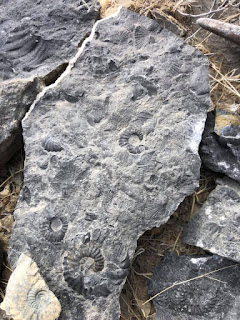
Middle Triassic (Anisian/Ladinian) Fauna
This broader group held an interest for J.P. Smith who published on the marine fauna in the early 1900s based on his collecting in scree and outcrops of the West Humboldt Mountains, Nevada. He published his first monograph on North American Middle Triassic marine invertebrate fauna in 1914.

N. J. Siberling from the US Geological Survey published on these same Nevada outcrops in 1962. His work included nearly a dozen successive ammonite faunas, many of which were variants on previously described species. Both their works would inform what would become a lifelong piecing together of the Triassic puzzle for Tozer.

If one looks at the fauna and the type of sediment, the paleogeography of the Triassic can be interpreted as follows: a tectonically calm west coast of the North American plate that bordered on an open sea; in the area far from the coast, a series of volcanic archipelagos delivered sediment to the adjacent basins. Some were lined or temporarily covered with coral wadding and carbonate banks. Deeper pools were in between. The islands were probably within 30 degrees of the triadic equator. They moved away from the coast up to about 5000 km from the forerunner of the East Pacific Ridge. The geographical situation west of the back was probably similar.

Jurassic and later generations of the crust from near the back have brought some of the islands to the North American plate; some likely to South America; others have drifted west, to Asia. There are indications that New Guinea, New Caledonia and New Zealand were at a northern latitude of 30 ° or more during the Triassic period.

The terranes that now form the western Cordillera were probably welded together and reached the North American plate before the end of the Jurassic period.

Marine Triassic occurs on the North American Plate over a latitudinal spread of 46 degrees, from California to Ellesmere Island. At some intervals of time faunas on the Plate permit the discrimination of two or three provinces with distinctively different coeval faunas. The faunal differences are evidently related to paleolatitude and the provinces are designated LPL, MPL, HPL (low, mid, high paleolatitude). Nevada provides the diagnostic characters of the LPL province; northeastern British Columbia the MPL; the Sverdrup Basin the HPL. In the Lower Triassic and early Middle Triassic (Anisian), the distinction between the MPL and HPL provinces cannot be made. All three provinces are recognized in the Ladinian, Carnian and Norian deposits.
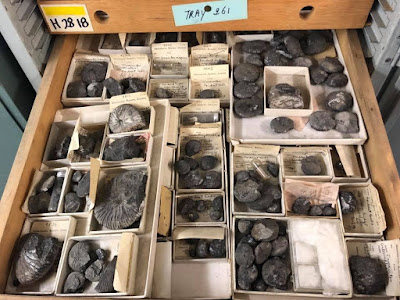
Juvavites sp. Geological Survey of Canada. Photo: John Fam
In the western tracts of the Cordillera, the part formed of suspect terranes, apparently allochthonous with respect to the North American Plate, marine faunas are known all the way from southern Alaska and Yukon to Mexico.

Lower and Upper Triassic faunas from these terranes, including some which today are at 63 degrees north, have the characters of the LPL province.

Middle Triassic faunas from the terranes, as presently known, do not contribute significant data. In the terranes of the Western Cordillera, LPL faunas were now up to 3,000 km north of their counterparts on the American Plate. Through the fossil fauna assemblages, we can see this level of tectonic displacement.

Taking into account the faunas and the nature of the rocks, the Triassic paleogeography is interpreted as a tectonically quiet west shore for the North American Plate, bordered by an open sea or ocean; then, well off-shore, a series of volcanic archipelagos shedding sediment into adjacent basins. Some were fringed or intermittently covered by coralline shoals and carbonate banks. Deeper basins were in between. The islands probably were within 30 degrees of the Triassic equator and extended offshore for about 5000 km, to the spreading ridge directly ancestral to the East Pacific Rise. The geography west of the spreading ridge was probably comparable.

Jurassic and later generation of crust at the ridge had driven some of the islands into the North American Plate; some probably to South America; others have gone west to Asia. Evidence is given that northern New Guinea, New Caledonia and New Zealand may have been at a north latitude of 30 degrees or more in the Triassic. The terranes now forming the Western Cordillera had probably amalgamated, and reached the North American Plate, before the end of the Jurassic.

At the end of the Rhaetian (part of the Triassic period), most of the ammonites had died out. The Hettangian, a rather poorly understood 3 million year time interval followed the Triassic-Jurassic mass extinction event.

During the Hettangian, the new or  Neoammonites developed quite quickly. Within a million years, a fairly large, diverse selection of genera and species had risen to fill the void. The gap created by the Triassic-Jurassic extinction event was re-filled and our ability to "read the rocks' to understand their continued movement through tectonic plate shifting recommenced.
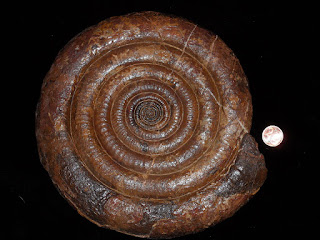
Alsatites proaries, Hettangian Ammonite
It is during the Hettangian that the smooth shelled ammonite genus Psiloceras first appears. They span the time between 201.3 ± 0.2 Ma and 199.3 ± 0.3 Ma (million years ago). For my European friends, the Hettangian is the time span in which the marine limestone, shales and clay Lias of western Europe were deposited.

This Hettangian ammonite, Alsatites proaries, is a lovely example of the cephalopods cruising our ancient oceans at that time. Alsatites is an extinct genus of cephalopod belonging to the Ammonite subclass. They lived during the Early Jurassic, Hettangian till the Sinemurian and are generally extremely evolute, many whorled with a broad keel. Or, as described by one of my very young friends, he looks like a coiled snake you make in pottery class.

The Hettangian is an interesting little period of our history. It spans the time between 201.3 ± 0.2 Ma and 199.3 ± 0.3 Ma (million years ago). For my European friends, the Hettangian is the time in which the marine limestone, shales and clay Lias of western Europe were deposited. In British Columbia, Canada, we see the most diverse middle and late Hettangian (Early Jurassic) ammonite assemblages in the Queen Charlotte Islands (Haida Gwaii), an archipelago about 50 km off British Columbia's northern Pacific coast. In total, 53 ammonite taxa are described of which Paradasyceras carteri, Franziceras kennecottense, Pleuroacanthites charlottensis, Ectocentrites pacificus and Curviceras haidae are new.

In general, North American Early Jurassic ammonites are of Tethyan affinity or endemic to the eastern Pacific. For this reason, a separate zonation for the Hettangian and Sinemurian of the Western Cordillera of North America was established. Taylor et al. (2001), wrote up and published on much of this early research though, at the time, very little Canadian information was included.

Longridge, L. M., et al. “Three New Species of the Hettangian (Early Jurassic) Ammonite Sunrisites from British Columbia, Canada.” Journal of Paleontology, vol. 82, no. 1, 2008, pp. 128–139. JSTOR, www.jstor.org/stable/20144175. Accessed 27 Jan. 2020.

Tozer, ET (Tim): Marine Triassic faunas of North America: Their significance for assessing plate and terrane movements. Geol Rundsch 71, 1077-1104 (1982). https://doi.org/10.1007/BF01821119

Danner, W. (Ted): Limestone resources of southwestern British Columbia. Montana Bur. Mines & Geol., Special publ. 74: 171-185, 1976.

Davis, G., Monger, JWH & Burchfiel, BC: Mesozoic construction of the Cordilleran “collage”, central British Columbia to central California. Pacific Coast Paleography symposium 2, Soc. Economic Paleontologists and Mineralogists, Los Angeles: 1-32, 1978.

Gibson, DW: Triassic rocks of the Rocky Mountain foothills and front ranges of northeastern British Columbia and west-central Alberta. Geol. Surv. Canada Bull. 247, 1975.

Photo of the large belemnite (Atractites sp?) and ammonites (Sunrisites & Badouxia) from the Lower Jurassic (Late Hettangian), Last Creek Formation (Castle Pass member), Taseko Lakes area, British Columbia, Canada in the collection of the deeply awesome John Fam.

Photo: A drawer of Juvavites sp. in the collections of the Geological Survey of Canada. These rarely seen Upper Triassic (Carnian to Norian) ammonoids were collected over many decades by geologists of the Geological Survey of Canada from Northeastern British Columbia. Photo care of the deeply awesome John Fam.

Photo: Grambergia sp. from the Early Anisian (Middle Triassic) ammonoid biostratigraphy of northeastern British Columbia, Canada. Collection of Fossil Huntress.

Photo: Alsatites proaries, Coll. Reiter, Neoammoniten, 30 July 2011, 19:26:10

Wednesday, 24 February 2021

DELICATELY RIDGED PORPOCERAS

An exquisite specimen of the delicately ridged ammonite, Porpoceras verticosum, from Middle Toarcian outcrops adjacent the Rhône in southeastern France.

Porpoceras (Buchman, 1911) is a genus of ammonite that lived during the early and middle Toarcian stage of the Early Jurassic. We see members of this genus from the uppermost part of the Serpentinum Zone to Variabilis Subzone. These beauties are found in Europe, Asia, North America and South America.

Ammonites belonging to this genus have evolute shells, with compressed to depressed whorl section. The flanks are slightly convex and the venter has been low. The whorl section is sub-rectangular. 

The rib is pronounced and somewhat fibulate on the inner whorls — just wee nodes here — and tuberculate to spined on the ventrolateral shoulder. It differs from Peronoceras by not having a compressed whorl section and regular nodes or fibulation. Catacoeloceras is also similar, but it has regular ventrolateral tubercles and is missing the classic nodes or fibulation of his cousins.

This specimen hails from southern France near the Rhône, one of the major rivers of Europe. It has twice the average water level of the Loire and is fed by the Rhône Glacier in the Swiss Alps at the far eastern end of the Swiss canton of Valais then passes through Lake Geneva before running through southeastern France. This 10 cm specimen was prepared by the supremely talented José Juárez Ruiz