Showing posts with label fossils. Show all posts

Tuesday, 26 March 2024

PARASAUROLOPHUS WALKERI OF ALBERTA

Holotype Specimen of P. walkeri, Royal Ontario Museum
Love Dinosaurs? We can find this beauty— Parasaurolophus walkeri in the Dinosaur Park Formation of Alberta, Canada. 

The Dinosaur Park Formation is the uppermost member of the Belly River Group — also known as the Judith River Group, a major geologic unit in southern Alberta. 

It is an area rich in fossils. The formation contains dense concentrations of dinosaur skeletons, both articulated and disarticulated, often found with preserved remains of soft-tissues. Remains of other animals such as fish, turtles, and crocodilians, as well as plant remains, are also abundant. The formation has been named after Dinosaur Provincial Park, a UNESCO World Heritage Site where the formation is well-exposed in the badlands that flank the Red Deer River.

The Dinosaur Park Formation was deposited during the Campanian stage of the Late Cretaceous, between about 76.9 and 75.8 million years ago in what was an alluvial and coastal plain environment. It is bounded by the nonmarine Oldman Formation below and the marine Bearpaw Formation above.

The formation includes diverse and well-documented fauna including dinosaurs such as the horned Centrosaurus, Chasmosaurus, and Styracosaurus, fellow duckbills Gryposaurus and Corythosaurus, the mighty tyrannosaurid Gorgosaurus, and armoured Edmontonia, Euoplocephalus and Dyoplosaurus

Dinosaur Park Formation is interpreted as a low-relief setting of rivers and floodplains that became more swampy and influenced by marine conditions over time as the Western Interior Seaway transgressed westward. The climate was warmer than present-day Alberta, without frost, but with wetter and drier seasons. Conifers were apparently the dominant canopy plants, with an understory of ferns, tree ferns, and angiosperms.

Some of the less common hadrosaurs in the Dinosaur Park Formation of Dinosaur Provincial Park, such as Parasaurolophus, may represent the remains of individuals who died while migrating through the region. They might also have had a more upland habitat where they may have nested or fed. The presence of Parasaurolophus and Kritosaurus in northern latitude fossil sites may represent faunal exchange between otherwise distinct northern and southern biomes in Late Cretaceous North America. Both taxa are uncommon outside of the southern biome, where, along with Pentaceratops, they are predominant members of the fauna.

Photo: Holotype Specimen: The incomplete Parasaurolophus walkeri type specimen in the Royal Ontario Museum. Location: 43° 40′ 5.09″ N, 79° 23′ 40.59″ W. Shared by MissBossy.

Thursday, 21 March 2024

FRACTAL BUILDING: AMMONITES

Argonauticeras besairei, Collection of José Juárez Ruiz.
An exceptional example of fractal building of an ammonite septum, in this clytoceratid Argonauticeras besairei from the awesome José Juárez Ruiz.

Ammonites were predatory, squid-like creatures that lived inside coil-shaped shells.

Like other cephalopods, ammonites had sharp, beak-like jaws inside a ring of squid-like tentacles that extended from their shells. They used these tentacles to snare prey, — plankton, vegetation, fish and crustaceans — similar to the way a squid or octopus hunt today.

Catching a fish with your hands is no easy feat, as I'm sure you know. But the Ammonites were skilled and successful hunters. They caught their prey while swimming and floating in the water column. Within their shells, they had a number of chambers, called septa, filled with gas or fluid that were interconnected by a wee air tube. By pushing air in or out, they were able to control their buoyancy in the water column.

They lived in the last chamber of their shells, continuously building new shell material as they grew. As each new chamber was added, the squid-like body of the ammonite would move down to occupy the final outside chamber.

They were a group of extinct marine mollusc animals in the subclass Ammonoidea of the class Cephalopoda. These molluscs, commonly referred to as ammonites, are more closely related to living coleoids — octopuses, squid, and cuttlefish) than they are to shelled nautiloids such as the living Nautilus species.

The Ammonoidea can be divided into six orders:
  • Agoniatitida, Lower Devonian - Middle Devonian
  • Clymeniida, Upper Devonian
  • Goniatitida, Middle Devonian - Upper Permian
  • Prolecanitida, Upper Devonian - Upper Triassic
  • Ceratitida, Upper Permian - Upper Triassic
  • Ammonitida, Lower Jurassic - Upper Cretaceous
Ammonites have intricate and complex patterns on their shells called sutures. The suture patterns differ across species and tell us what time period the ammonite is from. If they are geometric with numerous undivided lobes and saddles and eight lobes around the conch, we refer to their pattern as goniatitic, a characteristic of Paleozoic ammonites.

If they are ceratitic with lobes that have subdivided tips; giving them a saw-toothed appearance and rounded undivided saddles, they are likely Triassic. For some lovely Triassic ammonites, take a look at the specimens that come out of Hallstatt, Austria and from the outcrops in the Humboldt Mountains of Nevada.

Hoplites bennettiana (Sowby, 1826).
If they have lobes and saddles that are fluted, with rounded subdivisions instead of saw-toothed, they are likely Jurassic or Cretaceous. If you'd like to see a particularly beautiful Lower Jurassic ammonite, take a peek at Apodoceras. Wonderful ridging in that species.

One of my favourite Cretaceous ammonites is the ammonite, Hoplites bennettiana (Sowby, 1826). This beauty is from Albian deposits near Carrière de Courcelles, Villemoyenne, near la région de Troyes (Aube) Champagne in northeastern France.

At the time that this fellow was swimming in our oceans, ankylosaurs were strolling about Mongolia and stomping through the foliage in Utah, Kansas and Texas. Bony fish were swimming over what would become the strata making up Canada, the Czech Republic and Australia. Cartilaginous fish were prowling the western interior seaway of North America and a strange extinct herbivorous mammal, Eobaatar, was snuffling through Mongolia, Spain and England.

In some classifications, these are left as suborders, included in only three orders: Goniatitida, Ceratitida, and Ammonitida. Once you get to know them, ammonites in their various shapes and suturing patterns make it much easier to date an ammonite and the rock formation where is was found at a glance.

Ammonites first appeared about 240 million years ago, though they descended from straight-shelled cephalopods called bacrites that date back to the Devonian, about 415 million years ago, and the last species vanished in the Cretaceous–Paleogene extinction event.

They were prolific breeders that evolved rapidly. If you could cast a fishing line into our ancient seas, it is likely that you would hook an ammonite, not a fish. They were prolific back in the day, living (and sometimes dying) in schools in oceans around the globe. We find ammonite fossils (and plenty of them) in sedimentary rock from all over the world.

In some cases, we find rock beds where we can see evidence of a new species that evolved, lived and died out in such a short time span that we can walk through time, following the course of evolution using ammonites as a window into the past.

For this reason, they make excellent index fossils. An index fossil is a species that allows us to link a particular rock formation, layered in time with a particular species or genus found there. Generally, deeper is older, so we use the sedimentary layers rock to match up to specific geologic time periods, rather the way we use tree-rings to date trees. A handy way to compare fossils and date strata across the globe.

References: Inoue, S., Kondo, S. Suture pattern formation in ammonites and the unknown rear mantle structure. Sci Rep 6, 33689 (2016). https://doi.org/10.1038/srep33689
https://www.nature.com/articles/srep33689?fbclid=IwAR1BhBrDqhv8LDjqF60EXdfLR7wPE4zDivwGORTUEgCd2GghD5W7KOfg6Co#citeas

Photo: Hoplites Bennettiana from near Troyes, France. Collection de Christophe Marot

Saturday, 2 March 2024

GIANT GROUND SLOTH: MASSIVE, EXTINCT VEGANS

In 1788, this magnificent specimen of a Megatherium sloth was sent to the Royal Cabinet of Natural History from the Viceroyalty of Rio de la Plata.

The megatheria were large terrestrial sloths belonging to the group, Xenarthra. These herbivores inhabited large areas of land on the American continent. Their powerful skeleton enabled them to stand on their hind legs to reach leaves high in the trees, a huge advantage given the calories needed to be consumed each day to maintain their large size.

Avocados were one of the food preferences of our dear Giant ground sloths. They ate then pooped them out, spreading the pits far and wide. The next time you enjoy avocado toast, thank this large beastie. One of his ancestors may have had a hand (or butt) in your meal.

In 1788, Bru assembled the skeleton as you see it here. It is exhibited at the Museo Nacional De Ciencias Naturales in Madrid, Spain, in its original configuration for historic value. If you look closely, you'll see it is not anatomically correct. But all good paleontology is teamwork. Based upon the drawings of Juan Bautista Bru, George Cuvier used this specimen to describe the species for the very first time.

Wednesday, 28 February 2024

FOLKSTONE GAULT CLAY AMMONITES

This lovely wee 2.6 cm ammonite is Anahoplites planns from the Cretaceous Folkstone Gault Clay, county of Kent, southeast England. Joining him on this bit of matrix is a 3.2 cm section of Hamites sp

This matrix you see here is the Gault Clay, known locally as the Blue Slipper. This fine muddy clay was deposited 105-110 million years ago during the Lower Cretaceous (Upper and Middle Albian) in a calm, fairly deep-water continental shelf that covered what is now southern England and northern France.

Lack of brackish or freshwater fossils indicates that the gault was laid down in open marine environments away from estuaries. The maximum depth of the Gault is estimated 40-60m a figure which has been reached by the presence of Borings made by specialist Algal-grazing gastropods and supported by a study made by Khan in 1950 using Foraminifera. Estimates of the surface water temperatures in the Gault are between 20-22°c and 17-19°c on the seafloor. These estimates have been reached by bulk analysis of sediments which probably register the sea surface temperature for calcareous nanofossils.

It is responsible for many of the major landslides around Ventnor and Blackgang the Gault is famous for its diverse fossils, mainly from mainland sites such as Folkestone in Kent.

Folkestone, Kent is the type locality for the Gault clay yielding an abundance of ammonites, the same cannot be said for the Isle of Wight Gault, however, the south-east coast of the island has proved to be fossiliferous in a variety of ammonites, in particular, the Genus Hoplites, Paranahoplites and Beudanticeras.

While the Gault is less fossiliferous here on the island it can still produce lovely marine fossils, mainly ammonites and fish remains from these muddy mid-Cretaceous seas. The Gault clay marine fossils include the ammonites (such as Hoplites, Hamites, Euhoplites, Anahoplites, and Dimorphoplites), belemnites (such as Neohibolites), bivalves (notably Birostrina and Pectinucula), gastropods (including the lovely Anchura), solitary corals, fish remains (including shark teeth), scattered crinoid remains, and crustaceans (look for the crab Notopocorystes).

Occasional fragments of fossil wood may also be found. The lovely ammonite you see here is from the Gault Clays of Folkstone. Not all who name her would split the genus Euhoplites. There’s a reasonable argument for viewing this beauty as a very thick form of E. loricatus with Proeuhoplites being a synonym of Euhoplites

Jack Wonfor shared a wealth of information on the Gault and has many lovely examples of the ammonites found here in his collections. If you wish to know more about the Gault clay a publication by the Palaeontological Association called 'Fossils of the Gault clay' by Andrew S. Gale is available in Dinosaur Isle's gift shop.

There is a very good website maintained by Fred Clouter you can look at for reference. It also contains many handy links to some of the best fossil books on the Gault Clay and Folkstone Fossil Beds. Check it out here: http://www.gaultammonite.co.uk/

Friday, 16 February 2024

UPTHRUSTING PLATES: WASHINGTON GEOLOGY

Two hundred million years ago, Washington was two large islands, bits of the continent on the move westward, eventually bumping up against the North American continent and calling it home. The shifting continues, subtly changing the landscape like a breath. We only notice when pockets of resistance manifest as earthquakes, some newsworthy, some all but unnoticed. For now, the more extreme movement has subsided laterally and continues vertically, pushing California towards the North Pole. Hello Baja-BC.

The upthrusting of plates move our mountain ranges skyward – the path of least resistance. And it is this dynamic movement that's created the landscape we see today.

The 3,000 meters of the stratigraphic section of the Chuckanut Formation along Chuckanut Drive span an age range of just a few million years. The lower part is late Paleocene with a radiometric age of around 56 million years. The upper part of the section is early Eocene. The fossils found here lived and died very close to where they are now but in a much warmer, wetter, swampy setting. The exposures of the Chuckanut Formation were once part of a vast river delta; imagine, if you will, the bayou country of the Lower Mississippi. The siltstones, sandstones, mudstones and conglomerates of this formation were laid down during a time of luxuriant plant growth in the subtropical flood plain that covered much of the Pacific Northwest.

This ancient wetland provided ideal conditions to preserve the many trees, shrubs and plants that thrived here giving us a lot of information about climate, temperature, the water cycle and humidity of the region. The Chuckanut flora is made up predominantly of plants whose modern relatives live in tropical areas such as Mexico and Central America. While less abundant, evidence of the animals that called this ancient swamp home are also found here. Rare bird, reptile, and mammal tracks have been immortalized in the outcrops of the Chuckanut Formation.

Sumas Eocene Shorebird Trackway
Tracks of a type of archaic mammal of the Orders Pantodonta or Dinocerata (blunt foot herbivores), footprints from a small shorebird, and tracks from an early equid or webbed bird track give evidence to the vertebrates that inhabited the swamps, lakes and riverways of the Pacific Northwest 50 million years ago.

Fossil mammals and bird trackways from Washington State have caused great excitement over the past few years. Many new trackways have been discovered since the 2009 slides near Sumas. George Mustoe and team collected these important finds, bringing them to the Burke Museum in Washington State to study and make available for display.

The movement of these vertebrates was captured in the soft mud on the banks of an ancient river, one of the only depositional environments favourable for track preservation. The terrestrial paleontological record of Washington State at sites like Chuckanut and Racehorse Creek (U-Pb 53 Ma.) is primarily made up of plant material with some wonderfully enticing mammal, shorebird (seen here) and large Diatryma bird tracks on rare occasions.

Tuesday, 13 February 2024

JUVENILE HAMITES SUBROTUNDUS

A tremendously delicate juvenile Hamites subrotundus (J. Sowerby 1814) from Upper Albian outcrops in Mallorca, the largest of the three Balearic Islands in the Mediterranean at more than 3,600 square kilometers. 

Mallorca has been home to various inhabitants for thousands of years. Sitting some 200 kilometers off Spain’s southeastern, it is a idyllic setting for exploring the rich human and geologic history of this part of the world.

The island is made up of dolomite and limestone from a huge expanse of time, the Mesozoic and Cenozoic—170 million to 10 million years ago— and bookended by two parallel mountain chains top and bottom on its southern and northern coasts. 

As you walk the mountain passes northwest to northeast, you stroll across Miocene deposits 20 million to 13 million years ago that speak of the time in our Earth's recent past when part of the African continent collided with Europe. 

It is famous for its limestone mountains and Roman and Moorish remains. As you can see here, it is also home to some rather nice fossils including this specimen of Hamites subrotundus.

While H. subrotundus is generally a Middle Albian species, this specimen was found in the lower part of Upper Albian in the Cristatum zone by José Juárez Ruiz. José had to piece this lovely together from seven fragments. His labour of love was worth the effort. The final piece is sheer perfection and a beautiful specimen approximately 2.5 cm long.

Mallorca and the other Balearic Islands are geologically an extension of the Baetic Cordillera mountain chain of western Andalusia that extends to Murcia and Valencia. 

They are made up of sediments deposited in the Tethys Sea during the Mesozoic.

Exploring the islands, you can collect from deposits from the Triassic, Cretaceous, Jurassic, and Neogene periods. 

The limestone outcrops contain lovely examples of foraminifers—mainly the species Globigerina.

We also see lovely examples of Hamites (Hamites) subrotundus in the Euhoplites loricatus zone; Euhoplites meandrinus subzone from the Middle Albian (Lower Gault) of Folkestone, Kent, UK. 

Photo, preparation and in the collection of the deeply awesome José Juárez Ruiz. Wright C. W. 1996. Treatise on Invertebrate Paleontology (Part L Mollusca 4 Revised) Volume 4: Cretaceous Ammonoidea

Monday, 12 February 2024

FOSSILS, LIMESTONE & SALT: HALLSTATT

Hallstatt Salt Mines, Austria / Permian Salt Diapir
The Hallstatt Limestone is the world's richest Triassic ammonite unit, yielding specimens of more than 500 ammonite species.

Along with diversified cephalopod fauna  — orthoceratids, nautiloids, ammonoids — we also see gastropods, bivalves, especially the late Triassic pteriid bivalve Halobia (the halobiids), brachiopods, crinoids and a few corals. We also see a lovely selection of microfauna represented. 

For microfauna, we see conodonts, foraminifera, sponge spicules, radiolaria, floating crinoids and holothurian sclerites —  polyp-like, soft-bodied invertebrate echinozoans often referred to as sea cucumbers because of their similarities in size, elongate shape, and tough skin over a soft interior. 

Franz von Hauer’s exhaustive 1846 tome describing Hallstatt ammonites inspired renowned Austrian geologist Eduard Suess’s detailed study of the area’s Mesozoic history. That work was instrumental in Suess being the first person to recognize the former existence of the Tethys Sea, which he named in 1893 after the sister of Oceanus, the Greek god of the ocean. As part of the Northern Limestone Alps, the Dachstein rock mass, or Hoher Dachstein, is one of the large karstic mountains of Austria and the second-highest mountain in the Northern Limestone Alps. It borders Upper Austria and Styria in central Austria and is the highest point in each of those states.

Parts of the massif also lie in the state of Salzburg, leading to the mountain being referred to as the Drei-Länder-Berg or three-state mountain. Seen from the north, the Dachstein massif is dominated by the glaciers with the rocky summits rising beyond them. By contrast, to the south, the mountain drops almost vertically to the valley floor. The karst limestones and dolomites were deposited in our Mesozoic seas. The geology of the Dachstein massif is dominated by the Dachstein-Kalk Formation — the Dachstein limestone — which dates back to the Triassic.

Hallstatt and the Hallstatt Sea, Austria
There were several phases of mountain building in this part of the world pushing the limestone deposits 3,000 metres above current sea level. The rock strata were originally deposited horizontally, then shifted, broken up and reshaped by the erosive forces of ice ages and erosion.

The Hallstatt mine exploits a Permian salt diapir that makes up some of this area’s oldest rock. 

The salt accumulated by evaporation in the newly opened, and hence shallow, Hallstatt-Meliata Ocean. This was one of several small ocean basins that formed in what is now Europe during the late Paleozoic and early Mesozoic when the world’s landmasses were welded together to form the supercontinent Pangea. 

Pangea was shaped like a crescent moon that cradled the famous Tethys Sea. Subduction of Tethyian oceanic crust caused several slivers of continental crust to separate from Pangea, forming new “back-arc basins” (small oceans formed by rifting that is associated with nearby subduction) between the supercontinent and the newly rifted ribbon continents.

The Hallstatt-Meliata Ocean was one such back-arc basin. As it continued to expand and deepen during the Triassic, evaporation ceased and reefs flourished; thick limestone deposits accumulated atop the salt. When the Hallstatt-Meliata Ocean closed in the Late Jurassic, the compression squeezed the low-density salt into a diapir that rose buoyantly, injecting itself into the Triassic limestones above.

The Hallstatt salt diapir and its overlying limestone cap came to rest in their present position in the northern Austrian Alps when they were shoved northward as nappes (thrust sheets) during two separate collision events, one in the Cretaceous and one in the Eocene, that created the modern Alps. It is from the Hallstatt salt diapir that Hallstatt, like so many cities and towns, gets its name.

Deposits of rock salt or halite, the mineral name of sodium chloride with the chemical formula of NaCl, are found and mined around the globe. These deposits mark the dried remains of ancient oceans and seas. Names of rivers, towns and cities in Europe — Salzburg, Halle, Hallstatt, Hallein, La Salle, Moselle — all pay homage to their connection to halite and salt production. The Greek word for salt is hals and the Latin is sal. The Turkish name for salt is Tuz, which we see in the naming of Tuzla, a salt-producing region of northeastern Bosnia-Herzegovina and in the names of towns that dot the coast of Turkey where it meets the Black Sea. Hallstatt with its salt diapir is no exception.

The salt-named town of Hallstatt sits on the shores of the idyllic Hallstätter Sea at the base of the Dachstein massif. Visiting it today, you experience a quaint traditional fishing village built in the typical upper Austrian style. Tourism drives the economy as much as salt as this area of the world is picture-perfect from every angle.

Space is at a minimum in the town. For centuries, every ten years the local cemetery exhumes the bones of those buried there and moves them to an ossuary to make room for new burials. The Hallstatt Ossuary is called Karner, Charnel House, or simply Beinhaus (Bone House). Karners are places of secondary burials. They were once common in the Eastern Alps, but that custom has largely disappeared.

Hallstatt Beinhaus Ossuary, Hallstatt, Austria
A collection of over 700 elaborately decorated skulls rest inside the ossuary. They are lined up on rows of wooden shelves that grace the walls of the chapel. Another 500 undecorated skulls, bare and without any kind of adornment, are stacked in the corners.

Each is inscribed and attached to a record with the deceased's name, profession and date of death. The Bone House is located in a chapel in the basement of the Church of Saint Michael. The church dates from the 12th century CE. 

Decorating the skulls was traditionally the job of the local gravedigger and an honour granted to very few. At the family's request, garlands of flowers were painted on the skulls of deceased as decorative crowns if they were female. The skulls of men and boys were painted wreaths of oak or ivy.

Every building in Hallstatt looks out over the Hallstätter Sea. This beautiful mountain lake considered one of the finest of Austria's Salzkammergut region. It lies at the northern foot of the Dachstein mountain range, sitting eight-and-a-half kilometres long and two kilometres wide. The shoreline is dotted by the villages of  Obertraun, Steeg, and Hallstatt.

The region is habitat to a variety of diverse flora and fauna, including many rare species such as native orchids, in the wetlands and moors in the south and north.

Linked by road to the cities of Salzburg and Graz, Hallstatt and its lake were declared one of the World Heritage sites in Austria in 1997 and included in the Hallstatt-Dachstein Salzkammergut Alpine UNESCO World Heritage Site. The little market village of Hallstatt takes its name from the local salt mine.

Hallstatt, Salzkammergut region, Austria
The town is a popular tourist destination with its quaint shops and terraced cafes. In the centre of town, the 19th-century Evangelical Church of Hallstatt with its tall, slender spire is a lakeside landmark. You can see it here in the photo on the left.

Above the town are the Hallstatt Salt mines located within the 1,030-meter-tall Salzburg Salt Mountain. They are accessible by cable car or a three-minute journey aboard the funicular railway. There is also a wonderful Subterranean Salt Lake.

In 1734, there was a corpse found here preserved in salt. The fellow became known as the Man in Salt. Though no archaeological analysis was performed at the time — the mummy was respectfully reburied in the Hallstatt cemetery — based on descriptions in the mine records, archaeologists suspect the miner lived during the Iron Age. This Old Father, Senos ph₂tḗr, 'ɸatīr 'father' may have been a local farmer, metal-worker, or both and chatted with his friends and family in Celtic or Proto-Celtic.

Salt mining in the area dates back to the Neolithic period, from the 8th to 5th Centuries BC. This is around the time that Roman legions were withdrawing from Britain and the Goths sacked Rome. In Austria, agricultural settlements were dotting the landscape and the alpine regions were being explored and settled for their easy access to valuable salt, chert and other raw materials.

The salt-rich mountains of Salzkammergut and the upland valley above Hallstatt were attractive for this reason. The area was once home to the Hallstatt culture, an archaeological group linked to Proto-Celtic and early Celtic people of the Early Iron Age in Europe, c.800–450 BC.
Bronze Age vessel with cow and calf

In the 19th century, a burial site was discovered with 2,000 individuals, many of them buried with Bronze Age artefacts of amber and ivory.

It was this find that helped lend the name Hallstatt to this epoch of human history. The Late Iron Age, between around 800 and 400 BC, became known as the Hallstatt Period.

For its rich history, natural beauty and breathtaking mountainous geology, Hallstatt is a truly irresistible corner of the world.

Salzbergstraße 1, 4830 Hallstatt.  https://www.salzwelten.at/en/home/

Photo: Bronze vessel with cow and calf, Hallstatt by Alice Schumacher - Naturhistorisches Museum Wien - A. Kern – K. Kowarik – A. W. Rausch – H. Reschreiter, Salz-Reich. 7000 Jahre Hallstatt, VPA 2 (Wien, 2008) Seite 133 Abbildung 6. Hallstatt Village & Ossuary Photos: P. McClure Photography ca. 2015.

Bernoulli D, Jenkyns HC (1974) Alpine, Mediterranean, and Central Atlantic Mesozoic facies in relation to the early evolution of the Tethys. Soc Econ Paleont Mineral Spec Publ 19:129–160

Bernoulli D, Jenkyns H (2009) Ancient oceans and continental margins of the Alpine-Mediterranean Tethys: deciphering clues from Mesozoic pelagic sediments and ophiolites. Sedimentology 56:149–190

Saturday, 10 February 2024

YORKSHIRE HISTORY: FOSSILS TEXTILES AND URINE

Yorkshire Coast
You may recall the eight-metre Type Specimen of the ichthyosaur, Temnodontosaurus crassimanus, found in an alum quarry in Yorkshire, northern England.

The Yorkshire Museum was given this important ichthyosaur fossil back in 1857 when alum production was still a necessary staple of the textile industry. Without that industry, many wonderful specimens would likely never have been unearthed.

These quarries are an interesting bit of British history as they helped shape the Yorkshire Coast, created an entirely new industry and gave us more than a fixative for dyes. With them came the discovery of many remarkable fossil specimens and, oddly, local employment in the collection of urine.

In the 16th century, alum was essential in the textile industry as a fixative for dyes. 

By the first half of the 16th century, the clothing of the Low Countries, German states, and Scandinavia had developed in a different direction than that of England, France, and Italy, although all absorbed the sobering and formal influence of Spanish dress after the mid-1520s. Those fashions held true until the Inquisition when religious persecution, politics and fashion underwent a much-needed overhaul to something lighter.

Fashion in Medieval Livonia (1521): Albrecht Dürer
Elaborate slashing was popular, especially in Germany. In the depiction you see here, an artist pokes a bit of fun at Germanic fashion from the time. Bobbin lace arose from passementerie in the mid-16th century in Flanders, the Flemish Dutch-speaking northern portion of Belgium. Black was increasingly worn for the most formal occasions.

This century saw the rise of the ruff, which grew from a mere ruffle at the neckline to immense, slightly silly, cartwheel shapes. They adorned the necklines of the ultra-wealthy and uber-stylish men and women of the age.

At their most extravagant, ruffs required wire supports and were made of fine Italian reticella, a cutwork linen lace. You can imagine the many hours of skill and patience that would have gone into each piece to create the artful framework of these showy lace collars.

16th Century Fashion / Ruff Collars and Finery
In contrast to all that ruff, lace and cutwork linen, folk needed dyed fabrics. And to fix those dyes, they needed Alum. For a time, Italy was the source of that alum.

The Pope held a tidy monopoly on the industry, supplying both alum and the best dyes. He also did a nice trade in colourful and rare pigments for painting. And for a time, all was well with dandy's strutting their finery to the local fops in Britain.

All that changed during the Reformation. Great Britain, heathens as they were, were cut off from their Papal source and needed to fend for themselves.

The good Thomas Challoner took up the charge and set up Britain's first Alum works in Guisborough. Challoner looked to palaeontology for inspiration. Noticing that the fossils found on the Yorkshire coast were very similar to those found in the Alum quarries in Europe, he hatched a plan to set-up an alum industry on home soil. 

As the industry grew, sites along the coast were favoured as access to the shales and subsequent transportation was much easier.

Alum House, Photo: Joyce Dobson and Keith Bowers
Alum was extracted from quarried shales through a large scale and complicated process which took months to complete. 

The process involved extracting then burning huge piles of shale for 9 months, before transferring it to leaching pits to extract an aluminium sulphate liquor. This was sent along channels to the alum works where human urine was added.

At the peak of alum production, the industry required 200 tonnes of urine every year. That's the equivalent of all the potty visits of more than 1,000 people. Yes, strange but true.

The steady demand was hard to keep up with and urine became an imported resource from markets as far away as London and Newcastle upon Tyne in the northeast of England. Wooden buckets were left on street corners for folk to do their business then carted back to the south to complete the alum extraction process. The urine and alum would be mixed into a thick liquid. Once mixed, the aromatic slosh was left to settle and then the alum crystals were removed.

I'm not sure if this is a folktale or plain truth, but as the story goes, one knows when the optimum amount of alum had been extracted as you can pop an egg in the bucket and it floats on its own.

Alum House. Photo: Ann Wedgewood and Keith Bowers
The last Alum works on the Yorkshire Coast closed in 1871. This was due to the invention of manufacturing synthetic alum in 1855, then subsequently the creation of aniline dyes that contained their own fixative.

Many sites along the Yorkshire Coast bear evidence of the alum industry. These include Loftus Alum Quarries where the cliff profile is drastically changed by extraction and huge shale tips remain.

Further South are the Ravenscar Alum Works, which are well-preserved and enable visitors to visualize the processes which took place. The photos you see here are of Alum House at Hummersea. The first shows the ruin of Alum House printed on a postcard from 1906. The second (bottom) image shows the same ruin from on high with Cattersty Point in the background.

The good folk at the National Trust in Swindon are to thank for much of the background shared here. If you'd like to learn more about the Yorkshire area or donate to a very worthy charity, follow their link below.

Reference: https://www.nationaltrust.org.uk/yorkshire-coast/features/how-alum-shaped-the-yorkshire-coast

Sunday, 28 January 2024

THE SLOW RACE OF TIME: LIVING FOSSILS

Horseshoe crabs are marine and brackish water arthropods of the order Xiphosura — a slowly evolving, conservative taxa.

Much like (slow) Water Striders (Aquarius remigis), (relatively sluggish) Coelacanth (Latimeria chalumnae) and (the current winner on really slow evolution) Elephant Sharks (Callorhinchus milii), these fellows have a long history in the fossil record with very few anatomical changes. 

But slow change provides loads of great information. It makes our new friend, Yunnanolimulus luoingensis, an especially interesting and excellent reference point for how this group evolved. 

We can examine their genome today and make comparisons all the way back to the Middle Triassic (with this new find) and other specimens from further back in the Ordovician — 445 million years ago. 

These living fossils have survived all five mass extinction events. They are generalists who can live in shallow or deep water and will eat pretty much anything they can find on the seafloor.

The oldest horseshoe crab fossil, Lunataspis aurora, is found in outcrops in Manitoba, Canada. Charmingly, the name means crescent moon shield of the dawn. It was palaeontologist Dave Rudkin and team who chose that romantic name. Finding them as fossils is quite remarkable as their shells are made of protein which does not mineralized like typical fossils.

Even so, the evolution of their exoskeleton is well-documented by fossils, but appendage and soft-tissue preservation are extremely rare. 

A new study analyzes details of the appendage and soft-tissue preservation in Yunnanolimulus luoingensis, a Middle Triassic (ca. 244 million years old) horseshoe crab from Yunnan Province, SW China. The remarkable anatomical preservation includes the chelicerae, five pairs of walking appendages, opisthosomal appendages with book gills, muscles, and fine setae permits comparison with extant horseshoe crabs.

The close anatomical similarity between the Middle Triassic horseshoe crabs and their recent analogues documents anatomical conservatism for over 240 million years, suggesting persistence of lifestyle.

The occurrence of Carcinoscorpius-type claspers on the first and second walking legs in male individuals of Y. luoingensis tells us that simple chelate claspers in males are plesiomorphic for horseshoe crabs, and the bulbous claspers in Tachypleus and Limulus are derived.

As an aside, if you hadn't seen an elephant shark before and were shown a photo, you would likely say, "that's no freaking shark." You would be wrong, of course, but it would be a very clever observation.

Callorhinchus milii look nothing like our Great White friends and they are not true sharks at all. Rather, they are ghost sharks that belong to the subclass Holocephali (chimaera), a group lovingly known as ratfish. They diverged from the shark lineage about 400 million years ago.

If you have a moment, do a search for Callorhinchus milii. The odd-looking fellow with the ironic name, kallos, which means beautiful in Greek, sports black blotches on a pale silver elongate body. And their special feature? It is the fishy equivalent of business in the front, party in the back, with a dangling trunk-like projection at the tip of their snout and well-developed rectal glands near the tail.

As another small point of interest with regards to horseshoe crabs, John McAllister collected several of these while working on his MSc to see if they had microstructures similar to trilobites (they do) and whether their cuticles were likewise calcified. He found no real calcification in their cuticles, in fact, he had a rather frustrating time getting anything measurable to dissolve in acid in his hunt for trace elements. 

Likewise, when looking at oxygen isotopes (16/18) to get a handle on water salinity and temperature, his contacts at the University of Waterloo had tons of fun getting anything at all to analyze. It made for some interesting findings. Sadly, for a number of reasons, he abandoned the work, but you can read his very interesting thesis here: https://dr.library.brocku.ca/handle/10464/1959

Ref: Hu, Shixue & Zhang, Qiyue & Feldmann, Rodney & Benton, Michael & Schweitzer, Carrie & Huang, Jinyuan & Wen, Wen & Zhou, Changyong & Xie, Tao & Lü, Tao & Hong, Shuigen. (2017). Exceptional appendage and soft-tissue preservation in a Middle Triassic horseshoe crab from SW China. Scientific Reports. 7. 10.1038/s41598-017-13319-x.

Saturday, 13 January 2024

NOOTKA FOSSILS AND FIRST NATIONS HISTORY

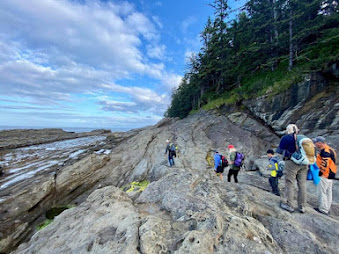
Nootka Fossil Field Trip. Photo: John Fam
The rugged west coast of Vancouver Island offers spectacular views of a wild British Columbia. Here the seas heave along the shores slowly eroding the magnificent deposits that often contain fossils. 

Just off the shores of Vancouver Island, east of Gold River and south of Tahsis is the picturesque and remote Nootka Island.

This is the land of the proud and thriving Nuu-chah-nulth First Nations who have lived here always

Always is a long time, but we know from oral history and archaeological evidence that the Mowachaht and Muchalaht peoples lived here, along with many others, for many thousands of years — a time span much like always

While we know this area as Nootka Sound and the land we explore for fossils as Nootka Island, these names stem from a wee misunderstanding. 

Just four years after the 1774 visit by Spanish explorer Juan Pérez — and only a year before the Spanish established a military and fur trading post on the site of Yuquot — the Nuu-chah-nulth met the Englishman, James Cook.  

Captain Cook sailed to the village of Yuquot just west of Vancouver Island to a very warm welcome. He and his crew stayed on for a month of storytelling, trading and ship repairs. Friendly, but not familiar with the local language, he misunderstood the name for both the people and land to be Nootka. In actual fact, Nootka means, go around, go around

Two hundred years later, in 1978, the Nuu-chah-nulth chose the collective term Nuu-chah-nulth — nuučaan̓uł, meaning all along the mountains and sea or along the outside (of Vancouver Island) — to describe themselves. 

It is a term now used to describe several First Nations people living along western Vancouver Island, British Columbia. 

It is similar in a way to the use of the United Kingdom to refer to the lands of England, Scotland and Wales — though using United Kingdom-ers would be odd. Bless the Nuu-chah-nulth for their grace in choosing this collective name.  

An older term for this group of peoples was Aht, which means people in their language and is a component in all the names of their subgroups, and of some locations — Yuquot, Mowachaht, Kyuquot, Opitsaht. While collectively, they are the Nuu-chah-nulth, be interested in their more regional name should you meet them. 

But why does it matter? If you have ever mistakenly referred to someone from New Zealand as an Aussie or someone from Scotland as English, you have likely been schooled by an immediate — sometimes forceful, sometimes gracious — correction of your ways. The best answer to why it matters is because it matters.

Each of the subgroups of the Nuu-chah-nulth viewed their lands and seasonal migration within them (though not outside of them) from a viewpoint of inside and outside. Kla'a or outside is the term for their coastal environment and hilstis for their inside or inland environment.

It is to their kla'a that I was most keen to explore. Here, the lovely Late Eocene and Early Miocene exposures offer up fossil crab, mostly the species Raninid, along with fossil gastropods, bivalves, pine cones and spectacularly — a singular seed pod. These wonderfully preserved specimens are found in concretion along the foreshore where time and tide erode them out each year.

Five years after Spanish explorer Juan Pérez's first visit, the Spanish built and maintained a military post at Yuquot where they tore down the local houses to build their own structures and set up what would become a significant fur trade port for the Northwest Coast — with the local Chief Maquinna's blessing and his warriors acting as middlemen to other First Nations. 

Following reports of Cook's exploration British traders began to use the harbour of Nootka (Friendly Cove) as a base for a promising trade with China in sea-otter pelts but became embroiled with the Spanish who claimed (albeit erroneously) sovereignty over the Pacific Ocean. 
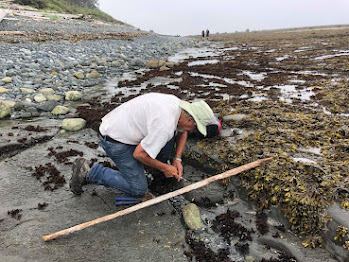
Dan Bowen searching an outcrop. Photo: John Fam
The ensuing Nootka Incident of 1790 nearly led to war between Britain and Spain (over lands neither could actually claim) but talk of war settled and the dispute was settled diplomatically. 

George Vancouver on his subsequent exploration in 1792 circumnavigated the island and charted much of the coastline. His meeting with the Spanish captain Bodega y Quadra at Nootka was friendly but did not accomplish the expected formal ceding of land by the Spanish to the British. 

It resulted however in his vain naming the island "Vancouver and Quadra." The Spanish captain's name was later dropped and given to the island on the east side of Discovery Strait. Again, another vain and unearned title that persists to this day.

Early settlement of the island was carried out mainly under the sponsorship of the Hudson's Bay Company whose lease from the Crown amounted to 7 shillings per year — that's roughly equal to £100.00 or $174 CDN today. Victoria, the capital of British Columbia, was founded in 1843 as Fort Victoria on the southern end of Vancouver Island by the Hudson's Bay Company's Chief Factor, Sir James Douglas. 

With Douglas's help, the Hudson's Bay Company established Fort Rupert on the north end of Vancouver Island in 1849. Both became centres of fur trade and trade between First Nations and solidified the Hudson's Bay Company's trading monopoly in the Pacific Northwest.

The settlement of Fort Victoria on the southern tip of Vancouver Island — handily south of the 49th parallel — greatly aided British negotiators to retain all of the islands when a line was finally set to mark the northern boundary of the United States with the signing of the Oregon Boundary Treaty of 1846. Vancouver Island became a separate British colony in 1858. British Columbia, exclusive of the island, was made a colony in 1858 and in 1866 the two colonies were joined into one — becoming a province of Canada in 1871 with Victoria as the capital.

Dan Bowen, Chair of the Vancouver Island Palaeontological Society (VIPS) did a truly splendid talk on the Fossils of Nootka Sound. With his permission, I have uploaded the talk to the ARCHEA YouTube Channel for all to enjoy. Do take a boo, he is a great presenter. Dan also graciously provided the photos you see here. The last of the photos you see here is from the August 2021 Nootka Fossil Field Trip. Photo: John Fam, Vice-Chair, Vancouver Paleontological Society (VanPS).

Know Before You Go — Nootka Trail

The Nootka Trail passes through the traditional lands of the Mowachaht/Muchalat First Nations who have lived here since always. They share this area with humpback and Gray whales, orcas, seals, sea lions, black bears, wolves, cougars, eagles, ravens, sea birds, river otters, insects and the many colourful intertidal creatures that you'll want to photograph.

This is a remote West Coast wilderness experience. Getting to Nootka Island requires some planning as you'll need to take a seaplane or water taxi to reach the trailhead. The trail takes 4-8 days to cover the 37 km year-round hike. The peak season is July to September. Permits are not required for the hike. 

Access via: Air Nootka floatplane, water taxi, or MV Uchuck III

  • Dan Bowen, VIPS on the Fossils of Nootka: https://youtu.be/rsewBFztxSY
  • https://www.thecanadianencyclopedia.ca/en/article/sir-james-douglas
  • file:///C:/Users/tosca/Downloads/186162-Article%20Text-199217-1-10-20151106.pdf
  • Nootka Trip Planning: https://mbguiding.ca/nootka-trail-nootka-island/#overview


Thursday, 11 January 2024

PALAEONTOLOGY OF CANADA'S KOOTENAY REGION

The East Kootenay region on the south-eastern edge of British Columbia is a land of colossal mountains against a clear blue sky. 

That is not strictly true, of course, as this area does see its fair share of rain and temperature extremes — but visiting in the summer every view is a postcard of mountainous terrain.

Rocks from deep within the Earth's crust underlie the entire East Kootenay region and are commonly exposed in the areas majestic mountain peaks, craggy rocky cliffs, glaciated river canyons, and rock cuts along the highways. Younger Ice Age sediments blanket much of the underlying rock.

I've been heading to the Cranbrook and Fernie area since the early 1990s. My interest is the local geology and fossil history that these rocks have to tell. I'm also drawn to the warm and welcoming locals who share a love for the land and palaeontological treasures that open a window to our ancient past.  

Cranbrook is the largest community in the region and is steeped in mining history and the opening of the west by the railway. It is also a stone's throw away from Fort Steele and the Lower Cambrian exposures of the Eager Formation. These fossil beds rival the slightly younger Burgess Shale fauna and while less varied, produce wonderful examples of olenellid trilobites and weird and wonderful arthropods nearly half a billion years old. 

Labiostria westriopi, McKay Group
The Lower Cambrian Eager Formation outcrops at a few localities close to Fort Steele, many known since the early 1920s, and up near Mount Grainger near the highway. 

Further east, the Upper Cambrian McKay Group near Tanglefoot Mountain is a palaeontological delight with fifteen known outcrops that have produced some of the best-preserved and varied trilobites in the province — many of them new species. 

The McKay Formation also includes Ordovician outcrops sprinkled in for good measure.

Other cities in the area and the routes to and from them produce other fossil fauna from Kimberley to Fernie and the district municipality of Invermere and Sparwood. This is an arid country with native grasslands and forests of semi-open fir and pine. Throughout there are a host of fossiliferous exposures from Lower Cretaceous plants to brachiopods. 

The area around Whiteswan Lake has wonderful large and showy Ordovician graptolites including Cardiograptus morsus and Pseudoclimacograptus angustifolius elongates — some of our oldest relatives. A drive down to Flathead will bring you to ammonite outcrops and you can even find Eocene fresh-water snails in the region. 

The drive from Cranbrook to Fernie is about an hour and change through the Cambrian into the Devonian which flip-flops and folds over revealing Jurassic exposures. 

Fernie Ichthyosaur Excavation, 1916
The Crowsnest Highway into Fernie follows Mutz Creek. From the highway, you can see the Fernie Group and the site along the Elk River where an ichthyosaur was excavated in 1916. 

The Fernie Formation is Jurassic. It is present in the western part of the Western Canada Sedimentary Basin in western Alberta and northeastern British Columbia. 

It takes its name from the town of Fernie, British Columbia, and was first defined by W.W. Leach in 1914. The town of Fernie is rimmed by rugged mountains tipped with Devonian marine outcrops. In essence, all these mountains are upside down with the oldest layers flipped to the top and a good 180 million years older than those they sit upon. 

Before they were mountains, these sedimentary rocks were formed as sediment collected in a shallow sea or inland basin. About 360 million years ago, the rocks that you see in Fernie today were down near the equator. They road tectonic plates, pushing northeast smashing into the coastline of what would become British Columbia. A little push here, shove there — compression and thrust faulting — and the rock was rolled over on its head — repeatedly. But that is how mountains are often formed, though not usually pushed so hard that they flip over. But still, it is a slow, relentless business. 

Cretaceous Plant Material, Fernie, BC
Within Fernie, there are small exposures of Triassic and Jurassic marine outcrops. East of the town there are Cretaceous plant sites, and of course, the Jurassic 1.4-metre Titanites occidentalis ammonite up on Coal Mountain.

The regional district's dominant landform is the Rocky Mountain Trench, which is flanked by the Purcell Mountains and the Rocky Mountains on the east and west, and includes the Columbia Valley region. The southern half of which is in the regional district — its northern half is in the Columbia-Shuswap Regional District. 

The regional district of Elk Valley in the southern Rockies is the entryway to the Crowsnest Pass and an important coal-mining area. 

Other than the Columbia and Kootenay Rivers, whose valleys shape the bottomlands of the Rocky Mountain Trench, the regional districts form the northernmost parts of the basins of the Flathead, Moyie and Yahk Rivers. 

The Moyie and Yahk are tributaries of the Kootenay, entering it in the United States, and the Flathead is a tributary of the Clark Fork into Montana.

Photo One: Tyaughton Mountain, Mckay Group; Photo Two: Labiostria westriopi, Upper Cambrian McKay Group, Site ML (1998); John Fam Collection; Photo Three: Ichthyosaur Excavation, Fernie, British Columbia, 1916; Photo Four: Cretaceous Plant Fossils, east of Fernie towards Coal Mountain. The deeply awesome Guy Santucci as hand-model for scale. 

Friday, 5 January 2024

FOSSILS OF THE NORTH SEA

A lovely 12 cm creamy orange Bottlenose Dolphin, Tursiops sp. lumbar vertebrae found in the Brown Bank area of the North Sea, one of the busiest seaways in the world.

Bottlenose dolphins first appeared during the Miocene and swam the shallow seas of this region. We still find them today in warm and temperate seas worldwide though unlike narwhal, beluga and bowhead whales, Bottlenose dolphins avoid the Arctic and Antarctic Circle regions. 

Their name derives from the Latin tursio (dolphin) and truncatus for their characteristic truncated teeth

We find their remains in the sediments of the North Sea. There are two known fossil species from Italy that include Tursiops osennae (late Miocene to early Pliocene) from the Piacenzian coastal mudstone, and Tursiops miocaenus (Miocene) from the Burdigalian marine sandstone.

Many waterworn vertebrae from the Harbour Porpoise Phocoena sp., (Cuvier, 1816), Bottlenose dolphin Tursiops sp. (Gervais, 1855), and Beluga Whale, Delphinapterus sp. (Lacépède‎, 1804‎) are found by fishermen as they dredge the bottom of the Brown Bank, one of the deepest sections of the North Sea.  

The North Sea is a sea of the Atlantic Ocean located between the United Kingdom, Denmark, Norway, Germany, the Netherlands, Belgium and France. An epeiric sea on the European continental shelf, it connects to the ocean through the English Channel in the south and the Norwegian Sea in the north.

The fishermen use small mesh trawl nets that tend to scoop up harder bits from the bottom. This technique is one of the only ways this Pleistocene and other more recent material is recovered from the seabed, making them relatively uncommon. The most profitable region for fossil mammal material is in the Brown Bank area of the North Sea. I've circled this area on the map below to give you an idea of the region.

Brown Bank, North Sea, Pleistocene Dredging Area
In May 2019, an 11-day expedition by European scientists from Belgium and the United Kingdom was undertaken to explore three sites of potential geologic and archaeologic interest in the southern North Sea. 

It has long been suspected that the southern North Sea plain may have been home to thousands of people, and chance finds by fishermen over many decades support this theory. 

A concentration of archaeological material, including worked bone, stone and human remains, has been found within the area around the Brown Bank, roughly 100 km due east from Great Yarmouth and 80 km west of the Dutch coast. The quantities of material strongly suggest the presence of a prehistoric settlement. As such the Brown Bank provides archaeologists with a unique opportunity to locate a prehistoric settlement in the deeper and more remote areas of the North Sea, known today as Doggerland.

Until sea levels rose at the end of the last Ice Age, between 8-10,000 years ago, an area of land connected Great Britain to Scandinavia and the continent.  It has long been suspected that the southern North Sea plain was home to thousands of people, and chance finds by fishermen over many decades support this theory. 

Over the past decades a concentration of archaeological material, including worked bone, stone and human remains, has been found within the area around the Brown Bank, roughly 100 km due east from Great Yarmouth and 80 km west of the Dutch coast. 

The quantities of material strongly suggest the presence of a prehistoric settlement. 

As such the Brown Bank provides archaeologists with a unique opportunity to locate a prehistoric settlement in the deeper and more remote areas of the North Sea, known today as Doggerland.

Prospecting for such a settlement within the North Sea is a challenging activity.  Multiple utilities cross the area, bad weather is frequent, and visibility underwater is often limited.  Given these challenging conditions, researchers on the Belgian vessel, RV Belgica, used acoustic techniques and physical sampling of the seabed to unravel the topography and history of the areas chosen for the survey.  

During the survey, the team used a novel parametric echosounder from the Flanders Marine Institute (VLIZ). This uses sonar technology to obtain images of the sub-bottom with the highest possible resolution and was combined with the more traditional “sparker” seismic source to explore deeper sediments.  On the Brown Bank, the Belgica also deployed a grab and a Gilson dredge for sampling near-surface stratigraphy. Video footage was collated using VLIZ’s dedicated video frame and a simpler GoPro mounted on the Gilson dredge. A video showing the equipment in operation on the expedition can be seen at https://youtu.be/sGKfyrDCtmw

Additional reading: http://www.vliz.be/en/press-release/update-research-prehistoric-settlements-North-Sea

Wednesday, 3 January 2024

UPPER TRIASSIC LUNING FORMATION, NEVADA

Exposures of the Upper Triassic (Early Norian, Kerri zone), Luning formation, West Union Canyon, just outside Berlin-Ichthyosaur State Park, Nevada.

The Berlin-Ichthyosaur State Park in central Nevada is a very important locality for the understanding of the Carnian-Norian boundary (CNB) in North America.

Rich ammonoid faunas from this site within the Luning Formation were studied by Silberling (1959) and provided support for the definition of the Schucherti and Macrolobatus zones of the latest Carnian, which are here overlain by well-preserved faunas of the earliest Norian Kerri Zone. Despite its importance, no further investigations have been done at this site during the last 50 years.

Jim Haggart, Mike Orchard and Paul Smith (all local Vancouverites) collaborated on a project that took them down to Nevada to look at the conodonts (Oh, Mike) and ammonoids (Jim's fav); the group then published a paper, "Towards the definition of the Carnian/Norian Boundary: New data on Ammonoids and Conodonts from central Nevada," which you can find in the proceedings of the 21st Canadian Paleontology Conference; by Haggart, J W (ed.); Smith, P L (ed.); Canadian Paleontology Conference Proceedings no. 9, 2011 p. 9-10.

They conducted a bed-by-bed sampling of ammonoids and conodonts in West Union Canyon during October 2010. The eastern side of the canyon provides the best record of the Macrolobatus Zone, which is represented by several beds yielding ammonoids of the Tropites group, together with Anatropites div. sp. Conodont faunas from both these and higher beds are dominated by ornate 'metapolygnthids' that would formerly have been collectively referred to Metapolygnathus primitius, a species long known to straddle the CNB. Within this lower part of the section, they resemble forms that have been separated as Metapolygnathus mersinensis. Slightly higher, forms close to Epigondolella' orchardi and a single Orchardella n. sp. occur. This association can be correlated with the latest Carnian in British Columbia.

Higher in the section, the ammonoid fauna shows a sudden change and is dominated by Tropithisbites. Few tens of metres above, but slightly below the first occurrence of Norian ammonoids Guembelites jandianus and Stikinoceras, two new species of conodonts (Gen et sp. nov. A and B) appear that also occur close to the favoured Carnian/Norian boundary at Black Bear Ridge, British Columbia. Stratigraphically higher collections continue to be dominated by forms close to M. mersinensis and E. orchardi. after BC's own Mike Orchard.

The best exposure of the Kerri Zone is on the western side of the West Union Canyon. Ammonoids, dominated by Guembelites and Stikinoceras div. sp., have been collected from several fossil-bearing levels. Conodont faunas replicate those of the east section. The collected ammonoids fit perfectly well with the faunas described by Silberling in 1959, but they differ somewhat from coeval faunas of the Tethys and Canada.

The genus Gonionotites, very common in the Tethys and British Columbia, is for the moment unknown in Nevada. More in general, the Upper Carnian faunas are dominated by Tropitidae, while Juvavitidae are lacking.

After years of reading about the correlation between British Columbia and Nevada, I had the very great pleasure of walking through these same sections in October 2019 with members of the Vancouver Paleontological Society and Vancouver Island Palaeontological Society. It was with that same crew that I'd originally explored fossil sites in the Canadian Rockies in the early 2000s. Those early trips led to paper after paper and the exciting revelations that inspired our Nevada adventure.

Monday, 25 December 2023

AMMONOIDS, BIVALVES AND POLAR BEARS OF SVALBARD

 This marvellous block is filled with Aristoptychites (syn=Arctoptychites) euglyphus (Mojsisovics, 1886) and Daonella sp., oyster-like saltwater clams or bivalves from the Middle Triassic (Ladinian) outcrops in the Botneheia Formation of Spitzbergen, in Edgeøya and Barentsøya, eastern Svalbard, Norway. 

Daonella and Monotis are important species for our understanding of biostratigraphy in the Triassic and are useful as an index fossil. Daonellids preferred soft, soupy substrates and we tend to find them in massive shell beds.

Svalbard is a Norwegian archipelago between mainland Norway and the North Pole. One of the world’s northernmost inhabited areas, it's known for its rugged, remote terrain of glaciers and frozen tundra sheltering polar bears, reindeer and Arctic fox. The Northern Lights are visible during winter, and summer brings the “midnight sun”—sunlight 24 hours a day.

The Botneheia Formation is made up of dark grey, laminated shales coarsening upwards to laminated siltstones and sandstones. South of the type area, the formation shows several (up to four) coarsening-upward units. 

The formation is named for Botneheia Mountain, a mountain in Nordenskiöld Land at Spitsbergen, Svalbard. It has a height of 522 m.a.s.l., and is located south of Sassenfjorden, east of the valley of De Geerdalen. 

Polar Bears, Ursus maritimus
As well as lovely ammonoids and bivalves, we have found ichthyosaur remains. 

It is not a huge surprise. We had been expecting too, but it was not until the early 2000s that the first bones were found.

Two specimens have of ichthyosaur have been recovered. They comprise part of the trunk and the caudal vertebral column respectively. 

Some features, such as the very high and narrow caudal and posterior thoracic neural spines, the relatively elongate posterior thoracic vertebrae and the long and slender haemapophyses tell us that they probably represent a member of the family Toretocnemidae. 

Numerous ichthyosaur finds are known from the underlying Lower Triassic Vikinghøgda Formation and the overlying Middle to Upper Triassic Tschermakfjellet Formation, the new specimens help to close a huge gap in the fossil record of the Triassic ichthyosaurs from Svalbard.

There is a resident research group working on the Triassic ichthyosaur fauna, the Spitsbergen Mesozoic Research Group. Lucky for them, they often find the fossil remains fully articulated — the bones having retained their spacial relationship to one another. Most of their finds are of the tail sections of primitive Triassic ichthyosaurs. In later ichthyosaurs, the tail vertebrae bend steeply downwards and have more of a fish-like look. In these primitive ancestors, the tail looks more eel-like — bending slightly so that the spines on the vertebrae form more of the tail.

Maisch, Michael W. and Blomeier, Dierk published on these finds back in 2009: Neues Jahrbuch für Geologie und Paläontologie - Abhandlungen Band 254 Heft 3 (2009), p. 379 - 384. Nov 1, 2009

The lovely block you see here is in the collections of the deeply awesome John Fam. The image of the Polar Bears, Ursus maritimus, is courtesy of the Fossil Huntress.