Showing posts with label paleontology. Show all posts

Friday, 5 January 2024

FOSSILS OF THE NORTH SEA

A lovely 12 cm creamy orange Bottlenose Dolphin, Tursiops sp. lumbar vertebrae found in the Brown Bank area of the North Sea, one of the busiest seaways in the world.

Bottlenose dolphins first appeared during the Miocene and swam the shallow seas of this region. We still find them today in warm and temperate seas worldwide though unlike narwhal, beluga and bowhead whales, Bottlenose dolphins avoid the Arctic and Antarctic Circle regions. 

Their name derives from the Latin tursio (dolphin) and truncatus for their characteristic truncated teeth

We find their remains in the sediments of the North Sea. There are two known fossil species from Italy that include Tursiops osennae (late Miocene to early Pliocene) from the Piacenzian coastal mudstone, and Tursiops miocaenus (Miocene) from the Burdigalian marine sandstone.

Many waterworn vertebrae from the Harbour Porpoise Phocoena sp., (Cuvier, 1816), Bottlenose dolphin Tursiops sp. (Gervais, 1855), and Beluga Whale, Delphinapterus sp. (Lacépède‎, 1804‎) are found by fishermen as they dredge the bottom of the Brown Bank, one of the deepest sections of the North Sea.  

The North Sea is a sea of the Atlantic Ocean located between the United Kingdom, Denmark, Norway, Germany, the Netherlands, Belgium and France. An epeiric sea on the European continental shelf, it connects to the ocean through the English Channel in the south and the Norwegian Sea in the north.

The fishermen use small mesh trawl nets that tend to scoop up harder bits from the bottom. This technique is one of the only ways this Pleistocene and other more recent material is recovered from the seabed, making them relatively uncommon. The most profitable region for fossil mammal material is in the Brown Bank area of the North Sea. I've circled this area on the map below to give you an idea of the region.

Brown Bank, North Sea, Pleistocene Dredging Area
In May 2019, an 11-day expedition by European scientists from Belgium and the United Kingdom was undertaken to explore three sites of potential geologic and archaeologic interest in the southern North Sea. 

It has long been suspected that the southern North Sea plain may have been home to thousands of people, and chance finds by fishermen over many decades support this theory. 

A concentration of archaeological material, including worked bone, stone and human remains, has been found within the area around the Brown Bank, roughly 100 km due east from Great Yarmouth and 80 km west of the Dutch coast. The quantities of material strongly suggest the presence of a prehistoric settlement. As such the Brown Bank provides archaeologists with a unique opportunity to locate a prehistoric settlement in the deeper and more remote areas of the North Sea, known today as Doggerland.

Until sea levels rose at the end of the last Ice Age, between 8-10,000 years ago, an area of land connected Great Britain to Scandinavia and the continent.  It has long been suspected that the southern North Sea plain was home to thousands of people, and chance finds by fishermen over many decades support this theory. 

Over the past decades a concentration of archaeological material, including worked bone, stone and human remains, has been found within the area around the Brown Bank, roughly 100 km due east from Great Yarmouth and 80 km west of the Dutch coast. 

The quantities of material strongly suggest the presence of a prehistoric settlement. 

As such the Brown Bank provides archaeologists with a unique opportunity to locate a prehistoric settlement in the deeper and more remote areas of the North Sea, known today as Doggerland.

Prospecting for such a settlement within the North Sea is a challenging activity.  Multiple utilities cross the area, bad weather is frequent, and visibility underwater is often limited.  Given these challenging conditions, researchers on the Belgian vessel, RV Belgica, used acoustic techniques and physical sampling of the seabed to unravel the topography and history of the areas chosen for the survey.  

During the survey, the team used a novel parametric echosounder from the Flanders Marine Institute (VLIZ). This uses sonar technology to obtain images of the sub-bottom with the highest possible resolution and was combined with the more traditional “sparker” seismic source to explore deeper sediments.  On the Brown Bank, the Belgica also deployed a grab and a Gilson dredge for sampling near-surface stratigraphy. Video footage was collated using VLIZ’s dedicated video frame and a simpler GoPro mounted on the Gilson dredge. A video showing the equipment in operation on the expedition can be seen at https://youtu.be/sGKfyrDCtmw

Additional reading: http://www.vliz.be/en/press-release/update-research-prehistoric-settlements-North-Sea

Wednesday, 3 January 2024

UPPER TRIASSIC LUNING FORMATION, NEVADA

Exposures of the Upper Triassic (Early Norian, Kerri zone), Luning formation, West Union Canyon, just outside Berlin-Ichthyosaur State Park, Nevada.

The Berlin-Ichthyosaur State Park in central Nevada is a very important locality for the understanding of the Carnian-Norian boundary (CNB) in North America.

Rich ammonoid faunas from this site within the Luning Formation were studied by Silberling (1959) and provided support for the definition of the Schucherti and Macrolobatus zones of the latest Carnian, which are here overlain by well-preserved faunas of the earliest Norian Kerri Zone. Despite its importance, no further investigations have been done at this site during the last 50 years.

Jim Haggart, Mike Orchard and Paul Smith (all local Vancouverites) collaborated on a project that took them down to Nevada to look at the conodonts (Oh, Mike) and ammonoids (Jim's fav); the group then published a paper, "Towards the definition of the Carnian/Norian Boundary: New data on Ammonoids and Conodonts from central Nevada," which you can find in the proceedings of the 21st Canadian Paleontology Conference; by Haggart, J W (ed.); Smith, P L (ed.); Canadian Paleontology Conference Proceedings no. 9, 2011 p. 9-10.

They conducted a bed-by-bed sampling of ammonoids and conodonts in West Union Canyon during October 2010. The eastern side of the canyon provides the best record of the Macrolobatus Zone, which is represented by several beds yielding ammonoids of the Tropites group, together with Anatropites div. sp. Conodont faunas from both these and higher beds are dominated by ornate 'metapolygnthids' that would formerly have been collectively referred to Metapolygnathus primitius, a species long known to straddle the CNB. Within this lower part of the section, they resemble forms that have been separated as Metapolygnathus mersinensis. Slightly higher, forms close to Epigondolella' orchardi and a single Orchardella n. sp. occur. This association can be correlated with the latest Carnian in British Columbia.

Higher in the section, the ammonoid fauna shows a sudden change and is dominated by Tropithisbites. Few tens of metres above, but slightly below the first occurrence of Norian ammonoids Guembelites jandianus and Stikinoceras, two new species of conodonts (Gen et sp. nov. A and B) appear that also occur close to the favoured Carnian/Norian boundary at Black Bear Ridge, British Columbia. Stratigraphically higher collections continue to be dominated by forms close to M. mersinensis and E. orchardi. after BC's own Mike Orchard.

The best exposure of the Kerri Zone is on the western side of the West Union Canyon. Ammonoids, dominated by Guembelites and Stikinoceras div. sp., have been collected from several fossil-bearing levels. Conodont faunas replicate those of the east section. The collected ammonoids fit perfectly well with the faunas described by Silberling in 1959, but they differ somewhat from coeval faunas of the Tethys and Canada.

The genus Gonionotites, very common in the Tethys and British Columbia, is for the moment unknown in Nevada. More in general, the Upper Carnian faunas are dominated by Tropitidae, while Juvavitidae are lacking.

After years of reading about the correlation between British Columbia and Nevada, I had the very great pleasure of walking through these same sections in October 2019 with members of the Vancouver Paleontological Society and Vancouver Island Palaeontological Society. It was with that same crew that I'd originally explored fossil sites in the Canadian Rockies in the early 2000s. Those early trips led to paper after paper and the exciting revelations that inspired our Nevada adventure.

Tuesday, 2 January 2024

KAZAKHSTAN ANAHOPLITES

This tasty block of Semenovites (Anahoplites) cf. michalskii ammonites hails from Cretaceous, Albian deposits that outcrop on the Tupqaraghan — Mangyshlak Peninsula on the eastern coast of the Caspian Sea, Kazakhstan. 

Present-day Kazakhstan is made up of several micro continental blocks that were broken up in the Cambrian and then crushed back together then smashed up against Siberia and came to rest where we find them today. 

Mangyshlak or Mangghyshlaq Peninsula is a large peninsula located in western Kazakhstan. It borders on the Caspian Sea in the west and with the Buzachi Peninsula, a marshy sub-feature of the main peninsula, in the northeast. The Tyuleniy Archipelago lies off the northern shores of the peninsula.

Lowlands make up one-third of Kazakhstan’s huge expanse, hilly plateaus and plains account for nearly half, and low mountainous regions about one-fifth. Kazakhstan’s highest point, Mount Khan-Tengri (Han-t’eng-ko-li Peak) at 22,949 feet (6,995 metres), in the Tien Shan range on the border between Kazakhstan, Kyrgyzstan, and China, contrasts with the flat or rolling terrain of most of the republic. 

The western and southwestern parts of Kazakhstan are dominated by the low-lying Caspian Depression, which at its lowest point lies some 95 feet below sea level. South of the Caspian Depression are the Ustyurt Plateau and the Tupqaraghan (formerly Mangyshlak) Peninsula jutting into the Caspian Sea. 

Vast amounts of sand formed the Greater Barsuki and Aral Karakum deserts near the Aral Sea, the broad Betpaqdala Desert of the interior, and the Muyunkum and Kyzylkum deserts in the south. Most of these desert regions have slight vegetative cover eeking out a slim existence fed by subterranean groundwater.

Depressions filled by salt lakes — whose water has largely evaporated — dot the undulating uplands of central Kazakhstan. 

In the north, the mountains reach about 5,000 feet, and there are similar high areas among the Ulutau Mountains in the west and the Chingiz-Tau Range in the east. In the east and southeast, massifs — enormous blocks of crystalline rock — are furrowed by valleys. 

The Altai mountain complex to the east sends three ridges into the republic, and, farther south, the Tarbagatay Range is an offshoot of the Naryn-Kolbin complex. Another range, the Dzungarian Alatau, penetrates the country to the south of the depression containing the icy waters of Lake Balkhash. The beautiful Tien Shan peaks rise along the southern frontier with Kyrgyzstan. 

As well as lovely ammonite outcrops, dinosaurian material and pterosaur remains are also found in Kazakhstan. The ammonites you see here are in the collections of the deeply awesome Emil Black.

Paleo Coordinates: 44 ° 35'46 ″ 51 ° 52'53″ 

Saturday, 30 December 2023

ZENASPIS PODOLICA HEAD SHIELD

A Devonian bony fish mortality plate showing a lower shield of Zenaspis podolica (Lankester, 1869) from Lower Devonian deposits of Podolia, Ukraine.

Podolia or Podilia is a historic region in Eastern Europe, located in the west-central and south-western parts of Ukraine, in northeastern Moldova. Podolia is the only region in Ukraine where 420 million-year-old remains of ichthyofauna can be found near the surface, making them accessible to collection and study. Zenaspis is an extinct genus of jawless fish which thrived during the early Devonian. Being jawless, Zenaspis was probably a bottom feeder, snicking on debris from the seafloor similar to how flounder, groupers, bass and other bottom-feeding fish make a living.

For the past 150 years, vertebrate fossils have been found in more than 90 localities situated in outcrops along banks of the Dniester River and its northern tributaries, and in sandstone quarries. At present, the faunal list of Early Devonian agnathans and fishes from Podolia number seventy-two species, including 8 Thelodonti, 39 Heterostraci, 19 Osteostraci, 4 Placodermi, 1 Acanthodii, and 1 Holocephali (Voichyshyn 2001a).

In Podolia, Lower Devonian redbeds strata (the Old Red Formation or Dniester Series) are up to 1800 m thick and range from Lochkovian to Eifelian in age (Narbutas 1984; Drygant 2000, 2003).

In their lower part (Ustechko and Khmeleva members of the Dniester Series) they consist of lovely multicoloured, mainly red, fine-grained cross-bedded massive quartz sandstones and siltstones with seams of argillites (Drygant 2000).

We see fossils of Zenaspis in the early Devonian of Western Europe. Both Zenaspis pagei and Zenaspis poweri can be found up to 25 centimetres long in Devonian outcrops of Scotland.

Reference: Voichyshyn, V. 2006. New osteostracans from the Lower Devonian terrigenous deposits of Podolia, Ukraine. Acta Palaeontologica Polonica 51 (1): 131–142. Photo care of the awesome Fossilero Fisherman.

Friday, 29 December 2023

VIPS LOBSTER: NOTAHOMARUS HAKELENSIS

An artfully enhanced example of an extinct genus of fossil lobster belonging to Notahomarus—a genus of fossil lobster belonging to the family Nephropidae that is known from fossils found only in Lebanon. 

The type species, N. hakelensis, was initially placed within the genus Homarus in 1878, but it was transferred to the genus Notahomarus in 2017. 

This lovely is in the collections of the Vancouver Island Palaeontological Society. 

Lobsters have long bodies with muscular tails and live in crevices or burrows on the seafloor. Three of their five pairs of legs have claws, including the first pair, which are usually much larger than the others.

Highly prized as seafood, lobsters are economically important and are often one of the most profitable commodities in coastal areas they populate.

These lobsters are related to the modern-day lobsters. They lived in warm, shallow seas during the Cenomanian, some 93.9–100.5 million years ago.

This cutie was found in Cretaceous outcrops at Hâdjoula. The sub‐lithographical limestones of Hâqel and Hâdjoula, in northwest Lebanon, produce beautifully preserved shrimp, fish, and octopus. The localities are about 15 km apart, 45 km away from Beirut and 15 km away from the coastal city of Jbail. 

Thursday, 28 December 2023

WOOLY MAMMOTHS: ANCIENT SNOW PLOUGHS

Woolly Mammoths, Mammuthus primigenius,  have always held wonder for me. These massive, hairy — and likely very smelly beasts — lived alongside us for a time. 

If you stood beside him and reached way up, you might be able to touch his tusks but likely not reach up to his mouth or even his eyes. 

He had a shaggy coat of light or dark coloured hair with long outer hair strands covering a dense thick undercoat. His oil glands would have worked overtime to secrete oils, giving him natural waterproofing. Some of the hair strands we have recovered are more than a meter in length. These behemoth proboscideans boasted long, curved tusks, little ears, short tails and grazed on leaves, shrubs and grasses that would have been hard work to get at as much of his world was covered in ice and snow during his reign.

We first see Woolly Mammoths in northeastern Siberia dating back 700,000 years. We find them in East Asia as far back as 800,000 years ago. They arose from the massive steppe mammoths, Mammuthus trogontherii, slowly evolving traits we see in this older species to the mammoths we think of today. 

Over time, their body size shrank and their teeth and tusks evolved to take advantage of the tough vegetation available to those few animals who could chew their way through ice and snow and work these tundra grasses into a digestible form. 

The enamel plates of their cheek teeth multiplied while the enamel itself became thinner. Tusks slowly took on more of a curved to act as ploughs for the snow. 

Those smaller than their predecessors, they were still formidable. Their size offered protection against predators once full grown. Sadly for the juveniles, they offered tasty prey to big cats like Homotherium who roamed these ancient grasslands alongside them.

The Mammoths of the Steppe spread to the northern areas of Eurasia, down through Europe, into the British Isles to Spain and crossed over to populate North America via the Bering Isthmus. It was the lowered sea levels during the last Ice Age that exposed dry land between Asia and the Americas. Here in this flat, grassy treeless plain known as the Bering Land Bridge or Isthmus, animals, including humans, could migrate from Europe west into North America.

The woolly mammoth coexisted with our ancestors who made good use of their bones and tusks for tools, housing, art and food. The last of their lineage died out relatively recently on Wrangel Island until 4,000 years ago — a time when we were making our first harps and flutes in Egypt, dams, canals and stone sculptures in Sumer, using numbers for the first time and using tin to make tools.

Wednesday, 27 December 2023

SVALBARD: ICE, SNOW AND ICHTHYOSAURS

Reindeer, Rangifer tarandus 
Ho Ho Ho. Ice, Snow, Reindeer & Ichthyosaurs — Svalbard is just what I imagine my version of Valhalla to be like, without all the mead, murder and mayhem. 

This Norwegian archipelago sits between mainland Norway and the North Pole. 

One of the world’s northernmost inhabited areas, it is known for its rugged, remote terrain of glaciers and frozen tundra sheltering polar bears, reindeer and Arctic fox. 

It is also known for reindeer. The lovelies you see here are all females as the males lose their antlers in the winter. So Rudolf and the rest of Santa's crew who pull his sleigh for him would have all been females as they are pictured with antlers. They are also shown flying across the sky, so the science gets a bit creative.

The Northern Lights or Nordlys are visible during winter, and summer brings the Midnight Sun — sunlight 24 hours a day. Norway or Norge is one of the very few locations where sunset merges into the sunrise, with no darkness in between, creating a soft, captivating twilight in which to view the world. 

The Botneheia Formation is made up of dark grey, laminated shales coarsening upwards to laminated siltstones and sandstones. South of the type area, the formation shows four coarsening-upward units. 

The formation is named for Botneheia Mountain, a mountain in Nordenskiöld Land at Spitsbergen, Svalbard. It has a height of 522 m.a.s.l., and is located south of Sassenfjorden, east of the valley of De Geerdalen. 

Svalbard, Norway
I was asked recently if folk head out in the torrential rain or ice and snow to fossil collect. I would generally say yes for those where the potential prize always outweighs the weather. For Svalbard, it is a resounding yes. 

You have to remove the snow cover — or ice if you are impatient or unlucky — to get to the outcrops here. It is well worth the effort. Beneath the icy cover, you find lovely ammonoids and bivalves. 

Tastier still, ichthyosaur remains are found here. The first Triassic ichthyosaurs from Svalbard were found in the early 20th century. Now there are quite a few Triassic and Jurassic ichthyosaur species from this archipelago.

Two ichthyosaur specimens have been recovered that are of particular interest. They comprise part of the trunk and the caudal vertebral column respectively. 

Some features, such as the very high and narrow caudal and posterior thoracic neural spines, the relatively elongate posterior thoracic vertebrae and the long and slender haemapophyses indicate that they probably represent a member of the family Toretocnemidae. 

Ichthyosaur Bones
Numerous ichthyosaur finds are known from the underlying Lower Triassic Vikinghøgda Formation and the overlying Middle to Upper Triassic Tschermakfjellet Formation, the new specimens help to close a huge gap in the fossil record of the Triassic ichthyosaurs from Svalbard. 

There is a resident research group working on the Triassic ichthyosaur fauna, the Spitsbergen Mesozoic Research Group. 

Lucky for them, they often find the fossil remains fully articulated — the bones having retained their spatial relationship to one another. 

Most of their finds are of the tail sections of primitive Triassic ichthyosaurs. In later ichthyosaurs, the tail vertebrae bend steeply downwards and have more of a fish-like look. 

In these primitive ancestors, the tail looks more eel-like — bending slightly so that the spines on the vertebrae form more of the tail. 

Maisch, Michael W. and Blomeier, Dierk published on these finds back in 2009: Neues Jahrbuch für Geologie und Paläontologie - Abhandlungen Band 254 Heft 3 (2009), p. 379 - 384. Nov 1, 2009.

Svalbard, Norway (Norge)
Svalbard was so remote that there were no Inuit or First Nation settlements. It is certainly possible an earlier people came through these islands, but they did not leave any trace of their travels. 

The first documented travellers to explore Spitsbergen arrived in 1795 as part of a hunting expedition. They included people from the arctic town of Hammerfest in Norway's far north. They were an excellent choice as they were used to barren, inhospitable lands and sailed to discover more. 

We know them as the Coast Sámi — a hearty, rugged people probably best known in history for their chieftain, Ottar. He left Hammerfest in the 9th century to visit then join King Alfred the Great's court in a newly forming England. 

Expeditions to the remote islands of Svalbard continued into the early 1800s and finally, a settlement was eked out of the cold landscape and slowly expanded to the rest of the islands. While today the islands are called Svalbard, I would have named them for the Norwegian word for remote — fjernkontroll.

Aristoptychites euglyphus and Daonella sp.
This marvellous block is filled with Aristoptychites (syn = Arctoptychites) euglyphus (Mojsisovics, 1886) and Daonella sp., oyster-like clams or bivalves from the Middle Triassic, Ladinian, rugged windswept outcrops at the top of the Daonella Shales, Botneheia Formation, Spitzbergen, Edgeøya and Barentsøya, eastern Svalbard, Norway. 

Daonella and Monotis are important species for our understanding of biostratigraphy in the Triassic and are useful as Index fossils. 

Index fossils are fossils used to define and identify geologic periods or faunal stages. To be truly useful, they need to have a short vertical range, wide geographic distribution and rapid evolutionary development.

Daonellids preferred soft, soupy substrates and we tend to find them in massive shell beds. Generally, if you find one, you find a whole bunch cemented together in coquina. The lovely block you see here is in the collections of the deeply awesome John Fam. 

Learning Languages

The Sámi languages (/ˈsɑːmi/ SAH-mee), Sami or Saami, are a group of Uralic languages spoken by the Sámi people in Northern Europe in parts of northern Finland, Norway, Sweden, and extreme northwestern Russia. Of the world's languages, I find them the most difficult for my mind and tongue to wrap around. The Uralic languages will be familiar to you as Hungarian (Magyar nyelv), Finnish and Estonian. 

Since my Sámi is terrible, I will share a few words of Norwegian that may come in handy if you visit Svalbard and have a hankering for their tasty fossils or fossiler. To say, ice, snow, reindeer and ichthyosaurs in Norwegian, you would say: is, snø, reinsdyr og ikthyosaurer

To say, "hello, where can I find fossils?" Use, "Hei, hvor kan jeg finne fossiler?" An expression you may not need but circumstances being what they are, "That is a big polar bear," is "Det er en stor isbjørn." A solid follow-up would be, "nice bear, run..." as "Fin bjørn, løp..." Good luck with that.

Wishing you and yours the very best of the holidays however you celebrate. 

Saturday, 23 December 2023

GOD JUL: TRILACINOCERAS NORVEGICUM

Trilacinoceras norvegicum
A lovely example of Trilacinoceras norvegicum (Sweet, 1958), a nektonic carnivorous cephalopod from Ordovician outcrops on Helgö Island, Hovindsholm, Helgøya, Lake Mjosa, Norway.

This has been a site of human habitation for more than 5,000 years. Vikings, kings, traders, farmers —  and geologists have walked these fields.

To give that timeframe a bit of context, that's about the age of Skara Brae, the Neolithic settlement in Orkney, Scotland — and older than Stonehenge which clocks in at 3000 BC to 2000 BC and the Great Pyramids — built around 2560 BC.

For my friend, Gale Bishop, that's about 469 km west or a good 7-hour drive from your ancestral home in Ask, just north of Bergen and just south of Knarvik where many of my relatives live — Hei du!

The fossils found here are part of the Engervik Member, Elnes Formation, Aseri, and date back to the Middle Ordovician, 463.5 - 460.9 million years ago. W. C. Sweet did fossil fieldwork here in the 1950s and published a paper on the Middle Ordovician of the Oslo Region, Norway 10. Nautiloid Cephalopods. Norsk Geologisk Tidsskrift 38:1-178.

Deservedly, Sweetoceras boreale is named for him and is one of the most delightful species names of all time. In the 1960s, Yochelson picked up where Sweet left off, continuing the survey of the Middle Ordovician of the Oslo region. I chose this Trilacinoceras for a holiday post because their curly tops remind me of a wee Norwegian gnome, or Nisse from the Norse niðsi, a dear little relative. My Swedish relatives call them Tomte, a throwback to Saint Birgitta of Sweden in the 1300s.

Helgøya is an island in Mjøsa located in the Ringsaker municipality of Hedmark county, Norway. It was formerly a part of the Nes municipality. 

Long before that, it was the ruling centre for the Kings in Hedmark, where bold men and women held great blót celebrations to Odin and planned raids and expansion into Europe and Russia — roughly A.D. 793 — the beginning of the Viking Age.

Today, it is lush and green and easy to explore — or fish. Mjøsa is Norway's largest lake, as well as one of the deepest lakes in Norway and in Europe. 

Battles have been fought on its waters and its depths hold interesting archaeological and paleontological secrets. They also hold a goodly amount of large and tasty trout, pike, perch, burbot and graylings.

Helgøya is the largest freshwater island in Norway at 18.3 km². The island is delightful to explore and home to 32 farms. One of the most beautiful of these is the Hovinsholm manor. You can visit the farm in both summer and winter — both equally beautiful — and enjoy a café, workshop or their Christmas market. They have lush gardens and some very friendly horses you can pet — or spoil with apples, as you do. The property is massive at 2012 acres, divided into grain, potatoes and forest. It has been home to kings and court. It was a monastery in the Middle Ages from the 5th to the 15th century. Today, Tolle Hoel Slotnæs and his wife, Charlotte Holberg Sveinsen own and run the manor with their three daughters.
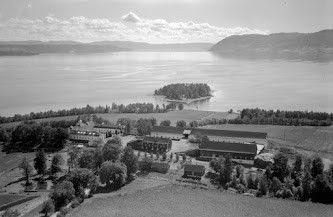
Hovinsholm, Helgøya, Lake Mjosa, Norway
Helgøya means holy island, in Norwegian. There is a lovely double meaning here and such layered history. The manor, in its various iterations, has been on this site since the 1500s. They had their own Christian manor church until 1612.

On the southern tip of the island, there is an old pagan temple to the Norse Gods, Thor, Frigg, Loki, Hod, Heimdall, Tyr, and Baldur.

Here, farmers of the area would gather at four blót sacrifices a year that followed the seasons — one for each of the winter solstice, spring equinox, summer solstice and autumn equinox. Animals would be sacrificed, their blood splattered on altars, walls and folk around them. Toasts were made. The first was in honour of Thor or Odin, “to the king and victory.” 

Odin, although nominally chief of the gods, was more the god of aristocrats. If a king were toasting, particularly a Danish King, it would be for Odin. If you look at place names in Scandinavia, you'll see him conspicuously absent in favour of Thor, the god of the common man.

When the farmers at Helgøya were shouting Skål, it was likely for Thor. The toasting and drinking continued with cups emptied for Njörd and Freyr and Freyja in the hope of securing a prosperous future. 

Finally, personal pledges (and beer-soaked boasts) would be made to undertake great exploits, Valknut — to die well in battle — and finally to kinsmen laid to rest now drinking with the gods in Valhalla. Weapons, jewellery and tools were thrown into the lake as offerings.

If they were gathering for Jol (Old Norse), Jul (Norwegian) or the Yule blót, they'd also make a large sun wheel (picture a circle with a cross in the middle), carve it up with runes, set it on fire and roll it down a hill. 

It was quite a celebration with the festivities going on for three days and nights. With the formalities over, people did as people do  — drink, sing, boast, play games and find someone to bed down with — Gods be good.

Thor and Odin are still going strong nearly 1,000 years after the end of the Viking Age. You'd think that the old Nordic religion — the belief in the Norse gods — disappeared with the introduction of Christianity. That is not the case. There are still folk in Denmark (Odin-lovers) and Norway (Thor's their guy) who follow the old Norse religion and worship its ancient gods — right down to the splatter.

If you visit Norway at Christmas, Jul (Yule), you'll find much more of the pagan than the Christian in the festivities. King Haakon, old Haakon the Good, Hákon Góði or Håkon den Gode,  moved the Winter Solstice or Yule, Jul, Jol blót over to match up with the Christian holiday on December 25th in his attempts to introduce Christianity in the 10th century. Both traditions are still celebrated but without an overtly religious tone.

Old traditions run deep, animals are still sacrificed (but without all the splatter), bread is baked, houses cleaned, beer is abundant and fires warmth the hearth.

After all the drinking, toasting and feasting at the Jul blót, leftover food was not cleaned up but left overnight for the little relatives. Though shy, Nisse like a good feast and failing to offer them their tithe brings ill-fortune.

But we started this journey together admiring a lovely (and oddly festive) Ordovician cephalopod. Go on, picture him in red and white with a little beard. If you fancy a visit to the Ordovician outcrops, you can find them at Nes-Hamar, Norway. 60.0° N, 11.2° E: paleo-coordinates 33.7° S, 10.3° W. Look for gastropods (five known species) and cephalopods (at least 15 species).

If you'd like to visit the burial mound of Haakon the Good, you'll want to head to Seim, Hordaland, about 10 km north of Knarvik. Good 'ol Haakon may have tried to bring Christianity to Norway but he died full Viking — taking an arrow at the Battle of Fitjar. Many of my rellies live in Knarvik. 

We have enjoyed many a sunny afternoon feasting at the Håkonarspelet summer festivals and exploring Haakon's burial mound at Håkonhaugen in Seim.

If you're more of the manor type, you can stop by Hovinsholm gård, Helgøyvegen 850, 2350 Nes på Hedmarken, Norway. 

If you're curious and want to see the farmstead, head on over to: https://www.skafferiet.no/about. 

If you need to square things up with Odin, you're on your own.

E. L. Yochelson. 1963. The Middle Ordovician of the Oslo Region, Norway. 15. Monoplacophora and Gastropoda. Norsk Geologisk Tidsskrift 43 (2):133-213.

Monday, 18 December 2023

TETRAPODS & FIRST NATION FOSSILS

Elpistostege watsoni

In the late 1930s, our understanding of the transition of fish to tetrapods — and the eventual jump to modern vertebrates — took an unexpected leap forward. The evolutionary a'ha came from a single partial fossil skull found on the shores of a riverbank in Eastern Canada. 

Meet the Stegocephalian, Elpistostege watsoni, an extinct genus of finned tetrapodomorphs that lived during the Late Givetian to Early Frasnian of the Late Devonian — 382 million years ago. 

Elpistostege watsoni — perhaps the sister taxon of all other tetrapods — was first described in 1938 by British palaeontologist and elected Fellow of the Royal Society of London, Thomas Stanley Westoll. Westoll's research interests were wide-ranging. He was a vertebrate palaeontologist and geologist best known for his innovative work on Palaeozoic fishes and their relationships with tetrapods. 

As a specialist in early fish, Westoll was asked to interpret that single partial skull roof discovered at the Escuminac Formation in Quebec, Canada. His findings and subsequent publication named Elpistostege watsoni and helped us to better understand the evolution of fishes to tetrapods — four-limbed vertebrates — one of the most important transformations in vertebrate evolution. 

Hypotheses of tetrapod origins rely heavily on the anatomy of but a few tetrapod-like fish fossils from the Middle and Late Devonian, 393–359 million years ago. These taxa — known as elpistostegalians — include Panderichthys, Elpistostege and Tiktaalik — none of which had yet to reveal the complete skeletal anatomy of the pectoral fin. 

Elpistostege watsoni
None until 2010 that is, when a complete 1.57-metre-long articulated specimen was found and described by Richard Cloutier et al. in 2020. 

The specimen helped us to understand the origin of the vertebrate hand. Stripped from its encasing stone, it revealed a set of paired fins of Elpistostege containing bones homologous to the phalanges (finger bones) of modern tetrapods and is the most basal tetrapodomorph known to possess them. 

Once the phalanges were uncovered, prep work began on the fins. The fins were covered in wee scales and lepidotrichia (fin rays). The work was tiresome, taking more than 2,700 hours of preparation but the results were thrilling. 

Origin of the Vertebrate Hand
We could now clearly see that the skeleton of the pectoral fin has four proximodistal rows of radials — two of which include branched carpals — as well as two distal rows organized as digits and putative digits. 

Despite this skeletal pattern — which represents the most tetrapod-like arrangement of bones found in a pectoral fin to date blurring the line between fish and land vertebrates — the fin retained lepidotrichia (those wee fin rays) distal to the radials. 

This arrangement confirmed an age-old question — showing us for the first time that the origin of phalanges preceded the loss of fin rays, not the other way around.

E. watsoni is very closely related to Tiktaalik roseae found in 2004 in the Canadian Arctic — a tetrapodomorpha species also known as a Choanata. These were advanced forms transitional between fish and the early labyrinthodonts playfully referred to as fishapods — half-fish, half-tetrapod in appearance and limb morphology. 

Up to that point, the relationship of limbed vertebrates (tetrapods) to lobe-finned fish (sarcopterygians) was well known, but the origin of major tetrapod features remained obscure for lack of fossils that document the sequence of evolutionary changes — until Tiktaalik. While Tiktaalik is technically a fish, this fellow is as far from fish-like you can be and still be a card-carrying member of the group. 

Tiktaalik roseae
Complete with scales and gills, this proto-fish lacked the conical head we see in modern fish but had a rather flattened triangular head more like that of a crocodile. 

Tiktaalik had scales on its back and fins with fin webbing but like early land-living animals, it had a distinctive flat head and neck. He was a brawny brute. The shape of his skull and shoulder look part fish and part amphibian.

The watershed moment came as Tiktaalik was prepped. Inside Tiktaalik's fins, we find bones that correspond to the upper arm, forearm and even parts of the wrist — all inside a fin with webbing — remarkable! 

Its fins have thin ray bones for paddling like most fish, but with brawny interior bones that gave Tiktaalik the ability to prop itself up, using his limbs for support. I picture him propped up on one paddle saying, "how you doing?" 

Six years after Tiktaalik was discovered by Neil Shubin and team in the ice-covered tundra of the Canadian Arctic on southern Ellesmere Island, a team working the outcrops at Miguasha on the Gaspé Peninsula discovered the only fully specimen of E. watsoni found to date — greatly increasing our knowledge of this finned tantalizingly transitional tetrapodomorph. 

E. watsoni fossils are rare — this was the fourth specimen collected in over 130 years of hunting. Charmingly, the specimen was right on our doorstop — extracted but a few feet away from the main stairs descending onto the beach of Miguasha National Park. 

L'nu Mi’gmaq First Nations of the Gespe’gewa’gi Region

Miguasha is nestled in the Gaspésie or Gespe’gewa’gi region of Canada — home to the Mi’gmaq First Nations who self-refer as L’nu or Lnu. The word Mi’gmaq or Mi’kmaq means the family or my allies/friends in Mi'kmaw, their native tongue (and soon to be Nova Scotia's provincial first language). They are the people of the sea and the original inhabitants of Atlantic Canada having lived here for more than 10,000 years. 

The L'nu were the first First Nation people to establish contact and trade with European explorers in the 16th and 17th centuries — and perhaps the Norse as early as the turn of the Millenium. Sailing vessels filled with French, British, Scottish, Irish and others arrived one by one to lay claim to the region — settling and fighting over the land. As each group rolled out their machinations of discovery, tensions turned to an all-out war with the British and French going head to head. I'll spare you the sordid details but for everyone caught in the crossfire, it went poorly.

North America Map 1775 (Click to Enlarge)
Cut to 1760, the British tipped the balance with their win at the Battle of the Restigouche, the last naval battle between France and England for possession of the North American continent — Turtle Island. 

The bittersweet British victory sparked the American War of Independence. 

For the next twenty years, the L'nu would witness and become embroiled in yet another war for these lands, their lands — first as bystanders, then as American allies, then intimidated into submission by the British Royal Navy with a show of force by way of a thirty-four gun man-of-war, encouraging L'nu compliance — finally culminating in an end to the hostilities with the 1783 Treaty of Paris. 

The peace accord held no provisions for the L'nu, Métis and First Nations impacted. None of these newcomers was Mi'kmaq — neither friends nor allies.

It was to this area some sixty years later that the newly formed Geological Survey of Canada (GSC) began exploring and mapping the newly formed United Province of Canada. Geologists in the New Brunswick Geology Branch traipsed through the rugged countryside that would become a Canadian province in 1867. 

It was on one of these expeditions that the Miguasha fossil outcrops were discovered. They, too, would transform in time to become Miguasha National Park or Parc de Miguasha, but at first, they were simply the promising sedimentary exposures on the hillside across the water —  a treasure trove of  Late Devonian fauna waiting to be discovered.

In the summer of 1842, Abraham Gesner, New Brunswick’s first Provincial Geologist, crossed the northern part of the region exploring for coal. Well, mostly looking for coal. Gesner also had a keen eye for fossils and his trip to the Gaspé Peninsula came fast on the heels of a jaunt along the rocky beaches of Chignecto Bay at the head of the Bay of Fundy and home to the standing fossil trees of the Joggins Fossil Cliffs. 

Passionate about geology and chemistry, he is perhaps most famous for his invention of the process to distil the combustible hydrocarbon kerosene from coal oil — a subject on which his long walks exploring a budding Canada gave him a great deal of time to consider. We have Gesner to thank for the modern petroleum industry. He filed many patents for clever ways to distil the soft tar-like coal or bitumen still in use today.

He was skilled in a broad range of scientific disciplines — being a geologist, palaeontologist, physician, chemist, anatomist and naturalist — a brass tacks geek to his core. Gesner explored the coal exposures and fossil outcrops across the famed area that witnessed the region become part of England and not France — and no longer L'nu.

Following the Restigouche River in New Brunswick through the Dalhousie region, Gesner navigated through the estuary to reach the southern coast of the Gaspé Peninsula into what would become the southeastern coast of Quebec to get a better look at the cliffs across the water. He was the first geologist to lay eyes on the Escuminac Formation and its fossils.

In his 1843 report to the Geologic Survey, he wrote, “...I found the shore lined with a coarse conglomerate. Farther eastward the rocks are light blue sandstones and shales, containing the remains of vegetables. (...) In these sandstone and shales, I found the remains of fish and a small species of tortoise with fossil foot-marks.”

We now know that this little tortoise was the famous Bothriolepis, an antiarch placoderm fish. It was also the first formal mention of the Miguasha fauna in our scientific literature. Despite the circulation of his report, Gesner’s discovery was all but ignored — the cliffs and their fossil bounty abandoned for decades to come. Geologists like Ells, Foord and Weston, and the research of Whiteaves and Dawson, would eventually follow in Gesner's footsteps.

North America Map 1866 (Click to Enlarge)
Over the past 180 years, this Devonian site has yielded a wonderfully diverse aquatic assemblage from the Age of Fishes — five of the six fossil fish groups associated with the Devonian including exceptionally well-preserved fossil specimens of the lobe-finned fishes. 

This is exciting as it is the lobe-finned fishes — the sarcopterygians — that gave rise to the first four-legged, air-breathing terrestrial vertebrates – the tetrapods. 

Fossil specimens from Miguasha include twenty species of lower vertebrates — anaspids, osteostra-cans, placoderms, acanthodians, actinopterygians and sarcopterygians — plus a limited invertebrate assemblage, along with terrestrial plants, scorpions and millipedes.

Originally interpreted as a freshwater lacustrine environment, recent paleontological, taphonomic, sedimentological and geochemical evidence corroborates a brackish estuarine setting — and definitely not the deep waters of the sea. This is important because the species that gave rise to our land-living animals began life in shallow streams and lakes. It tells us a bit about how our dear Elpistostege watsoni liked to live — preferring to lollygag in cool river waters where seawater mixed with fresh. Not fully freshwater, but a wee bit of salinity to add flavour.  

  • Photos: Elpistostege watsoni (Westoll, 1938 ), Upper Devonian (Frasnian), Escuminac formation, Parc de Miguasha, Baie des Chaleurs, Gaspé, Québec, Canada. John Fam, VanPS
  • Origin of the Vertebrate Hand Illustration, https://www.nature.com/articles/s41586-020-2100-8
  • Tiktaalik Illustration: By Obsidian Soul - Own work, CC BY 4.0, https://commons.wikimedia.org/w/index.php?curid=47401797

References & further reading:

  • From Water to Land: https://www.miguasha.ca/mig-en/the_first_discoveries.php
  • UNESCO Miguasha National Park: https://whc.unesco.org/en/list/686/
  • Office of L'nu Affairs: https://novascotia.ca/abor/aboriginal-people/
  • Cloutier, R., Clement, A.M., Lee, M.S.Y. et al. Elpistostege and the origin of the vertebrate hand. Nature 579, 549–554 (2020). https://doi.org/10.1038/s41586-020-2100-8
  • Daeschler, E. B., Shubin, N. H. & Jenkins, F. A. Jr. A Devonian tetrapod-like fish and the evolution of the tetrapod body plan. Nature 440, 757–763 (2006).
  • Shubin, Neil. Your Inner Fish: A Journey into the 3.5 Billion History of the Human Body.
  • Evidence for European presence in the Americas in AD 1021: https://www.nature.com/articles/s41586-021-03972-8

Sunday, 8 October 2023

FOSSILS OF TURTLE ISLAND'S EAST KOOTENAY REGION

Tanglefoot Mountain. Photo: Dan Bowden
The East Kootenay region on the south-eastern edge of British Columbia is a land of colossal mountains against a clear blue sky. 

That is not strictly true, of course, as this area does see its fair share of rain and temperature extremes — but visiting in the summer every view is a postcard of mountainous terrain.

Rocks from deep within the Earth's crust underlie the entire East Kootenay region and are commonly exposed in the area's majestic mountain peaks, craggy rocky cliffs, glaciated river canyons, and rock cuts along the highways. Younger Ice Age sediments blanket much of the underlying rock.

I have been heading to the Cranbrook and Fernie area since the early 1990s. My interest is the local geology and fossil history that these rocks have to tell. I am also drawn to the warm and welcoming locals who share a love for the land and palaeontological treasures that open a window to our ancient past.  

Cranbrook is the largest community in the region and is steeped in mining history and the opening of the west by the railway. It is also a stone's throw away from Fort Steele and the Lower Cambrian exposures of the Eager Formation. These fossil beds rival the slightly younger Burgess Shale fauna and while less varied, produce wonderful examples of olenellid trilobites and weird and wonderful arthropods nearly half a billion years old. 

Labiostria westriopi, McKay Group
The Lower Cambrian Eager Formation outcrops at a few localities close to Fort Steele, many known since the early 1920s, and up near Mount Grainger near the highway. 

Further east, the Upper Cambrian McKay Group near Tanglefoot Mountain is a palaeontological delight with fifteen known outcrops that have produced some of the best-preserved and varied trilobites in the province — many of them new species. 

The McKay Formation also includes Ordovician outcrops sprinkled in for good measure.

Other cities in the area and the routes to and from them produce other fossil fauna from Kimberley to Fernie and the district municipality of Invermere and Sparwood. This is an arid country with native grasslands and forests of semi-open fir and pine. Throughout there are a host of fossiliferous exposures from Lower Cretaceous plants to brachiopods. 

The area around Whiteswan Lake has wonderful large and showy Ordovician graptolites including Cardiograptus morsus and Pseudoclimacograptus angustifolius elongates — some of our oldest relatives. A drive down to Flathead will bring you to ammonite outcrops and you can even find Eocene fresh-water snails in the region. 

The drive from Cranbrook to Fernie is about an hour and change through the Cambrian into the Devonian which flip-flops and folds over revealing Jurassic exposures. On my last visit, I made the trip with local geologist Guy Santucci who swings around the hairpin bends with panache. He is a delight to travel with and interspersed great conversation with tasty bits of information on the local geology.

Fernie Ichthyosaur Excavation, 1916
The Crowsnest Highway into Fernie follows Mutz Creek. From the highway, you can see the Fernie Group and the site along the Elk River where an ichthyosaur was excavated in 1916. 

The Fernie Formation is Jurassic. It is present in the western part of the Western Canada Sedimentary Basin in western Alberta and northeastern British Columbia. 

It takes its name from the town of Fernie, British Columbia, and was first defined by W.W. Leach in 1914. The town of Fernie is rimmed by rugged mountains tipped with Devonian marine outcrops. In essence, all these mountains are upside down with the oldest layers flipped to the top and a good 180 million years older than those they sit upon. 

Before they were mountains, these sedimentary rocks were formed as sediment collected in a shallow sea or inland basin. About 360 million years ago, the rocks that you see in Fernie today were down near the equator. They road tectonic plates, pushing northeast smashing into the coastline of what would become British Columbia. A little push here, shove there — compression and thrust faulting — and the rock was rolled over on its head — repeatedly. But that is how mountains are often formed, though not usually pushed so hard that they flip over. But still, it is a slow, relentless business. 

Cretaceous Plant Material, Fernie, BC
Within Fernie, there are small exposures of Triassic and Jurassic marine outcrops. East of the town there are Cretaceous plant sites, and of course, the Jurassic 1.4-metre Titanites occidentalis ammonite up on Coal Mountain.

Once up at the fossil exposures we begin to look for treasures. Over the next four or five hours, as the heat of the day sets in, we find block after block of dark brown to beige Cretaceous material embedded with coal seams and lithified fossil remains.

The regional district's dominant landform is the Rocky Mountain Trench, which is flanked by the Purcell Mountains and the Rocky Mountains on the east and west, and includes the Columbia Valley region. The southern half of which is in the regional district — its northern half is in the Columbia-Shuswap Regional District. 

The regional district of Elk Valley in the southern Rockies is the entryway to the Crowsnest Pass and an important coal-mining area. 

Other than the Columbia and Kootenay Rivers, whose valleys shape the bottomlands of the Rocky Mountain Trench, the regional districts form the northernmost parts of the basins of the Flathead, Moyie and Yahk Rivers. 

The Moyie and Yahk are tributaries of the Kootenay, entering it in the United States, and the Flathead is a tributary of the Clark Fork into Montana.

Photo One: Tyaughton Mountain, Mckay Group taken by Dan Bowden via drone; Photo Two: Labiostria westriopi, Upper Cambrian McKay Group, Site ML (1998); John Fam Collection; Photo Three: Ichthyosaur Excavation, Fernie, British Columbia, 1916; Photo Four: Cretaceous Plant Fossils, east of Fernie towards Coal Mountain. The deeply awesome Guy Santucci as hand-model for scale. 

Sunday, 20 August 2023

LOWER LIAS LYTOCERAS

A superbly prepped and extremely rare Lytoceras (Suess, 1865) ammonite found as a green ammonite nodule by Matt Cape in the Lower Lias of Dorset. 

Lytoceras are rare in the Lower Lias of Dorset — apart from the Belemnite Stone horizon — so much so that Paul Davis, whose skilled prep work you see here, initially thought it might be a Becheiceras hidden within the large, lumpy nodule. 

One of the reasons these lovelies are rarely found from here is that they are a Mediterranean Tethyian genus. The fossil fauna we find in the United Kingdom are dominated by Boreal Tethyian genera. 

We do find Lytoceras sp. in the Luridum subzone of the Pliensbachian showing that there was an influx of species from the Mediterranean realm during this time. This is the first occurrence of a Lytoceras that he has ever seen in a green nodule and Paul's seen quite a few. 

This absolutely cracking specimen was found and is in the collections of the awesome Matt Cape. Matt recognized that whatever was hidden in the nodule would take skilled and careful preparation using air scribes. Indeed it did. It took more than five hours of time and skill to unveil the lovely museum-worthy specimen you see here. 

We find Lytoceras in more than 1,000 outcrops around the globe ranging from the Jurassic through to the Cretaceous, some 189.6 to 109.00 million years ago. Once this specimen is fully prepped with the nodule material cut or scraped away, you can see the detailed crinkly growth lines or riblets on the shell and none of the expected coarse ribbing. 

Lytoceras sp. Photo: Craig Chivers
If you imagine running your finger along these, you would be tracing the work of decades of growth of these cephalopods. 

While we cannot know their actual lifespans, but we can make a healthy guess. 

The nautilus, their closest living cousins live upwards of 20 years — gods be good — and less than three years if conditions are poor.

The flanges, projecting flat ribs or collars, develop at the edge of the mouth border on the animal's mantle as they grow each new chamber. 

Each delicate flange grows over the course of the ammonites life, marking various points in time and life stages as the ammonite grew. There is a large variation within Lytoceras with regards to flanges. They provide both ornamentation and strength to the shell to protect it from water pressure as they moved into deeper seas.

The concretion prior to prep
This distinctive genus with its evolute shells are found in the Cretaceous marine deposits of: 

Antarctica (5 collections), Austria (19), Colombia (1), the Czech Republic (3), Egypt (2), France (194), Greenland (16), Hungary (25), Italy (11), Madagascar (2), Mexico (1), Morocco (4), Mozambique (1), Poland (2), Portugal (1), Romania (1), the Russian Federation (2), Slovakia (3), South Africa (1), Spain (24), Tanzania (1), Trinidad and Tobago (1), Tunisia (25); and the United States of America (17: Alaska, California, North Carolina, Oregon).

We also find them in Jurassic marine outcrops in:

Austria (15), Canada (9: British Columbia), Chile (6), France (181), Germany (11), Greenland (1), Hungary (189), India (1), Indonesia (1), Iran (1), Italy (50), Japan (14), Kenya (2), Luxembourg (4), Madagascar (2), Mexico (1), Morocco (43), New Zealand (15), Portugal (1), Romania (5), the Russian Federation (1), Slovakia (1), Spain (6), Switzerland (2), Tunisia (11), Turkey (12), Turkmenistan (1), Ukraine (5), the United Kingdom (12), United States (11: Alaska, California) — in at least 977 known collections. 

References:

Sepkoski, Jack (2002). "A compendium of fossil marine animal genera (Cephalopoda entry)". Bulletins of American Paleontology. 363: 1–560. Archived from the original on 2008-05-07. Retrieved 2017-10-18.

Paleobiology Database - Lytoceras. 2017-10-19.

Systematic descriptions, Mesozoic Ammonoidea, by W.J Arkell, Bernhard Kummel, and C.W. Wright. 1957. Treatise on Invertebrate Paleontology, Part L. Geological Society of America and University of Kansas press.

Saturday, 1 July 2023

FOSSIL FELINES: MISTER MOZART

Mister Mozart
Cats—those purring enigmas who act like they invented gravity and disdain—have been perfecting their aloof charm for tens of millions of years. 

Long before domestic life on the couch, they prowled prehistoric forests and savannas, already masters of stealth.

The feline family tree begins about 25 million years ago with the Proailurus, whose name literally means “first cat.” 

This Miocene-era predator lived in Europe and Asia and probably looked like your housecat—if your housecat could take down small deer. 

Proailurus gave rise to the Pseudaelurus, the cat that would eventually split into two great evolutionary lineages: the big cats (Pantherinae, including lions, tigers, and leopards) and the small cats (Felinae, which include your couch companion, Felis catus), and snuggle bunnies like Mister Mozart you see here.

By the Pleistocene, cats had diversified spectacularly—from the legendary Smilodon, the sabre-toothed showstopper of Ice Age fame, to the lithe wildcats that would one day move into our granaries, charm our ancestors, and domesticate us. 

Yes, evidence suggests that around 10,000 years ago, humans didn’t so much tame cats as cats decided that humans were helpful enough to tolerate. A trend that continues to this day. 

Their fossils—sleek jaws, retractable claws, and the occasional pawprint—tell a story of evolutionary precision. Cats didn’t just evolve; they optimised. Every leap, pounce, and inscrutable stare has been honed by millions of years of predatory perfection.

So when your cat knocks your favourite mug off the counter and looks smug about it, remember: you’re gazing into the eyes of a finely tuned Miocene hunter. Evolution, it seems, has a sense of humour—and a soft spot for whiskers.

Kane & Mozart divving up the best bed spots
Despite centuries of cartoon propaganda suggesting otherwise, cats and dogs can form some of the most endearing interspecies friendships in the animal kingdom. 

While their social codes differ—dogs being pack-oriented and demonstrative, cats favouring solitary stealth and subtlety—mutual respect (and occasionally a shared sunny spot or prime position on your bed) often bridges the divide. 

Studies in animal behaviour show that early socialisation, body language recognition, and individual temperament play key roles in fostering harmony between felines and canines. 

A confident cat and a calm, well-socialised dog are a recipe for peaceful coexistence—and sometimes, genuine affection. Watching a cat gently groom a dog’s ears or a Ridgeback stoically endure a kitten’s playful ambush brings a smile to us all. Evolution may have set them on different paths, but friendship, it seems, is a universal instinct.

Friday, 23 June 2023

VANCOUVER ISLAND'S HIDDEN GEMS: TRENT RIVER

Dan Bowen, Chair, VIPS, Trent River
The rocks that make up the Trent River on Vancouver Island were laid down south of the equator as small, tropical islands. They rode across the Pacific heading north and slightly east over the past 85 million years to where we find them today.

The Pacific Plate is an oceanic tectonic plate that lies beneath the Pacific Ocean. And it is massive. At 103 million km2 (40 million sq mi), it is the largest tectonic plate and continues to grow fed by volcanic eruptions that piggyback onto its trailing edge.

This relentless expansion pushes the Pacific Plate into the North American Plate. The pressure subducts it beneath our continent where it then melts back into the earth. Plate tectonics are slow but powerful forces. 

The island chains that rode the plates across the Pacific smashed into our coastline and slowly built the province of British Columbia. And because each of those islands had a different origin, they create pockets of interesting and diverse geology.

It is these islands that make up the Insular Belt — a physio-geological region on the northwestern North American coast. It consists of three major island groups — and many smaller islands — that stretches from southern British Columbia up into Alaska and the Yukon. These bits of islands on the move arrived from the Late Cretaceous through the Eocene — and continues to this day.

The rocks that form the Insular Superterrane are allochthonous, meaning they are not related to the rest of the North American continent. The rocks we walk over along the Trent River are distinct from those we find throughout the rest of Vancouver Island, Haida Gwaii, the rest of the province of British Columbia and completely foreign to those we find next door in Alberta.

To discover what we do find on the Trent takes only a wee stroll, a bit of digging and time to put all the pieces of the puzzle together. The first geological forays to Vancouver Island were to look for coal deposits, the profitable remains of ancient forests that could be burned to the power industry.

Jim Monger and Charlie Ross of the Geological Survey of Canada both worked to further our knowledge of the complex geology of the Comox Basin. 

They were at the cutting edge of west coast geology in the 1970s. It was their work that helped tease out how and where the rocks we see along the Trent today were formed and made their way north.

We know from their work that by 85 million years ago, the Insular Superterrane had made its way to what is now British Columbia. 

The lands were forested much as they are now but by extinct genera and families. The fossil remains of trees similar to oak, poplar, maple and ash can be found along the Trent and Vancouver Island. We also see the lovely remains of flowering plants such as Cupanities crenularis, figs and breadfruit.

Heading up the river, you come to a delineation zone that clearly marks the contact between the dark grey marine shales and mudstones of the Haslam Formation where they meet the sandstones of the Comox Formation. Fossilized material is less abundant in the Comox sandstones but still contains some interesting specimens. Here you begin to see fossilized wood and identifiable fossil plant material.

Further upstream, there is a small tributary, Idle Creek, where you can find more of this terrestrial material in the sandy shales. As you walk up, you see identifiable fossil plants beneath your feet and jungle-like, overgrown moss-covered, snarly trees all around you.

Walking west from the Trent River Falls at the bottom, you pass the infamous Ammonite Alley, where you can find Mesopuzosia sp. and Kitchinites sp. of the Upper Cretaceous (Santonian), Haslam Formation. Minding the slippery green algae covering some of the river rocks, you can see the first of the Polytychoceras vancouverense zone.

Continuing west, you reach the first of two fossil turtle sites on the river — amazingly, one terrestrial and one marine. If you continue, you come to the Inland Island Highway.

The Trent River has yielded some very interesting marine specimens, and significant terrestrial finds. We have found a wonderful terrestrial helochelydrid turtle, Naomichelys speciosa, and the caudal vertebrae of a Hadrosauroid dinosaur. Walking down from the Hadrosaur site you come to the site of the fossil ratfish find — one of the ocean's oddest fish.

Ratfish, Hydrolagus Collie, are chimaera found in the north-eastern Pacific Ocean today. The fossil specimen from the Trent would be considered large by modern standards as it is a bruiser in comparison to his modern counterparts. 

This robust fellow had exceptionally large eyes and sex organs that dangled enticingly between them. You mock, but there are many ratfish who would differ. While inherently sexy by ratfish standards, this fellow was not particularly tasty to their ancient marine brethren (or humans today) — so not hugely sought after as a food source or prey.

A little further again from the ratfish site we reach the contact of the two Formations. The rocks here have travelled a long way to their current location. With them, we peel away the layers of the geologic history of both the Comox Valley and the province of British Columbia.

The Trent River is not far from the Puntledge, a river whose banks have also revealed many wonderful fossil specimens. The Puntledge is also the name used by the K'ómoks First Nation to describe themselves. They have lived here since time immemorial. Along with Puntledge, they refer to themselves as Sahtloot, Sasitla and Ieeksun.

References: Note on the occurrence of the marine turtle Desmatochelys (Reptilia: Chelonioidea) from the Upper Cretaceous of Vancouver Island Elizabeth L. Nicholls Canadian Journal of Earth Sciences (1992) 29 (2): 377–380. https://doi.org/10.1139/e92-033; References: Chimaeras - The Neglected Chondrichthyans". Elasmo-research.org. Retrieved 2017-07-01.

Directions: If you're keen to explore the area, park on the side of Highway 19 about three kilometres south of Courtenay and hike up to the Trent River. Begin to look for parking about three kilometres south of the Cumberland Interchange. There is a trail that leads from the highway down beneath the bridge which will bring you to the Trent River's north side.