![]() |
| Ophthalmoplax brasiliana / Photo: José F. Ventura |
This marine species was originally thought to have been found only in the upper Member (Owl Creek Formation) Late/Upper Maastrichtian deposits of Tippah County in Mississippi, USA.
![]() |
| Ophthalmoplax brasiliana / Photo: José F. Ventura |
![]() |
| Hoplites maritimus / Hoplites rudis |
![]() |
| Hoplites sp. from the Early Cretaceous of Dorset, UK |
![]() |
| Hoplites dentalus, from Albian deposits near Troyes, France |
Porpoceras (Buchman, 1911) is a genus of ammonite that lived during the early and middle Toarcian stage of the Early Jurassic. We see members of this genus from the uppermost part of Serpentinum Zone to Variabilis Subzone. These beauties are found in Europe, Asia, North America and South America.
Ammonites belonging to this genus have evolute shells, with compressed to depressed whorl section. Flanks were slightly convex and venter has been low. The whorl section is sub-rectangular.
The rib is pronounced and somewhat fibulate on the inner whorls — just wee nodes here — and tuberculate to spined on the ventrolateral shoulder. It differs from Peronoceras by not having a compressed whorl section and regular nodes or fibulation. Catacoeloceras is also similar, but it has regular ventrolateral tubercules and is missing the classic nodes or fibulation of his cousins.
This specimen hails from southern France near the Rhône, one of the major rivers of Europe. It has twice the average water level of the Loire and is fed by the Rhône Glacier in the Swiss Alps at the far eastern end of the Swiss canton of Valais then passes through Lake Geneva before running through southeastern France. This 10 cm specimen was prepared by the supremely talented José Juárez Ruiz
Rene was a mountain goat in the field, stalking the hills in his signature red t-shirt. He was tremendously knowledgeable about the natural world and delighted in it. For many years, he was Chair of the White Rock and Surrey Naturalists, while I was Chair of the Vancouver Paleontological Society. Together, we would plan and often co-lead field trips to many of the wonderful fossil outcrops in British Columbia and Washington state.
In 2002, we were planning a very exciting round of field trips. I was offered a fully paid trip to India with Karen Lund to hike to the headwaters of the Ganges, a trip which I was to forgo in favour of a hike up to the outcrops of the Cathedral Escarpment and Burgess Shale and then to yummy Lower Jurassic and Lower Cretaceous, Albian, outcrops accessed only by boat in Haida Gwaii.
Rene and I had talked about "walking in the shoes" of Joseph Whiteaves, the GSC's chief palaeontologist in Ottawa. He published a paper in 1876 describing the Jurassic and Cretaceous faunas of Skidegate Inlet and spent a significant portion of his career working out the fossil fauna of the Burgess Shale. Combining these two sites within the same field season was a fitting homage.
John Fam, Vancouver Paleontological Society (VanPS) and Dan Bowen, Vancouver Island Palaeontological Society (VIPS), did much of the planning for that Haida Gwaii trip, they too being inspired by Whiteaves papers and the work of James Richardson and George Dawson — as a whole, we were giddy with the prospect of the year ahead.
Rene and I had planned to do both, but in the end, I had to give up the hike to Burgess that year and Rene never made it back to join me in Haida Gwaii.
| Rene Savenye |
I take heart that he lived and died doing what he loved most. I got the news a few days later and cried for the loss of a great friend. I am sharing my memory of him with you so that you can remember him, too, and share in the delight and loss of one of the loveliest men to ever walk our planet. His years of teaching, mentoring, encouragement and generosity have helped shape natural science and those who have gone on to make it their passion or career — or happily, both.
Rene's name will not be forgotten to science. His namesake, H. Savenyei, is a lovely fossil halictine bee from Early Eocene deposits near Quilchena, British Columbia — and the first bee body-fossil known from the Okanagan Highlands — and indeed from Canada.
As a school teacher, Rene once taught the, then student, now SFU biology instructor, Rolf Mathewes. Rene passed his scientifically valuable specimen to Mathews, knowing it was important to science. Mathewes brought it to the attention of Bruce Archibald and Michael Engel, who described Rene's bee in the Canadian Journal of Zoology. Their work is a lovely legacy to a wonderful man and a specimen from one of his favourite collecting sites — Quilchena — a small road-cut exposure of the Coldwater beds of the Princeton Group, one of several depositional basins in the Merritt region of south-central British Columbia.
Rene is also remembered in spirit by the British Columbia Paleontological Alliance (BCPA) Rene Savenye Award. It was established in 2003 to honour those who have demonstrated outstanding service to the science of palaeontology or to palaeontological education in British Columbia.
Notable past recipients are a veritable who's who from the Pacific Northwest — Graham Beard of Qualicum in 2005, Charles Helm of Tumbler Ridge in 2011, Pat Trask of Courtenay in 2014, Rod Bartlett in 2016, and Joseph "Joe" Haegert in 2018. I'll share a link to the award below so you can read more at your leisure about Rene and those who bear the award with his name.
About H. Savenyei, (Engel & Archibald, 2003): The type specimen is a fairly well preserved complete adult female preserved with portions of the fore-wings and hind-wings. The specimen is 7.04 millimetres (0.277 in) long with the possibility of alteration in length during fossilization. The sections of the forewing which are preserved are approximately 4.8 millimetres (0.19 in) long and show dark brown to black colouration. The presence of a pygidial plate bordered by setae on the fifth metasomal tergum supports the placement into the Halictidae subfamily Halictinae. Placement into the tribe Halictini is based on the lack of a medial cleft in the fifth tergum.
References:
Archibald, B. & R. W. Mathewes. 2000. “Early Eocene Insects from Quilchena, BC, and their Paleoclimatic Implications.” Canadian Journal of Zoology, Volume 78, Number 6: pp 1441-1462.
Grimaldi, D. 1999. “The Co-radiations of Pollinating Insects and Angiosperms in the Cretaceous.” Annals of the Missouri Botanical Garden. 86: 373-406.
Photo: Halictidae sp.; Archibald and Mathewes 2000: 1453.
Rene Savenye Award: https://bcfossils.ca/rene-savenye-award
![]() |
| Aioloceras besairiei (Collingnon, 1949) |
![]() |
| Red-Tailed Lemurs, Waiwai & Hedgehog |
Much like (slow) Water Striders (Aquarius remigis), (relatively sluggish) Coelacanth (Latimeria chalumnae) and (the current winner on really slow evolution) Elephant Sharks (Callorhinchus milii), these fellows have a long history in the fossil record with very few anatomical changes.
But slow change provides loads of great information. It makes our new friend, Yunnanolimulus luoingensis, an especially interesting and excellent reference point for how this group evolved.
We can examine their genome today and make comparisons all the way back to the Middle Triassic (with this new find) and other specimens from further back in the Ordovician — 445 million years ago.
These living fossils have survived all five mass extinction events. They are generalists who can live in shallow or deep water and will eat pretty much anything they can find on the seafloor.
The oldest horseshoe crab fossil, Lunataspis aurora, is found in outcrops in Manitoba, Canada. Charmingly, the name means crescent moon shield of the dawn. It was palaeontologist Dave Rudkin and team who chose that romantic name. Finding them as fossils is quite remarkable as their shells are made of protein which does not mineralized like typical fossils.
Even so, the evolution of their exoskeleton is well-documented by fossils, but appendage and soft-tissue preservation are extremely rare.
A new study analyzes details of the appendage and soft-tissue preservation in Yunnanolimulus luoingensis, a Middle Triassic (ca. 244 million years old) horseshoe crab from Yunnan Province, SW China. The remarkable anatomical preservation includes the chelicerae, five pairs of walking appendages, opisthosomal appendages with book gills, muscles, and fine setae permits comparison with extant horseshoe crabs.
![]() |
The occurrence of Carcinoscorpius-type claspers on the first and second walking legs in male individuals of Y. luoingensis tells us that simple chelate claspers in males are plesiomorphic for horseshoe crabs, and the bulbous claspers in Tachypleus and Limulus are derived.
As an aside, if you hadn't seen an elephant shark before and were shown a photo, you would likely say, "that's no freaking shark." You would be wrong, of course, but it would be a very clever observation.
Callorhinchus milii look nothing like our Great White friends and they are not true sharks at all. Rather, they are ghost sharks that belong to the subclass Holocephali (chimaera), a group lovingly known as ratfish. They diverged from the shark lineage about 400 million years ago.
If you have a moment, do a search for Callorhinchus milii. The odd-looking fellow with the ironic name, kallos, which means beautiful in Greek, sports black blotches on a pale silver elongate body. And their special feature? It is the fishy equivalent of business in the front, party in the back, with a dangling trunk-like projection at the tip of their snout and well-developed rectal glands near the tail.
As another small point of interest with regards to horseshoe crabs, John McAllister collected several of these while working on his MSc to see if they had microstructures similar to trilobites (they do) and whether their cuticles were likewise calcified. He found no real calcification in their cuticles, in fact, he had a rather frustrating time getting anything measurable to dissolve in acid in his hunt for trace elements.
Likewise, when looking at oxygen isotopes (16/18) to get a handle on water salinity and temperature, his contacts at the University of Waterloo had tons of fun getting anything at all to analyze. It made for some interesting findings. Sadly, for a number of reasons, he abandoned the work, but you can read his very interesting thesis here: https://dr.library.brocku.ca/handle/10464/1959
Ref: Hu, Shixue & Zhang, Qiyue & Feldmann, Rodney & Benton, Michael & Schweitzer, Carrie & Huang, Jinyuan & Wen, Wen & Zhou, Changyong & Xie, Tao & Lü, Tao & Hong, Shuigen. (2017). Exceptional appendage and soft-tissue preservation in a Middle Triassic horseshoe crab from SW China. Scientific Reports. 7. 10.1038/s41598-017-13319-x.
Euhoplites is an extinct ammonoid cephalopod from the Lower Cretaceous, characterized by strongly ribbed, more or less evolute, compressed to inflated shells with flat or concave ribs, typically with a deep narrow groove running down the middle.
In some, ribs seem to zigzag between umbilical tubercles and parallel ventrolateral clavi. In others, the ribs are flexious and curve forward from the umbilical shoulder and lap onto either side of the venter.
Its shell is covered in the lovely lumps and bumps we associate with the genus. The function of these adornments are unknown. I wonder if they gave them greater strength to go deeper into the ocean to hunt for food.
They look to have been a source of hydrodynamic drag, likely preventing Euhoplites from swimming at speed. Studying them may give some insight into the lifestyle of this ancient marine predator. Euhoplites had shells ranging in size up to a 5-6cm.
We find them in Lower Cretaceous, middle to upper Albian age strata. Euhoplites has been found in Middle and Upper Albian beds in France where it is associated respectively with Hoplites and Anahoplites, and Pleurohoplites, Puzosia, and Desmoceras; in the Middle Albian of Brazil with Anahoplites and Turrilites; and in the Cenomanian of Texas.
This species is the most common ammonite from the Folkstone Fossil Beds in southeastern England where a variety of species are found, including this 37mm beauty from the collections of José Juárez Ruiz.
![]() |
| CDM 002 / Hadrosauroid Caudal Vertebrae |
| Drawing of Trent River Hadrosauroid Caudal Vertebrae |
![]() |
| Aturia angustata, Lower Miocene, WA |
There are seven living nautiloid species in two genera: Nautilus pompilius, N. macromphalus, N. stenomphalus, N. belauensis, and the three new species being described from Samoa, Fiji, and Vanuatu (Ward et al.). We have specimens of fossil nautiloids dating to the Turonian of California, and possibly the Cenomanian of Australia. There has also been a discovery of what might be the only known fossil of Allonautilus (Ward and Saunders, 1997), from the Nanaimo Group of British Columbia, Canada.
![]() |
| Aturia in the Collection of Rick Ross, VIPS |
Aturia lived in cooler water in the Cenozoic, preferring it over the warmer waters chosen by their cousins. Aturia, are commonly found as fossils from Eocene and Miocene outcrops. That record ends with their extinction in the late Miocene. This was a fierce little beast with jaws packed with piranha-like teeth. They grew at least twice that of the largest known Nautilus living today.
Aturia is characterized by a smooth, highly involute, discoidal shell with a complex suture and subdorsal siphuncle. The shell of Aturia is rounded ventrally and flattened laterally; the dorsum is deeply impressed. The suture is one of the most complex within the subclass Nautiloidea. Of all the nautiloids, he may have been able to go deeper than his brethren.
Nautiloids are known for their simple suturing in comparison to their ammonite cousins. This simplicity of design limited their abilities in terms of withstanding the water pressure experienced when several atmospheres below the sea. Nautiloids were not able to compete with their ammonite cousins in this regard.
Instead of elaborate and complex sutures capable of withstanding the pressures of the deep, nautiloids have simpler sutures that would have them enfold on themselves and crush at depth.
![]() |
| Aturia angustata; Rick Ross Collection |
The siphuncle is moderate in size and located subdorsally in the adapical dorsal flexure of the septum. Based on the feeding and hunting behaviours of living nautiluses, Aturia most likely preyed upon small fish and crustaceans.
I've found a few of these specimens along the beaches of Clallam Bay and nearby in a local clay quarry. I've also seen calcified and chalcedony — microcrystalline quartz — agatized beauties of this species collected from river sites within the Olympic Peninsula range. In the bottom photos, you can see Aturia from Washington state and one (on the stand on the left) from Oregon, USA. These beauties are in the collections of the deeply awesome Rick Ross, Vancouver Island Palaeontological Society.
References: Ward, P; Haggart, J; Ross, R; Trask, P; Beard, G; Nautilus and Allonautilus in the Nanaimo Group, and in the modern oceans; 12th British Columbia Paleontological Symposium, 2018, Courtenay, abstracts; 2018 p. 10-11
![]() |
| Time Slows at Berlin-Ichthyosaur State Park |
The area is known worldwide as one of the most important ichthyosaur Fossil-Lagerstätte because of the sheer volume of remarkably well-preserved, fully articulated (all the sweet bones laid out all in a row...) specimens of Shonisaurus popularis.
Rich ammonoid faunas outcrop in the barren hills of the Upper Triassic (Early Norian, Kerri zone), Luning Formation, West Union Canyon, Nevada. They were studied by N. J. Silberling (1959) and provide support for the definition of the Schucherti and Macrolobatus zones of the latest Carnian — which are here overlain by well-preserved faunas of the earliest Norian Kerri Zone.
The genus Gonionotites, very common in the Tethys and British Columbia, is for the moment, unknown in Nevada. The Upper Carnian faunas are dominated by Tropitidae, while Juvavitidae are conspicuously lacking.
![]() |
| Middle Triassic Ammonoids |
October is an ideal time to do fieldwork in this area. There are a few good weeks between screaming hot and frigid cold. It is also tarantula breeding season so keep your eyes peeled. Those sweet little burrows you see are not from rodents but rather largish arachnids.
The eastern side of the canyon provides the best record of the Macrolobatus Zone, which is represented by several beds yielding ammonoids of the Tropites group, together with Anatropites div. sp.Conodont faunas from both these and higher beds are dominated by ornate metapolygnthids that would formerly have been collectively referred to Metapolygnathus primitius, a species long known to straddle the CNB. Within this lower part of the section, they resemble forms that have been separated as Metapolygnathus mersinensis. Slightly higher, forms close to Epigondolella' orchardi and a single Orchardella n. sp. occur. This association can be correlated with the latest Carnian in British Columbia.
Higher in the section, the ammonoid fauna shows a sudden change and is dominated by Tropithisbites. Few tens of metres above, but slightly below the first occurrence of Norian ammonoids Guembelites jandianus and Stikinoceras, two new species of conodonts (Gen et sp. nov. A and B) appear that also occur close to the favoured Carnian/Norian boundary at Black Bear Ridge, British Columbia. Stratigraphically higher collections continue to be dominated by forms close to M. mersinensis and E. orchardi after BC's own Mike Orchard.
The best exposure of the Kerri Zone is on the western side of the West Union Canyon. Ammonoids, dominated by Guembelites and Stikinoceras div. sp., have been collected from several fossil-bearing levels. Conodont faunas replicate those of the east section. The collected ammonoids fit perfectly well with the faunas described by Silberling in 1959, but they differ somewhat from coeval faunas of the Tethys and Canada.
The ammonoid fauna paints a compelling picture of Tethyan influence with a series of smoking guns. We see an abundance of Tropitidae in the Carnian, a lack of Pterosirenites in the Norian, copious Guembelites, the Tethyan species G. philostrati, the stratigraphic position of G. clavatus and the rare occurrence of Gonionotites. Their hallelujah moment was likely finding an undescribed species of the thin-shelled bivalve Halobia similar to Halobia beyrichi — the clincher that perhaps seals this deal on Tethyan influence.
I'll take a boo to see what Christopher McRoberts published on the find. A jolly good idea to have him on this expedition as it would have been easy to overlook if the focus remained solely on the conodonts and ammonoids. McRoberts has published on the much-studied Pardonet Formation up in the Willison Lake Area of Northeastern, British Columbia. He knows a thing or two about Upper Triassic Bivalvia and the correlation to coeval faunas elsewhere in the North American Cordillera, and to the Boreal, Panthalassan and Tethyan faunal realms.
If you fancy a read, they published a paper: "Towards the definition of the Carnian/Norian Boundary: New data on Ammonoids and Conodonts from central Nevada," which you can find in the proceedings of the 21st Canadian Paleontology Conference; by Haggart, J W (ed.); Smith, P L (ed.); Canadian Paleontology Conference Proceedings no. 9, 2011 p. 9-10.
| Fig. 1. Location map of Berlin-Ichthyosaur State Park |
After years of reading about the correlation between British Columbia and Nevada, I had the very great pleasure of walking through these same sections in October 2019 with members of the Vancouver Paleontological Society and Vancouver Island Palaeontological Society. It was with that same crew that I'd originally explored fossil sites in the Canadian Rockies in the early 2000s. Those early trips led to paper after paper and the exciting revelations that inspired our Nevada adventure.
If you plan your own adventure, you'll want to keep an eye out for some of the other modern fauna — mountain lions, snakes, lizards, scorpions, wolves, coyotes, foxes, ground squirrels, rabbits, falcons, hawks, eagles, bobcats, sheep, deer and pronghorns.
Figure One: Location map of Berlin-Ichthyosaur State Park. A detailed road log with access information for this locality is provided in Lucas et al. (2007).
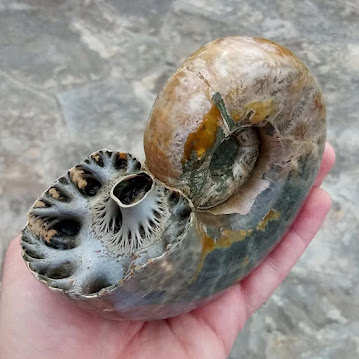
Ammonites were predatory, squidlike creatures that lived inside coil-shaped shells. Like other cephalopods, ammonites had sharp, beak-like jaws inside a ring of squid-like tentacles that extended from their shells. They used these tentacles to snare prey — plankton, vegetation, fish and crustaceans — similar to the way a squid or octopus hunt today.
Catching a fish with your hands is no easy feat, as I'm sure you know. Ammonites did the equivalent, catching prey in their tentacles. They were skilled and successful hunters. They caught their prey while swimming and floating in the water column. Within their shells, they had a number of chambers, called septa, filled with gas or fluid that were interconnected by a wee air tube. By pushing air in or out, they were able to control their buoyancy in the water column.
They lived in the last chamber of their shells, continuously building new shell material as they grew. As each new chamber was added, the squid-like body of the ammonite would move down to occupy the final outside chamber.
They were a group of extinct marine mollusc animals in the subclass Ammonoidea of the class Cephalopoda. These molluscs, commonly referred to as ammonites, are more closely related to living coleoids — octopuses, squid, and cuttlefish) then they are to shelled nautiloids such as the living Nautilus species.
Ammonites have intricate and complex patterns on their shells called sutures. The suture patterns differ across species and tell us what time period the ammonite is from. If they are geometric with numerous undivided lobes and saddles and eight lobes around the conch, we refer to their pattern as goniatitic, a characteristic of Paleozoic ammonites.Ammonites first appeared about 240 million years ago, though they descended from straight-shelled cephalopods called bacrites that date back to the Devonian, about 415 million years ago, and the last species vanished in the Cretaceous–Paleogene extinction event.
They were prolific breeders that evolved rapidly. If you could cast a fishing line into our ancient seas, it is likely that you would hook an ammonite, not a fish. They were prolific back in the day, living (and sometimes dying) in schools in oceans around the globe. We find ammonite fossils (and plenty of them) in sedimentary rock from all over the world.
In some cases, we find rock beds where we can see evidence of a new species that evolved, lived and died out in such a short time span that we can walk through time, following the course of evolution using ammonites as a window into the past.
For this reason, they make excellent index fossils. An index fossil is a species that allows us to link a particular rock formation, layered in time with a particular species or genus found there. Generally, deeper is older, so we use the sedimentary layers rock to match up to specific geologic time periods, rather the way we use tree-rings to date trees. A handy way to compare fossils and date strata across the globe.
![]() |
| Argonauticeras besairei, José Juárez Ruiz |
Ammonites were predatory, squidlike creatures that lived inside coil-shaped shells.
Like other cephalopods, ammonites had sharp, beak-like jaws inside a ring of squid-like tentacles that extended from their shells.
They used these tentacles to snare prey, — plankton, vegetation, fish and crustaceans — similar to the way a squid or octopus hunt today.
Catching a fish with your hands is no easy feat, as I am sure you know. But the Ammonites were skilled and successful hunters. They caught their prey while swimming and floating in the water column.
Within their shells, they had a number of chambers, called septa, filled with gas or fluid that were interconnected by a wee air tube. By pushing air in or out, they were able to control their buoyancy in the water column.
They lived in the last chamber of their shells, continuously building new shell material as they grew. As each new chamber was added, the squid-like body of the ammonite would move down to occupy the final outside chamber.
They were a group of extinct marine mollusc animals in the subclass Ammonoidea of the class Cephalopoda.These molluscs, commonly referred to as ammonites, are more closely related to living coleoids — octopuses, squid, and cuttlefish) than they are to shelled nautiloids such as the living Nautilus species.
The Ammonoidea can be divided into six orders:
Ammonites have intricate and complex patterns on their shells called sutures. The suture patterns differ across species and tell us what time period the ammonite is from. If they are geometric with numerous undivided lobes and saddles and eight lobes around the conch, we refer to their pattern as goniatitic, a characteristic of Paleozoic ammonites.
If they are ceratitic with lobes that have subdivided tips; giving them a saw-toothed appearance and rounded undivided saddles, they are likely Triassic. For some lovely Triassic ammonites, take a look at the specimens that come out of Hallstatt, Austria and from the outcrops in the Humboldt Mountains of Nevada.
![]() |
| Hoplites bennettiana (Sowby, 1826) Christophe Marot |
One of my favourite Cretaceous ammonites is the ammonite, Hoplites bennettiana (Sowby, 1826). This beauty is from Albian deposits near Carrière de Courcelles, Villemoyenne, near la région de Troyes (Aube) Champagne in northeastern France.
At the time that this fellow was swimming in our oceans, ankylosaurs were strolling about Mongolia and stomping through the foliage in Utah, Kansas and Texas. Bony fish were swimming over what would become the strata making up Canada, the Czech Republic and Australia. Cartilaginous fish were prowling the western interior seaway of North America and a strange extinct herbivorous mammal, Eobaatar, was snuffling through Mongolia, Spain and England.
In some classifications, these are left as suborders, included in only three orders: Goniatitida, Ceratitida, and Ammonitida. Once you get to know them, ammonites in their various shapes and suturing patterns make it much easier to date an ammonite and the rock formation where it is found.
Ammonites first appeared about 240 million years ago, though they descended from straight-shelled cephalopods called bacrites that date back to the Devonian, about 415 million years ago, and the last species vanished in the Cretaceous–Paleogene extinction event.
They were prolific breeders that evolved rapidly. If you could cast a fishing line into our ancient seas, it is likely that you would hook an ammonite, not a fish. They were prolific back in the day, living (and sometimes dying) in schools in oceans around the globe. We find ammonite fossils (and plenty of them) in sedimentary rock from all over the world.
In some cases, we find rock beds where we can see evidence of a new species that evolved, lived and died out in such a short time span that we can walk through time, following the course of evolution using ammonites as a window into the past.For this reason, they make excellent index fossils. An index fossil is a species that allows us to link a particular rock formation, layered in time with a particular species or genus found there.
Generally, deeper is older, so we use the sedimentary layers of rock to match up to specific geologic time periods, rather like the way we use tree rings to date trees. A handy way to compare fossils and date strata across the globe.
References: Inoue, S., Kondo, S. Suture pattern formation in ammonites and the unknown rear mantle structure. Sci Rep 6, 33689 (2016). https://doi.org/10.1038/srep33689
https://www.nature.com/articles/srep33689?fbclid=IwAR1BhBrDqhv8LDjqF60EXdfLR7wPE4zDivwGORTUEgCd2GghD5W7KOfg6Co#citeas
Photos: Argonauticeras besairei from the awesome José Juárez Ruiz.
Photo: Hoplites bennettiana from near Troyes, France. Collection de Christophe Marot
![]() |
| Apodoceras / Stonebarrow Fossils |
![]() |
| Brown Bank, North Sea, Pleistocene Dredging Area |
It has long been suspected that the southern North Sea plain may have been home to thousands of people, and chance finds by fishermen over many decades support this theory.
A concentration of archaeological material, including worked bone, stone and human remains, has been found within the area around the Brown Bank, roughly 100 km due east from Great Yarmouth and 80 km west of the Dutch coast. The quantities of material strongly suggest the presence of a prehistoric settlement. As such the Brown Bank provides archaeologists with a unique opportunity to locate a prehistoric settlement in the deeper and more remote areas of the North Sea, known today as Doggerland.
Until sea levels rose at the end of the last Ice Age, between 8-10,000 years ago, an area of land connected Great Britain to Scandinavia and the continent. It has long been suspected that the southern North Sea plain was home to thousands of people, and chance finds by fishermen over many decades support this theory.
Over the past decades a concentration of archaeological material, including worked bone, stone and human remains, has been found within the area around the Brown Bank, roughly 100 km due east from Great Yarmouth and 80 km west of the Dutch coast.Prospecting for such a settlement within the North Sea is a challenging activity. Multiple utilities cross the area, bad weather is frequent, and visibility underwater is often limited. Given these challenging conditions, researchers on the Belgian vessel, RV Belgica, used acoustic techniques and physical sampling of the seabed to unravel the topography and history of the areas chosen for the survey.
During the survey, the team used a novel parametric echosounder from the Flanders Marine Institute (VLIZ). This uses sonar technology to obtain images of the sub-bottom with the highest possible resolution and was combined with the more traditional “sparker” seismic source to explore deeper sediments. On the Brown Bank, the Belgica also deployed a grab and a Gilson dredge for sampling near-surface stratigraphy. Video footage was collated using VLIZ’s dedicated video frame and a simpler GoPro mounted on the Gilson dredge. A video showing the equipment in operation on the expedition can be seen at https://youtu.be/sGKfyrDCtmw
Additional reading: http://www.vliz.be/en/press-release/update-research-prehistoric-settlements-North-Sea