Saturday, 20 May 2023

CAMBRIAN FOSSILS NEAR CRANBROOK, BRITISH COLUMBIA

The partial specimen you see here is an Olenellus trilobite from the Eager Formation near Cranbrook, British Columbia.

It was exciting to crack open the rock and find a specimen, many specimens, more than half a billion years old. It is something we so rarely do but the opportunity is all around us in the many sedimentary rocks that outcrop near the surface around the globe. 

Near Cranbrook, the Eager Formation outcrops at several locations just outside of town. This particular lovely is from the Rifle Range locality and is in my collection at 98-CR-EF042 — meaning it was collected in 1998 and the 42nd find of the day. This is a prolific site and with diligent collecting, you can find many wonderful specimens of scientific and aesthetic value in the course of a day.

The Rifle Range locality sits on the Silhouette Rifle Range — which is literally on a rifle range where folks go to shoot at things.

The fossils we find here are just a shade older than those found at the Burgess Shale. Burgess is Middle Cambrian and the species match the Eager fauna one for one but the Eager fauna are much less varied. 

Olenellus is an extinct genus of redlichiid trilobites, early arthropods, that litter this glorious Cambrian site. Olenellus is the only genus currently recognised in the subfamily Olenellinae. The sister group called the Mesonacinae consists of the genera Mesonacis and Mesolenellus.

Olenellus range in size but are about 5 centimetres or 2.0 inches long on average. They lived during the Botomian and Toyonian stages, Olenellus-zone, 522 to 510 million years ago, in what is currently North America in what was part of the paleocontinent of Laurentia.

Olenellus are both common in and restricted to Early Cambrian rocks — 542 million to 521 million years old — and thus a useful Index Fossil for the Early Cambrian. 

Olenellus had a well-developed head, large and crescentic eyes, and a poorly developed, small tail. The fellow you see had a bit of his tail crushed as he turned to stone.

Trilobites were amongst the earliest fossils with hard skeletons. While they are extinct today, they were the dominant life form at the beginning of the Cambrian and it is what we find as the primary fossil in the fauna of the Eager Formation. 

A slightly crushed lingulida brachiopod
The Eager Formation has produced many beautifully preserved Wanneria, abundant Olellenus and a handful of rare and treasured Tuzoia and Anomalocaris claws. The shale matrix lends itself to amazing preservation. 

The specimens of Wanneria from here are impressively large. Some are up to thirteen centimetres long and ten centimetres wide. You find a mixture of complete specimens and head impressions from years of perfectly preserved moults.

From July 21 to 31, 2015, the Royal Ontario Museum (ROM), under the direction of Dr. Jean-Bernard Caron carried out a palaeontological dig at an exposure of the Eager Formation that outcrops between Cranbrook and  Fort Steele in the East Kootenay Region of British Columbia. 

The team included David George (APS), Dr. Bob Gaines (Pomona College), Dr. Jean-Bernard Caron (ROM), Dr. Gabriela Mangano (University of Saskatchewan), Maryam Akrami (ROM), Darrell Nordby (APS), Joe Moysiuk (University of Toronto), and local, Guy Santucci (APS and project field co-ordinator), and Dr. Mark Webster (University of Chicago).

Dr. Caron was interested in the fauna of the Eager Formation as there is an overlap with the Burgess Shale species — the Eager is a window into time 513 million years ago — 8 million years earlier than the Burgess. 

Lower Cambrian Brachiopod
They found the usual suspects, including multiple specimens of Wanneria dunnae and Olenellus ricei along with the rarer genus Mesonacis, in addition to specimens of the elusive Tuzoia

They also found a block with at least 112 individual trilobites (mostly moulted cephalons) of Olenellus ricei and Wanneria dunnae

The most exciting of their finds included a sponge, Anomalocaris, Morania (a cyanobacterial growth), and a hyolithid similar to the Burgess Haplophrentis.

They also found many trace fossils. There was a particularly fetching 30 cm trace fossil, likely from a large Wanneria, that I hope Dr. Mángano or one of her graduate students lend their gaze — Gabriela is a particularly good writer. 

She is co-editor of Palaios, in addition to being a member of the editorial board of a number of journals, including Journal of Paleontology, Paleontologia Electronica, Palaeogeography Palaeoclimatology Palaeoecology, Ameghiniana, and Revista Brasilera de Paleontologia. Gabriela is a member of the Scientific Board of the UNESCO International Geoscience Program (IGCP), member of the SEPM Board, and Treasurer of the International Ichnological Association. Add all that to extensive fieldwork and supervising over fifteen graduate students and postdoctoral fellows — she's an amazing woman.

Their excavation of the site was thorough — reducing all of the potentially fossil-bearing strata to pieces the size or smaller than a dinner plate. The 2015 team used a backhoe to take off the weathered top layer and get down to the bedrock below.

It has been six years since their visit and we will hopefully see some worthy publications from their efforts. There had been talk of multiple publications stemming from the spectrum of species, a comparison to the Burgess fauna and papers on the trace fossils. I checked in with Joe Moysuik from the University of Toronto who had been on the dig in 2015. To his knowledge, no new papers have yet to be published — though, Caron has been a busy bee on a sexy new nektobenthic suspension feeder from the Burgess material. I am rather hoping their team sorts out the naming of some of the species and gets them to publication so we can finally put them to bed.

Days after my correspondence with Moysuik, Chris Jenkins, a Cranbrook local and huge contributor to our knowledge of Upper Cambrian trilobites, shared an exciting find. 

He and Don Askew had ventured out together for their first fossil field trip of 2021 — and made a rather auspicious start to the year. 

The two had met some 10 years previous when Don, an avid outdoorsman and Jenkins' neighbour, had wandered over to see what all the rocks were about in Jenkins' yard. 

Tales of trilobites and a lifelong friendship ensued. It was also the beginnings of shared fieldwork. This time, it was to outcrops of the Eager Formation just outside of Cranbrook. Together, the two unearthed a three-foot-wide band of Eager Formation bedrock. Not unusual in and of itself — but instead of the usual trilobites — this rock revealed several varieties of Lower Cambrian brachiopods. 

Jenkins shared photos of at least three different types of brachiopods — potentially new fauna for the Eager. Although they superficially resemble the molluscs that make modern seashells, they are not related. Brachiopods were the most abundant and diverse fossil invertebrates of the Paleozoic — over 4500 genera known; the number of species is far greater. So, naturally, we had expected to find brachiopods in the Eager Formation as they were abundant in Lower Cambrian seas — but so far they had eluded us.

And, interestingly, the rock containing the brachiopods is devoid of any trilobite specimens — not a one. Have they found a wee slip of the Eager Formation that records a nearshore environment or have they stumbled across a segment that records another time period altogether?

The brachiopods you see in the photos above are roughly 1/4 inch to 3/4 inches. Should Caron and team return to the site, these new brachiopods will be of great interest as they look to rewrite the geology and palaeontology of the site and region. 

Friday, 19 May 2023

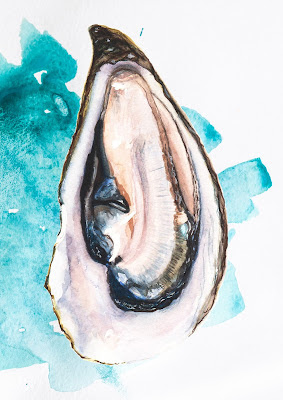
OYSTERS ON THE HALF SHELL

One of the now rare species of oysters in the Pacific Northwest is the Olympia oyster, Ostrea lurida, (Carpenter, 1864).  

While rare today, these are British Columbia’s only native oyster. 

Had you been dining on their brethren in the 1800s or earlier, it would have been this species you were consuming. Middens from Port Hardy to California are built from Ostrea lurida.

These wonderful invertebrates bare their souls with every bite. Have they lived in cold water, deep beneath the sea, protected from the sun's rays and heat? Are they the rough and tumble beach denizens whose thick shells tell us of a life spent withstanding the relentless pounding of the sea? Is the oyster in your mouth thin and slimy having just done the nasty—spurred by the warming waters of Spring? 

Is this oyster a local or was it shipped to your current local and, if asked, would greet you with "Kon'nichiwa?" Not if the beauty on your plate is indeed Ostrea lurida

Oyster in Kwak'wala is t̕łox̱t̕łox̱
We have been cultivating, indeed maximizing the influx of invasive species to the cold waters of the Salish Sea for many years. 

But in the wild waters off the coast of British Columbia is the last natural abundant habitat of the tasty Ostrea lurida in the pristine waters of  Nootka Sound. 

The area is home to the Nuu-chah-nulth First Nations who have consumed this species boiled or steamed for thousands of years. Here these ancient oysters not only survive but thrive — building reefs and providing habitat for crab, anemones and small marine animals. 

Oysters are in the family Ostreidae — the true oysters. Their lineage evolved in the Early Triassic — 251 - 247 million years ago. 

In the Kwak̓wala language of the Kwakwaka'wakw, speakers of Kwak'wala, of the Pacific Northwest and my family, an oyster is known as t̕łox̱t̕łox̱

I am curious to learn if any of the Nuu-chah-nulth have a different word for an oyster. If you happen to know, I would be grateful to learn.

Thursday, 18 May 2023

BONE VERSUS HORN

The skulls of many dinosaurs had bumps, crests or horns for display, scaring rivals and impressing potential mates.

Instead of the sharp nose horn of many of their large plant-eating cousins, Pachyrhinosuaurs had a big, bony lump on their snout.

Pachyrhinosaurus were ceratopsian dinosaurs that lived in North America during the Late Cretaceous. 

Unlike their Triceratops cousins, Pachyrhinosaurus can be distinguished by their large lumps or bosses over their nose rather than horns.

The first fossil specimens were found in western Canada in Alberta by Charles M. Sternberg in 1946 and named in 1950. Charles Mortram Sternberg (1885–1981) was an American-Canadian fossil collector and palaeontologist, and son of the famous Charles Hazelius Sternberg (1850-1943) who worked with Edward Drinker Cope and Othniel C. Marsh, and for the British Museum, the San Diego Natural History Museum and other museums. 

Late in his career, Charles M. collected and described Pachyrhinosaurus, Brachylophosaurus, Parksosaurus and Edmontonia. A contemporary author wrote, "No published study of Canadian dinosaurs is possible today without citing one or another of Sternberg's papers. 

Over a dozen partial skulls and a large assortment of other fossils from various species have been found in Alberta and Alaska. A great number were not available for study until the 1980s, resulting in a relatively recent increase of interest in Pachyrhinosaurus.

Three species have been identified. P. lakustai, from the Wapiti Formation, the bonebed horizon of which is roughly equivalent age to the upper Bearpaw and lower Horseshoe Canyon Formations, is known to have existed from about 73.5–72.5 million years ago. P. canadensis is younger, known from the lower Horseshoe Canyon Formation, about 71.5–71 Ma ago and the St. Mary River Formation. 

Fossils of the youngest species, P. perotorum, have been recovered from the Prince Creek Formation of Alaska, and date to 70–69 Ma ago. The presence of three known species makes this genus the most speciose among the centrosaurines.

Wednesday, 17 May 2023

DELGADOCRINUS OPORTOVINUM

This exceptionally well-preserved crinoid, Delgadocrinus oportovinum, was found on October 11, 1905, by Nery Delgado during his work mapping the geology and paleontology of Portugal.

His find resulted in the creation of a new family, Delgadocrinoinidae, a new genus and a new species.

Ausich et al. published on New and Revised Occurrences of Ordovician Crinoids from Southwestern Europe in the Journal of Paleontology, November 2007. In their work, they honour Delgado. His find was the first record of an Ordovician crinoid from Portugal, Delgadocrinus oportovinum, marking it as the oldest known crinoid from the Iberian Peninsula, Arenigian/Oretanian boundary, early Darriwilian.

The team took a comprehensive look at the Ordovician crinoids of southwestern Europe, including taxa based on articulated crowns and stems. This summary incorporates new material, new localities, and a revision of some southwestern Europe occurrences and is well worth a read. The Type Specimen you see here is now housed in the Natural History Museum of Lisbon. Luis Lima shared a photo of his recent visit to their beautiful collections and kindly granted permission to share the photo.

Reference: Ausich, William & Sá, Artur & Gutiérrez-Marco, Juan. (2007). New and revised occurrences of Ordovician crinoids from southwestern Europe. Journal of Paleontology - J PALEONTOL. 81. 1374-1383. 10.1666/05-038.1.

Tuesday, 16 May 2023

SAYWARD FOSSILS OF VANCOUVER ISLAND

Coroniceras sp. from Sayward, British Columbia
This yummy Lower Jurassic ammonite with the creamy dark chocolate colouring is from an all but inaccessible outcrop of the Upper Sinemurian, Bonanza Group,  Harbledownense Zone, Memekay River area, near Sayward, Vancouver Island, British Columbia, Canada. 

This area is home to the We Wai Kai and Wei Wai Kum First Nations and lands of the K'omoks whose culture thrives and reflects the natural rugged beauty of the central island region.

I passed through Sayward earlier this month on the way to northern Vancouver Island. 

It is rugged, remote and beautiful. Think trees and valleys for as far as the eye can see. Some of those hillsides on the horizon contain wonderful fossils, including this Coroniceras sp. with the truly marvellous keel.

By the time these ammonites were being buried in sediment, Wrangellia, the predominately volcanic terrane that now forms Vancouver Island and Haida Gwaii, had made its way to the northern mid-latitudes.

Within the basal part of the sequence, sedimentary beds are found interbedded with lapilli and crystal tuffs. Here you'll see maroon tuffaceous sandstone, orange-grey sandstone, granule sandstone and conglomerate. Within them we find ammonites nestled in with gastropods and pelecypods. 

While the fossiliferous outcrop is quite small, the Bonanza group is much larger, estimated to be at least 1000 metres thick. The site is quite small and in an active logging area, so the window to collect was limited. The drive up the mountain was thrilling as there had just been heavy rains and the road was washed out and narrowed until it was barely the width of our wheelbase and very, very steep. Closer to the top it narrowed to be just shy of the width of the vehicle — thrilling, to say the least. 

So scary that my passengers all got out as there was a high probability of going head-first over the edge. I was navigating by some handwritten field notes and a wee map on a paper napkin that should have read, "park at the bottom and hike up." 

Did we park at the bottom and hike up? No, we did not. 

The torrential rains of the Pacific Northwest had been working their magic on the hillside and slowly washing out the road until it slowly became more of a trail.

At the base of the hillside all looked well. Giddy for the fossils to come, we ventured off with a truck full of enthusiasm. Within 15 minutes of steep elevation gain, we had a wonderful view of the valley below. We were halfway up the mountain before I realized the error of my ways. The road twisted and turned then slowly narrowed to the width of my tires. Too narrow to turn around, so the only way was up. 

Graham Beard from Qualicum Beach was the fellow who showed me the site and drew the wee map for me. I cannot recall everyone on the trip, but Perry Poon was there — he shot a video of the drive up that he described as thrilling. I have never seen it but would like to one day — and so was Patricia Coutts with her lovely Doberman. 

She and I had just done a trip up to Goldbridge where the cliff we were on had turned into a landslide into a ravine so she was feeling understandably cautious about the power of Mother Nature. 

Picture the angle, the hood of my jeep riding high and hiding what remained of the road beneath and a lovely stick shift that made you roll backwards a wee bit with every move to put it into gear. So, without being able to see the very narrow path beneath, I had to just keep going. 

Both Perry and Patricia helped with filling in the potholes so my tires would have something to grip. 

I bent the frame on the jeep heading up and had some explaining to do when I returned it to the car rental place. 

As I recall, I wasn't in my ordinary vehicle but a rental because my car had been stolen the weekend before when I was away with John Fam and Dan Bowen collecting at Jurassic Point, an epic fossil site accessible only by boat on our wild west coast.

Fortuitous timing really, as they stole my car but I had unloaded my precious fossil collecting gear out of the trunk just days before.  

In the end, we found what we were looking for. Memekay yields a mix of ammonites, gastropods and bivalves. 

Many of them are poorly preserved. It was a hell of a ride but well worth the effort as we found some great fossils and with them more information on the palaeontology and geology of Vancouver Island. Just look at the keel on this beauty.

I would share the site information but it is now covered over with debris and inaccessible. One day, this whole region will be developed and the site will be opened up again. Until then, we'll have to enjoy what has been unearthed.

Monday, 15 May 2023

PSEUDOTHURMANNIA PICTETI

Pseudothurmannia is a genus of extinct cephalopods belonging to the subclass Ammonoidea and included in the family Crioceratitidae of the ammonitid superfamily Ancylocerataceae.

Ammonites have intricate and complex patterns on their shells called sutures. The suture patterns differ across species and tell us what time period the ammonite is from.

We can see from the suture patterns shown here and by comparing it to others that are similar that this fast-moving nektonic carnivore lived in the Cretaceous, from the Hauterivian to the Barremian.

Like other cephalopods, ammonites had sharp, beak-like jaws inside a ring of squid-like tentacles that extended from their shells. They used these tentacles to snare prey — plankton, vegetation, fish and crustaceans — similar to the way a squid or octopus hunt today.

Catching a fish with your hands is no easy feat, as I'm sure you know. Ammonites were skilled and successful hunters. They caught their prey while swimming and floating in the water column. 

Within their shells, they had a number of chambers, called septa, filled with gas or fluid that were interconnected by a wee air tube. By pushing air in or out, they were able to control their buoyancy in the water column. They lived in the last chamber of their shells, continuously building new shell material as they grew. As each new chamber was added, the squid-like body of the ammonite would move down to occupy the final outside chamber.

Shells of Pseudothurmannia can reach a diameter of about 4–12 centimetres (1.6–4.7 in). They show flat or slightly convex sides, with dense ribs and a subquadrate whorl section.

We find fossils of Pseudothurmannia in Cretaceous outcrops in Antarctica, Czechoslovakia, France, Hungary, Italy, Japan, Morocco, Spain, Russia and the United States. The specimen you see here is in the collection of the deeply awesome Manuel Peña Nieto from Córdoba, Spain and is from the Lower Cretaceous of Mallorca.

Sunday, 14 May 2023

JURASSIC STARFISH


This beautiful fossil brittle star with his slender whip-like arms is from Jurassic outcrops of Portugal and hails from the collection of Vitor Miranda. I've also included some photos of his colourful modern relatives.

At a glance, sea stars and brittle stars look quite similar. These echinoderms generally have five radiating arms (or a multiple thereof) and creep along on the seafloor using their arms for locomotion. And they come in wonderful colours.

Sea stars and brittle stars look similar and are related but are actually quite different.

Both sea stars and brittle stars are in the phylum Echinodermata, which also includes sea cucumbers, sea urchins, sand dollars and sea lilies. The most common brittle star is the long-armed brittle star, Amphipholis squamata, a gray-blue, luminescent (glowing) species.

Echinoderms can be found making a living in our oceans and are known for their five-point radial symmetry and unique water vascular system. They typically have a tough, spiny surface, which inspired their name. In Greek, echinos means “spiny” and derma means “skin.”

A neat little evolutionary feature of these lovelies is their ability to regrow lost body parts, and sea stars and brittle stars can regrow arms if broken off or eaten.

Within the phylum, sea stars and brittle stars are in different classes. Sea stars are in the class Asteroidea, where brittle stars are in Ophiuroidea, which also includes basket stars.

To tell the two apart, first, look at their bodies. The modern brittle star you see to the right looks delicate, almost spindly. The sea stars you see below are more robust. Their fundamental structure is different, especially when you look at where the arms connect to the center of the body. Brittle stars have tube feet along their arms that sense light and scent.

Sea stars have thicker, triangular-shaped arms that are typically their widest at the point of connection to the center of the body. They can be found in blue, red, orange, purple, pink, white and a mixture of those same colours.

Brittle stars, on the other hand, have much thinner, more delicate arms that appear more snake-like. Their arms connect to a central disk but do not touch one another.

Sea stars rely on their water vascular system to move. The water vascular system includes a number of small tube feet that become stiff when water is pushed into them, allowing the sea star to move on a conveyor belt-like rotation of feet.

Although brittle stars also have a water vascular system, they twist and bend their long arms to move, instead. This means that they can move much more quickly than sea stars, especially when trying to escape a predator. Handy that!

Saturday, 13 May 2023

DOUVILLEICERAS MAMMILLATUM

Some lovely examples of Douvilleiceras mammillatum (Schlotheim, 1813), ammonites from the Lower Cretaceous (Middle-Lower Albian) Douvilliceras inequinodum zone of Ambarimaninga, Mahajanga Province, Madagascar.

The genus Douvilleiceras range from Middle to Late Cretaceous and can be found in Asia, Africa, Europe and North and South America. 

We have beautiful examples in the early to mid-Albian from the archipelago of Haida Gwaii in British Columbia. Joseph F. Whiteaves was the first to recognize the genus from Haida Gwaii when he was looking over the early collections of James Richardson and George Dawson. The beauties you see here measure 6cm to 10cm.

Friday, 12 May 2023

UK ROLLED TRILOBITE

A lovely rolled trilobite, Calymene blumenbachii,  from outcrops in the UK. This wee beauty is in the collections of the deeply awesome Theresa Paul Spink Dunn — or perhaps in her daughter Layla's collections as she is quite the budding palaeontologist. This Silurian beauty is from the Homerian, Wenlock Series, Wrens Nest, Dudley, UK.

Calymene blumenbachii, sometimes erroneously spelled blumenbachi, is a species of trilobite found in the limestone quarries of the Wren's Nest in Dudley, England.

Nicknamed the Dudley Bug or Dudley Locust by an 18th-century quarryman, it became a symbol of the town and featured on the Dudley County Borough Council coat-of-arms. Calymene blumenbachii is commonly found in Silurian rocks (422.5-427.5 million years ago) and is thought to have lived in the shallow waters of the Silurian, in low energy reefs.

This particular species of Calymene — a fairly common genus in the Ordovician-Silurian — is unique to the Wenlock series in England and comes from the Wenlock Limestone Formation in Much Wenlock and the Wren's Nest in Dudley. These sites seem to yield trilobites more readily than any other areas on the Wenlock Edge, and the rock here is dark grey as opposed to yellowish or whitish as it appears on other parts of the Edge, just a few miles away, in Church Stretton and elsewhere. This suggests local changes in the environment in which the rock was deposited. The Wenlock Edge quarry is closed now to further collecting but may be open to future research projects. We shall have to see.

Thursday, 11 May 2023

SQUIRRELS: SHADOW TAILS

One of the little animals I see daily in Kitsilano, Vancouver, are the very busy, highly comic rodents we know as squirrels. 

They spend their days busily gathering and caching food and their nights resting from all that hard work. 

My neighbourhood has mostly Eastern Gray squirrels, Sciurus carolinensis (Gmelin, 1788) who come in a colour palette of reddish-brown, grey (British spelling) and black. 

These cuties have bushy tails and a spring in their step — racing around gathering nuts, finding secret hiding spots to cache them, teasing dogs and generally exuding cuteness.

We find the first fossil evidence of tree squirrels in the Pleistocene. At least twenty specimens have been found of Sciurus carolinensis in Pleistocene outcrops in Florida on the eastern coast of the United States. Over time, their body size grew larger then shrunk down to the 400 to 600 g (14 to 21 oz) weight we see them today.  

Eastern Gray squirrels have two breeding seasons in December-January and June-July. This past year was warm. On Vancouver Island, the Eastern Grays bred again in early September. One wonders if the heat dome killed off the July litter, and with the return of more favourable weather, the parents have been induced to breed again.

While they are not native to Vancouver, they are plentiful. They were introduced to the region over a hundred years ago and have been happily multiplying year upon year. 

Our native species are the smaller, reddish-brown, rather shy Douglas squirrels, Tamiasciurus douglasii (Bachman, 1839), and the nocturnal Northern Flying Squirrels, Glaucomys sabrinus (Shaw, 1801).  

Sciurus, is derived from two Greek words, skia, meaning shadow, and oura, meaning tail. The name choice is poetic, alluding to squirrels sitting in the shadow of their tails. 

The specific epithet, carolinensis, refers to the Carolinas on the eastern seaboard of the United States, an area that includes both North and South Carolina. It was here that the species was first recorded and still rather common. In the United Kingdom and Canada, Sciurus carolinensis is referred to as the Eastern Gray or grey squirrel — and though adorable is an invasive species. 

In the United States, Eastern is used to differentiate the species from the Western Gray or Silver-Gray squirrel, Sciurus griseus, (Ord, 1818). 

The Ord here, of course, is George Ord, the American zoologist who named the species based on notes recorded by Lewis and Clark in the early 1800s. If you fancy a read, check out his article from 1815, "Zoology of North America." It is charming, anachronistic and the first systemic zoology of America by an American. 

In the Kwak̓wala language of the Kwakwaka'wakw First Nation, speakers of Kwak'wala, of the Pacific Northwest, we use the word ta̱minasux̱, to say: "that is a squirrel." 

The word for shadow in Kwak'wala is gagumas and tail is ha̱t̕sa̱x̱ste' — so I will think of these wee wonders of the Order Rodentia in the family Sciuridae as the Gagumas ha̱t̕sa̱x̱ste' of Khahtsahlano. 

EOCENE CRYPTODIRAN TURTLE

An Eocene Cryptodiran Fossil Turtle, Baena arenosa, from fine-grained lime mud outcrops in the Green River Formation, Wyoming, USA.

This fellow, with the extra-long tail, marks the last of his lineage. The now extinct family Baenidae appeared first in the Jurassic and died out at the end of the Eocene. We've found specimens of Baena, along with 14 other species of turtles in seven genera and five families in the Lower Eocene San Jose Formation, San Juan Basin of New Mexico.

This specimen is from the Green River Formation of Wyoming which was once the bottom of one of an extensive series of Eocene lakes. The Green River Formation is particularly abundant in beautifully preserved fossil fish, eleven species of reptiles including a 13.5ft crocodile, an armadillo-like mammal, Brachianodon westorum, bats, birds and other fresh-water aquatic goodies.

This specimen of a beautiful Baena was found and prepped by the Green River Stone Company. They purchased their private 12-acre quarry about 20 years ago. It's at the Eocene lake's centre, shared with Fossil Butte National Monument about 24 kilometres (15 miles) west of Kemmerer, Lincoln County, Wyoming.

Wednesday, 10 May 2023

TRUMPET CALLS FROM THE CRETACEOUS

Reconstruction of Prosaurolophus maximus
When this good looking fellow was originally described by Brown, Prosaurolophus maximus was known only from a skull and jaw. Half of the skull was badly weathered at the time of examination, and the level of the parietal was distorted and crushed upwards to the side. 

You can imagine that these deformations in preservation created some grief in the final description.

Prosaurolophus maximus was a large-headed duckbill dinosaur, or hadrosaurid, in the ornithischian family Hadrosauridae.

The most complete Prosaurolophus maximus specimen had a massive skull an impressive 0.9 metres (3.0 ft) long that graced a skeleton about 8.5 metres (28 ft) long. 

He had a small, stout, triangular crest in front of his eyes. The sides of the crest are concave, forming depressions. 

The crest grew isometrically — without changing in proportion — throughout the lifetime of each individual, leading one to wonder if Prosaurolophus had had a soft tissue display structure such as inflatable nasal sacs. We see this feature in hooded seals, Cystophora cristata, who live in the central and western North Atlantic today. Prosaurolophus maximus may have used their inflatable nasal sac for a display to warn a predator or to entice the ladies, attracting the attention of a female.

The different bones of the skull are easily defined with the exception of the parietal and nasal bones. Brown found that the skull of the already described genus Saurolophus was very similar overall, just smaller than the skull of Prosaurolophus maximus. The unique feature of a shortened frontal in lambeosaurines is also found in Prosaurolophus maximus, and the other horned hadrosaurines Brachylophosaurus, Maiasaura, and Saurolophus. Although they lack a shorter frontal, the genera Edmontosaurus and Shantungosaurus share an elongated dentary structure.

Prosaurolophus maximus, Ottawa Museum of Nature
Patches of preserved skin are known from two juvenile specimens, TMP 1998.50.1 and TMP 2016.37.1; these pertain to the ventral extremity of the ninth through fourteenth dorsal ribs, the caudal margin of the scapular blade, and the pelvic region. 

Small basement scales (scales that make up the majority of the skin surface), 3–7 millimetres (0.12–0.28 in) in diameter, are preserved on these patches - this is similar to the condition seen in other saurolophine hadrosaurs.

More uniquely, feature scales (larger, less numerous scales which are interspersed within the basement scales) around 5 millimetres (0.20 in) wide and 29 millimetres (1.1 in) long are found interspersed in the smaller scales in the patches from the ribs and scapula (they are absent from the pelvic patches). 

Similar scales are known from the tail of the related Saurolophus angustirostris (on which they have been speculated to indicate pattern), and it is considered likely adult Prosaurolophus would've retained the feature scales on their flanks like the juveniles.

Image: Three-dimensional reconstruction of Prosaurolophus maximus. Created using the skull reconstructions in the original description as reference. (Fig. 1 and 3 in Brown 1916). According to Lull and Wright (1942), the muzzle was restored too long in its original description. The colours and/or patterns, as with nearly all reconstructions of prehistoric creatures, are speculative. Created & uploaded to Wikipedia by Steveoc 86.

Tuesday, 9 May 2023

BELEMNITES: SQUID-LIKE CEPHALOPODS

Lower Jurassic Belemnites, Photo: Georg Laki
Belemnitida is an extinct order of squid-like cephalopods that swam our ancient seas from the Late Triassic to Late Cretaceous. 

Unlike squid, belemnites had an internal skeleton that made up the cone and it is this hard part that we often find fossilized. 

The parts are, from arms to tip: the tongue-shaped pro-ostracum, the conical phragmocone, and the pointy guard.  

When you find these as fossils, it is not intuitive as to what kind of animal they came from. This is the internal hard part of a rather soft, squishy squid-like fellow. 

Because the softer bits are often scavenged and decay, we rarely see them fossilized. Instead, we get what looks like a pointy selection of cigar-shaped goodies that are all that is left of these marine cephalopods. 

We find this fossil in many places around the world. Some friends shared where they have personally found them which I thought might be of interest to you. Arno Martini has found them in northern California, Anne Glenn finds them in Wyoming, Marco Valentin has an enviable collection from Hannover, Misburg, Germany, Juanjo Ugalde Robledo finds them in La Rioja, Spain, Barbara Hnb finds them in Normandy, Patrick Buster finds them in the Navesink Formation of New Jersey, Kim Pervis shared a monograph on Mississippian Belemnites by Rousseau. 

Georg Laki has collected many of their number in the Early Jurassic (Sinemurian/Pliensbachian) of South Luxembourg at Gasperich. I included a photo of Georg's belemnites (with permission) here for you to enjoy. He has a lovely collection that shows the variety of these fossils. 

Anatomy of a Belemnite Fossil

Other notable finds are from Scott Carpenter and his daughter who collect them on the Jurassic Coast, Gabriel Santos who collects them in Peniche, Portugal and Rossi Franco shared a belemnite he found in the building materials used to construct the Bank of Italy in Genoa. 

There are also some wonderfully preserved plates of multiple Jurassic belemnites from Mistelgau, Germany you may want to take a boo at. Imagine slate grey to honey brown Youngibelus and Paxillosus clusters on a beige matrix. Quite stunning. 

I have found them around British Columbia, as has Lloyd Rempel, including at Harrison Lake, British Columbia, Canada.