![]() |
| Pachydiscus suchiaensis ID: 18-08-CP-002 |
![]() |
| Nostoceras hornbyense (Whiteaves, 1895) |
![]() |
| Pachydiscus suchiaensis ID: 18-08-CP-002 |
![]() |
| Nostoceras hornbyense (Whiteaves, 1895) |
![]() |
| Captain George Vancouver's Commission to Lieutenant |
| Taseko Lakes Region |
| Taseko Fossil Field Camp |
![]() |
| Fergusonites hendersonae |
![]() |
| Badouxia ammonites |
![]() |
| Living and Fossil Ginko biloba |
Ginko are Living Fossils native to China. We find them in the fossil record as far back as the Permian, 270 million years, rising with cycads, seed ferns and early conifers. They were part of the low, open, shrubby canopy covering our world well before the first flowering plants arrived.
Ginko grew when Weigeltisaurus jaekeli, the oldest gliding vertebrates first soared our ancient skies and the first wee beetles munched on decaying wood on our forest floors. It is the long history of predation by beetles and their friends that have made Ginko what they are today — hardy, stinky and weaponized.
These trees are truly a wonder. Consider that they have lasted since the Permian, living through multiple extinction events that wiped out millions of species on the planet. They are one of the few living things to survive a recent human-made extinction event — the atomic bomb blast in Hiroshima, Japan on August 6, 1945 — weathering one of the most horrifying moments in human history.
![]() |
| 170 Ginko Survived the Atomic Bombing of Hiroshima |
Somehow 170 resident Gingko trees withstood the ferocity and heat of that blast — and they are still standing to this day, 76 years later. Seemingly impossible, and yet quite true. It is because of their hardy nature that we began looking closely at their genetic make-up.
Plants with seeds are either angiosperms, our showy flowering plants, or gymnosperms, the naked seed plants. Ginkgo are gymnosperms but in their own subclass, Ginkgoidae. The ginkgos we see growing today are the last remaining member of that subclass.
We see Ginko's rise and diversify in the Permian. By the Jurassic, they had spread across Laurasia, the lands that would become modern Asia. It is this lucky foothold in a young Asia that would eventually save their species.
From the Jurassic to the Pleistocene their numbers slowly dwindled. We have some great Eocene fossils from outcrops at Quilchena, Tranquille and the McAbee Fossil Beds that show them doing quite well in the interior of British Columbia some 50 million years ago, but this pocket of lush growth seems the exception and not the norm.
By the Pleistocene, just 2.5 million years ago, glaciation threatened to kill off the last of the ginkgo lineages. Their last stand and platform for global distribution once again was rooted in the forests of central China. Every Ginko you see today originated from that small foothold in China.
While beautiful, Ginkgo are stinky. I was out for a late stroll the night before last to try and catch a glimpse of the Aurora Borealis up at Queen Elizabeth Park. As I walked along one of the darkened pathways, my nose caught a whiff of something smelly. Think vomit mixed with decaying leaf matter. I looked up to confirm the culprit, a gorgeous bright yellow Ginko backlit from above.
![]() |
| Ginko in Dan & Lena Bowen's Garden |
Ginko boast a massive genome comprising some 10.6 billion DNA letters within each strand. You and I boast only three billion letters in our human genome.
Written within this vast genetic code are 41,840 genes or templates that the tree’s cells use to make complex protein molecules that build and maintain each tree and give these stinky lovelies an enviable anti-insect arsenal.
The photo at the top shows the yellow lobed leaves of a Ginko biloba against an Eocene partial lobe from the McAbee Fossil Beds up near Cache Creek, British Columbia, Canada. The bright yellow is this tree's Autumn colour palette. The bright green leaves you see in the bottom photo are the summer colour palette of this same species. The photo was taken this summer in Dan and Lena Bowen's garden during the VIPS Saber-toothed Salmon Barbeque.
![]() |
| Totem, Welcome & Mortuary Poles at Stanley Park |
What you are viewing are replicas of First Nation welcome and totem poles that once stood in the park but have been returned to their homes within the province's diverse First Nation communities — or held within museum collections.
Some of the original totems came from Alert Bay on Cormorant Island, near the Port McNeill on the north coast of Vancouver Island.
Others came from communities in Haida Gwaii — and still more from the Wuikinuxv First Nations at Rivers Inlet on British Columbia's central west coast — home of the Great Bear Rainforest with her Spirit Bears.
The exception is the most recent addition carved by Robert Yelton in 2009. Robert is a First Nation carver from the Squamish Nation and his original welcome pole graces Brockton Point, the original settlement site of a group of Squamish-Portuguese settlers.
If you look at the photo above, the lovely chocolate, red and turquoise pole on the right is a replica of the mortuary pole raised to honour the Raven Chief of Skedans or Gida'nsta, the Haida phrase for from his daughter, the title of respect used when addressing a person of high rank. Early fur traders often took the name of the local Chief and used it synonymously as the place names for the sites they visited — hence Skedans from Gida'nsta.
![]() |
| Chief Skedans Mortuary Pole |
Upon Chief Skedan's death, the mortuary pole was carved both to honour him and provide his final resting place. Dates are a bit fuzzy, but local accounts have this as sometime between 1870-1878 — and at a cost of 290 blankets or roughly $600 in today's currency.
The great artistry of the pole was much admired by those in the community and those organizing the celebrations for the 1936 Vancouver Golden Jubilee — witnessed by 350,000 newly arrived residents.
Negotiations were pursued and the pole made its way down from Haida Gwaii to Stanley Park in time for the celebrations. The original totem graced Stanley Park for a little over twenty years before eventually making its way back to Haida Gwaii. It was returned to the community with bits of plaster and shoddy paint marring the original. These bits were scraped off and the pole welcomed back with due ceremony.
In 1964, respected and renowned Northwest Coast master carver, Bill Reid, from the Kaadaas gaah Kiiguwaay, Raven/Wolf Clan of T'anuu, Haida Gwaii and Scottish-German descent, was asked to carve this colourful replica.
![]() |
| Mountain Goat Detail, Skedans Mortuary Pole |
Don Yeomans, Haida master carver, meticulously recarved the moon crest in 1998. If you have admired the totem pole in the Vancouver Airport, you will have seen some of Yeoman's incredible work.
The crest is Moon with the face, wings, legs and claws of a mighty and proud Thunderbird with a fairly smallish hooked beak in a split design. We have Moon to thank for the tides and illuminating our darkest nights. As a crest, Moon is associated with transformation and acting as both guardian and protector.
The original pole had a mortuary box that held the Chief's remains. The crest sits atop a very charming mountain goat. I have included a nice close-up here of the replica for you to enjoy.
Mountain Goats live in the high peaks of British Columbia and being so close to the sky, they have the supernatural ability to cross over to the sky world. They are also credited as being spirit guardians and guides to First Nation shamans.
I love his horns and tucked in cloven hooves. There is another pole being carved on Vancouver Island that I hope to see during its creation that also depicts a Mountain Goat. With permission and in time, I hope to share some of those photos with you.
Mountain Goat is sitting atop Grizzly Bear or Huaji or Xhuwaji’ with little human figures placed in his ears to represent the Chief's daughter and son-in-law, who raised the pole and held a potlatch in his honour.
Beneath the great bear is Seal or Killer Whale in his grasp. The inscription in the park says it is a Killer Whale but I am not sure about that interpretation — both the look and lore make Seal more likely. Perhaps if Killer Whale were within Thunderbird's grasp — maybe.
Though it is always a pleasure to see Killer Whale carved in red cedar, as the first whales came into being when they were carved in wood by a human — or by Raven — then magically infused with the gift of life.
![]() |
| Siwash Rock on the northern end of Third Beach, Stanley Park |
Glacial deposits sit atop as a mix of clay, sand, cobbles and larger boulders of glacial till.
There are a few areas of exposed volcanics within the park that speak to the scraping of the glaciers as they retreated about 12,500 years ago.
The iconic moss and lichen coated Siwash Rock on the northern end of Third Beach is one of the more picturesque of these. It is a basaltic and andesitic volcanic rock — a blend of black phenocrysts of augite cemented together with plagioclase, hornblende and volcanic glass.
Images not shown:
Do check out the work of Emily Carr and her paintings of Q:o'na from the 1940s. I'll share a link here but do not have permission to post her works. http://www.emilycarr.org/totems/exhibit/haida/ssintro.htm
![]() |
| Eohiodon Fish, McAbee Fossil Beds |
![]() |
| Dawn Redwood Cones with scales paired in opposite rows |
The seed-bearing cones of Metasequoia have a stalk at their base and the scales are arranged in paired opposite rows which you can see quite well in the visual above. Coast redwood cone scales are arranged in a spiral and lack a stalk at their base.
Although the least tall of the redwoods, it grows to an impressive sixty meters (200 feet) in height. It is sometimes called Shui-sa, or water fir by those who live in the secluded mountainous region of China where it was rediscovered.
![]() |
| Fossil Metasequoia, McAbee Fossil Beds |
During the Paleocene and Eocene, extensive forests of Metasequoia thrived as far north as Strathcona Fiord on Ellesmere Island and sites on Axel Heiberg Island in Canada's far north around 80° N latitude.
We find lovely examples of Metasequoia occidentalis in the Eocene outcrops at McAbee near Cache Creek, British Columbia, Canada. I shared a photo here of one of those specimens. Once this piece dries out a bit, I will take a dental pick to it to reveal some of the teaser fossils peeking out.
The McAbee Fossil Beds are known for their incredible abundance, diversity and quality of fossils including lovely plant, insect and fish species that lived in an old lake bed setting. While the Metasequoia and other fossils found here are 52-53 million years old, the genus is much older. It is quite remarkable that both their fossil and extant lineage were discovered in just a few years of one another.
Metasequoia was first described as a new genus from a fossil specimen found in 1939 and published by Japanese paleobotanist Shigeru Miki in 1941. Remarkably, the living version of this new genus was discovered later that same year.
Professor Zhan Wang, an official from the Bureau of Forest Research was recovering from malaria at an old school chum's home in central China. His friend told him of a stand of trees discovered in the winter of 1941 by Chinese botanist Toh Gan (干铎). The trees were not far away from where they were staying and Gan's winter visit meant he did not collect any specimen as the trees had lost their leaves.
The locals called the trees Shui-sa, or water fir. As trees go, they were reportedly quite impressive with some growing as much as sixty feet tall. Wang was excited by the possibility of finding a new species and asked his friend to describe the trees and their needles in detail. Emboldened by the tale, Wang set off through the remote mountains to search for his mysterious trees and found them deep in the heart of Modaoxi (磨刀溪; now renamed Moudao (谋道), in Lichuan County, in the central China province of Hubei. He found the trees and was able to collect living specimens but initially thought they were from Glyptostrobus pensilis (水松).
A few years later, Wang showed the trees to botanist Wan-Chun Cheng and learned that these were not the leaves of s Glyptostrobus pensilis (水松 ) but belonged to a new species.
While the find was exciting, it was overshadowed by China's ongoing conflict with the Japanese that was continuing to escalate. With war at hand, Wang's research funding and science focus needed to be set aside for another two years as he fled the bombing of Beijing.
When you live in a world without war on home soil it is easy to forget the realities for those who grew up in it.Zhan Wang and his family lived to witness the 1931 invasion of Manchuria, then the 1937 clash between Chinese and Japanese troops at the Marco Polo Bridge, just outside Beijing.
That clash sparked an all-out war that would grow in ferocity to become World War II.
Within a year, the Chinese military situation was dire. Most of eastern China lay in Japanese hands: Shanghai, Nanjing, Beijing, Wuhan. As the Japanese advanced, they left a devastated population in their path where atrocity after atrocity was the norm. Many outside observers assumed that China could not hold out, and the most likely scenario was a Japanese victory over China.
Yet the Chinese hung on, and after the horrors of Pearl Harbor, the war became genuinely global. The western Allies and China were now united in their war against Japan, a conflict that would finally end on September 2, 1945, after Allied naval forces blockaded Japan and subjected the island nation to intensive bombing, including the utter devastation that was the Enola Gay's atomic payload over Hiroshima.
With World War II behind them, the Chinese researchers were able to re-focus their energies on the sciences. Sadly, Wang was not able to join them. Instead, two of his colleagues, Wan Chun Cheng and Hu Hsen Hsu, the director of Fan Memorial Institute of Biology would continue the work. Wan-Chun Cheng sent specimens to Hu Hsen Hsu and upon examination realised they were the living version of the trees Miki had published upon in 1941.
Hu and Cheng published a paper describing a new living species of Metasequoia in May 1948 in the Bulletin of Fan Memorial Institute of Biology.
That same year, Arnold Arboretum of Harvard University sent an expedition to collect seeds and, soon after, seedling trees were distributed to various universities and arboreta worldwide.
Today, Metasequoia grow around the globe. When I see them, I think of Wang and all he went through. He survived the conflict and went on to teach other bright, young minds about the bountiful flora in China. I think of Wan Chun Cheng collaborating with Hu Hsen Hsu in a time of war and of Hu keeping up to date on scientific research, even published works from colleagues from countries with whom his country was at war. Deep in my belly, I ache for the huge cost to science, research and all the species impacted on the planet from our human conflicts. Each year in April, I plant more Metasequoia to celebrate Earth Day and all that means for every living thing on this big blue orb.
References:
![]() |
| Dove Creek Mosasaur (Tylosaur) found by Rick Ross, VIPS |
| Glyptoxoceras heteromorph found by Rick Ross, VIPS |
![]() |
| T. proriger specimen found with a plesiosaur in its stomach |
| Palaeontology Lecture Series — March 20, 2022 |
In this lecture, Kirk draws on his experience as a working paleontologist who has led expeditions in eighteen US states and eleven countries.
Kirk is a geologist, paleobotanist, and the Sant Director of the Smithsonian’s National Museum of Natural History. His research focuses on fossil plants and the extinction of the dinosaurs, and he is known for his scientific articles, popular books, museum exhibitions, documentaries, and collaborations with artists.
His recent documentaries include “Making North America” (2015) and “Polar Extremes” (2019). His recent books include “Cruisin’ the Fossil Coastline: The Travels of an Artist and a Scientist along the Shores of the Prehistoric Pacific” (2018); “Visions of Lost Worlds, the Paleoart of Jay Matternes” (2019); and “Trees are made of Gas, The Story of Carbon and Climate” (2021). Johnson is originally from Bellevue, Washington.
Fossil Road Trip? Heck, Yeah!
| Cruisin' the Fossil Coastline |
It is not your average paleo book. Filled with Troll's whimsical pop-art illustrations — how many dinosaur books feature sauropods crossing the road? — and Johnson's entertaining descriptions of their journey, the book is simultaneously entertaining and informative.
The equally entertaining Cruisin' the Fossil Coastline is a must-read and will do you proud as an addition to your library.
To read Riley Black's article for the Smithsonian on Cruisin' the Fossil Freeway, visit:
https://www.smithsonianmag.com/science-nature/cruisin-the-fossil-freeway-59717763/
Fossil Talks & Field Trips — Palaeontology Lecture Series
To get the live Zoom link to Kirk Johnson's Free Lecture as part of the 2022 Palaeontology Lecture Series, visit: www.fossiltalksandfieldtrips.com
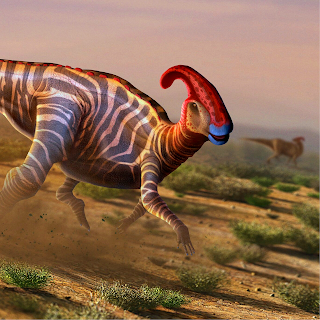
| A delightful red crested hadrosaur |
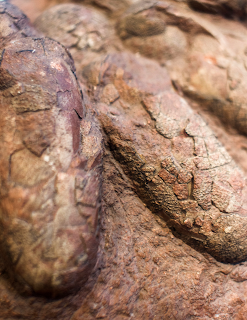
| Hadrosaur Eggs |
![]() |
| Charles H. Sternberg, American Palaeontologist |