Saturday, 21 December 2024

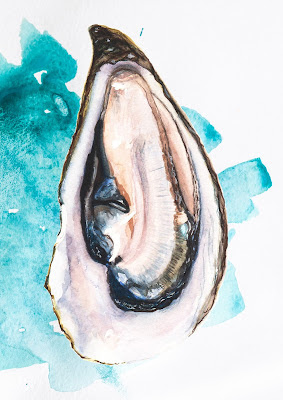
MIDDENS AND WEST COAST OYSTERS: T'LOXT'LOX

One of the now rare species of oysters in the Pacific Northwest is the Olympia oyster, Ostrea lurida, (Carpenter, 1864).  

While rare today, these are British Columbia’s only native oyster. 

Had you been dining on their brethren in the 1800s or earlier, it would have been this species you were consuming. Middens from Port Hardy to California are built from Ostrea lurida.

These wonderful invertebrates bare their souls with every bite. Have they lived in cold water, deep beneath the sea, protected from the sun's rays and heat? Are they the rough and tumble beach denizens whose thick shells tell us of a life spent withstanding the relentless pounding of the sea? Is the oyster in your mouth thin and slimy having just done the nasty—spurred by the warming waters of Spring? 

Is this oyster a local or was it shipped to your current local and, if asked, would greet you with "Kon'nichiwa?" Not if the beauty on your plate is indeed Ostrea lurida

Oyster in Kwak'wala is t̕łox̱t̕łox̱
We have been cultivating, indeed maximizing the influx of invasive species to the cold waters of the Salish Sea for many years. 

But in the wild waters off the coast of British Columbia is the last natural abundant habitat of the tasty Ostrea lurida in the pristine waters of  Nootka Sound. 

The area is home to the Nuu-chah-nulth First Nations who have consumed this species boiled or steamed for thousands of years. Here these ancient oysters not only survive but thrive — building reefs and providing habitat for crab, anemones and small marine animals. 

Oysters are in the family Ostreidae — the true oysters. Their lineage evolved in the Early Triassic — 251 - 247 million years ago. 

In the Kwak̓wala language of the Kwakwaka'wakw, speakers of Kwak'wala, of the Pacific Northwest and my family, an oyster is known as t̕łox̱t̕łox̱

I am curious to learn if any of the Nuu-chah-nulth have a different word for an oyster. If you happen to know, I would be grateful to learn.

Thursday, 19 December 2024

ASK THE FOSSIL HUNTRESS: WHAT IS A FOSSIL

Pick up a fossil and you are holding evidence of a life.

Not merely an old rock. Not an attractive geological paperweight. Not something the Earth made solely to tempt us into climbing unstable slopes in inappropriate footwear.

A fossil is a message from the past.

It may be a bone, tooth, shell or leaf. It may be the delicate impression of a feather, the tunnel left by a burrowing animal or the footprints of a creature that crossed a muddy shoreline hundreds of millions of years ago.

It may even be fossilized dung.

The fossil record has never been overly concerned with dignity.

Together, fossils preserve the history of life on Earth: its astonishing experiments, spectacular successes, evolutionary detours and occasional catastrophes. They introduce us to organisms no human ever saw alive and to ecosystems that vanished long before our own species appeared.

But what exactly qualifies as a fossil—and how can something as fleeting as a footprint survive for millions of years?

Let us begin at the beginning.

SO, WHAT IS A FOSSIL?

Dinosaur Footprints near Tumbler Ridge, BC
A fossil is naturally preserved evidence of past life. That definition is deliberately broad because life leaves evidence in many different ways.

A fossil can be part of an organism’s body, such as a bone, tooth, shell, leaf or piece of wood. It can also be a mark made by an organism while it was alive: a footprint, burrow, feeding trail, nest or bite mark.

The organism itself does not necessarily need to be present.

This is one of the most important things to understand about fossils. We often picture a magnificent dinosaur skeleton standing in a museum, every rib neatly arranged and every tooth poised for drama. Yet complete skeletons are extraordinarily rare. Most fossils are fragments: a single tooth, part of a shell, a scrap of leaf, one vertebra or a dark smudge of carbon in the rock.

Some fossils are so small that thousands could sit comfortably on the head of a pin. Others belong to animals that stretched longer than a city bus.

All of them are evidence.

We divide fossils into two major categories: body fossils and trace fossils. The distinction is simple, but it opens the door to an astonishing variety of preservation.

BODY FOSSILS: WHEN PART OF THE ORGANISM REMAINS

A body fossil preserves part of the organism itself—or a direct impression, mould or cast of its remains.

The most familiar body fossils include:

  • Bones
  • Teeth
  • Shells
  • Exoskeletons
  • Scales
  • Wood
  • Leaves
  • Seeds
  • Pollen
  • Spores

Cenoceras Fossilized Shell Material
Hard parts are much more likely to enter the fossil record because they resist decay longer than soft tissues. Teeth are especially durable. A vertebrate animal may lose and replace thousands of teeth during its lifetime, greatly improving the odds that at least a few will survive long enough to become fossils.

This is one reason isolated fossil teeth are much more common than complete fossil animals. Nature produces teeth generously and skeletons only once per customer.

Shells also have an excellent chance of preservation. Ancient seafloors could accumulate the remains of countless brachiopods, molluscs, corals and other marine organisms. Over time, those shells became part of the sediment and, eventually, part of the rock itself.

The most durable portions of an organism dominate the fossil record. According to the National Park Service overview of body fossils, bones, teeth, shells, mineralized plates and wood are preserved far more frequently than skin, organs, flowers or fruit.

This creates an immediate problem.

The fossil record is not a complete census of everything that ever lived. It has a built-in preference for organisms with hard parts, those living in places where burial could occur and those fortunate enough to die under favourable conditions.

A clam living on a muddy seafloor has a better chance of becoming a fossil than a soft-bodied creature living on a windswept mountain. This does not mean the mountain creature was less important. It was simply less likely to leave us its forwarding address. We find many more of the durable creatures than we do the squishy. 

TRACE FOSSILS: WHEN BEHAVIOUR BECOMES STONE

Theropod Track, Thailand
Trace fossils preserve evidence of what an organism did rather than the organism’s actual body.

They are also called ichnofossils, from the Greek word ichnos, meaning track or trace. Scientists who specialize in studying them are called ichnologists.

Trace fossils include:

  • Footprints and trackways
  • Burrows and tunnels
  • Trails
  • Resting impressions
  • Nests
  • Root traces
  • Feeding marks
  • Bite marks
  • Borings in shells or wood
  • Coprolites, or fossilized dung
  • Regurgitated material
  • Gastroliths associated with an animal

A body fossil can tell us that an organism existed. A trace fossil may reveal what it was doing.

A line of footprints can show whether an animal walked on two legs or four. The distance between prints can help researchers estimate speed. Several parallel trackways may suggest that animals moved together, although such interpretations must be made carefully.

A burrow can reveal how an animal moved through sediment, searched for food or protected itself. Bite marks can document interactions between predator and prey. A resting impression can preserve the outline of an animal settling momentarily onto a soft surface.

Trace fossils often remain in the substrate where the behaviour originally occurred. Unlike bones, which may be carried away by water, scavengers or gravity, a burrow generally records activity at that exact location.

This gives trace fossils an extraordinary quality. They preserve moments. An animal stepped here. A worm burrowed here. Something bit this shell.

A dinosaur crossed this stretch of wet sediment, placing one foot after another beneath a sky no human would ever see. The animal continued on. The moment passed. But the ground remembered.

YES, FOSSILIZED POO IS A REAL FOSSIL

Coprolites are fossilized faeces, and they are among some of our most personal treasures.

They vary enormously in size and appearance. Some resemble pellets, spirals or lumpy stones. Others are difficult to distinguish from ordinary rock without examining their shape, contents or chemical composition.

Coprolites can preserve:

  • Bone fragments
  • Fish scales
  • Plant fibres
  • Seeds
  • Pollen
  • Insect remains
  • Parasite eggs
  • Chemical evidence of diet

They can help researchers determine whether an animal ate meat, plants, insects, fish—or almost anything unfortunate enough to fit inside it.

The difficulty lies in identifying the producer. Unless a coprolite is found directly associated with a particular animal, assigning it to a species can be challenging. Size, shape, contents and geological context may narrow the possibilities, but we must resist the temptation to point dramatically at every ancient dropping and declare, “Tyrannosaurus!”

Not every large coprolite came from the most famous carnivore available.

Still, fossilized dung offers something bones alone cannot: evidence of a meal passing through an animal’s digestive system. Coprolites are trace fossils that can provide direct clues about ancient diets.

One creature’s private moment has become everyone’s scientific business. Deep time can be terribly indiscreet.

DOES A FOSSIL HAVE TO BE TURNED TO STONE?

No. “Fossil” describes evidence of past life, not one particular style of preservation.

Some fossils are petrified or mineralized. Others preserve original material. Fossils can occur as impressions, carbon films, moulds, casts or remains trapped in substances such as amber, tar or ice.

Let us look at a few possibilities.

Permineralized Fossils

Bones and wood contain microscopic spaces. After burial, mineral-rich water may move through the sediment and deposit minerals inside those spaces.

This process is called permineralization.

The original structure may remain while its pores become filled with minerals such as silica, calcite or iron compounds. The result is denser and heavier than the original material but can preserve remarkable internal detail.

Petrified wood is a beautiful example. Its tissues may become mineralized so precisely that growth rings and cellular structures remain visible.

Replacement Fossils

In some fossils, the original biological material dissolves and is gradually replaced by minerals. The new mineral preserves the form—and sometimes even the microscopic structure—of the original organism.

It is rather like replacing a building one brick at a time while somehow retaining its shape.

Moulds and Casts

Imagine a shell buried in sediment.

The sediment hardens around it, but the shell later dissolves, leaving an empty impression. This cavity is a mould. If minerals or sediment later fill that mould and harden, they create a cast: a three-dimensional replica of the original shell.

An internal mould can form when sediment fills the inside of a shell and hardens before the shell disappears. Such fossils are sometimes called steinkerns, a German term meaning “stone kernel.”

Nothing of the original shell may remain, yet its shape survives. The body is gone. The absence has become the fossil. 

Compression and Carbon Films

McAbee Fossil Plants
Plants and soft-bodied organisms may be buried and flattened beneath accumulating sediment. Pressure drives away liquids and gases, sometimes leaving a thin film rich in carbon.

These fossils can appear as dark, delicate outlines on the rock. Leaves may preserve their veins. 

Fish may retain the shapes of scales and fins. Soft-bodied animals can sometimes be recorded in astonishing detail.

They are the geological equivalent of silhouettes—life pressed into stone. Some of the lovely specimens we find at the Eocene McAbee Fossil Beds near Cache Creek, British Columbia, are a great example.

Amber Preservation

Amber begins as sticky resin produced by ancient trees. Small organisms such as insects, spiders, mites and fragments of plants can become trapped in the resin. As the resin is buried and chemically altered over time, it becomes amber.

Amber can preserve extraordinary detail: hairs, wings, compound eyes and delicate structures that would normally decay rapidly.

It can even preserve tiny moments of behaviour. Organisms have been found trapped while feeding, mating, carrying pollen or interacting with parasites.

Amber is not a perfect time capsule, however, and it has not provided usable dinosaur DNA. The mosquitoes of Jurassic Park remain unemployed. If you are looking for some superb examples of amber preservation, check out the collection of Harry Tabiner in the UK. He has a remarkable eye and enviable collection, which he shares online.

Ice, Dryness and Natural Tar 

Cold, arid or oxygen-poor conditions can dramatically slow decay. Mammoths preserved in frozen ground may retain hair, skin, muscle and stomach contents. Natural tar deposits can preserve vast collections of bones, although the remains themselves may be stained, altered or compressed.

These forms of preservation remind us that a fossil does not need to resemble a traditional stone skeleton. Fossilization is not a single recipe. It is a vast collection of unlikely outcomes.

WHAT ABOUT FOOTPRINTS? HOW CAN A HOLE BECOME A FOSSIL?

A footprint fossil begins with a perfectly ordinary step.

An animal walks across a surface soft enough to receive an impression but firm enough to retain its shape. Mud and damp sand are excellent candidates.

The track must then be buried before wind, waves, rain, other animals or enthusiastic members of the herd destroy it. A new layer of sediment settles over the surface, filling and protecting the impression.

With continued burial, both layers may harden into rock. Millions of years later, erosion separates them again. One surface may preserve the original footprint as a depression. The layer that filled the print may preserve a raised natural cast.

Tracks are not simply stamps of the foot. The animal’s weight can deform layers beneath the surface, producing structures known as undertracks. These may be less anatomically precise than the original print but can still record the passage of the animal.

Interpreting tracks requires caution. Wetness, sediment texture, erosion and the animal’s movement can all alter a footprint’s appearance. The same animal could leave surprisingly different tracks after walking only a short distance.

We must study the track, the sediment and the entire trackway—not merely find three vaguely pointed marks and immediately summon the media.

HOW OLD DOES SOMETHING HAVE TO BE BEFORE IT BECOMES A FOSSIL?

You may have heard that a fossil must be at least 10,000 years old.

That figure is commonly used as a practical dividing line in educational materials and some regulatory contexts, but nature has not installed an official fossil clock that rings at midnight on an organism’s ten-thousandth birthday.

We may use terms such as subfossil for relatively recent remains that are not fully fossilized or that retain considerable original material. The terminology can vary depending on the field, material and legal jurisdiction.

Age alone is not the only consideration. Geological context, preservation and scientific usage all matter.

An ammonite shell 100 million years old is unquestionably a fossil. A mammoth tusk 30,000 years old is also a fossil, even if some of its original material remains. Very recent bones from an archaeological site may be described as remains rather than fossils.

The boundary is useful, but it is not a magical transformation.

ARE ALL FOSSILS VISIBLE?

Not remotely. Some of the most important fossils on Earth are microscopic.

Microfossils include fossilized pollen, spores, algae, bacteria, protists and the tiny shells or skeletal elements of marine organisms.

They may be smaller than a grain of sand, yet they occur in enormous numbers and can be tremendously useful. Because some microscopic organisms evolved rapidly and lived across wide geographic areas, their fossils can help scientists date and correlate rock layers.

Microfossils also reveal ancient environments. Different species lived under different conditions, so their presence can provide clues about water depth, temperature, salinity, oxygen levels and climate.

Oil and gas exploration has long relied on micropalaeontology to interpret underground rock layers. A microscopic fossil no larger than a speck of dust may help identify the age and environment of rocks buried kilometres beneath the surface.

Dinosaurs receive the posters. Microfossils quietly organize geological time. Alas, always the bridesmaid, never the bride... Dinos get all the love.

CAN MOLECULES BE FOSSILS?

Ancient life can sometimes leave chemical evidence even when no recognizable body or trace remains.

These signals are often called chemical fossils or biomarkers.

Certain molecules are associated with particular groups of organisms or biological processes. Modified versions of those compounds may survive in ancient rocks, providing evidence that particular kinds of life were present.

Stable isotope patterns can also carry biological information. Living organisms use elements in ways that can leave characteristic chemical signatures in their tissues or surrounding sediments.

Chemical fossils require careful interpretation because geological heat, pressure and contamination can alter molecular evidence. But when combined with other data, they can help scientists investigate some of the earliest chapters in the history of life.

Sometimes life leaves a bone. Sometimes it leaves a footprint. Sometimes it leaves little more than chemistry.

IS A DINOSAUR SKELETON IN A MUSEUM MADE OF REAL FOSSILS?

Sometimes entirely. Sometimes partly. Sometimes hardly at all.

Complete dinosaur skeletons are rare. Museum mounts are often composites, combining fossil bones from more than one individual of the same species. Missing elements may be reconstructed as casts.

In some displays, the original fossils are too heavy, fragile or scientifically valuable to suspend in a dramatic pose. Museums may mount lightweight replicas while keeping the genuine fossils safely stored for research.

This does not make the display fake. A high-quality cast reproduces the shape and surface detail of the original fossil while protecting irreplaceable material. Casts can also be shared with museums, schools and researchers around the world.

Labels generally explain which elements are original fossils and which are reconstructed. It is always worth looking.

The glamorous skeleton towering over the gallery may be a carefully assembled ambassador for a far more fragmentary animal.

IS EVERY OLD BONE A FOSSIL?

No. Sometimes an old bone is just that, an old bone. Not a fossil. Age and appearance alone do not prove that something is fossilized. Modern bones can become stained by soil and minerals, making them look ancient. Conversely, genuine fossils do not always appear dramatically different from ordinary bone.

Identification may involve examining:

  • Geological context
  • Colour and density
  • Surface texture
  • Internal structure
  • Mineral composition
  • Associated fossils
  • Degree of mineralization
  • Evidence of recent organic material

And no, licking it is not the preferred scientific method but, I confess, it is helpful in the field. Not fully diagnostic, but helpful. I have a good friend Skippy who swears by it.

There is an old field trick based on the idea that porous fossil bone may stick slightly to the tongue, but modern bone can do the same, as can many ordinary rocks. The technique is unhygienic, unreliable and particularly regrettable when the mystery specimen is not bone at all.

Use a hand lens. Use comparative anatomy. Use laboratory analysis. Leave your tongue out of the peer-reviewed methodology.

WHY ARE FOSSILS SO RARE?

To become a fossil, an organism must pass through a series of improbable filters. Fossils are not rare per se, as I can think of localities with hundreds spread across the surface and more beneath, but they are rare in the sense that only a small percentage of the organisms that have lived have been preserved this way. To become a fossil is a bit of a process, as you might expect. 

First, the organism, dino, plant, or what have you, must die in a place where preservation is possible.

Then its remains must escape scavengers, decay, trampling, weather and destruction. They must be buried. The sediment must remain intact as it becomes rock. The fossil must survive heat, pressure, chemical alteration, faulting, erosion and the slow recycling of Earth’s crust.

Finally, it must become exposed—or be reached by excavation—at precisely the right time for someone to recognize it. Too early, and it remains buried. Too late, and erosion destroys it.

The fossil record is therefore both magnificent and profoundly incomplete.

Most organisms that ever lived left no known fossil. Entire species may have appeared, flourished and vanished without preserving a trace that we have yet discovered.

Soft-bodied organisms are especially underrepresented. Environments such as mountains, forests and tropical soils generally offer fewer opportunities for long-term preservation than lakes, river floodplains and marine sediments.

When we reconstruct ancient ecosystems, we are working with survivors of a second kind—not organisms that survived extinction, but evidence that survived geology.

IS A FOSSIL THE SAME THING AS A ROCK?

A fossil is preserved within a geological material, and many fossils have been heavily mineralized, but “fossil” and “rock” are not interchangeable terms.

A rock forms through geological processes and may contain fossils. A fossil is evidence of past life preserved within rock, sediment, amber, ice or another natural context.

The distinction can become wonderfully complicated.

A fossil shell may retain original shell material. A petrified log may be almost entirely mineral. A mould contains none of the organism but preserves its shape. A trace fossil may consist entirely of disturbed sediment.

So, is a fossil a rock? Sometimes it has effectively become one. But what makes it a fossil is not simply its material. It is the biological information it carries.

WHAT CAN ONE FOSSIL TELL US?

Far more than its name. A fossil’s anatomy may reveal how an organism moved, fed or defended itself. Growth rings can record seasons or age. Microscopic wear on teeth may reveal diet. Bone injuries can preserve evidence of accidents, disease, combat and healing.

The surrounding sediment can tell us whether the organism lived in a river, desert, forest, lake or sea. Associated fossils help reconstruct the plants, animals and microorganisms sharing that environment.

Chemical analysis may reveal temperature, water conditions, migration or food-web relationships. Footprints may preserve speed and direction. Burrows can reveal oxygen levels in ancient sediments. Coprolites can contain the remains of a final meal.

Even the way a body was buried matters. Were the bones scattered by a river? Gnawed by scavengers? Transported by waves? Buried in a sudden flood?

The study of what happens to an organism between death, burial and discovery is called taphonomy. It helps palaeontologists separate evidence of how an animal lived from evidence of what happened after it died. A fossil is not simply an object. It is a scene containing clues.

WHAT IS NOT A FOSSIL?

Not every interesting pattern in rock was created by life.

Mineral crystals, concretions, sedimentary structures and weathered rocks can resemble eggs, shells, bones, skin, feathers or entire mysterious creatures. These geological look-alikes are sometimes called pseudofossils. Or, leaverits, as in leave it right there. 

Manganese minerals can grow in branching patterns resembling ferns. Concretions can look remarkably like eggs. Layered rocks may split into shapes suggesting shells or leaves. Some rocks possess suspiciously skull-like features and an unreasonable amount of charisma.

The human brain excels at recognizing familiar forms. This tendency, called pareidolia, helps us see faces in clouds, animals in tree bark and dinosaurs in the landscaping gravel.

None of this makes an unusual rock uninteresting. A pseudofossil can still be geologically beautiful.

It simply tells a different story.

THE FOSSIL RECORD IS BIASED

The fossil record is sometimes imagined as a great stone library containing the complete history of life.

It is more like a library after fire, flood, renovation, several lost catalogues and four billion years of questionable management.

Some chapters are richly detailed. Others contain a few scattered sentences. Entire volumes are missing.

Organisms with shells, bones or teeth are more likely to be preserved than soft-bodied organisms. Aquatic environments are generally better represented than upland habitats. Abundant and widespread species have a greater chance of discovery than rare, geographically restricted ones.

Even human activity introduces bias. Fossils are more likely to be discovered where rocks are exposed, where researchers can travel and where scientific work has been funded.

Palaeontologists must account for these biases when interpreting patterns of diversity, evolution and extinction. An absence of fossils does not necessarily prove that an organism was absent. It may mean that the right rocks were not deposited, did not survive or have not yet been explored.

The fossil record is incomplete. But incomplete does not mean useless. It means we must read it carefully.

A FOSSIL IS A RELATIONSHIP

There is another way to think about fossils. A fossil is not merely a thing that was once alive. It is the relationship between life and the Earth that preserved it. The organism contributed its body or behaviour. The environment supplied mud, sand, ash, resin, ice or minerals. Time transformed the evidence. Erosion returned it to the light. Then someone noticed.

That final part matters. A fossil can lie exposed among a thousand ordinary stones and remain silent until a curious person stops, looks closely and asks a question.

What made this shape? Why is this shell inside a mountain? Who walked here? What kind of world once existed beneath my feet? Every fossil discovery begins with attention. And many great specimens have been found by folk of all ages (many of them too young to vote) who take notice of the world around them.

A MESSAGE THAT SURVIVED

To hold a fossil is to hold a contradiction. It is evidence of death that teaches us about life. It is a motionless object that may record movement. It is a fragment capable of revealing an ecosystem.

It is ancient, yet newly discovered.

The animal, plant or microorganism did not set out to leave us a message. The footprint was not made for our benefit. The shell did not settle onto the seafloor hoping to appear one day in a museum drawer.

And yet the evidence survived.

Across burial, mineralization, shifting continents, rising mountains and relentless erosion, something remained.

A tooth.

A leaf.

A burrow.

A trail across the mud.

A tiny, stubborn piece of deep time waiting for someone to recognize it.

That is a fossil.

Wednesday, 18 December 2024

CHARLES DARWIN: A TASTE FOR STUDIES

Chelonia. Schildkröten by Ernst Haeckel, 1904
Care for some tarantula with that walrus? No? how about some Woolly mammoth?

While eating study specimens is not de rigueur today, it was once common practice for researchers in the 1700-1880s. 

The English naturalist, Charles Darwin belonged to an elite men's club dedicated to tasting exotic meats. In his first book, Darwin wrote almost three times as much about dishes like armadillo and tortoise urine as he did on the biogeography of his Galapagos finches. 

From his great love of gastronomy, I am surprised any of his tasty specimens made it back from his historic voyage on the HMS Beagle — particularly the turtles.

One of the most famous scientific meals occurred one Saturday evening on the 13th of January, 1951. This was at the 47th Explorers Club Annual Dinner (ECAD) when members purportedly dined on a frozen woolly mammoth. 

Commander Wendell Phillips Dodge was the promotor of the banquet. He sent out press notices proclaiming the event's signature dish would be a selection of prehistoric meat. Whether Dodge did this simply to gain attendees or play a joke remains a mystery. 

The prehistoric meat was supposedly found at Woolly Cove on Akutan in the Aleutians Islands of Alaska, USA, by the eminent polar explorers' Father Bernard Rosecrans Hubbard, American geologist, explorer sometimes called the Glacier Priest, and polar explorer Captain George Francis Kosco of the United States Navy.

Fried Tarantula & Goat Eyeballs

This much-publicized meal captured the public’s imagination and became an enduring legend and source of pride for the Club, popularizing an annual menu of exotics that continues today. The Club is well-known for its notorious hors d’oeuvres like fried tarantulas and goat eyeballs as it is for its veritable whose who of notable members — Teddy Roosevelt, Neil Armstrong, Buzz Aldrin, Roy Chapman Andrews, Thor Heyerdahl, James Cameron.

The Yale Peabody Museum holds a sample of meat preserved from the 1951 meal, interestingly labelled as a South American Giant Ground Sloth, Megatherium, not Mammoth. The specimen of meat from that famous meal was originally designated BRCM 16925 before a transfer in 2001 from the Bruce Museum to the Yale Peabody Museum of Natural History (New Haven, CT, USA) where it gained the number YPM MAM 14399.

The specimen is now permanently deposited in the Yale Peabody Museum with the designation YPM HERR 19475 and is accessible to outside researchers. The meat was never fixed in formalin and was initially stored in isopropyl alcohol before being transferred to ethanol when it arrived at the Peabody Museum. DNA extraction occurred at Yale University in a clean room with equipment reserved exclusively for aDNA analyses.

In 2016, Jessica Glass and her colleagues sequenced a fragment of the mitochondrial cytochrome-b gene and studied archival material to verify its identity, which if genuine, would extend the range of Megatherium over 600% and alter views on ground sloth evolution. 

Mammoth, Megatherium — Green Sea Turtle

Their results showed that the meat was not Mammoth or Megatherium, but a bit of Green Sea Turtle, Chelonia mydas. So much for elaborate legends. The prehistoric dinner was likely meant as a publicity stunt. 

Glass's study emphasizes the value of museums collecting and curating voucher specimens, particularly those used for evidence of extraordinary claims. Not so long before Glass et al. did their experiment, a friend's mother (and my kayaking partners) served up a venison steak from her freezer to dinner guests in Castlegar that hailed from 1978. Tough? Inedible? I have it on good report that the meat was surprisingly divine.

Reference: Glass, J. R., Davis, M., Walsh, T. J., Sargis, E. J., & Caccone, A. (2016). Was Frozen Mammoth or Giant Ground Sloth Served for Dinner at The Explorers Club?. PloS one, 11(2), e0146825. https://doi.org/10.1371/journal.pone.0146825

Image: Chelonia. Schildkröten by Ernst Haeckel, 1904, Prints & Photographs Division, Library of Congress, LC-DIG-ds-07619.

Join the Explorer's Club

Fancy yourself an explorer who should join the club? Here is a link to their membership application. The monied days of old are still inherent, but you will be well pleased to learn you can now join for as little as $50 US.

Link: https://www.explorers.org/wp-content/uploads/Membership-Application_2021-11-19.pdf

Monday, 16 December 2024

TUSKED TITANS OF THE ARCTIC: WALRUS ᐊᐃᕕᖅ

A lazy walrus lounges on an ice floe, its massive, blubbery body shimmering under the low Arctic sun. 

With a deep, rumbling sigh, it shifts its weight and scratches an itch on its side—more out of habit than necessity. Life, for this marine titan, moves at the pace of the tides.

Odobenus rosmarus, the walrus is the only surviving member of the family Odobenidae, a once-diverse group of pinnipeds that includes extinct relatives such as Dusignathus and Pontolis

Fossil remains place their lineage back to the late Miocene, around 10–11 million years ago. Early odobenids first appeared in the North Pacific and were more varied than the tusked, bottom-feeding walrus we know today—some had shorter tusks or none at all, and many hunted fish rather than clams.

These ancient walruses belonged to a broader superfamily, the Pinnipedia, which also includes seals and sea lions. Genetic and fossil evidence suggests pinnipeds split from terrestrial carnivores roughly 25–30 million years ago, likely from bear-like ancestors that took to the water during the Oligocene. Odobenids evolved later, perfecting their specialization as suction feeders. 

Their powerful tongues can vacuum soft-bodied mollusks straight from their shells—a skill that defines modern walrus diets.

Today, walruses inhabit the icy Arctic and subarctic waters of the Northern Hemisphere, with two recognized subspecies: the Atlantic walrus, O. r. rosmarus, found in the Canadian Arctic and Greenland, and the Pacific walrus, O. r. divergens, ranging from the Bering Sea to the Chukchi Sea. They prefer shallow continental shelf regions where bivalves abound and haul out on sea ice or rocky shores in vast, noisy colonies.

Despite their ponderous appearance, walruses are powerful swimmers and social creatures with intricate communication and hierarchy systems. Their tusks—elongated canines present in both males and females—serve for dominance displays, hauling out, and defense. 

To Arctic peoples, walruses have long been vital for food, hides, and ivory, woven into traditional lifeways and mythology.

In Inuktitut, the word for walrus is “aiviq” (ᐊᐃᕕᖅ). It’s pronounced roughly eye-vik or ay-vik, depending on the dialect. The plural form is “aiviat” (ᐊᐃᕕᐊᑦ). The walrus, aiviq, holds deep cultural and spiritual importance in Inuit communities, long valued for its meat, ivory, and hide—vital resources for survival in the Arctic.

From Miocene shores to the modern polar ice, the walrus story is one of adaptation and endurance—a lineage that has survived shifting seas and ice ages, still scratching its ancient itch beneath the northern sun.

Saturday, 14 December 2024

BARNACLES: K'WITA'A

One of the most interesting and enigmatic little critters we find at the seashore are barnacles. They cling to rocks deep in the sea and at the waters' edge, closed to our curiosity, their domed mounds like little closed beaks shut to the water and the world.

They choose their permanent homes as larvae, sticking to hard substrates that will become their permanent homes for the rest of their lives. It has taken us a long time to find how they actually stick or what kind of "glue" they were using.

Remarkably, the barnacle glue sticks to rocks in a similar way to how red cells bind together. Red blood cells bind and clot with a little help from some enzymes. 

These work to create long protein fibres that first blind, clot then form a scab. The mechanism barnacles use, right down to the enzyme, is very similar. That's especially interesting as about a billion years separate our evolutionary path from theirs.

So, with the help of their clever enzymes, they can affix to most anything – ship hulls, rocks, and even the skin of whales. If you find them in tidepools, you begin to see their true nature as they open up, their delicate feathery finger-like projections flowing back and forth in the surf.

One of my earliest memories is of playing with them in the tidepools on the north end of Vancouver Island. It was here that I learned their many names. In the Kwak'wala language of the Pacific Northwest, the word for barnacles is k̕wit̕a̱'a — and if it is a very small barnacle it is called t̕sot̕soma — and the Kwak'wala word for glue is ḵ̕wa̱dayu.

Thursday, 12 December 2024

HOW DO FOSSILS FORM? CAN I BECOME A FOSSIL?

Let us begin with a rather brutal truth. You are probably not going to become a fossil.

Neither am I.

Neither is the salmon that washed onto the riverbank, the beetle beneath the cedar tree nor the unfortunate vole currently being carried away by an owl.

Most living things disappear completely after death. 

They are eaten, scavenged, scattered, dissolved, trampled, weathered or dismantled by bacteria and fungi. Their nutrients return to the ecosystem, but their physical remains leave no lasting geological record.

Fossilization is the exception. Yet, it is still a conversation I have with my fossil friends more times than I can count. We would all love to become fossils ourselves. Geeky? Yes, but one can dream!

To become a fossil requires the right organism to die in the right place, at the right time, under the right conditions—and then remain protected through thousands, millions or even billions of years of geological upheaval.

To become a fossil is to win one of the most improbable lotteries on Earth.

Even then, success is not guaranteed. A fossil must survive burial, pressure, mineral-rich water, chemical change, shifting continents, rising mountains and erosion. Finally, it must reach the surface at precisely the moment when someone is there to recognize it.

Too early, and it remains hidden. Too late, and it erodes into dust.

Fossilization is therefore not a single event. It is a journey—a long and perilous passage from life to stone and, with extraordinary luck, back into the light.

STEP ONE: SOMETHING DIES

Upper Cambrian Trilobite
Every body fossil begins with death. This may happen quietly. A leaf drops into a lake. A clam dies on the seafloor. A fish sinks into deep water.

Or it may happen with considerably more geological enthusiasm.

A volcanic eruption blankets an ecosystem in ash. A flood sweeps animals into a river channel. A mudslide buries an entire community. A tree releases sticky resin around a struggling insect. A creature wanders into natural tar and discovers, much too late, that the surface is not as solid as advertised.

The cause of death can influence what happens next, but death alone does not begin fossilization.

The critical issue is what happens to the remains immediately afterward.

A dead organism is suddenly of great interest to nearly everything around it. Scavengers arrive. Insects feed and lay eggs. Microorganisms begin breaking down tissues. Sunlight, oxygen, water and temperature all accelerate physical and chemical change.

Fossilization begins as a race between destruction and preservation. Destruction usually wins.

STEP TWO: THE BODY BEGINS TO DECAY

Soft tissues generally disappear first.

Eyes, skin, internal organs, muscles and other delicate tissues are quickly attacked by bacteria, fungi, insects and scavengers. Under ordinary conditions, little may remain after days, weeks or months.

Hard parts last longer. Bones, teeth, shells, exoskeletons and wood resist decay, giving them a greater opportunity to be buried. This is why the fossil record contains far more shells and teeth than jellyfish and worms.

It is also why our picture of ancient life is biased.

An ecosystem may have been filled with soft-bodied creatures, but unless unusually favourable conditions preserved them, their absence from the fossil record can make them nearly invisible to us.

Imagine trying to reconstruct the modern ocean using only shark teeth, clam shells and the occasional whale bone. You would learn a great deal, but you would miss most of the story.

Hard body parts and rapid burial are two of the most important factors increasing an organism’s chance of fossilization. Without them, the journey often ends before it begins.

STEP THREE: RAPID BURIAL CHANGES EVERYTHING

Burial is the great opportunity.

When remains are quickly covered by mud, sand, silt, volcanic ash or another material, they become less accessible to scavengers and less exposed to weather.

Burial can also reduce the amount of oxygen reaching the remains. Many bacteria and scavenging organisms require oxygen, so low-oxygen conditions can slow decomposition.

This does not mean all buried organisms become fossils. Most do not. But rapid burial buys time.

The best locations for fossilization are therefore usually places where sediment accumulates:

  • River channels and floodplains
  • Lakes
  • Deltas
  • Beaches
  • Shallow seas
  • Deep ocean basins
  • Sand dunes
  • Caves
  • Volcanic ash deposits
  • Tar seeps
  • Peat bogs

An animal dying on a rocky mountaintop has poor prospects. Its remains may be scattered by wind, water and scavengers without ever being buried.

A clam dying on a muddy seafloor has much better odds. Sediment is already accumulating around it, and its shell is resistant to decay.

This is one reason marine organisms are so well represented in the fossil record. Oceans have covered enormous portions of the planet, and their floors provide vast areas where sediment can accumulate.

Many rocks now exposed high in mountains began as sediment beneath ancient seas.

Finding seashells on a mountain does not mean clams were once exceptionally skilled climbers. It means the seafloor was lifted. We can look to the Burgess Shale Biota as a wonderful example of this.

HOW MUCH BURIAL IS ENOUGH?

The first thin layer may protect remains temporarily, but continued burial is usually necessary for long-term preservation.

New sediment settles on top of older sediment. Layer after layer accumulates, gradually increasing the pressure on the material below.

The sediment becomes compacted. Water is squeezed from the spaces between grains. Dissolved minerals precipitate and act like cement, binding those grains together.

Loose mud may become shale. Sand may become sandstone. Accumulations of shells and carbonate mud may become limestone.

Sedimentary rocks form when deposited material is buried, compacted and cemented. These rocks are particularly important to palaeontology because they form at Earth’s surface under conditions capable of preserving evidence of life.

Fossils are rarely found in rocks that once existed as molten magma. Lava is not known for its gentle handling of organic remains.

Metamorphism can also destroy fossils. When sedimentary rocks are subjected to intense heat and pressure, their minerals recrystallize. Delicate structures may be distorted or erased entirely.

Fossils therefore survive best when their rocks experience enough burial to become solid, but not so much heat and pressure that their history is cooked beyond recognition.

It is a narrow path. Sinking to the bottom of a body of water with little to no oxygen will also do the trick in many cases. 

THE ODDS ARE NOT IN YOUR FAVOUR

Even rapid burial does not guarantee fossilization. The remains may later dissolve. Groundwater may carry them away. Geological pressure may crush them. The surrounding rock may be heated, folded, faulted or dragged deep into Earth’s crust.

Entire fossil-bearing formations can disappear through erosion or be transformed so completely that no recognizable trace of life remains.

Then there is the final difficulty: discovery.

A fossil may remain safely hidden underground for millions of years. Tectonic movement must lift the fossil-bearing rocks, and erosion must remove enough material to expose them at the surface.

Exposure creates another race against time.

Wind, rain, waves, frost and flowing water reveal fossils—but they also destroy them. A bone that survived 100 million years underground may begin crumbling within a few seasons of reaching the surface.

Someone must pass by during that brief window, notice an unusual shape and understand that it matters.

A line of vertebrae. The curve of a shell. A tooth emerging from sandstone. A delicate leaf pressed into shale.

The moment of discovery may feel sudden, but it is the final stage of a journey that began with death and continued through deep time.

AN IMPROBABLE MESSAGE FROM THE PAST

Fossils are often described as the remains of dead organisms. I prefer to think of them as survivors.

They survived decay, scavengers and weather. They survived burial, pressure and chemical change. They survived the shifting, folding and fracturing of Earth’s crust. Finally, they survived erosion long enough for someone to find them.

Wednesday, 11 December 2024

OF LAND AND SEA

Our dear penguins, seals, sea lions, walruses, whales, crocodiles and sea turtles were once entirely terrestrial. Yes, they lived mostly or entirely on land. 

Many of these once land-dwelling animals returned to the sea throughout evolutionary history. We have beautifully documented cases from amphibians, reptiles, birds and mammals from over 30 different lineages over the past 250 million years.

Some dipped a toe or two into freshwater ponds, but make no mistake, they were terrestrial. Each of these animals had ancestors that tried out the sea and decided to stay. They evolved and employed a variety of adaptations to meet their new saltwater challenges. Some adapted legs as fins, others became more streamlined, and still, others developed specialized organs to extract dissolved oxygen from the water through their skin or gills. The permutations are endless.

Returning to the sea comes with a whole host of benefits but some serious challenges as well. Life at sea is very different from life on land. Water is denser than air, impacting how an animal moves, sees and hears. More importantly, it impacts an air-breathing animal's movement on a pretty frequent basis. If you need air and haven't evolved gills, you need to surface frequently. Keeping your body temperature at a homeostatic level is also a challenge as water conducts heat much better than air. Even with all of these challenges, the lure of additional food sources and freedom of movement kept those who tried the sea in the sea and they evolved accordingly.

Most major animal groups appear for the first time in the fossil record half a billion years ago. We call this flourishing of species the Cambrian Explosion. While this was a hugely intense period of species radiation, the evolutionary origins of animals are likely to be significantly older. About 700 million years ago the Earth was covered in ice and snow. This was an ice age so intense we refer to this time in our ancient history as Snowball Earth. Once that ice receded, it exposed rocks that contained a variety of weird and wonderful fossils that speak to ancient animals that are only now being studied.

Dr Frankie Dunn, a palaeontologist and an Early Career Research Fellow at the Oxford University Museum of Natural History and Merton College is one of the folks who are examining this early history of some of our first animals. Her research focuses on the origin and early evolution of animals and particularly on the fossil record of the late Ediacaran Period (570 – 540 million years ago).  Dr Dunn's research is exploring ancient species like the long-extinct Rangeomorpha to help understand how animal body plans evolved in deep time well before the divergence of the extant (living) animal lineages.

Andy Temple (bless him) sent me a link for an online talk Dr Dunn is giving, The Chronicles of Charnia, Wed, June 17th at 7PM. She's based in Oxford so adjust your timezone accordingly. The talk is free but booking is required. Here's the link: https://event.webinarjam.com/register/59/xyy07flg 

This is an interesting article from Alicia Ault writing for the Smithsonian who interviewed Nick Pysenson and Neil Kelley about some of their research that touches on this area. They published a paper on it in the journal Science. Here's the link: https://science.sciencemag.org/content/348/6232/aaa3716

And Ault's work is definitely worth a read: https://www.smithsonianmag.com/smithsonian-institution/take-deep-dive-reasons-land-animals-moved-seas-180955007/

Thursday, 5 December 2024

HOLLARDOPS: LE MAÎTRE

Hollardops sp. Devonian Trilobite
Hollardops is a genus of trilobite in the order Phacopida that lived during the Eifelian of the Middle Devonian. It was described by Le Maître in 1952 under type species Metacanthina mesocristata

The genus underwent reclassification in 1997 and emerged as Hollardops. We find this extinct arthropod in present-day Morocco. They share similarities with Greenops of New York and Canada but are generally larger than most Greenops species.

Hollardops have schizochroal eyes and a glabella that is slightly raised on the surface of the cephalon. Genal spines extend from the cephalon and extend to approximately the 6th thoracic segment.

Hollardops has eleven thoracic segments and also has five pairs of spines extending from the segments of the pygidium. Length ranges from approximately 3 to 9 cm.

Palaeo Coordinates — If you are a keen bean to head out in search of this lovely yourself, head to the Tazoulait Formation at Jbel (Jebel) Oufatène 30.8374368°N 4.9018067°W and Issimour 30.9669834°N 5.0373266°W SE of Alnif, western of Oued Alnif, Ma'ider region, Morocco.

Sunday, 1 December 2024

THE CURIOUS TALE OF THE FOSSIL RHINO

The Miocene pillow basalts from the Lake Roosevelt National Recreation Area of central Washington hold an unlikely fossil. 

What looks to be a rather unremarkable ballooning at the top of a cave is actually the mould of a small rhinoceros, preserved by sheer chance as its bloated carcass sunk to the bottom of a shallow lake just prior to a volcanic explosion.

We have known about this gem for a long while now. The fossil was discovered by hikers back in 1935 and later cast by the University of California palaeontologists in 1948. 

The Dirty Thirties & The Great Depression

These were the Dirty Thirties and those living in Washington state were experiencing the Great Depression along with the rest of the country and the world. Franklin D. Roosevelt was President of the United States, navigating the States away from laissez-faire economics. 

Charmingly, Roosevelt would have his good name honoured by this same park in April of 1946, a few years before researchers at Berkeley would rekindle interest in the site.

Both hiking and fossil collecting was a fine answer to these hard economic times and came with all the delights of discovery with no cost for natural entertainment. And so it was that two fossil enthusiast couples were out looking for petrified wood just south of Dry Falls on Blue Lake in Washington State. 

While searching the pillow basalt, the Frieles and Peabodys came across a large hole high up in a cave that had the distinctive shape of an upside-down rhinoceros.

This fossil is interesting in all sorts of ways. First, we so rarely see fossils in igneous rocks. As you might suspect, both magma and lava are very hot. Magma, or molten rock, glows a bright red/orange as it simmers at a toasty 700 °C to 1300 °C (or 1300 °F to 2400 °F) beneath the Earth's surface.

A Rhinoceros Frozen in Lava

During the late Miocene and early Pliocene, repeated basaltic lava floods engulfed about 63,000 square miles of the Pacific Northwest over a period of ten to fifteen million years. After these repeated bathings the residual lava accumulated to more than 6,000 feet.

As magma pushes up to the surface becoming lava, it cools to a nice deep black. In the case of our rhino friend, this is how this unlikely fellow became a fossil. Instead of vaporizing his remains, the lava cooled relatively quickly preserving his outline as a trace fossil and remarkably, a few of his teeth, jaw and bones. The lava was eventually buried then waters from the Spokane Floods eroded enough of the overburden to reveal the remains once more.

Diceratherium tridactylum (Marsh, 1875)
Diceratherium (Marsh, 1875) is known from over a hundred paleontological occurrences from eighty-seven collections.

While there are likely many more, we have found fossil remains of Diceratherium, an extinct genus of rhinoceros, in the Miocene of Canada in Saskatchewan, China, France, Portugal, Switzerland, and multiple sites in the United States.

He has also been found in the Oligocene of Canada in Saskatchewan, and twenty-five localities in the United States — in Arizona, Colorado, Florida, Nebraska, North Dakota, Oregon, South Dakota, Washington and Wyoming.  

Diceratherium was a scansorial insectivore with two horns and a fair bit of girth. He was a chunky fellow, weighing in at about one tonne (or 2,200 lbs). That is about the size of a baby Humpback Whale or a walrus.

Back in the Day: Washington State 15 Million-Years Ago

He roamed a much cooler Washington state some 15 million years ago. Ice dams blocked large waterways in the northern half of the state, creating reservoirs. Floodwaters scoured the eastern side of the state, leaving scablands we still see today. In what would become Idaho, volcanic eruptions pushed through the Snake River, the lava cooling instantly as it burst to the surface in a cloud of steam. 

By then, the Cascades had arrived and we had yet to see the volcanic eruptions that would entomb whole forests up near Vantage in the Takama Canyon of Washington state. 

Know Before You Go

You are welcome to go see his final resting site beside the lake but it is difficult to reach and comes with its own risks. Head to the north end of Blue Lake in Washington. Take a boat and search for openings in the cliff face. You will know you are in the right place if you see a white "R" a couple hundred feet up inside the cliff. Inside the cave, look for a cache left by those who've explored here before you. Once you find the cache, look straight up. That hole above you is the outline of the rhino.

If you don't relish the thought of basalt caving, you can visit a cast of the rhino at the Burke Museum in Seattle, Washington. They have a great museum and are pretty sporting as they have built the cast sturdy enough for folk to climb inside. 

The Burke Museum 

The Burke Museum recently underwent a rather massive facelift and has re-opened its doors to the public. You can now explore their collections in the New Burke, a 113,000 sq. ft. building at 4300 15th Ave NE, Seattle, WA 98105, United States. Or visit them virtually, at https://www.burkemuseum.org/

Photo: Robert Bruce Horsfall - https://archive.org/details/ahistorylandmam00scotgoog, Public Domain, https://commons.wikimedia.org/w/index.php?curid=12805514

Reference: Prothero, Donald R. (2005). The Evolution of North American Rhinoceroses. Cambridge University Press. p. 228. ISBN 9780521832403.

Reference: O. C. Marsh. 1875. Notice of new Tertiary mammals, IV. American Journal of Science 9(51):239-250

Lincoln, Roosevelt and Recovery from The Great Depression

Rural Tennessee has electricity for the same reason Southeast Alaska has totem parks. In order to help the nation recover from The Great Depression, President Franklin D. Roosevelt, created a number of federal agencies to put people to work. From 1938-1942 more than 200 Tlingit and Haida men carved totem poles and cleared land for the Civilian Conservation Corps in an effort to create “totem parks” the federal government hoped would draw travelers to Alaska.

This odd intersection of federal relief, Alaska Native art and marketing is the subject of Emily L. Moore’s book “Proud Raven, Panting Wolf: Carving Alaska’s New Deal Totem Parks.”

This effort to bring poles out of abandoned villages includes the Lincoln Pole being moved to Saxman Totem Park by the Civilian Conservation Corps (CCC), who established the Saxman Totem Park in 1938.  

The top carving on the Lincoln Pole bears a great likeness of Abraham Lincoln. According to the teachings of many Tlingit elders, this carving was meant to represent the first white man seen in Tlingit territory in the 18th century.  

A century later, in the 1880s, one of my ancestors from the Gaanax.ádi Raven clan of the Tongass Tlingit commissioned the pole to commemorate our ancestor's pride to have seen this first white man—which has become a Gaanax.ádi crest—using a photograph of Abraham Lincoln as the model. 

It is important not only for these various readings of the crests but also because it claims Gaanax.ádi clan territory before the first Europeans and budding Americans came to these shores—territory that Tlingit carvers who were re-carving the pole in the 1940s were trying to assert to the U.S. government as sovereign land.

Interestingly, another pole in that same park is the Dogfish Pole, carved for Chief Ebbits Andáa, Teikweidi, Valley House. The Chief Ebbits Memorial Pole—the Dogfish Kootéeyaa Pole—was raised in 1892 in Old Tongass Village in honour of a great man, Head Chief of the Tongass and my ancestor. It was then moved, re-carved and re-painted at Saxman Totem Park in 1938 as part of Roosevelt's program—and it due to be re-carved again this year. 

It tells the story of his life and the curious way he became Ebbits as he was born Neokoots. He met and traded with some early American fur traders. One of those traders was a Mister Ebbits. The two became friends and sealed that friendship with the exchanging of names.  

If you would like to read more about that pole and others, I recommend, The Wolf and the Raven, by anthropologist Viola Garfield and architect Linn Forrest (my talented cousin), published in 1961 and still in print as I ordered a copy for a friend just this year.

Thursday, 28 November 2024

TRACKING WHALES WITH BARNACLES

We can trace the lineage of barnacles back to the Middle Cambrian. That is half a billion years of data to sift through. 

If you divide that timeline in half yet again, we begin to understand barnacles and their relationship to other sea-dwelling creatures — with a lens that reveals ancient migration patterns.

Barnacles are in the infraclass Cirripedia in the class Maxillopoda. They are marine arthropods related to crabs and lobsters. 

In the Kwak̓wala language of the Kwakiutl or Kwakwaka'wakw, speakers of Kwak'wala, of the Pacific Northwest, barnacles are known as k̕wit̕a̱'a and broken barnacle shells are known as t̕sut̕su'ma. Unless scraped off, barnacles live on one single sturdy object for their entire lives — 8 to 20 years — while chowing down on tasty snacks like plankton and algae they absorb from the surrounding water.

One of the most interesting aha moments in palaeontology came from the study of 270,000 million-year-old k̕wit̕a̱'as. These sticky wee crustaceans have enabled us to trace the course of ancient whale migration. 

University of California Berkeley doctoral student Larry Taylor published some clever findings on how fossil barnacles hitched a ride on the backs of humpback and grey whales millions of years ago and used this data to reconstruct the migrations of ancient whale populations.

The barnacles record details about the whales’ yearly travels in the fossil record. By following this barnacle trail, Taylor et al. were able to reconstruct migration routes of whales from millions of years in the past.

Today, Humpback whales come from both the Southern Hemisphere (July to October with over 2,000 whales) and the Northern Hemisphere (December to March about 450 whales along with Central America) to Panama (and Costa Rica). They undertake annual migrations from polar summer feeding grounds to winter calving and nursery grounds in subtropical and tropical coastal waters.

One surprise find is that the coast of Panama has been a meeting ground for humpback whales going back at least 270,000 years. To see how the barnacles have travelled through the migration routes of ancient whales, the team used oxygen isotope ratios in barnacle shells and measured how they changed over time with ocean conditions. 

Did the whale migrate to warmer breeding grounds or colder feeding grounds? Barnacles retain this information even after they fall off the whale, sink to the ocean bottom, and become fossils. As a result, the travels of fossilized barnacles can serve as a proxy for the journeys of whales in the distant past.

Barnacles can play an important role in estimating paleo-water depths. The degree of disarticulation of fossils suggests the distance they have been transported, and since many species have narrow ranges of water depths, it can be assumed that the animals lived in shallow water and broke up as they were washed down-slope. 

Barnacles have few predators. Their one nemesis is the whelk. It seems that catching a lifetime's ride on a passing whale would have extended their ability to feed on plankton in a variety of settings whelk-free and likely live longer than they might have cemented to something closer to the seafloor.

Wednesday, 27 November 2024

OPABINIA: QUIRKY CAMBRIAN ARTHROPOD

Meet one of the most wonderfully peculiar animals to ever grace our ancient seas. 

This five-eyed marvel swam through the Cambrian oceans some 508 million years ago, its soft body drifting above the seafloor of what is now British Columbia—preserved in exquisite detail within the famed Burgess Shale of Yoho National Park.

At first glance, Opabinia regalis feels almost mischievous in its design. I think of them as Cambrian submarines. Five stalked eyes sit atop its head like a crown of periscopes, scanning a world teeming with early life. 

Along its sides, a series of delicate lobes ripple in coordinated waves, propelling it forward with gentle, undulating grace. But it is the feeding apparatus that truly steals the show—a long, flexible proboscis ending in a tiny claw, perfectly suited for plucking soft prey from the seafloor and delivering it to its backward-facing mouth tucked beneath the head.

Yes—five eyes. And a claw-tipped trunk. Nature was experimenting, and Opabinia was one of her boldest sketches.

When Charles Doolittle Walcott first described this curious creature in 1912, it puzzled generations of paleontologists. At the time, he believed it was an anostracan branchiopod. I don't see the resemblance but I wasn't looking at a fossil mystery with his lived experience of the time.

Walcott named the species Opabinia after Opabin Peak in the Canadian Rockies. While his initial classification as a crustacean was later debated and revised by researchers like Harry Whittington in the 1970s—who identified it as a far more enigmatic "weird wonder"—Walcott's 1912 publication remains the initial scientific description of this marvelous fancy of nature.

For decades, its place on the tree of life remained uncertain, its anatomy so unlike anything alive today that it seemed almost alien. 

Thanks to the careful work of Harry Whittington and colleagues—that Opabinia was understood as part of an early branch of arthropod evolution, a relative—albeit a very strange one—of the lineage that would eventually give rise to insects, crustaceans and spiders.

Soft-bodied and delicate, Opabinia would never have fossilized under ordinary circumstances. It is only through the extraordinary preservation of the Burgess Shale—where rapid burial in fine mud and low-oxygen conditions halted decay—that we are gifted this glimpse into deep time’s more experimental chapters.

In Opabinia, we see evolution not as a straight line, but as a riot of possibilities—forms tried, tested, and sometimes abandoned with countless strange and beautiful designs flickering briefly before fading into the stone. I am truly thrilled that we got a chance to see this one as so many never had the chance to fossilize and we'll never get to know their quirky selves. 

Tuesday, 26 November 2024

BARNACLES: CUVIER TO DARWIN

Barnacles All Closed Up
One of the most interesting and enigmatic little critters we find at the seashore are barnacles. 

They cling to rocks at the waters' edge, closed to our curiosity, their domed mounds like little closed beaks shut to the water and the world.

They choose their permanent homes as larvae, sticking to hard substrates that will become their permanent homes for the rest of their lives. It has taken us a long time to find how they actually stick or what kind of "glue" they were using.

A clever fellow from Duke University's Marine Laboratory in Durhan, North Carolina finally cracked that puzzle. Instead of chopping up barnacles to see what makes them stick, he observed and collected the oozing glue from some Amphibalanus amphitrite as they secreted it.

Remarkably, the barnacle glue sticks to rocks in a similar way to how red cells bind together. Red blood cells bind and clot with a little help from some enzymes. These work to create long protein fibres that first blind, clot then form a scab. The mechanism barnacles use, right down to the enzyme, is very similar. That's especially interesting as about a billion years separate our evolutionary path from theirs.

So, with the help of their clever enzymes, they can affix to most anything – ship hulls, rocks, and even the skin of whales. If you find them in tidepools, you begin to see their true nature as they open up, their delicate feathery finger-like projections flowing back and forth in the surf.

Barnacle Cirri Seeking Tasty Plankton
Those wee feather-like bits you see are called cirri. Eight pairs of these thoracic limbs help barnacles to filter tasty bits of plankton from the surrounding water into their mouths.

Barnacles are cirripedes, a kind of crustacean that is covered with hard plates of calcium carbonate. Named for their cirri, they live stuck to hard surfaces in and around our world's oceans. While they do not look like crustaceans, they are definitely part of this taxonomic grouping that includes crab, lobster, crayfish, prawn, krill, and woodlice.

BARNACLES IN KWAK'WALA

In the Kwak̓wala language of the Kwakwaka'wakw, speakers of Kwak'wala, of the Pacific Northwest, barnacles are known as k̕wit̕a̱'a and broken barnacle shells are known as t̕sut̕su'ma.

BARNACLES IN THE FOSSIL RECORD

They have an old history. Their ancestors can be traced back to animals such as Priscansermarinus that lived during the Middle Cambrian – some 510 to 500 million years ago. I found my first barnacle fossil at a fossil site called Muir Creek on the south end of Vancouver Island. The fossil exposures at Muir are Oligocene, 20-25 million years old. This is about the time that barnacles can be found more readily as skeletal remains.

One of the reasons for the limited number of barnacle remains in the fossil record is their preferred habitat – high energy, shallow ocean environments. These tend to see a lot of tidal action that leads to erosion and barnacles being broken apart, slowly eroded down to bits too small to recognize for what they are.

One of the fossil remains we do find are not the barnacles themselves, but trace fossils of acrothoracican barnacle borings from Rogerella. These are commonly found in the fossil record beginning in the Devonian right up to today. Rogerella is a small pouch-shaped boring (a type of trace fossil) with a slit-like aperture currently produced by acrothoracican barnacles. 

These crustaceans extrude their legs upwards through the opening for filter-feeding (Seilacher, 1969; Lambers and Boekschoten, 1986). They are known in the fossil record as borings in carbonate substrates (shells and hardgrounds) from the Devonian to the Recent (Taylor and Wilson, 2003).

Barnacle Ancestry Goes Back to the Middle Cambrian
FROM MOLLUSCA TO ARTICULATA

Barnacles were originally classified by Linnaeus and Cuvier as Mollusca, but in 1830 John Vaughan Thompson published observations showing the metamorphosis of the nauplius and cypris larvae into adult barnacles. He noted how these larvae were similar to those of crustaceans.

In 1834 Hermann Burmeister published further information, reinterpreting these findings. The effect was to move barnacles from the phylum of Mollusca to Articulata, showing naturalists that detailed study was needed to reevaluate their taxonomy.

Charles Darwin took up this challenge in 1846 and developed his initial interest in a major study published as a series of monographs in 1851 and 1854. Darwin undertook this study, at the suggestion of his friend Joseph Dalton Hooker, to thoroughly understand at least one species before making the generalizations needed for his theory of evolution by natural selection.

BARNACLES IN A NUT SHELL

Barnacles are suspension feeders, sweeping small food into their mouth with their curved 'feet'. They are cemented to rock (usually), and covered with hard calcareous plates, which they shut firmly when the tide goes out. The barnacles reproduce sexually and produce little nauplius larvae that disperse in the plankton. Eventually, the larvae change into cypris form and attach on other hard surfaces to form new barnacles.

Monday, 25 November 2024

FOSSIL HUNTRESS PALEONTOLOGY PODCAST

Step into deep time with the Fossil Huntress Podcast—your warm and wonder-filled gateway to dinosaurs, trilobites, ammonites, and the astonishing parade of life that has ever walked, swum, or crawled across our planet.

Close your eyes and travel with me through ancient oceans teeming with early life, lush primeval forests echoing with strange calls, and sunbaked badlands where the bones of giants rest beneath your feet. 

Each episode is a journey into Earth’s secret past, where every fossil tells a story and every stone remembers.

Together, we’ll wander across extraordinary fossil beds, sacred landscapes, and timeworn shores that have witnessed the rise and fall of worlds. 

From tiny single-celled pioneers to mighty dinosaurs, from cataclysms to new dawns, this is where science meets storytelling—and where the past comes vividly alive.

So wherever you are—on the trail, by the sea, or cozy at home—bring your curiosity and join me in the great adventure of discovery. Favourite the show and come fossil-hunting through time with me!

Listen now: Fossil Huntress Podcast on Spotify: https://open.spotify.com/show/1hH1wpDFFIlYC9ZW5uTYVL

Saturday, 23 November 2024

HUMPBACK WHALES: GWA'YAM

Look deep into the knowing eye of this magnificent one. He is a Humpback whale, Megaptera novaeangliae, a species of baleen whale for whom I hold a special place in my heart. 

Baleens are toothless whales who feed on plankton and other wee oceanic tasties that they consume through their baleens, a specialised filter of flexible keratin plates that frame their mouth and fit within their robust jaws.

Baleen whales, the mysticetes, split from toothed whales, the Odontoceti, around 34 million years ago. The split allowed our toothless friends to enjoy a new feeding niche and make their way in a sea with limited food resources. There are fifteen species of baleen whales who inhabit all major oceans. Their number include our humbacks, grays, right whales and the massive blue whale. Their territory runs as a wide band running from the Antarctic ice edge to 81°N latitude. These filter feeders

In the Kwak̓wala language of the Kwakiutl or Kwakwaka'wakw, speakers of Kwak'wala, of the Pacific Northwest, and my cousins on my father's side, whales are known as g̱wa̱'ya̱m. Both the California grey and the Humpback whale live on the coast. Only a small number of individuals in First Nation society had the right to harpoon a whale. This is a practice from many years ago. It was generally only the Chief who was bestowed this great honour. Humpback whales like to feed close to shore and enter the local inlets. Around Vancouver Island and along the coast of British Columbia, this made them a welcome food source as the long days of winter passed into Spring.

Humpback whales are rorquals, members of the Balaenopteridae family that includes the blue, fin, Bryde's, sei and minke whales. The rorquals are believed to have diverged from the other families of the suborder Mysticeti during the middle Miocene. 

While cetaceans were historically thought to have descended from mesonychids—which would place them outside the order Artiodactyla—molecular evidence supports them as a clade of even-toed ungulates—our dear Artiodactyla. 

It is one of the larger rorqual species, with adults ranging in length from 12–16 m (39–52 ft) and weighing around 25–30 metric tons (28–33 short tons). The humpback has a distinctive body shape, with long pectoral fins and a knobbly head. It is known for breaching and other distinctive surface behaviours, making it popular with whale watchers and the lucky few who see them from the decks of our local ferries.

Both male and female humpback whales vocalize, but only males produce the long, loud, complex "song" for which the species is famous. Males produce a complex soulful song lasting 10 to 20 minutes, which they repeat for hours at a time. I imagine Gregorian Monks vocalizing their chant with each individual melody strengthening and complimenting that of their peers. All the males in a group produce the same song, which differed in each season. Its purpose is not clear, though it may help induce estrus in females and bonding amongst the males.

Humpback Whale, Megaptera novaeangliae
Found in oceans and seas around the world, humpback whales typically migrate up to 25,000 km (16,000 mi) each year. 

They feed in polar waters and migrate to tropical or subtropical waters to breed and give birth, fasting and living off their fat reserves. Their diet consists mostly of krill and small fish. 

Humpbacks have a diverse repertoire of feeding methods, including the bubble net technique.

Humpbacks are a friendly species that interact with other cetaceans such as bottlenose dolphins. They are also friendly and oddly protective of humans. You may recall hearing about an incident off the Cook Islands a few years back. Nan Hauser was snorkelling and ran into a tiger shark. Two adult humpback whales rushed to her aid, blocking the shark from reaching her and pushing her back towards the shore. We could learn a thing or two from their kindness. We have not been as good to them as they have been to us.

Like other large whales, the humpback was a tasty and profitable target for the whaling industry. My grandfather and uncle participated in that industry out of Coal Harbour on northern Vancouver Island back in the 1950s. So did many of my First Nation cousins. My cousin John Lyon has told me tales of those days and the slippery stench of that work.

Six whaling stations operated on the coast of British Columbia between 1905 and 1976. Two of these stations were located at Haida Gwaii, one at Rose Harbour and the other at Naden Harbour. Over 9,400 large whales were taken from the waters around Haida Gwaii. The catch included blue whales, fin whales, sei whales, humpback whales, sperm whales and right whales. In the early years of the century, primarily humpback whales were taken. In later years, fin whales and sperm whales dominated the catch. 

Whales were hunted off South Moresby in Haida Gwaii, on the north side of Holberg Inlet in the Quatsino Sound region. It was the norm at the time and a way to make a living, especially for those who had hoped to work in the local coal mine but lost their employment when it shut down. 

While my First Nations relatives hunted whales in small numbers and many years ago, my Norwegian relatives participated in the hunt on a scale that nearly led to their extinction before the process was banned. The Coal Harbour Whaling Station closed in 1967. Once it had closed, my grandfather Einar Eikanger, my mother's father, took to fishing and my uncle Harry lost his life the year before when he slipped and fell over the side of the boat. He was crushed between the hull and a Humpback in rough seas. 

Humpback populations have partially recovered since that time to build their population up to 80,000 animals worldwide—but entanglement in fishing gear, collisions with ships, and noise pollution continue to negatively impact the species. So be kind if you see them. Turn your engine off and see if you can hear their soulful cries echoing in the water.

I did up a video on Humpback Whales over on YouTube so you could see them in all their majesty. Here is the link: https://youtu.be/_Vbta7kQNoM