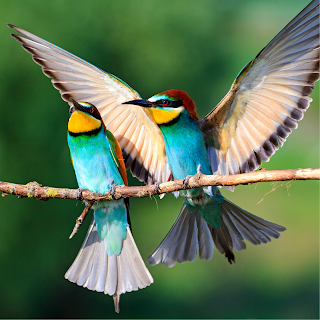
Friday, 7 August 2026

AVES: LIVING DINOSAURS

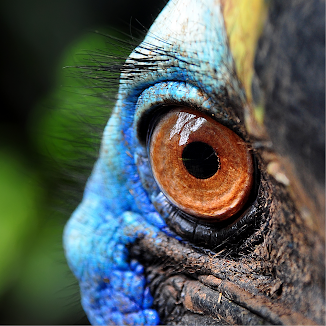
Cassowary, Casuariiformes
Wherever you are in the world, it is likely that you know your local birds. True, you may call them des Oiseaux, pássaros or uccelli — but you'll know their common names by heart.

You will also likely know their sounds. The tweets, chirps, hoots and caws of the species living in your backyard.

Birds come in all shapes and sizes and their brethren blanket the globe. It is amazing to think that they all sprang from the same lineage given the sheer variety. 

If you picture them, we have such a variety on the planet — parrots, finches, wee hummingbirds, long-legged waterbirds, waddling penguins and showy toucans. 

But whether they are a gull, hawk, cuckoo, hornbill, potoo or albatross, they are all cousins in the warm-blooded vertebrate class Aves. 

The defining features of the Aves are feathers, toothless beaked jaws, the laying of hard-shelled eggs, a high metabolic rate, a four-chambered heart, and a strong yet lightweight skeleton. The best features, their ability to dance, bounce and sing, are not listed, but it is how I see them in the world.

These modern dinosaurs live worldwide and range in size from the 5 cm (2 in) bee hummingbird to the 2.75 m (9 ft) ostrich. 

There are about ten thousand living species, more than half of which are passerine, or "perching" birds. Birds have wings whose development varies according to species; the only known groups without wings are the extinct moa and elephant birds.

Wings evolved from forelimbs giving birds the ability to fly
Wings, which evolved from forelimbs, gave birds the ability to fly, although further evolution has led to the loss of flight in some birds, including ratites, penguins, and diverse endemic island species. 

The digestive and respiratory systems of birds are also uniquely adapted for flight. Some bird species of aquatic environments, particularly seabirds and some waterbirds, have further evolved for swimming.

Wee Feathered Theropod Dinosaurs

We now know from fossil and biological evidence that birds are a specialized subgroup of theropod dinosaurs, and more specifically, they are members of Maniraptora, a group of theropods that includes dromaeosaurs and oviraptorids, amongst others. As palaeontologists discover more theropods closely related to birds, the previously clear distinction between non-birds and birds has become a bit muddy.

Recent discoveries in the Liaoning Province of northeast China, which include many small theropod feathered dinosaurs — and some excellent arty reproductions — contribute to this ambiguity. 

Still, other fossil specimens found here shed a light on the evolution of Aves. Confuciusornis sanctus, an Early Cretaceous bird from the Yixian and Jiufotang Formations of China is the oldest known bird to have a beak.

Like modern birds, Confuciusornis had a toothless beak, but close relatives of modern birds such as Hesperornis and Ichthyornis were toothed, telling us that the loss of teeth occurred convergently in Confuciusornis and living birds.

The consensus view in contemporary palaeontology is that the flying theropods, or avialans, are the closest relatives of the deinonychosaurs, which include dromaeosaurids and troodontids.

Together, these form a group called Paraves. Some basal members of this group, such as Microraptor, have features that may have enabled them to glide or fly. 

The most basal deinonychosaurs were wee little things. This raises the possibility that the ancestor of all paravians may have been arboreal, have been able to glide, or both. Unlike Archaeopteryx and the non-avialan feathered dinosaurs, who primarily ate meat, tummy contents from recent avialan studies suggest that the first avialans were omnivores. Even more intriguing...

Avialae, which translates to bird wings, are a clade of flying dinosaurs containing the only living dinosaurs, the birds. It is usually defined as all theropod dinosaurs more closely related to modern birds — Aves — than to deinonychosaurs, though alternative definitions are occasionally bantered back and forth.

The Earliest Avialan: Archaeopteryx lithographica

Archaeopteryx, bird-like dinosaur from the Late Jurassic
Archaeopteryx lithographica, from the late Jurassic Period Solnhofen Formation of Germany, is the earliest known avialan that may have had the capability of powered flight. 

However, several older avialans are known from the Late Jurassic Tiaojishan Formation of China, dating to about 160 million years ago.

The Late Jurassic Archaeopteryx is well-known as one of the first transitional fossils to be found, and it provided support for the theory of evolution in the late 19th century. 

Archaeopteryx was the first fossil to clearly display both traditional reptilian characteristics — teeth, clawed fingers, and a long, lizard-like tail—as well as wings with flight feathers similar to those of modern birds. It is not considered a direct ancestor of birds, though it is possibly closely related to the true ancestor.

Unlikely yet true, the closest living relatives of birds are the crocodilians. Birds are descendants of the primitive avialans — whose members include Archaeopteryx — which first appeared about 160 million years ago in China.

DNA evidence tells us that modern birds — Neornithes — evolved in the Middle to Late Cretaceous, and diversified dramatically around the time of the Cretaceous–Paleogene extinction event 66 mya, which killed off the pterosaurs and all non-avian dinosaurs.

In birds, the brain, especially the telencephalon, is remarkably developed, both in relative volume and complexity. Unlike most early‐branching sauropsids, the adults of birds and other archosaurs have a well‐ossified neurocranium. In contrast to most of their reptilian relatives, but similar to what we see in mammals, bird brains fit closely to the endocranial cavity so that major external features are reflected in the endocasts. What you see on the inside is what you see on the outside.

This makes birds an excellent group for palaeoneurological investigations. The first observation of the brain in a long‐extinct bird was made in the first quarter of the 19th century. However, it was not until the 2000s and the application of modern imaging technologies that avian palaeoneurology really took off.

Understanding how the mode of life is reflected in the external morphology of the brains of birds is but one of several future directions in which avian palaeoneurological research may extend.

Although the number of fossil specimens suitable for palaeoneurological explorations is considerably smaller in birds than in mammals and will very likely remain so, the coming years will certainly witness a momentous strengthening of this rapidly growing field of research at the overlap between ornithology, palaeontology, evolutionary biology and the neurosciences.

Reference: Cau, Andrea; Brougham, Tom; Naish, Darren (2015). "The phylogenetic affinities of the bizarre Late Cretaceous Romanian theropod Balaur bondoc (Dinosauria, Maniraptora): Dromaeosaurid or flightless bird?". PeerJ. 3: e1032. doi:10.7717/peerj.1032. PMC 4476167. PMID 26157616.

Reference: Ivanov, M., Hrdlickova, S. & Gregorova, R. (2001) The Complete Encyclopedia of Fossils. Rebo Publishers, Netherlands. p. 312.

Thursday, 6 August 2026

DRIFTWOOD CANYON FOSSIL BEDS

Puffbird similar to Fossil Birds found at Driftwood Canyon 
Driftwood Canyon Provincial Park 

Driftwood Canyon Provincial Park covers 23 hectares of the Bulkley River Valley, on the east side of Driftwood Creek, a tributary of the Bulkley River, 10 km northeast of the town of Smithers in northern British Columbia. 

Driftwood Canyon is recognized as one of the world’s most significant fossil beds. 

It provides park users with a fascinating opportunity to understand the area’s evolutionary processes of both geology and biology. The day-use area is open from May 15 to September 2. There is a short, wheelchair-accessible interpretative trail that leads from the parking are to the fossil beds. Pets are welcome on leash. Signs along the trail provide information on fossils and local history. 

Wet'suwet'en First Nation

The parklands are part of the Traditional Territory of the Wet'suwet'en First Nation which includes lands around the Bulkley River, Burns Lake, Broman Lake, and François Lake in the northwestern Central Interior of British Columbia. 

The Wetʼsuwetʼen are part of the Dakelh or Carrier First Nation, and in combination with the Babine First Nation are referred to as the Western Carrier. They speak Witsuwitʼen, a dialect of the Babine-Witsuwitʼen language which, like its sister language Carrier, is a member of the Athabaskan family.

Their oral history or kungax recounts a time when their ancestral village, Dizkle or Dzilke, once stood upstream from the Bulkley Canyon. This cluster of cedar houses on both sides of the river was said to be abandoned because of an omen of impending disaster. The exact location of the village has been lost but their stories live on. 

The neighbouring Gitxsan, collectively the People of Smooth Waters—the Gilseyhu Big Frog Clan, the Laksilyu Small Frog Clan, the Tsayu Beaver Clan, the Gitdumden Wolf and Bear Clan and the Laksamshu Fireweed and Owl Clan—each phratry or kinship group calling the Lax Yip home—33,000 km2 of land and water in northwestern ​British Columbia along the waters of the Skeena River and its tributaries—have a similar tale—though the village in their versions is referred to as Dimlahamid or Temlahan depending on which house group or wilp is sharing the tale—as well as where they are located as dialects differ. 

Gitksan speak Sim'algaxthe real or true language. Within the Gitxsan communities there are two slightly different dialects. The Gyeets (Downriver) dialect spoken in Gijigyukwhla (Gitsegukla), Gitwangax, and Gitanyow—and the Gigeenix (Upriver) dialect is spoken in Ansbayaxw (Kispiox), Sik-E-Dakh and Gitanmaax.

Driftwood Canyon Fossil Beds

Driftwood Canyon's Fossil Beds record life in the earlier portion of the Eocene when British Columbia — and indeed our world — was much warmer than it is today. This site was discovered in the beginning of the 20th century and is now recognized as containing significant fossil material. 

I was speaking this week with a friend and classmate recently from a Traditional Ecological Knowledge course through the University of Northern British Columbia, Jessy, about Driftwood Canyon and the fossil resources found here.

The fossils are tremendous—and their superb preservation—provide a fascinating opportunity to understand the area’s evolutionary processes of both geology and biology over the past fifty million years or so. The fossils themselves are 51.7 million years old and look remarkably like many of the species we recognize today. 

The fossil beds are on the east side of Driftwood Creek, C’ide’Yikwah in Witsuwit’en, which has its headwaters in the main, southwest facing basin of the Babine Mountains. The park that contains these beautiful fossils is fifty-seven years old. 

It was created in 1967 by the generosity of the late Gordon Harvey (1913–1976). He donated the land to protect fossil resources that he truly loved and wanted to see preserved. How Harvey came to be in a position to donate lands once part of a First Nation Traditional Territory will need to be explored deeper. I will share as I learn more about this as I learn more from locals and the local history museum in the coming weeks and months.

Metasequoia, the Dawn Redwood
Exploring the region today, we see a landscape dominated by conifers blanketing the area. 

Forests teem with the aromatic Western Red Cedar, Pacific Silver Fir with its many medicinal properties, the tall and lanky Subalpine Fir with its soft, brittle and quickly decaying wood, the slender scaly Lodgepole Pine, the graceful and slightly forlorn looking Western Hemlock. 

Across the landscape you see several species of Spruce, including the impressive Sitka, Picea sitchensis, the world's largest spruce tree who live up to an impressive 800 years. 

The stands of mature Sitka standing here today were just being established in this ground back in 1921 when Smithers was designated as the first incorporated village in British Columbia. They are slow to establish and get going, but once embedded are amongst the fastest growing trees we see on the western edge of Canada, colonizing glacial moraines with their cold resistant stock centuries ago when the glaciers that once covered this land eventually retreated.

Some of the tallest on view would have been mere seedlings, colonizing the glacial moraines centuries ago when the glaciers retreated. Collectively, these conifers tell the tale of the region's cool climate today. 

The Gitsan territory boasts seven of the 14 biogeoclimatic zones of the province—the Alpine Tundra, Spruce-Willow-Birch, Boreal White and Black Spruce, Sub-Boreal Pine-Spruce, Sub-Boreal Spruce, Engelmann Spruce-Subalpine Fir and Interior Cedar-Hemlock. 

The fossil material we find here speaks to a warmer climate in this region's past. We find fossil plants, fish—including specimens of salmon, suckerfish and bowfin, a type of air breathing fish—and insect fossil here—wasps and water striders—fossil plants including Metasequoia, the Dawn Redwood, alder—and interesting vertebrate material. Bird feathers are infrequently collected from the shales; however, two bird body fossils have been found here.

In 1968, a bird body fossil was collected in the Eocene shales of the Ootsa Lake Group in Driftwood Canyon Provincial Park by Pat Petley of Kamloops. 

Pat donated the specimen in 2000 to the Thompson Rivers University (TRU) palaeontology collections. This fossil bird specimen is tentatively identified as the puffbird, Piciformes bucconidae, of the genus Primobucco.

Primobucco is an extinct genus of bird placed in its own family, Primobucconidae. The type species, Primobucco mcgrewi, lived during the Lower Eocene of North America. It was initially described by American paleo-ornithologist Pierce Brodkorb in 1970, from a fossil right-wing, and thought to be an early puffbird. However, the discovery of a further 12 fossils in 2010 indicate that it is instead an early type of roller.

Related fossils from the European Messel deposits have been assigned to the two species P. perneri and P. frugilegus. Two specimens of P. frugilegus have been found with seeds in the area of their digestive tract, which suggests that these birds were more omnivorous than the exclusively predaceous modern rollers. The Driftwood specimen has never been thoroughly studied. If there is a grad student out there looking for a worthy thesis, head on down to the Thompson Rivers University where you'll find the specimen on display.

Another fossil bird, complete with feathers, was collected at Driftwood Canyon in 1970, This one was found by Margret and Albrecht Klöckner who were travelling from Germany. Theirs is a well-travelled specimen, having visited many sites in BC as they toured around, then to Germany and finally back to British Columbia when it was repatriated and donated to the Royal British Columbia Museum in Victoria. 

I am not sure if it is still on display or back in collections, but it was lovingly displayed back in 2008. There is a new grad student, Alexis, looking at Eocene bird feathers down at the RBCM, so perhaps it is once again doing the rounds. 

This second bird fossil is of a long-legged water bird and has been tentatively identified by Dr. Gareth Dyke of the University of Southampton as possibly from the order Charadriiformes, a diverse order of small to medium-ish water birds that include 350 species of gulls, plovers, sandpipers, terns, snipes, and waders. Hopefully, we'll hear more on this find in the future.

A Tapir showing off his prehensile nose trunk
Tapirs and Tiny Hedgehogs

The outcrops at Driftwood Canyon are also special because they record a record of some of the first fossil mammals ever to be found in British Columbia at this pivotal point in time. 

Wee proto-hedgehogs smaller than your thumb lived in the undergrowth of that fossil flora. They shared the forest floor with an extinct tapir-like herbivore in the genus Heptodon that looked remarkably similar to his modern, extant cousins (there is a rather cheeky fellow shown here so you get the idea) but lacked their pronounced snout (proboscis). I am guessing that omission made him the more fetching of his lineage.

In both cases, it was a fossilized jaw bone that was recovered from the mud, silt and volcanic ash outcrops in this ancient lakebed site. And these two cuties are significant— they are the very first fossil mammals we've ever found from the early Eocene south of the Arctic.

How can we be sure of the timing? The fossil outcrops here are found within an ancient lakebed. Volcanic eruptions 51 million years ago put loads of fine dust into the air that settled then sank to the bottom of the lake, preserving the specimens that found their way here — leaves, insects, birds, mammals.

As well as turning the lake into a fossil making machine—water, ash, loads of steady sediment to cover specimens and stave off predation—the volcanic ash contains the very chemically inert—resistant to mechanical weathering—mineral zircon which we can date with uranium/lead (U/Pb). 

The U/Pb isotopic dating technique is wonderfully accurate and mighty helpful in dating geologic events from volcanic eruptions, continental movements to mass extinctions. This means we know exactly when these lovelies were fossilized and, in turn, their significance.

Know Before You Go

If you fancy a visit to Driftwood Canyon Park, the park is accessible from Driftwood Road from Provincial Highway 16. You are welcome to view and photograph the fossils found here but collecting is strictly forbidden. 

Driftwood Canyon is recognized as one of the world’s most significant fossil beds. It provides park users with a fascinating opportunity to understand the area’s evolutionary processes of both geology and biology. The day-use area is open from May 15 to September 2. There is a short, wheelchair-accessible interpretative trail that leads from the parking are to the fossil beds. Pets are welcome on leash. Signs along the trail provide information on fossils and local history. 

Below a cliff face at the end of the trail is a viewing area that has interpretive information and viewing area overlooking Driftwood Creek.

This park proudly operated by Mark and Anais Drydyk
Email: kermodeparks@gmail.com / Tel: 1 250 877-1482 or 1 250 877-1782

Palaeo Coordinates: Latitude: 50° 51' 59" N / Longitude: 116° 27' 37" W
Lat/Long (dec): 50.86665,-116.46042 / GUID: d3a6bd3e-68d6-42cf-9b2c-d20a30576988

Driftwood Canyon Provincial Park Brochure: 
https://bcparks.ca/explore/parkpgs/driftwood_cyn/driftwood-canyon-brochure.pdf?v=1638723136455

Sheila Peters: Driftwood Creek – and the ways we cross it; here Sheila Peters shares a wonderful lived history which I have not had the pleasure to yet fully explore as of 09 February 2025. I do recommend you checking out her post as it contains information and photographs worthy of a newcomers visit to the area.
Link: https://sheilapeters.com/tag/peavine-harvey/
.


Wednesday, 5 August 2026

LA BREA TAR PITS: STICKY DEATH AND DIRE WOLVES

Smilodon Skull at La Brea Tar Pits
In the heart of Los Angeles, surrounded by traffic, office towers and people carrying coffees of improbable complexity, the Earth is still bubbling. 

Dark pools of natural asphalt rise through the ground at Hancock Park, methane breaks at the surface and the air carries the unmistakable scent of petroleum. 

Beneath the lawns and walkways lies one of the richest Late Pleistocene fossil deposits on Earth.

Mammoths are here. Dire wolves are here. Sabre-toothed cats, enormous bison, ancient horses, camels, ground sloths, coyotes, birds, beetles, seeds, pollen and the delicate bones of tiny rodents are all here. 

Not alive, mercifully, but preserved in extraordinary numbers beneath modern Los Angeles, where natural asphalt seeps have been trapping plants and animals for tens of thousands of years.

The La Brea Tar Pits do not record one terrible day. They contain the accumulated evidence of countless separate accidents repeated across millennia. One animal became trapped, another arrived to investigate and several more approached because the Ice Age had not yet developed adequate warning signage.

FIRST, THEY ARE NOT ACTUALLY TAR PITS

The substance at La Brea is more accurately called natural asphalt, asphaltum or bitumen. Tar is generally produced by heating organic materials such as wood or coal, while asphalt is a naturally occurring petroleum substance. The familiar name has nevertheless stuck, which seems appropriate under the circumstances.

There is also a pleasing redundancy in “La Brea Tar Pits.” La brea means “the tar” in Spanish, making the full name roughly “the Tar Tar Pits.” 

It always has me thinking of Jar Jar Binks from Star Wars — “the Tar Tar Pits” has that same playful rhythm.

We could insist upon calling them the La Brea Asphalt Seeps, but that would deprive palaeontology of a perfectly good geological tongue-twister.

Beneath the Los Angeles Basin are thick, oil-rich marine deposits laid down millions of years ago. Petroleum migrated upward through faults and fractures until it reached the surface. There, lighter components evaporated or were degraded by microorganisms, leaving the heavier and remarkably sticky asphalt behind.

This material did not necessarily form the enormous open pools often depicted in paintings and museum dioramas. Asphalt could seep into shallow depressions and spread across the ground, sometimes hidden beneath water, dust, leaves or sediment. To an approaching animal, the surface may have looked like ordinary damp soil or a harmless watering place.

The mistake would become apparent with the first step.

THE MAKING OF A PREDATOR TRAP

An asphalt seep did not need to be deep enough to swallow a mammoth whole. It needed only to be sticky enough to hold a foot. Once a hoof sank into the asphalt, the animal’s attempts to pull free could trap another limb. Struggling pressed the feet deeper, spread asphalt across hair and skin and rapidly exhausted the victim.

Large herbivores such as bison, horses, camels, mammoths and ground sloths occasionally became immobilized in this way. Their distress calls and movements attracted predators and scavengers. 

A trapped bison represented a large meal that had already been thoughtfully restrained, and predators approached the opportunity with understandable enthusiasm and insufficient caution.

Dire wolves gathered. Sabre-toothed cats moved closer. Coyotes and scavenging birds arrived. Some fed from firmer ground, while others stepped onto the same deceptive surface and became trapped themselves.

This process is known as the predator-trap hypothesis, and it helps explain the remarkable abundance of carnivores in the La Brea deposits. One struggling herbivore could attract several predators and scavengers, producing a fossil assemblage in which carnivores greatly outnumber herbivores.

Roughly 70 to 80 per cent of the site’s larger mammal specimens are carnivores. That is almost the reverse of what we would expect in a living ecosystem, where herbivores generally outnumber large predators. The Natural History Museums of Los Angeles County notes that this carnivore-heavy composition distinguishes La Brea from most other fossil deposits.

This does not mean Ice Age Los Angeles was carpeted in dire wolves with the occasional bison squeezed between them. It means the asphalt seeps selectively trapped animals attracted to struggling prey. The deposit records not only which species lived in the region, but also how their behaviour influenced their likelihood of preservation.

The fossil record is rarely an impartial census. At La Brea, it is closer to a list of everyone who approached the buffet without first inspecting the floor.

DIRE WOLVES, SABRE-TOOTHED CATS AND ANCIENT COYOTES

Dire wolves were among the most frequently trapped large mammals. Known scientifically as Aenocyon dirus, they were heavily built canids that lived across the Americas during the Late Pleistocene. They had robust jaws and teeth suited to feeding on large prey, although, like living wolves, they probably scavenged when a meal presented itself.

Their abundance at La Brea may provide indirect evidence of social behaviour. If dire wolves hunted or scavenged in groups, one trapped herbivore might attract several pack members. A single incident could therefore add multiple wolves to the deposit. One meal, several hopeful carnivores and a deeply regrettable group decision.

The large collection allows researchers to study dire wolves as a population rather than as a scattering of isolated specimens. Individual animals can be compared for age, body size, tooth wear, injury and disease. Changes in anatomy and diet can also be tracked through time.

The most famous predator at La Brea is Smilodon fatalis, the sabre-toothed cat. If you have seen the skull and teeth of this kitty, you will agree the name is apt. 

A fun fact and wee aside, Canada's first Smilodon was found in a drawer in a museum by Dr. Rufus Churcher when he was poking about an old collection in Alberta. A wonderful storyteller with a keen eye, we owe that man a lot.

It was not a tiger, despite the enduring popularity of the name “sabre-toothed tiger.” Smilodon belonged to an extinct branch of the cat family and had a body built quite differently from that of modern lions or tigers.

It possessed enormous upper canine teeth, exceptionally powerful forelimbs, a deep chest and a relatively short tail. Its jaw could open extraordinarily wide, allowing those elongated canines to be used without colliding with the lower jaw. Rather than pursuing prey over long distances, Smilodon was likely an ambush predator. Its muscular forelimbs may have helped restrain large prey while it delivered a carefully positioned bite.

This was important because the famous canine teeth, though formidable, were not indestructible. They were effective weapons but poor candidates for being driven casually into struggling bone. Even the Ice Age’s most dramatic dental arrangement required responsible handling.

La Brea specimens preserve evidence of arthritis, fractures, tooth damage and healing. Some animals survived serious injuries long enough for their bones to repair. This has raised intriguing questions about whether sabre-toothed cats lived socially and whether impaired individuals may have received food or protection from others.

Healing proves survival, but it does not automatically prove social care. An injured animal might have scavenged, selected smaller prey or simply endured. We must distinguish what a bone demonstrates from what it merely suggests. Still, the injuries reveal that these cats had individual histories. They aged, suffered accidents, recovered and continued living in a landscape filled with large prey, competing carnivores and treacherously sticky patches of ground.

Coyotes, Canis latrans, also occur abundantly at La Brea, but unlike dire wolves and sabre-toothed cats, they survived the end-Pleistocene extinction. Their ecological flexibility may have given them an advantage. Coyotes can eat mammals, insects, fruit, carrion and an impressive assortment of whatever else becomes available. They can occupy deserts, grasslands, woodlands, agricultural areas and cities.

Large specialists often thrive when their preferred prey and habitats are stable, but they can struggle when ecosystems change rapidly. Coyotes appear to have regarded climatic upheaval, megafaunal extinction and the eventual construction of Los Angeles as challenges requiring only minor adjustments.

They still live in the city today.

MAMMOTHS, MASTODONS AND CAMELS IN CALIFORNIA

The herbivores preserved at La Brea include ancient bison, horses, camels, deer, pronghorn, mammoths and mastodons. Together, they reveal a Southern California landscape quite different from the one we know today.

Columbian mammoths, Mammuthus columbi, were enormous members of the elephant family. They possessed long, curving tusks and high-crowned ridged teeth suited to processing abrasive vegetation. Their diets varied across environments and could include both grasses and other plants.

American mastodons, Mammut americanum, were shorter and more heavily built, with molar teeth bearing rounded cusps. These teeth were better suited to crushing leaves, twigs and branches. Mammoths and mastodons were related, but they were not interchangeable shaggy elephants wandering through identical habitats.

Their teeth record the difference rather elegantly. Mammoth molars resemble enormous washboards. Mastodon molars carry prominent rounded cusps, which gave the animal its name: “mastodon” refers to the breast-like shape of the tooth projections. Palaeontology occasionally arrives at terminology by routes we might not choose today.

One of the site’s remarkable discoveries is a largely complete Columbian mammoth nicknamed Zed. His remains were uncovered in 2006 during the construction of an underground parking facility beside the Los Angeles County Museum of Art. Zed. 

Not every major palaeontological discovery requires an expedition to a distant desert. Sometimes they require a construction crew, a parking proposal and someone sensible enough to stop digging. If you have a chance, look up the Dove Creek Mosasaur find. Similar story. Different place. Equally eagle-eyed humans. I'm thinking of you, Rick Ross! 

Ancient camels also lived in Ice Age California. The western camel, Camelops hesternus, was a large North American member of the camel family. This seems surprising only because we associate camels with Africa and Asia today. Camels actually evolved in North America and lived on the continent for tens of millions of years. Some migrated into Eurasia across Beringia, while others moved into South America and eventually gave rise to llamas, alpacas, guanacos and vicuñas.

The disappearance of camels from North America is the unusual part. Their presence at La Brea was perfectly ordinary at the time.

PROJECT 23: PALAEONTOLOGY BY WOODEN BOX

When construction near the Tar Pits encountered fossil deposits in 2006, excavating every specimen individually would have delayed work for an extremely long time. Instead, palaeontologists and engineers built large wooden crates around 23 fossil-bearing deposits. The blocks were lifted intact and moved to La Brea Tar Pits, where they could be excavated under controlled conditions.

The operation became known as Project 23.

Along with the boxed deposits came 327 buckets of fossil-rich sediment. The material contains large mammal bones, but also turtles, fish, snails, insects, seeds, leaves, small vertebrates and other remains essential to reconstructing the wider ecosystem. The museum’s Project 23 overview notes that researchers will be processing this enormous collection for years.

Project 23 demonstrates an important reality of modern palaeontology: fossil discovery frequently occurs during construction. Roads, foundations, mines and parking structures expose geological layers that would otherwise remain hidden. When scientific teams and developers work together, these unexpected discoveries can be recovered without sacrificing either the fossils or the project.

It also proves that if you place 23 enormous crates of asphalt-soaked Ice Age sediment in front of palaeontologists, they will be happily occupied for the foreseeable future.

THE TINY FOSSILS THAT RECONSTRUCT A LANDSCAPE

Mammoths and sabre-toothed cats attract attention, but some of La Brea’s most informative fossils are less than a centimetre long.

The asphalt and surrounding sediments preserve insects, spiders, seeds, leaves, pollen, molluscs, fish, frogs, lizards, bird bones, rodent teeth and tiny skeletal fragments. These remains are recovered from the excavated sediment, or matrix, which is carefully processed and examined under microscopes.

Staff and volunteers sort through it grain by grain. It is patient, meticulous work requiring steady hands and an ability to become sincerely delighted by something resembling a burnt sesame seed.

Microfossils allow researchers to reconstruct details that large mammal bones cannot provide. Pollen and seeds identify ancient vegetation. Beetles and other insects can indicate temperature, moisture and local habitat. Frogs and salamanders reveal the presence of freshwater or damp environments. Rodents can be sensitive indicators of particular ecological conditions.

The La Brea Fossil Lab emphasizes the importance of these small fossils for understanding environmental and climatic change during the Late Pleistocene.

Large mammals tell us who occupied the landscape. Microfossils tell us what the landscape was like.

Ice Age Los Angeles was not buried beneath a continental glacier. The region was generally cooler and wetter than it is today, with streams, grasslands, scrub and woodlands of oak and juniper. Mammoths, bison, horses and camels moved through these habitats while predators followed them.

It was recognizably Southern California, but with more water, fewer freeways and a substantial increase in large mammals capable of overturning your vehicle.

HOW ASPHALT PRESERVED THE FOSSILS

When animals became trapped, their bodies decayed and their bones sank into asphalt-rich sediment. Petroleum entered the pores of the bones, staining them dark brown or black and helping protect them from weathering and some forms of microbial destruction.

The asphalt also preserved delicate biological materials rarely retained at other fossil sites. These include bone collagen, plant cellulose and chitin from insect exoskeletons. Such materials can be used for radiocarbon dating, stable-isotope analysis and other forms of biochemical research.

La Brea is an exceptional Late Quaternary fossil deposit created by petroleum seepage over approximately the past 60,000 years. Its geoheritage profile notes that the site preserves millions of fossils representing hundreds of species.

The preservative, however, is also a contaminant. Petroleum contains ancient carbon that can distort radiocarbon dates. Researchers must therefore remove the asphalt carefully and isolate original organic material from the fossil.

The substance that protected the bone for tens of thousands of years must be persuaded to leave before the bone will surrender its age.

La Brea likes to keep its secrets sticky.

DATING EXTINCTION

Specialized methods for removing petroleum contamination have allowed researchers to obtain increasingly reliable radiocarbon dates from La Brea specimens.

In a major study of Ice Age extinction, scientists produced approximately 170 new dates for coyotes, horses, camels, bison, sabre-toothed cats, giant ground sloths, American lions and dire wolves. These dates helped establish when each species disappeared from Southern California.

The results suggest that the regional extinction did not occur in one sudden event. Large mammals vanished as the climate warmed, drought intensified, vegetation changed and fire activity increased. Human populations were also becoming established in the region, adding another ecological influence.

These pressures interacted. A warming climate altered habitats. Drought dried vegetation. Fire transformed plant communities. Large herbivores lost forage, while predators lost prey. Species able to change their diets or behaviour had an advantage over those dependent on a narrower range of conditions.

The Natural History Museums of Los Angeles County describes La Brea as an exceptional record because some species are represented by hundreds or thousands of individuals. This makes it possible to study not simply their existence, but their decline and disappearance through time.

The Tar Pits preserve extinct animals, but more importantly, they preserve the approach of extinction.

GIANT GROUND SLOTHS AND OTHER UNEXPECTED RESIDENTS

Among the more impressive herbivores at La Brea was Harlan’s ground sloth, Paramylodon harlani. Unlike modern tree sloths, it lived on the ground and possessed a heavily built body, powerful limbs and long claws. Small bony plates called osteoderms were embedded within its skin, providing an additional layer of protection.

It may have used its claws to pull down vegetation, dig for roots or defend itself from predators. When standing partly upright and supported by its tail, it could reach vegetation well above the ground.

Modern sloths give the impression that they would apologize for occupying your chair. Giant ground sloths look as though they might take the chair, the dining table and the adjacent shrubbery.

The deposits also preserve American lions, short-faced bears, pronghorn, peccaries and native horses, alongside reptiles, amphibians and an extraordinary diversity of birds. Asphalt is particularly effective at preserving delicate hollow bird bones, which are easily destroyed at other sites. As a result, La Brea holds one of the world’s largest fossil bird collections.

The birds are not merely background characters. Eagles, vultures, owls, ravens, waterbirds and songbirds occupied different parts of the ecosystem. Their remains help reconstruct habitats and food webs, while changes in bird communities can reflect broader environmental change.

ASPHALT AS A CULTURAL RESOURCE

The La Brea landscape has a human history as well as a palaeontological one. Indigenous peoples knew and used natural asphalt long before scientific excavation or commercial extraction began.

Tongva and Chumash peoples used asphalt to waterproof baskets and canoes, improve tools and create decorative objects. The material was also traded across the region. Educational material from La Brea Tar Pits recognizes this long history of Indigenous knowledge and use.

The asphalt was therefore not simply a dangerous geological substance. In knowledgeable hands, it was a valuable technology.

Commercial mining and extraction followed much later. Asphalt from Rancho La Brea was used for roofing and road construction before the area became protected for its fossils.

The site cannot be understood only as a trap for Ice Age animals. It is a cultural landscape where people observed, understood and worked with a distinctive natural resource for thousands of years.

A COLLECTION OF MILLIONS

Scientific excavation at La Brea began in earnest in 1913, although fossil bones had been encountered earlier. More than 100 excavations have since been conducted.

At the collection’s last comprehensive census in 1992, it already contained more than 3.5 million specimens. That number includes everything from large mammal bones to insects, seeds and tiny vertebrate remains. The La Brea collections include more than 60 mammal species, along with birds, reptiles, amphibians, fishes, molluscs, arthropods and plants.

The site remains scientifically active. Asphalt continues to seep, methane continues to bubble and fossil-bearing deposits continue to be excavated. La Brea is not a completed quarry whose discoveries are safely finished and catalogued. It is an active research site in the middle of a major city.

Beneath the lawns, streets and buildings, the Ice Age is still present.

A FOSSIL RECORD WITH A TRAP BUILT INTO IT

La Brea offers a particularly useful lesson in how fossil deposits must be interpreted.

The asphalt did not collect organisms fairly. Large animals were more likely to become immobilized than very small ones. Carnivores and scavengers were disproportionately drawn to trapped herbivores. Birds, insects and plants entered the deposits through different pathways. Individual seeps may also have accumulated remains over hundreds or thousands of years rather than during a single event.

We cannot simply count the fossils and assume the resulting proportions mirror the living community. More dire wolf bones do not prove that dire wolves vastly outnumbered bison across the landscape. 

They may demonstrate that dire wolves were social, attracted to distressed prey and willing to step onto suspicious ground when meat was involved.

Understanding how remains accumulated is the work of taphonomy—the study of everything that happens between an organism’s death and its discovery as a fossil.

La Brea is both a window and a filter. It reveals the Ice Age, but it reveals it through asphalt.

THE STICKY ARCHIVE OF LOS ANGELES

There is something wonderfully improbable about La Brea. A city famous for reinvention sits above an archive of extinction. Traffic moves along Wilshire Boulevard while methane rises from petroleum formed by ancient marine organisms. 

People walk through Hancock Park above the remains of mammoths, dire wolves and sabre-toothed cats. The past is not somewhere else. It is directly beneath the picnic blanket. Oh, how I would love to dig a little but they frown on that sort of thing in parks. Shame. Yes, we can see wonderful examples in the museum, but it is sheer pleasure to excavate yourself.

The Tar Pits preserve death in overwhelming abundance, but their scientific value lies in what they reveal about life. Their fossils tell us what animals ate, how they were injured, which plants grew around them and how ecosystems responded as the climate changed. Tiny seeds document shifting vegetation. Tooth enamel preserves chemical evidence of diet. Bones record growth, disease and survival.

Even the strange abundance of carnivores tells a story. One trapped herbivore could attract several predators. One tempting meal could produce fossils studied tens of thousands of years later.

The asphalt waited. The animals approached, encouraged by hunger and betrayed by optimism.

And the Earth kept every receipt.

Image Credit: Asset id: 2278428163. Prehistoric bones and the skull of saber-tooth cat, Smilodon fatalis, in a block of resin at the La Brea Tar Pits, Los Angeles, California.

Tuesday, 4 August 2026

HOW DO FOSSILS FORM? THE MOST UNLIKELY AFTERLIFE ON EARTH

Let us begin with a rather brutal truth. You are probably not going to become a fossil.

Neither am I.

Neither is the salmon that washed onto the riverbank, the beetle beneath the cedar tree nor the unfortunate vole currently being carried away by an owl.

Most living things disappear completely after death. 

They are eaten, scavenged, scattered, dissolved, trampled, weathered or dismantled by bacteria and fungi. Their nutrients return to the ecosystem, but their physical remains leave no lasting geological record.

Fossilization is the exception. Yet, it is still a conversation I have with my fossil friends more times than I can count. We would all love to become fossils ourselves. Geeky? Yes, but one can dream!

To become a fossil requires the right organism to die in the right place, at the right time, under the right conditions—and then remain protected through thousands, millions or even billions of years of geological upheaval.

To become a fossil is to win one of the most improbable lotteries on Earth.

Even then, success is not guaranteed. A fossil must survive burial, pressure, mineral-rich water, chemical change, shifting continents, rising mountains and erosion. Finally, it must reach the surface at precisely the moment when someone is there to recognize it.

Too early, and it remains hidden. Too late, and it erodes into dust.

Fossilization is therefore not a single event. It is a journey—a long and perilous passage from life to stone and, with extraordinary luck, back into the light.

STEP ONE: SOMETHING DIES

Upper Cambrian Trilobite
Every body fossil begins with death. This may happen quietly. A leaf drops into a lake. A clam dies on the seafloor. A fish sinks into deep water.

Or it may happen with considerably more geological enthusiasm.

A volcanic eruption blankets an ecosystem in ash. A flood sweeps animals into a river channel. A mudslide buries an entire community. A tree releases sticky resin around a struggling insect. A creature wanders into natural tar and discovers, much too late, that the surface is not as solid as advertised.

The cause of death can influence what happens next, but death alone does not begin fossilization.

The critical issue is what happens to the remains immediately afterward.

A dead organism is suddenly of great interest to nearly everything around it. Scavengers arrive. Insects feed and lay eggs. Microorganisms begin breaking down tissues. Sunlight, oxygen, water and temperature all accelerate physical and chemical change.

Fossilization begins as a race between destruction and preservation. Destruction usually wins.

STEP TWO: THE BODY BEGINS TO DECAY

Soft tissues generally disappear first.

Eyes, skin, internal organs, muscles and other delicate tissues are quickly attacked by bacteria, fungi, insects and scavengers. Under ordinary conditions, little may remain after days, weeks or months.

Hard parts last longer. Bones, teeth, shells, exoskeletons and wood resist decay, giving them a greater opportunity to be buried. This is why the fossil record contains far more shells and teeth than jellyfish and worms.

It is also why our picture of ancient life is biased.

An ecosystem may have been filled with soft-bodied creatures, but unless unusually favourable conditions preserved them, their absence from the fossil record can make them nearly invisible to us.

Imagine trying to reconstruct the modern ocean using only shark teeth, clam shells and the occasional whale bone. You would learn a great deal, but you would miss most of the story.

Hard body parts and rapid burial are two of the most important factors increasing an organism’s chance of fossilization. Without them, the journey often ends before it begins.

STEP THREE: RAPID BURIAL CHANGES EVERYTHING

Burial is the great opportunity.

When remains are quickly covered by mud, sand, silt, volcanic ash or another material, they become less accessible to scavengers and less exposed to weather.

Burial can also reduce the amount of oxygen reaching the remains. Many bacteria and scavenging organisms require oxygen, so low-oxygen conditions can slow decomposition.

This does not mean all buried organisms become fossils. Most do not. But rapid burial buys time.

The best locations for fossilization are therefore usually places where sediment accumulates:

  • River channels and floodplains
  • Lakes
  • Deltas
  • Beaches
  • Shallow seas
  • Deep ocean basins
  • Sand dunes
  • Caves
  • Volcanic ash deposits
  • Tar seeps
  • Peat bogs

An animal dying on a rocky mountaintop has poor prospects. Its remains may be scattered by wind, water and scavengers without ever being buried.

A clam dying on a muddy seafloor has much better odds. Sediment is already accumulating around it, and its shell is resistant to decay.

This is one reason marine organisms are so well represented in the fossil record. Oceans have covered enormous portions of the planet, and their floors provide vast areas where sediment can accumulate.

Many rocks now exposed high in mountains began as sediment beneath ancient seas.

Finding seashells on a mountain does not mean clams were once exceptionally skilled climbers. It means the seafloor was lifted. We can look to the Burgess Shale Biota as a wonderful example of this.

HOW MUCH BURIAL IS ENOUGH?

The first thin layer may protect remains temporarily, but continued burial is usually necessary for long-term preservation.

New sediment settles on top of older sediment. Layer after layer accumulates, gradually increasing the pressure on the material below.

The sediment becomes compacted. Water is squeezed from the spaces between grains. Dissolved minerals precipitate and act like cement, binding those grains together.

Loose mud may become shale. Sand may become sandstone. Accumulations of shells and carbonate mud may become limestone.

Sedimentary rocks form when deposited material is buried, compacted and cemented. These rocks are particularly important to palaeontology because they form at Earth’s surface under conditions capable of preserving evidence of life.

Fossils are rarely found in rocks that once existed as molten magma. Lava is not known for its gentle handling of organic remains.

Metamorphism can also destroy fossils. When sedimentary rocks are subjected to intense heat and pressure, their minerals recrystallize. Delicate structures may be distorted or erased entirely.

Fossils therefore survive best when their rocks experience enough burial to become solid, but not so much heat and pressure that their history is cooked beyond recognition.

It is a narrow path. Sinking to the bottom of a body of water with little to no oxygen will also do the trick in many cases. 

THE ODDS ARE NOT IN YOUR FAVOUR

Even rapid burial does not guarantee fossilization. The remains may later dissolve. Groundwater may carry them away. Geological pressure may crush them. The surrounding rock may be heated, folded, faulted or dragged deep into Earth’s crust.

Entire fossil-bearing formations can disappear through erosion or be transformed so completely that no recognizable trace of life remains.

Then there is the final difficulty: discovery.

A fossil may remain safely hidden underground for millions of years. Tectonic movement must lift the fossil-bearing rocks, and erosion must remove enough material to expose them at the surface.

Exposure creates another race against time.

Wind, rain, waves, frost and flowing water reveal fossils—but they also destroy them. A bone that survived 100 million years underground may begin crumbling within a few seasons of reaching the surface.

Someone must pass by during that brief window, notice an unusual shape and understand that it matters.

A line of vertebrae. The curve of a shell. A tooth emerging from sandstone. A delicate leaf pressed into shale.

The moment of discovery may feel sudden, but it is the final stage of a journey that began with death and continued through deep time.

AN IMPROBABLE MESSAGE FROM THE PAST

Fossils are often described as the remains of dead organisms. I prefer to think of them as survivors.

They survived decay, scavengers and weather. They survived burial, pressure and chemical change. They survived the shifting, folding and fracturing of Earth’s crust. Finally, they survived erosion long enough for someone to find them.

Monday, 3 August 2026

SAXMAN TOTEM PARK AND TLINGIT HISTORY

In the hard-edged years of the Great Depression, when darkness settled across the American economy and hope felt threadbare, President Franklin D. Roosevelt launched an unprecedented experiment. 

His New Deal programs sent electricity into rural Tennessee, built schools and dams across the nation, and—far to the northwest in the dripping rainforests of Southeast Alaska—sparked a cultural resurgence few federal planners could have imagined.

Between 1938 and 1942, more than two hundred Tlingit and Haida artists were hired through the Civilian Conservation Corps (CCC). 

Their charge was to carve monumental cedar poles and restore others standing in the mossy remains of unoccupied villages. 

Officials imagined the creation of “totem parks” that would lure American tourists northward. Perhaps not in the short term, as the recession raged across the nation and the world, but eventually, these parks would bring new visitors and their welcome dollars to the north.

Instead, the project became something far more profound: a revitalization of cultural memory, clan identity, and sovereignty, expressed through carving, paint, story, and the spirits of crest beings older than the United States itself.

Historian Emily L. Moore explores this unlikely convergence in her landmark book Proud Raven, Panting Wolf: Carving Alaska’s New Deal Totem Parks. 

Her research reveals the New Deal not as a moment of cultural salvage, but as one of Indigenous resurgence—an era when Tlingit families reclaimed their visual histories and reaffirmed their relationships to ancestral land.
 
Crests: Living Ancestors, Sacred Property

To understand the poles of Saxman Totem Park, one must understand the Crests depicted upon them. Among the Tlingit, a Crest is not a symbol in the Western sense. 

It is a living being—an animal person, a supernatural entity, or a powerful natural force—encountered by clan ancestors in the ancient past. 

 Dogfish Memorial Pole for Chief Ebbits 
These encounters, often world-changing and sometimes life-threatening, established the unique identity, character, and territorial rights of each clan.

The right to depict a Crest is sacred. In many histories, the ownership of a crest was acquired as kaa naawuweidi'—a payment for the life of an ancestor who survived or was lost during the clan's originating event—a death for a crest. 

That payment bestowed upon the clan not only the right to portray the being, but stewardship over its spirit, the land where the encounter occurred, and all material expressions of that relationship. 

These include carved house screens, frontlets and headdresses, Chilkat robes (naaxein), Chilkat tunics (naaxein k'oodás') spruce root hats, carved cedar war canoes, grave posts, weapons, ceremonial objects, stories, songs, mourning calls at ku.éex’, personal names, and place names.

Crests are held in perpetuity as at.óow—sacred clan property regarded as very much alive. Their spirits dwell within the objects and narratives that represent them. 

Seen in this way, you begin to understand that a totem pole is a monument, a being, a lineage, a territorial claim, and a continuation of the moment when a human ancestor first encountered a powerful other-than-human life.
 
The Lincoln Pole: A Crest, a Claim, a Lineage

One of the most discussed poles brought into Saxman Totem Park during the CCC era was the Lincoln Pole, relocated in 1938. 

The Lincoln Pole
At its summit, a familiar face gazes outward—a stylized representation of Abraham Lincoln. Many visitors assume the figure references American politics, but Tlingit Elders have long taught that the image originally referred to the first white man seen in Tlingit territory in the 1700s.

By the 1880s, members of the Gaanax.ádi Raven clan of the Tongass Tlingit—my ancestors—commissioned this pole to commemorate the event. Carvers selected Lincoln’s likeness simply because it was widely recognizable. 

As with many Crests, the visual representation is less important than the lineage of the encounter and the rights it affirms. This particular pole claims Gaanax.ádi presence and sovereignty long before American expansion reached Alaska.

When CCC carvers restored the pole in the 1940s, they revived more than cedar. They revived the voice of a clan asserting its ancient rights—rights transmitted through at.óow, through story, and through carved beings whose spirits continue to watch over their homeland.
The Dogfish Pole: Honour for a Chief, Story of a Life

Not far from the Lincoln Pole stands another monument filled with ancestral power: the Dogfish Pole, carved for Chief Ebbits Andáa of the Teikweidi, Valley House. Raised in Old Tongass Village in 1892, the pole memorializes the Head Chief of the Tongass Tlingit, whose crest relationships, titles, and life story are carved into its cedar body.

At birth, he was Neokoots. In adulthood, he inherited the title of Chief Sheiks from his father—Chief of Chiefs among the Tlingit of the region. Tlingit names are tides, earned and bestowed throughout a lifetime. 

Yet the transition from Sheiks to Ebbits was unusual. In the late nineteenth century, while trading with Americans aboard one of John Jacob Astor’s vessels, the Chief formed a deep friendship with a fur trader named Ebbits. In a rare ceremony, the two exchanged names. Their act created a bond that echoed through generations.

Chief Ebbits married Aanseet, Chief-of-All-Women of Drifted Ashore House. Their children—Anisalaga Mary Ebbits Hunt, Gaachnéin, Abbie (Atk'géigee), Keenanúk, Kéilsháawat, and the son Yaashút’, who died tragically in 1876—became ancestors to hundreds of descendants across British Columbia and Alaska. Anisalaga, renowned for her Chilkat weaving, carried many names, as is the way among Tlingit and Kwaguʼł families. 

Seattle Pole in Pioneer Square raised for Aanseet
Her artistry and lineage unite today’s Cadwallader, Spencer, Lyons, Hunt, Henderson, and many families of the Pacific Northwest.

Aanseet drowned on the Nass River in 1870. Two memorial poles, Princess-Shining-on-Copper, were raised in her honour: one in Alaska, and one in Tsaxis (Fort Rupert), raised by her daughter Anisalaga. 

The pole that stands in Pioneer Square in Seattle is a replica of the original pole stolen from Tongass Island back in 1899. The theft was undertaken by a group of Seattle businessmen on an expedition to the north. They moored near the village of Old Tongass and went ashore to cut down the pole. It was later presented to the city of Seattle and erected in Pioneer Square. 

In 1938, it was heavily damaged by arson and a new pole, a replica, was made. Once the families found out where their pole had gone, a court case ensued. A federal grand jury indicated eight men, but the case was dismissed. 

The Dogfish Pole weathered to a silvery grey by the early twentieth century, its paint long stripped by wind and time now stands restored in Saxman Totem Park. 

CCC artists restored it in 1938. In 2022, a new restoration stabilized its cedar and freshened its paint so that coming generations might continue to read its stories and honour its spirit.
Letters Across Time

Chief Abbits to Anisalaga
Not all history is carved. Some is fragile as paper. 

Among our family records is a letter from Chief Ebbits—signed “Abbits”—written in 1876 to his daughter Anisalaga, informing her of her brother’s death. 

The shifting spelling of names in these documents reflects not inconsistency, but the complexity of translating Tlingit sounds into English—a multilingual echo of a time when Indigenous and Euro-American worlds were learning to speak across profound differences.
 
A Legacy of Sovereignty

Today, visitors strolling through Saxman Totem Park near Ketchikan see more than restored poles—they see a forest of living beings, each carrying the spirits of crest ancestors. 

Ironically, a program designed to reshape Indigenous lives helped strengthen them. CCC carvers, many of them young Tlingit and Haida men, used federal wages to carve their clan stories back into visibility.

It also put carving tools back into the hands of artists to use their skills and refine them in the refurbishing of poles that would have (rightly) decayed into the moss and sands of these windswept shores.  

The Tlingit, along with other Northwest Coast peoples, hold the belief that totem poles should be allowed to decay naturally and return to the earth as part of the life cycle of these crests 

Photographer Jeff Whyte, whose work captures the saturated greens and mist-washed cedar of the Pacific Northwest, shared images with me from Saxman. 

His lens reveals what Tlingit communities have always known: the poles are alive, watching over their descendants as steadfastly as the spruce and hemlock rising behind them.

For those seeking deeper understanding, The Wolf and the Raven by anthropologist Viola Garfield and architect Linn Forrest—another talented member of our extended family—remains essential reading.
Cedar Memory

Saxman Totem Park
Alaska’s totem parks do not exist soley because a federal program sought to ease unemployment. That was the action that set them in motion but to carry out the work takes skill honed over many years. 

These parks exist because Tlingit clans chose to pick up their adzes, reclaim their Crests, restore their at.óow, and reassert their sovereignty in a rapidly changing world.

What stands at Saxman today is a story-forest, a lineage made visible, a gathering of ancestral beings raised toward the sky and carried into the future by those who continue to speak their names.

Visiting Saxman Totem Park

Saxman Totem Park is a public park located just south of Ketchikan in the Tlingit community of Saxman, Alaska. Established during the New Deal as part of the Civilian Conservation Corps’ ambitious totem restoration project, the park today houses one of the world’s most significant collections of Tlingit and Haida poles.

Many poles were relocated from unoccupied villages including Old Tongass, Cat Island, Village Island, Pennock Island, and Fox Village. Others were re-carved by master Tlingit artists hired through the CCC in the 1930s, and then again later as the poles once more weathered to show their age. 

Among the cultural treasures recovered from abandoned sites was a marble statue of a grizzly bear—an exceptional example of Indigenous stone carving.

Notable Poles and House Posts
  • Sun and Raven
  • Raven and Frog
  • Tired-Wolf House Posts
  • The Beaver Posts
  • The Blackfish Pole
  • Klawak Blackfish Fin
  • The Frog Tree
  • Grizzly Bear Monument
  • Kats and his Bear Wife
  • The Lincoln Totem
  • Secretary of State Pole
  • Raven Pole
  • The Grizzly Bear Post
  • The Loon Tree
  • Owl Memorial
  • Pointing Figure
  • Giant Rock Oyster Pole
  • Memorials of Eagle Tail House
  • Dogfish Totem
Photo Credit: Saxman Totem Park poles courtesy of Jeff Whyte of  www.jeffwhytephotography.com.

Sunday, 2 August 2026

SEALS OF THE NORTH PACIFIC: FOSSILS AND LIVING STORIES OF THE KWAKIUTL

Along the storm-polished shores of northern Vancouver Island, where cedar-dark forests lean out over the Salt Chuck and the tide breathes in long, tidal sighs, the seal has long held a place of honour—not only as a keystone species of the coast, but as a cultural relative, teacher, and provider to the First Nations of northern Vancouver Island. 

Long before marine biologists began tagging pinnipeds or calculating biomass, Kwakwaka'wakw families, my family, understood the rhythms, migrations, and behaviours of ts’áxwi (harbour seals) intimately. 

Seals were never merely animals of the sea; they were participants in the community of beings, woven through stories, ceremony, and the practical technologies that allowed coastal life to flourish.

This deep relationship is reflected vividly in one of the most important annual institutions of Kwakiutl society: the Seal Society.

The Seal Society (Tsawadi): Winter Dances, Identity, and the First Step Into Knowledge

During the winter tseka—the great ceremonial season—First Nation communities transformed their bighouses into worlds between worlds. Flames swayed across cedar-planked walls. Dancers and masked performers embodied supernatural beings, ancestors, and the animal nations with whom the Kwakiutl share their homelands.

Among these dramatic and spiritually potent societies, the Seal Society (Tsawadi) held special significance.

For younger initiates, it was often the first step on a lifelong path into deeper ceremonial knowledge. Through dance, drama, and story, they learned to see the seal not only as a source of subsistence but as a teacher of adaptability, cooperation, and ocean wisdom.

The performances were more than representations—they were conversations across species, reaffirming relationships renewed each winter.

The Most Useful Animal of the Salt Chuck

Kwakiutl oral historians often remark that no other sea animal has been more consistently useful than the seal. Before the arrival of Europeans, seals provided:

  • Meat and fat — rich, nutritious, and vital for winter survival
  • Skin and fur — warm, water-resistant, stitched into clothing, blankets, and waterproof gear
  • Intestines and sinew — fashioned into floats, fishing nets, and line
  • Oil — for lamps, waterproofing, and trade

Because the seal was gentle and could be quietly approached on rocky islets and river-mouth sandbars, it became an essential part of coastal subsistence rounds.

Even feasts—the great ceremonial showcases of wealth, generosity, and status—featured seal meat as a prestige dish. The most tender portions were reserved for honoured guests. Thus, the seal became a motif in carved feast bowls, cooking vessels, and serving dishes, often inlaid with glistening abalone shell. I have a beautiful carved seal bowl that holds a place of honour in my house.

To eat seal at a potlatch was not simply to partake of food; it was to acknowledge relationship, territory, and gratitude.

The Thunder Bird and the Cedar Stump: A Kwakiutl Legend of Hunger and Humility

Stories, like tides, reveal deeper truths beneath the surface. Among the Kwakiutl, one legend tells of Tootooch, the Thunder Bird—a being of immense power and appetite—whose hunger leads to a moment of both humour and humility.

One day, Thunder Bird descended near the mouth of a river where a herd of seals slept on the rocks.

Using a rough club, he struck them down, piled them into a great roast, and consumed the lot.

But even after the feast, he remained ravenous—a reminder that supernatural hunger is never easily satisfied.

Borrowing a man’s canoe and seal spear, he hunted four more seals and placed them atop fire-heated rocks to cook. Needing skunk cabbage leaves to wrap the meat, he left his feast unattended beside a great cedar stump.

Before leaving he teased the stump:

“Don’t you wish you had some?”

But cedar stumps are not as passive as they appear.

While Thunder Bird was away, the stump crept over—quiet as old growth moss—and sat directly on the roasting seals, flattening and spoiling the meal. When Thunder Bird returned, he wept and cursed, fearing the long hunger ahead before he could find more seals.

To the Kwakiutl, the story is a reminder of humility before the natural world—and a playful nudge toward respecting even those beings we think rooted and still. Kwakiutl stories and practices align strikingly with ecological realities that scientists are only now fully appreciating.

Harbour Seals (Phoca vitulina richardsi) 

Common along the BC coast, they haul out on beaches, rocks, and estuaries—the very places described in oral traditions. Genetic studies show strong site fidelity: seals return to the same haul-outs generation after generation, much as families return to ancestral fishing grounds.

Elephant Seals (Mirounga angustirostris)

Once hunted nearly to extinction, they are now returning to Vancouver Island, Haida Gwaii and all the waters of the Pacific Northwest—something First Nation Guardians and researchers alike have noted with fascination.

Today, we Kwakwaka'wakw continue to honour seals through art, stories, and cultural practice. This knowledge offers a vital human perspective to modern marine conservation—our ecosystems are not only ecological networks, but relationships of reciprocity, story, and responsibility.

And in every tale—from scientific surveys to Thunder Bird’s misadventures—one truth remains:

The seal is not merely an animal of the sea. It is a relative, a resource, a teacher, and a partner in the great living web of the Northwest Coast.

Saturday, 1 August 2026

SVALBARD: A WINDOW INTO THE END PERMIAN EXTINCTION EVENT

Trekking in Svalbard, Norwegian Arctic
When the end-Permian extinction struck 252 million years ago, it nearly wiped the slate clean. 

More than 80% of marine species vanished. Coral reefs collapsed. Food webs unraveled. 

We've long believed that ocean life, particularly vertebrates, clawed its way back slowly and stepwise, with ecosystems taking millions of years to re-establish complexity.

But new research from the Arctic archipelago of Svalbard is rewriting that narrative.

Svalbard is a Norwegian archipelago between mainland Norway and the North Pole. One of the world’s northernmost inhabited areas, it's known for its rugged, remote terrain of glaciers and frozen tundra sheltering polar bears, Svalbard reindeer and Arctic foxes. 

It's a place close to my heart as a lover of cold, rugged landscapes and tasty fossils. We've been excavating Jurassic and Triassic marine reptile skeletons here since the early 2000s. 

It is a brutal place to do fieldwork, but the results are worth it, as Aubrey J. Roberts and team (and others) have discovered. The frozen tundra hides the answers to mysteries millions of years in the making.

A study led by Roberts and colleagues reveals a remarkable fossil treasure: a condensed bone bed on the island of Spitsbergen that captures an entire marine ecosystem only ~3 million years after the cataclysmic event. 

Rather than a slow, cautious re-entry into marine ecosystems, vertebrates appear to have surged back in a series of rapid evolutionary radiations—filling ecological niches far sooner than anyone expected.

A Fossil Window Into Early Triassic Seas

The newly described site dates to the early Spathian stage of the Early Triassic (~249 Ma), a time when Earth was still recovering from its worst biological crisis. Yet the bone bed tells a story of surprising ecological richness.

This ecosystem hosted:

  • Apex predator ichthyosaurians — large, streamlined marine reptiles at the top of the food chain.
  • Small-bodied ichthyopterygians — early relatives of ichthyosaurs, nimble hunters of smaller prey.
  • Durophagous ichthyosauriforms — animals with crushing teeth adapted to hard-shelled prey.
  • Semiaquatic archosauromorphs — early representatives of a group that later gave rise to crocodiles, dinosaurs, and birds.
  • Euryhaline temnospondyls — amphibians comfortable in both fresh and salt water.
  • Coelacanths and lungfish — living fossils of a lineage stretching back hundreds of millions of years.
  • Ray-finned fish and sharks — the ever-present backbone of marine food webs.

Ichthyosaur Bone Bed
Taken together, these species formed an unexpectedly complex trophic network, one far more diverse and structured than previously assumed for such an early recovery interval.

We had once imagined a slow buildup of post-extinction ecosystems—simple communities giving way to more complex ones as time allowed evolutionary innovation. 

But the Svalbard bone bed challenges this view.

Diversity analyses by Roberts et al. show that heterogeneous marine vertebrate communities were already present by the late-earliest Triassic (Dienerian–Smithian, ~251 Ma).

These fully variegated tetrapod niches were re-established by ~3 million years after the extinction. Meaning vertebrates rebounded quickly, diversifying explosively into vacant ecological spaces left behind by the crisis. The recovery was not slow and linear—it was dynamic, fast, and opportunistic.

The discovery suggests that the complexification of marine ecosystems occurred through rapid radiations, not gradual, stepwise escalation. This is a new vision of our post-extinction oceans.

Picture the Early Triassic seas of Spitsbergen: warm, oxygen-stressed waters swirling with predators and prey, from sleek ichthyosaurs to ancient coelacanths. Against a backdrop of environmental turmoil, these animals built ecosystems every bit as intricate as the ones that existed before the extinction.

The implications reach far beyond Svalbard. They reshape our understanding of how life rebounds from global crises, hinting at a resilience and evolutionary adaptability more powerful than previously imagined.

The world after the end-Permian extinction was bruised, battered, and biologically diminished—but not for long. Within a geological blink, vertebrates were back in force, pioneering new ways of life in oceans still recovering from near-total collapse.

Life, as ever, found a way.

Reference: Earliest oceanic tetrapod ecosystem reveals rapid complexification of Triassic marine communities. https://scim.ag/4i1IKqK.


Friday, 31 July 2026

TRENT RIVER FOSSIL TURTLE

The Trent River near Courtenay, British Columbia is a hotbed of 85-million-year-old fossil fauna immortalized in stone. 

The bedrock of the Trent River has yielded both marine and terrestrial fossils. 

While you might just gloss over that tidbit of information with a casual nod, consider how unlikely this particular fossil site is. 

We find fossils of species that lived on the land just metres from those who lived in our ancient oceans — remarkable!

We have found a nearly complete terrestrial helochelydrid turtle, the bones of a juvenile elasmosaur marine reptile and the caudal vertebrae of a Hadrosauroid dinosaur who munched on plants, all within spitting distance of one another.

If you stroll along the Trent solo or as part of a guided tour through the Courtenay Museum, you can walk right up to the Hadrosaur site. 

It was here many years ago that Mike Trask (whose name may ring a bell as he found the first elasmosaur on the Puntledge River) found bones from a duck-bill dinosaur. Now in Alberta, the province just east of British Columbia, there are areas where if you throw a rock, you'll hit a duck-bill bone, but in British Columbia, they were unheard of. 

This was not just the first duck-billed dinosaur, it was also the first dinosaur found on Vancouver Island — ever.   

Let's park that little bit of goodness for now and hold your awe and applause for the bounty of the Trent and walk just a wee bit down from the hadrosaur site where you come to the greyish bedrock that looks so plain it seems hardly worth noting, but it was once the resting place of a fossil ratfish, one of the ocean's oddest fish.  

If you head a wee bit upriver, you come to the delineation zone marking the contact between the dark grey marine shales and mudstones of the Haslam Formation where they meet the sandstones of the Comox Formation. 

Fossilized material in the Comox sandstones is less abundant but still well worth a look. If you look closely you begin to see fossilized wood and identifiable fossil plant material. So, hadrosaur, terrestrial, ratfish, marine, then terrestrial plant material. This river just keeps on giving.

Further upstream, there is a small tributary, Idle Creek, where you can find more of this terrestrial material in the sandy shales. A little further up the river, you see more identifiable fossil plants beneath your feet and jungle-like, overgrown snarly trees all around you.

Mesopuzosia sp.; Collection of Rick Ross
If you started your journey at the Trent River Falls and walked west, you pass the infamous Ammonite Alley, where you can find Mesopuzosia sp. and Kitchinites sp. of the Upper Cretaceous (Santonian), Haslam Formation. 

I have included one of the yummy, chocolate coloured Mesopuzosia sp. ammonite found, prepped and photographed by the deeply awesome Rick Ross of the Vancouver Island Palaeontological Society for you to enjoy. 

You are now in the Polytychoceras vancouverense zone. Continuing west, we reach the first of two fossil turtle sites on the river — one terrestrial and one marine. I thought I would share a bit about the terrestrial turtle found here as it is one of my favourite discoveries — after the excitement of the elasmosaur excavated last summer.   

Helochelydrids are a group of poorly known turtles from Late Jurassic to Late Cretaceous deposits in North America and Europe. It is the only known North American member of Helochelydridae.

Naomichelys is known from numerous specimens throughout western North America, most notably the holotype partial shell from the Early Cretaceous Cloverly Formation of Montana and a complete skeleton from the Antlers Formation of Texas. The Cloverly Formation includes a number of vertebrate fossils including a diverse assemblage of dinosaur fossils. the site was designated as a National Natural Landmark by the National Park Service in 1973.

Naomichelys is a member of the family Helochelydridae. We find their fossilized remains in Late Jurassic to Late Cretaceous deposits in North America and Europe. Within North America, only the species Naomichelys speciosa is known from relatively complete material which makes comparisons between specimens from other localities challenging. The delightful Phil Currie along with co-authors Matthew J. Vavrek, Derek W. Larson, Donald B. Brinkman and Courtenay's own Joe Morin described the new species of Helochelydrid terrestrial turtle and put the Trent River near Courtenay, British Columbia on the palaeontological map once again.

The new genus and species of helochelydrid turtle were based on the relatively complete shell from the bedrock of the Trent. This area is a section of the marine Haslam Formation (Santonian) of Vancouver Island, British Columbia, Canada.

The new species is characterized by several distinctive shell features, notably a forward curving process on the anterior portion of the hyoplastra, strongly distinguishing it from N. speciosa

The shell is relatively small — and much smaller than one might expect — but does appear to be from a fully grown individual and not a juvenile, suggesting that the species was generally much smaller than other known helochelydrids.

Previously most records of helochelydrids in North America had been assigned to N. speciosa, regardless of actual diagnosable characters. 

The presence of an additional species of helochelydrid from North America tells us that a greater diversity of the taxon was present than was previously recognized. While the interspecific relationships of helochelydrids remain difficult to fully assess, due to the lack of well-preserved specimens, this new species provides additional geographic and phylogenetic data that aids our understanding of this enigmatic group.

As the rock of the Trent River slowly erodes away, it will be interesting to see what it reveals next. We have now found both marine and terrestrial reptiles along with plants, ammonites and other fossil goodies. Tis a story — and river — to keep an eye on!

What to Know Before You Go — Trent River Walk

The full Trent River Walk is 14.8 kilometres of moderate hiking on a well-maintained trail. You may choose to enjoy the wide, flat beginning section of the loop and leave off the narrower sections of the trail where you need to navigate roots and rock. Dogs on leash are welcome. 

You can do this as a family year-round. The trail provides access to the many collecting areas of the river. Be mindful of slippery rocks and keep your eyes peeled for fossils. To enter the trail and find parking, set 375 Hatton Road, Courtenay, British Columbia, into your GPS. Enjoy!