Monday, 17 August 2026

MOVE OVER, T. REX: THERE IS A NEW KING IN TOWN

Eighty million years ago, long before Texas acquired highways, cattle ranches or the unshakeable belief that everything should be larger there, much of the region lay beneath a warm inland sea.

And cruising through those waters was an animal that appears to have taken the entire “bigger in Texas” philosophy rather seriously.

Meet Tylosaurus rex, a newly recognized species of giant mosasaur described in 2026.

It measured as much as 13.2 metres long, carried a mouthful of finely serrated teeth and possessed adaptations for unusually powerful jaw and neck muscles.

In short, it was an enormous marine lizard with steak knives for teeth and the disposition of something that had never once been asked to use its indoor voice.

The name Tylosaurus rex means “king of the tylosaurs.”

Yes, that makes it another T. rex. No, it was not a dinosaur.

Mosasaurs were enormous marine reptiles belonging to the squamate lineage that includes modern snakes and lizards. Their ancestors began as land-dwelling animals, but by the Late Cretaceous their descendants had become thoroughly committed to ocean life.

They developed streamlined bodies, paddle-like limbs and long, powerful tails. Some grew to extraordinary sizes and occupied the upper reaches of Cretaceous marine food webs.

While Tyrannosaurus rex would not appear until millions of years later, Tylosaurus rex was already patrolling the Western Interior Seaway—the vast body of water that once divided North America into eastern and western landmasses.

The resemblance between the two kings is largely one of reputation. Both were enormous apex predators, both possessed formidable skulls, and both appear to have occasionally settled disagreements by biting one another in the face.

Ah, royalty.

A FOSSIL HIDING IN PLAIN SIGHT

The story of Tylosaurus rex is a lovely little tale. It is one that sparks a gleeful, "oh, what do we have here?" The story begins inside a museum drawer.

Lead author Amelia Zietlow was studying a mosasaur fossil in the collection of the American Museum of Natural History when she noticed that it did not fit comfortably with Tylosaurus proriger, the species to which it had been assigned.

It was larger. Its anatomy was different. Its teeth carried fine serrations—an unusual feature among mosasaurs.

That suspicious specimen led researchers back through fossils held in several museum collections. More than a dozen specimens, most collected from northern Texas decades earlier, began to reveal a consistent pattern.

These were not simply especially large or slightly peculiar examples of T. proriger. They represented another species.

In May 2026, Zietlow, Michael Polcyn and Ronald Tykoski formally described Tylosaurus rex in the Bulletin of the American Museum of Natural History. The fossils came from rocks of Campanian age, approximately 80 million years old. Read the original scientific paper through the American Museum of Natural History.

This is one of my favourite kinds of palaeontological revelation: not a fossil newly pulled from the earth, but an animal newly seen.

The bones had been found. They had been collected, prepared, catalogued and cared for. What changed was the question being asked of them.

Museum collections are not mausoleums for finished ideas. They are scientific libraries, and occasionally one of the books turns out to have been shelved under the wrong name.

THE SIZE OF A SCHOOL BUS

The specimens assigned to Tylosaurus rex produced estimated body lengths ranging from about 7.7 to 13.2 metres. The largest was approximately the length of a school bus.

Imagine, if you will, a school bus with flippers, a long muscular tail and a skull designed to make the other residents of the seaway reconsider their afternoon plans.

The species was consistently larger than Tylosaurus proriger in the researchers’ comparisons, although the authors appropriately caution that preservation and sampling can influence apparent size differences in the fossil record.

The skull is where matters become especially interesting.

Tylosaurus rex possessed structural features associated with enlarged jaw and neck muscles. Its teeth were also finely serrated, providing cutting edges that would have helped it process large prey.

This was a long animal powerfully built at the business end.

The precise menu is not preserved as a tidy Cretaceous restaurant bill, but the Western Interior Seaway contained abundant fish, sharks, turtles, seabirds and other marine reptiles. A predator of this size and construction may have been capable of attacking a considerable variety of animals.

It was, in scientific terms, a very large problem with flippers.

THE BLACK KNIGHT (NO, NOT BATMAN... HE'S THE DARK KNIGHT...NON-AQUATIC)

One of the most memorable specimens is held by the Perot Museum of Nature and Science in Dallas.

Nicknamed the “Black Knight,” it is missing the tip of its snout and has a fractured lower jaw. Researchers believe the injuries were inflicted by another similarly sized tylosaur.

That means at least some members of this species survived spectacularly violent encounters with their own kind.

Whether these battles involved territory, mates, food or the Cretaceous equivalent of someone cutting ahead in the ammonite queue is impossible to know. Yet the injuries provide a rare glimpse into behaviour.

Bones do more than reveal anatomy. They can preserve the consequences of a life actually lived: disease, healing, predation, combat and survival.

The Black Knight was not simply a representative diagram of a species. It was an individual animal that experienced an exceptionally bad day and lived long enough for its damaged bones to record the event.

A FAMILY TREE IN NEED OF PRUNING

The 2026 study named a spectacular predator, and also revised the anatomical character list used to reconstruct relationships among mosasaurs. 

Some earlier analyses relied upon datasets assembled from limited specimens and repeated through successive studies. Returning to the fossils allowed the team to reassess which features were genuinely useful for distinguishing species and tracing evolutionary relationships.

Mosasaur evolution was remarkably rapid.

Their terrestrial ancestors entered aquatic environments during the Cretaceous, and within a relatively short geological interval, mosasaurs diversified into an impressive variety of marine predators. Some developed crushing teeth suited to hard-shelled prey. Others possessed slender jaws for catching fish. 

The tylosaurs became long-snouted, powerful hunters and were among the first mosasaur lineages to achieve truly gigantic body sizes.

Tylosaurus rex appears to represent an especially robust expression of that experiment: larger, heavily muscled and equipped with unusually sharp-edged teeth.

Evolution did not simply produce a big mosasaur. It produced a big mosasaur and then apparently gave it upgrades.

THE IMPORTANCE OF LOOKING AGAIN

There is something deeply satisfying about a fossil that refuses to remain what its label says it is.

For decades, these Texas specimens were known, preserved and studied under another name. Their discovery as a distinct species required someone to pause, notice the inconsistencies and ask whether the established identification was actually correct.

That is science at its finest.

Science is not weakened when an old interpretation changes. It is doing precisely what it is meant to do: responding to evidence, refining its explanations and occasionally admitting that the giant, serrated-toothed marine lizard in the cupboard has been misidentified.

The description of Tylosaurus rex also honours Texas palaeontologist John Thurmond, who had suspected decades earlier that the region’s unusual tylosaur fossils might represent a separate species. 

John had solid instincts. He was bang on.

LONG LIVE THE KING

Around 80 million years ago, Tylosaurus rex moved through a sea that no longer exists.

Above it flew pterosaurs and ancient birds. Beneath it swam fish, sharks, turtles and other marine reptiles. Ammonites drifted through the water carrying their beautifully coiled shells, presumably hoping not to draw attention to themselves.

Then the seaway vanished. Sediments became stone. Bones were buried, uncovered and placed in museums beneath names that seemed reasonable at the time.

It took a fresh pair of eyes to recognize the king.

Museum collections are a wonderful place to poke about and time and time again that looking with fresh eyes pays gold. It is true for Canada's first Sabre-toothed cat fossil and Vancouver Island's first dinosaur, too. They were both sitting pretty, woefully mislabeled then serendipity along with fresh eyes revealed the truth.

New species may already be resting in cabinets and storerooms, patiently waiting for someone to notice that their teeth are a little too serrated, their jaws a little too muscular and their identity altogether more magnificent than the label suggests.

And somewhere in Texas, the other T. rex is finally enjoying its coronation.

Lead Image: Amelia Zietlow, lead author of the new study, examines the Tylosaurus rex holotype skeleton (PMNS 8029) in February 2023 at the Perot Museum of Nature and Science.

Courtesy of Perot Museum of Nature and Science

Charming end note:

As well as these lovelies, there is also an ancient marsupial lion (Thylacoleo rex), a blind, cave-dwelling salamander (Typhlomolge rex), and a parasitic leech (Tyrannobdella rex), who are proudly in the T. rex club.

Sunday, 16 August 2026

SEX, MOVEMENT AND A 567-MILLION-YEAR-OLD SEAFLOOR

Dickinsonia, Kimberella, and Funisia
Long before teeth began biting, shells began clattering, or trilobites developed the audacity to scuttle fashionably across the seafloor, something was stirring in the ancient waters of northern Canada.

It was soft. It was strange. In some cases, it looked rather like a quilted bathmat.

And according to a remarkable collection of fossils announced in 2026, it was already moving, feeding and finding increasingly creative ways to make more of itself some 567 million years ago.

Welcome to the Ediacaran, an interval of Earth history spanning approximately 635 to 539 million years ago. It was a world before dinosaurs, before forests, before fish and even before the evolutionary enthusiasm of the Cambrian Explosion.

There were no ammonites spiralling through the seas, no crabs shuffling sideways and no vertebrates of any kind looking down their noses at the spineless masses.

Indeed, there were no noses.

For most of Earth’s history, life had been microscopic. Bacteria and other single-celled organisms had occupied the planet for billions of years, quietly transforming its oceans and atmosphere. Then, during the Ediacaran, large, multicellular organisms began appearing in the fossil record.

Some resembled fronds, discs, tubes, cushions or segmented mattresses. Others looked so unlike living organisms that we are still debating where—or whether—they belong on the modern tree of life.

These soft-bodied communities are collectively known as the Ediacara Biota, and the fossils discovered in the Mackenzie Mountains of the Northwest Territories are giving us an extraordinary new look at this evolutionary experiment.

A LOST SEAFLOOR IN THE CANADIAN NORTH

The fossils come from the lower Blueflower Formation near Sekwi Brook, a remote area of the Mackenzie Mountains. We've recovered more than 100 specimens from rocks that once formed part of a deep marine slope on the ancient continent of Laurentia—the continental core upon which much of present-day North America would eventually assemble.

The collection includes several organisms normally associated with what palaeontologists call the White Sea assemblage, a particularly diverse phase of Ediacaran life traditionally dated to between about 559 and 550 million years ago.

The Canadian fossils appear to be older.

Radiometric dates from nearby rock units, combined with their position in the geological sequence, indicate that the fossil-bearing beds may be close to 567 million years old. If that interpretation is correct, these organisms were living five to ten million years earlier than comparable communities were previously thought to have appeared.

Ten million years may seem an almost comically imprecise appointment by human standards. If someone tells you they will meet you for coffee sometime within the next ten million years, I would advise ordering without them.

In evolutionary history, however, pushing the appearance of complex behaviours back by several million years is significant. It changes how we understand the timing, geography and environmental setting of early animal evolution.

The fossils also include six groups not previously documented in North America, connecting this Canadian site with Ediacaran communities found in places such as Russia, South Australia and Namibia.

Apparently, even 567 million years ago, life was already more widely travelled than many of us.

MEET THE QUILTED BATHMAT

Dickensonia Fossils
Among the most intriguing fossils is Dickinsonia, one of the great celebrities of the Ediacaran—although celebrity looked considerably flatter in those days.

Dickinsonia had an oval, segmented body that could range from a few millimetres to well over a metre in length, depending upon the species and specimen. Its repeated rib-like units gave it the appearance of a quilted cushion, a bathmat or perhaps a very ambitious pancake.

For many years, scientists debated whether Dickinsonia was an animal, a fungus, a giant single-celled organism, a lichen or a member of an entirely extinct branch of life.

Chemical evidence preserved in some specimens, including cholesterol-related molecules associated with animals, has strengthened the argument that Dickinsonia belonged somewhere within the animal kingdom.

It did not possess an obvious mouth, gut, head or limbs. Instead, it may have absorbed nutrients through the underside of its body as it moved across microbial mats covering the seafloor.

Fossilized impressions sometimes occur alongside patches where the microbial mat appears to have been disturbed or consumed. These “feeding traces” suggest that Dickinsonia did not simply sit in one place looking decorative. It moved from one patch of food to another.

This was not movement in the style of a cheetah, a salmon or even an especially motivated snail. There was no dramatic pursuit, no snapping of jaws and certainly no soundtrack.

But movement directed toward food represents behaviour. It means an organism could interact with its surroundings, respond to opportunity and relocate its remarkably bathmat-like self when dinner required it.

The Mackenzie Mountain specimens may extend the known record of such mobile animals by millions of years.

ENTER THE SEAFLOOR SCRAPER

Then there is Kimberella.

This low, oval organism possessed a more clearly defined front and back than many of its Ediacaran neighbours. It may have had a muscular foot and moved across the seafloor in a manner somewhat comparable to a mollusc.

Scientists have found distinctive scratch-like feeding traces called Kimberichnus associated with Kimberella. These marks were probably produced as the animal scraped or raked microbial material from the seafloor.

At Sekwi Brook, both the body fossil and its characteristic traces occur within the ancient community. Together, they provide compelling evidence that Kimberella lived and fed in this deep-water environment rather than being washed in from somewhere shallower.

Whether Kimberella was a true mollusc, a close relative of molluscs or something branching near the base of the bilaterian family tree remains debated. Bilaterians are animals with broadly symmetrical left and right sides—a sprawling evolutionary club that eventually came to include worms, insects, molluscs, dinosaurs and ourselves.

If Kimberella was an early bilaterian, then it represents an important step toward the more mobile, muscular and behaviourally complex animals that would flourish during the Cambrian.

It also suggests that the ancient seafloor had acquired its own small cleaning crew.

No eyes. No teeth. No tiny branded apron. Just a soft-bodied scraper working methodically across the microbial buffet. 

I think of it as the Ediacaran’s plecostomus—Hypostomus plecostomus, the suckermouth catfish, or common pleco—merrily scraping away. No relation, of course, but I cannot shake the association from my mind.

AND THEN THERE WAS SEX—PROBABLY

The wonderfully provocative part of our story belongs to Funisia.

Funisia was a tube-shaped organism that lived attached to the seafloor, often in dense clusters. Individuals grew close together, forming communities that might have resembled stands of narrow marine tubes rising from the sediment.

Previous research on similarly sized clusters of Funisia from South Australia suggested that the organisms may have reproduced sexually through synchronized spawning. Modern corals and other marine animals use a comparable strategy, releasing eggs and sperm into the surrounding water at roughly the same time.

We cannot, of course, observe an Ediacaran spawning event directly. No fossil preserves a discreet little sign reading, “Reproduction underway—please give the tubes some privacy.”

The interpretation comes from the organisms’ distribution, size patterns and colonial growth. The evidence suggests that Funisia may have reproduced through waterborne stages, perhaps dispersing offspring or larvae over considerable distances.

The Canadian fossils show that Funisia was not confined to South Australia, as once thought. Its presence on Laurentia supports the idea that some Ediacaran organisms could disperse across ancient oceans.

One specimen from the Blueflower Formation may also record an early stage of branching growth.

So, while the site does not preserve sex itself, it contains a member of a lineage associated with some of the earliest evidence for sexual reproduction among complex organisms.

Sex, it appears, may be nearly as old as awkwardness—though awkwardness, being soft-bodied, has left a frustratingly poor fossil record.

LIFE BELOW THE LIGHT

The depth of the Canadian site may be just as important as the age of its fossils.

White Sea communities were previously best known from comparatively shallow marine environments. 

The Blueflower fossils, however, lived on a deeper continental slope, probably below the photic zone—the depth to which sufficient sunlight penetrates for photosynthesis.

This was not a bright tropical reef. It was a dark offshore world beyond the regular disturbance of waves and storms.

At first glance, deep water might seem an inhospitable nursery for early animals. Yet it may have offered one considerable advantage: stability.

Shallow environments can experience rapid changes in temperature, oxygen, currents and storm activity. Deeper settings may remain more consistent over time. That stability could have provided early animals with an environment in which new body plans and ecological strategies could develop.

The discovery supports a fascinating possibility: some early animal groups may have become established offshore and later expanded into shallower environments.

That is the reverse of a pattern commonly observed later in the fossil record, when evolutionary innovations often appear first in shallow, nearshore habitats before spreading into deeper water.

Early animal evolution may not have followed the rules we derived from its descendants.

This is one of the delights of palaeontology. The rocks are under no obligation whatsoever to respect our favourite theories.

PRESERVING THE IMPROBABLE

Finding these fossils is remarkable because the organisms had few hard parts—or none at all.

Bones, teeth and shells fossilize relatively readily because their mineralized tissues resist decay and destruction. Soft bodies normally collapse, decompose or become someone else’s lunch long before burial can preserve them.

Ediacaran fossils required exceptional circumstances. Organisms had to be covered quickly by sediment, and microbial mats may have helped stabilize their impressions. Even then, what remains is often a faint outline, ridge or textured surface rather than a conventional body fossil.

Researchers examined the Blueflower specimens using carefully controlled lighting and Reflectance Transformation Imaging. This technique combines photographs taken with light coming from different directions, allowing subtle surface details to be examined digitally.

In palaeontology, lighting is everything. A fossil that looks like an unremarkable slab beneath flat light can suddenly reveal the ghost of an organism when illuminated from the side.

The specimens collected during the study are housed at the Prince of Wales Northern Heritage Centre in Yellowknife, where these ancient residents of the North remain in the North.

BEFORE THE CAMBRIAN EXPLOSION

The Mackenzie Mountain fossils also help soften the old idea that complex animal life appeared suddenly during the Cambrian Explosion, beginning around 539 million years ago.

The Cambrian remains one of the most spectacular evolutionary intervals in Earth history. Animals developed mineralized skeletons, increasingly complex sensory systems, new feeding strategies and an impressive assortment of grasping, burrowing, swimming and biting equipment.

But it was not a beginning from nothing.

The Ediacaran world was already experimenting with movement, symmetry, feeding, reproduction, ecological communities and relationships between organisms and their environments.

The Cambrian Explosion had a prelude.

It was quiet, soft-bodied and frequently shaped like household furnishings, but it mattered.

The Blueflower fossils suggest that the transition from the older Avalon communities to the more diverse White Sea organisms was not necessarily a sharp replacement. The two groups may have overlapped in time and environment, pointing toward a more gradual evolutionary progression.

Evolution rarely arrives on cue, neatly replaces the previous cast and pauses for scientists to label the scene. It branches, overlaps, experiments and leaves us to reconstruct the performance hundreds of millions of years later.

THE SEAFLOOR THAT CHANGED THE STORY

Some 567 million years ago, the ancient seafloor of northern Laurentia hosted a community unlike anything alive today.

Dickinsonia moved across microbial mats, absorbing food beneath its quilted body.

Kimberella crept and scraped, leaving evidence of purposeful feeding behind it.

Funisia gathered in tubular communities and may have relied upon a reproductive strategy capable of carrying new generations across ancient seas.

None had bones. None had teeth. None could have imagined trilobites, dinosaurs, mammoths or palaeontologists hiking through the Mackenzie Mountains in search of their faint impressions.

Yet within these soft bodies were some of the behaviours that would come to define animal life: movement, feeding, environmental awareness, community and reproduction.

The ancient Canadian seafloor was not empty and it was not waiting for the Cambrian to make life interesting.

It was already alive with evolutionary possibility.

Soft, strange and quietly getting on with the complicated business of becoming an animal.

The 2026 research was published by Scott D. Evans, Erik A. Sperling, Kimberly V. Lau and Justin V. Strauss in Science Advances as “Discovery of White Sea assemblage fossils from Laurentia.” 

Additional information sourced from the American Museum of Natural History, and an institutional research article published by Dartmouth’s Faculty of Arts and Sciences on June 9, 2026. 

If you're searching for it, it is not a separate scientific study; it explains the same peer-reviewed Science Advances paper in accessible language.

Dartmouth is directly connected to the research through Dr. Justin Strauss, an associate professor of Earth and Planetary Sciences at Dartmouth. Strauss was a co-corresponding author of the scientific paper and led the expedition that recovered the fossils from the Mackenzie Mountains.

Dickensonia Image: Asset id: 1960060888.


Saturday, 15 August 2026

FOSSILS, FAIRY TALES AND A QUIET REVOLUTION: CLEMENTINE HELM BEYRICH

Clementine Helm Beyrich
On a grey Berlin morning in the winter of 1863, a young girl named Anna quietly entered her foster mother’s study.

She expected to find Clementine Helm bent over the draft of a gentle domestic tale—something proper, improving and entirely suitable for the young ladies of nineteenth-century Europe.

Instead, she found her deep in conversation with a visiting scientist.

He spoke of fossil beds in Prussia and the strange creatures entombed within them—remnants of vanished worlds written into layers of stone. 

Anna watched, transfixed, as Clementine’s eyes lit up. This was no performance of polite interest. It was the unmistakable spark of genuine curiosity.

After the scientist departed, Clementine returned to her manuscript with renewed purpose.

In that moment, Anna glimpsed what readers across Central Europe would soon discover: her aunt was not simply writing stories. She was quietly—and rather brilliantly—rewriting the boundaries of what women and girls were permitted to know about the natural world.

And she was smuggling fossils into the nursery.

A Childhood Surrounded by Science

Clementine Helm Beyrich was born in 1825 and grew up at the edges of two very different worlds.

One was governed by the strict expectations placed upon girls in the German states: be dutiful, be modest, learn the domestic arts and try not to ask too many inconvenient questions.

The other was alive with scientific discovery.

Orphaned at an early age, Clementine was raised first by one maternal uncle and then another—the renowned mineralogist Christian Samuel Weiss. His Berlin household was steeped in geology, crystallography and energetic intellectual debate. Rocks were not merely rocks; they were evidence. Crystals held mathematical order. The Earth had a history, and that history could be read.

It was an extraordinary environment for a girl of her time, and Clementine absorbed it eagerly.

She later travelled to Berlin to earn a teaching diploma at the Königliche Luisenstiftung, one of the few institutions where a determined young woman could pursue advanced education. She taught for several years, developing the discipline, empathy and instinct for explanation that would later shape her writing.

A good teacher understands that knowledge need not be made dull to be respectable. Clementine seems to have understood this particularly well.

A Household of Geologists, Writers and Ideas

In 1848, Clementine married Heinrich Ernst Beyrich, one of her uncle’s former students. He would become a celebrated geologist and palaeontologist—and the sort of husband whose professional conversations were likely to include ancient seas, extinct organisms and the careful naming of rock layers.

Their Berlin home became a gathering place for scientists, artists and writers. Among their circle were Theodor Fontane, Otto Roquette and Friedrich Eggers, members of the Rütli literary group.

Clementine reportedly held her own in these conversations with warmth, intelligence and a quiet but formidable wit.

One can imagine the scene: earnest gentlemen debating geology over coffee while Clementine listened, questioned, remembered—and later transformed their grand scientific discussions into stories that children could actually understand.

The couple had no children of their own. After Clementine’s sister died in 1851, however, they adopted and raised her nieces, Anna and Elly. Surviving letters and diaries reveal the closeness of their relationship. The girls helped shape Clementine’s understanding of young readers, while she encouraged their intellectual curiosity in return.

This was a household where girls were cared for. It was also one in which they were expected to think.

Science Between the Covers

Clementine published her first work, a collection of children’s songs, in 1861. Over the following three decades, she produced more than 40 books, along with numerous stories, fairy tales and anthologies. She also established an annual almanac for girls with fellow writer Frida Schanz.

Her work travelled well beyond Germany and was translated into English, French, Dutch and Scandinavian languages.

Her best-known novel, Backfischchens Leiden und Freuden, published in 1863, became a beloved example of the Backfischroman—a genre written for adolescent girls. The term Backfisch referred to a girl somewhere between childhood and adulthood: not quite ready for society’s formal table, as it were, but no longer a minnow either.

Yet Clementine’s books offered far more than pleasant entertainment and lessons in good behaviour.

She gave her young readers access to science.

Geology, palaeontology, biology and the emerging debates of the scientific world appeared throughout her stories. Fossils and natural history were woven into narratives about girls learning who they were and what they might become.

In Dornröschen und Schneewittchen, Clementine even referred openly to Charles Darwin’s On the Origin of Species. This was a bold choice. Darwin’s ideas remained deeply controversial, and scientific debate was hardly considered appropriate reading material for girls.

Clementine disagreed—quietly, but quite decisively.

Her heroines were curious, educated and eager to understand the world around them. They were not decorative creatures waiting patiently for life to happen. They observed, questioned and participated in the unfolding story of scientific discovery.

In other words, they behaved like scientists.

Breaking Barriers—Quietly and Brilliantly

During the nineteenth century, women were largely barred from formal study in geology and the other natural sciences. Academic societies, universities and professional appointments were overwhelmingly closed to them.

Clementine found another route.

Imagination became her passport, and literature became her lecture hall.

Through her family and social circles, she encountered many of the people and ideas transforming nineteenth-century science. Her world connected her to figures such as Alexander von Humboldt, Ernst Haeckel, Christian Samuel Weiss, and Heinrich Ernst Beyrich. She absorbed the great debates surrounding geology, deep time, fossils and evolution, then translated them into engaging stories for younger readers.

She may not have held a university position or published geological monographs under her own name, but she became something equally influential: a gifted popularizer of geoscience at a time when most women were denied even the social permission to be curious.

That matters.

Scientific knowledge does not advance only through laboratories, museums and scholarly papers. It also grows through the people who carry ideas beyond those walls—those who make discovery feel possible to someone encountering it for the first time.

Through fairy tales enlivened by fossils and novels threaded with natural history, Clementine carried science into households across Central Europe. Her books reached girls who might never enter a university, attend a geological lecture or be invited into a learned society.

Within those pages, however, they could wander through deep time.

They could encounter vanished worlds, consider evolution and recognize that curiosity was not a masculine trait. Intellect belonged to them, too.

Clementine Helm Beyrich died in 1896, only a month after her husband. Yet the quiet revolution she helped nurture continued long after her final chapter.

Her legacy lives not only in the books she wrote, but in the minds she opened—especially those of the girls who saw themselves reflected in her intelligent, inquisitive heroines and understood that the story of science included them.

Friday, 14 August 2026

ROCK TO MUSEUM: JOURNEY OF A FOSSIL

Finding a fossil is like time-traveling with your hands. 

One moment you’re walking along a riverbank or quarry, scanning the ground, and the next—a fragment of bone, a whorl of an ammonite, or the outline of a fern leaf catches your eye. 

That thrill? It never gets old.

But the real magic happens after discovery. Fossils are often locked away in hard rock, fragile as porcelain and millions of years old. 

Paleontologists and citizen scientists use delicate tools—dental picks, air scribes, and fine brushes—to slowly free them, grain by grain. In some cases, a fossil is encased in plaster field jackets to keep it safe during transport, like a mummy wrapped for a journey through time.

Fossil Prep Lab
Once back in the lab, preparation becomes part science, part art. 

Stabilizing cracks, cleaning away stone, and sometimes even using microscopes to reveal the smallest details—all of this ensures the fossil tells its story clearly. 

For research, every surface and feature matters: teeth reveal diets, bone growth shows age, and even microscopic scratches whisper about ancient ecosystems.

When the work is done, fossils can either stay in collections for study or move into museum galleries. There, preparators mount them with custom armatures or create casts so the originals remain protected. Under lights and glass, these specimens connect us to their history—turning silent stone into storytellers. 

Prepping with an Air Scribe
Sometimes we see the specimen in isolation and other times we see who that creature was living amongst, how it made a living and what the environmental conditions were like. 

We might look at the pollen in the rock next to the fossil or bits of debris that help share these clues. 

Every fossil in a museum has taken this long journey: discovered in the field, carefully freed in the lab, then shared with the world. 

As you walk through the paleo exhibits at museums, you will begin to see the amount of time and patience that goes into preparing those specimens, both for study and display. 

Thursday, 13 August 2026

A MOST PERSONAL FOSSIL: WHAT ANCIENT POO TELLS US ABOUT PREHISTORIC LIFE

Coprolites: Fossil Poop
Not every fossil enters the scientific record wrapped in dignity.

Some emerge from the rock with elegant ribs, formidable teeth or shells spiralled like mathematical poetry. Others are, quite unmistakably, ancient poo.

These geological indiscretions are known as coprolites—fossilized droppings left behind by animals that lived thousands or even millions of years ago. They may lack the grandeur of a dinosaur skull, but they are among the most intimate messages ever delivered from the prehistoric world.

A bone tells us that an animal lived. A coprolite tells us what it had for lunch. Sometimes, it also tells us whether lunch fought back.

The word coprolite comes from the Greek words kopros, meaning dung, and lithos, meaning stone. The term was introduced in the nineteenth century by the English geologist and fossil hunter William Buckland, a man who was famously fascinated by the less glamorous evidence left behind by ancient animals.

Despite the name, coprolites are not simply old droppings that have dried out and somehow survived. Like other fossils, their original material has usually been altered or replaced by minerals over time. Under the right conditions, an animal’s waste may be buried rapidly in sediment, protected from scavengers and decay, and gradually transformed into stone.

The result is a remarkably personal time capsule.

Inside a coprolite, we may discover fragments of bone, fish scales, shells, plant fibres, pollen, seeds and other traces of an ancient meal. Some even preserve the remains of parasites—proof that intestinal freeloaders have been making themselves unwelcome for a very long time.

Nature, it seems, invented digestive inconvenience well before humanity invented antacids.

WHO LEFT IT?

Determining that something is fossilized dung is only the beginning. Identifying the creature responsible can be considerably more difficult.

Unlike a tooth or skull, a coprolite rarely comes with the name of its producer conveniently attached. Its size, shape and contents can offer clues, but several animals living in the same environment may have produced similar droppings.

Researchers therefore study where the specimen was found, which animals are known from the surrounding rocks and what the coprolite contains. Spiralled coprolites, for example, may have been produced by animals with spiral-shaped intestinal valves, including certain ancient fishes and sharks. Large coprolites packed with shattered bone could point toward a sizeable carnivore with powerful jaws and an enthusiastic approach to dinner.

Even then, assigning a coprolite to a particular species may remain uncertain. Fossil poo is informative, but it is not always cooperative.

THE ORIGINAL DINNER RECEIPT

Coprolites provide evidence that skeletons alone cannot.

A collection of sharp teeth may suggest that an animal was a predator, but a coprolite containing chewed bone offers direct evidence of what at least one animal actually consumed. Plant-filled specimens can reveal the vegetation available in an ancient ecosystem. Fish scales, shell fragments and tiny bones may expose relationships between predator and prey.

Occasionally, tooth marks or partially digested remains reveal how food was processed. The condition of the material may even provide clues about digestive chemistry and how efficiently an animal broke down its meals.

Coprolites can also help reconstruct entire food webs. By combining their contents with fossil plants, pollen, footprints, bones and environmental evidence preserved in the surrounding rock, scientists can begin to understand who lived in an ecosystem, who ate whom and what happened after everyone had finished eating.

It is prehistoric ecology reconstructed from the least glamorous evidence imaginable.

THE PROBLEM WITH PREHISTORIC POO

Of course, not every suspiciously shaped lump is a coprolite.

Rocks are perfectly capable of impersonating biological objects. Mineral concretions, mud structures and strangely weathered stones may all resemble fossilized droppings—sometimes with alarming conviction.

Shape alone is rarely enough to confirm an identification. Researchers may examine a suspected coprolite under a microscope, study thin sections, analyze its chemical composition or use imaging technology to look inside without destroying it.

Phosphates associated with digested material can support an identification, as can recognizable food remains embedded within the specimen. Context matters enormously. A poo-shaped stone found in sediment containing abundant animal fossils is more promising than an identical lump discovered somewhere with no evidence of ancient life.

Sometimes a strangely shaped rock is a trace of prehistoric behaviour.

Sometimes it is simply a rock with an unfortunate silhouette.

Coprolites inevitably inspire laughter—and rightly so. Palaeontology does not become less serious when we admit that some fossils are funny.

But beneath the humour lies an extraordinary scientific resource. Coprolites preserve moments that bones often cannot: an animal feeding, digesting and moving through its environment. They capture behaviour rather than merely anatomy.

They remind us that prehistoric animals were not static museum displays. They hunted, grazed, scavenged, swallowed, digested, hosted parasites and occasionally consumed things they may later have regretted.

Millions of years later, we examine the mineralized remains of those meals and try to reconstruct the vanished worlds around them.

It is humbling, really.

We spend our lives hoping to leave behind something meaningful—a great work, a lasting legacy, perhaps a beautifully preserved skeleton in a respectable museum.

Have you found fossilized poop? Good on you! It is a mark of pride in any civilized collection!

Yet for some ancient creatures, the most revealing thing they ever left us was what they left behind.

Image: Asset id: 2461279721; Fossilized dinosaur feces (coprolites) on display at Rainbow Forest Museum and Visitor Center in Petrified Forest National Park, Arizona. Dinosaur droppings or poop fossil.

Wednesday, 12 August 2026

URSUS CURIOUS: TLA'YI

A young Black Bear cub, Ursus americanus, tip-toes toward a frisky (and very startled) Striped Skunk, Mephitis mephitis — two wonderfully charismatic neighbours here in southern British Columbia.

Skunks, despite their reputation as the great olfactory villains of the mammal world, are actually closer to Old World stink badgers than to true polecats. 

Their infamous spray comes from paired anal scent glands capable of delivering a sulphur-rich chemical cocktail with uncanny accuracy — up to three metres, cross-wind. 

A single blast contains thiols so potent that predators learn, very quickly, that curiosity is overrated. Well… most predators. This wee bear clearly didn’t get the memo.

Black Bear cubs are, by nature, little bundles of kinetic joy and overwhelming inquisitiveness. Born in mid-winter, blind and tiny (weighing little more than a can of soup), they spend their first months cozied up in the den. 

By spring, though? Trouble. Pure, adorable trouble. Cubs stay with their mothers for about two years, learning every essential skill — how to climb, what to eat, what not to poke — but sometimes a particularly irresistible mystery will lure one a few metres away for a solo investigation.

Skunks, meanwhile, are far more than their signature scent. They’re accomplished insectivores with surprisingly strong forelimbs, adapted for rooting out beetle larvae, grubs, and other soil-dwelling goodies. 

They’re also bold. A skunk will usually stomp its feet, click its teeth, and arch its tail in a dramatic “Don’t make me do it” warning display. 

And yet — miracle of miracles — nobody got skunked. A karmic win for everyone involved.

This charming moment is also a reminder of the rich biodiversity we’re blessed with on the rugged west coast of British Columbia, where coastal rainforests shelter everything from salmon-loving black bears to nocturnal, grub-snuffling skunks.

Bears and skunks also have deep, fascinating roots in the fossil record. The lineage leading to modern skunks (Mephitidae) first appears in the Oligocene, roughly 30–32 million years ago, with early forms like Promephitis showing many of the skeletal hallmarks — and likely the scent-gland superpowers — of their modern cousins. 

Bears (Ursidae), meanwhile, trace their ancestry back even further. Their earliest known relatives emerge in the late Eocene, around 38 million years ago, with small, doglike proto-bears such as Parictis and later the hemicyonids, sometimes called “dog-bears,” bridging the evolutionary steps toward the true bears we know today. 

By the Miocene, both families were well established across North America, sharing ancient forests and floodplains just as their modern descendants do today — though hopefully with just as few skunk-related mishaps.

In the Kwak'wala language of the Kwakwaka'wakw First Nations of the Pacific Northwest, this playful black bear is t̕ła'yi — a name that captures both its spirit and its place within these lands. 

A perfect word for a perfect little explorer with an arguably questionable sense of danger.

Tuesday, 11 August 2026

SPISULA FOSSIL CLAMS OF HAIDA GWAII

Some lovely Spisula praecursor (Dall) fossil clams from the Skonun Formation of Haida Gwaii, British Columbia, captured from the Miocene when this coastline looked very different from today. 

These fossil bivalves belong to the surf clam lineage, a group well adapted to shallow, energetic marine environments with shifting sands and strong wave action. 

Their robust, equivalve shells and streamlined form speak to a life spent burrowed just beneath the sediment surface, filtering seawater for food while riding out constant motion above.

The Skonun Formation preserves a rich snapshot of nearshore marine life along the northeastern Pacific margin during the Miocene, roughly 23 to 5 million years ago. 

At that time, Haida Gwaii lay along an active tectonic edge, with sediments accumulating in coastal and shelf settings influenced by currents, storms, and abundant nutrient flow. 

Fossils such as Spisula praecursor help us reconstruct these dynamic environments, offering clues about water depth, substrate type, and even paleoclimate.

These particular specimens came from a single block only accessible on a falling tide. Timing, as ever, was everything—and the tide had other ideas. 

The excavation involved equal parts determination and seawater, leaving both collector and fossils thoroughly soaked. Still, there is something fitting about getting wet while freeing marine clams from their ancient shoreline, a small reminder that fieldwork often mirrors the environments we are trying to understand.

Monday, 10 August 2026

EUROPEAN FLAMINGO: STILT WALKERS OF ANTIQUITY

European Flamingo
At dawn along the salt lagoons of the Mediterranean, the European flamingo rises like a soft-feathered sunrise, a sweep of pale rose and ember pink drifting across mirror-still water. 

Their long, reed-thin legs stitch delicate ripples through the shallows, while their downcurved bills — precision tools of evolutionary engineering — sift brine shrimp and algae with gentle, rhythmic sweeps.

But Phoenicopterus roseus, the European flamingo, is more than a creature of luminous wetlands. 

It is the living remnant of a lineage forged in deep time, a story that stretches back more than 30 million years into a world utterly transformed.

For decades, flamingos stood as an evolutionary puzzle — strange in form, stranger still in habit. Their closest relatives were unclear. Then the fossil record began offering clues.

The earliest birds recognizable as flamingo ancestors appear in the Late Eocene to Early Oligocene, a period when the world was cooling and vast salt lakes spread across what is now Europe and North America.

The star of this ancient cast is Palaelodus, a long-legged wader known from deposits in France, Germany, and even North America. Often described as an “unfinished flamingo,” Palaelodus stood tall on slender legs but lacked the extreme bill curvature of modern species.

Paleontologists see it as a sister lineage — a bird halfway between the ancestral stock and the unmistakable modern flamingo form.

Their environments tell the same tale: shallow, alkaline waters rich with diatoms, crustaceans, and blue-green algae. The perfect proving ground for a future flamingo.

By the Miocene, true flamingos had fully arrived. Fossil flamingos — many nearly indistinguishable from modern species — appear in the lakebeds of Spain, Italy, Hungary, and Greece.

Some highlights of Europe’s deep flamingo past include:

  • Phoenicopterus minutus, an elegant early species known from the Late Miocene of Hungary
  • Phoenicopterus gracilis, which stalked ancient Iberian wetlands

Abundant trackways in Miocene lakebeds of Spain, showing flocks wading and foraging as they do today

What’s striking is how little the flamingo body plan has changed. Once their ecological niche crystallized — the brackish shallows, the sieving bill, the social flocking behaviour — evolution held its breath. Flamingos became masters of a lifestyle so successful it needed no further remodeling.

Until recently, the flamingo’s closest living relatives were uncertain. For years, hypotheses bounced between storks, herons, waders, and even waterfowl. Then genetics reshaped the field.

Flamingos are now grouped with grebes in a clade called Mirandornithes.

It’s a pairing that initially seems improbable — one bird is a pink desert ballerina, the other a compact diver of northern lakes. Yet the fossil record supports it: early grebe-like birds and Palaelodus share key skeletal traits, hinting at a common aquatic ancestor before their lineages diverged.

Today the European flamingo thrives in the wetlands of:

  • The Camargue, France
  • Doñana, Spain
  • Sardinia and Sicily
  • The salt pans of Turkey
  • Coastal lagoons of North Africa

Their pink colour, borrowed from carotenoid pigments in their prey, is a living reminder of their deep bond with saline waters. Their massive colonial nests, sculpted from mud into miniature towers, echo the behaviour of flamingos preserved in Miocene fossil beds.

Each bird, elegant and improbable, embodies a lineage honed by climate shifts, vanished lakes, and ancient ancestors who once stepped cautiously through Europe’s long-lost wetlands.

From the lithified sediments of the Oligocene to the shimmering pink flocks drifting across the Mediterranean today, flamingos stand as one of the great evolutionary constants: birds whose story is etched into stone, water, and sunlight.

Sunday, 9 August 2026

BEAUTY IN STONE: ANAHOPLITES PLANUS

There are fossils that whisper and then there are those that positively sing.

This interesting beauty is a splendid specimen of Anahoplites planus (Mantell, 1822), drawn from Albian-aged sediments at Courcelles-sur-Voire in the Aube region of north-central France. 

And sing, it does! There are so many things going on here!

Roughly 105 million years ago, when warm Cretaceous seas spread across much of Europe, this elegant cephalopod cruised ancient waters with all the poise of a creature that knew it wore excellent tailoring.

Anahoplites, first named by Sowerby in 1815, is a delightfully refined genus of hoplitid ammonite. 

Its shell is compressed and neatly streamlined, with flat flanks, a narrow venter — sometimes grooved, sometimes smooth — and graceful, flexuous ribs rising from modest umbilical tubercles before ending in a fringe of fine ventrolateral nodes. In short: less brute force, more couture. 

Its sturdier cousins in the Hoplitinae favour broader whorls and heavier ornament, but Anahoplites has always struck a finer silhouette.

Today, the genus sits comfortably within the subfamily Anahoplitinae, a taxonomic reshuffle that recognises its more delicate build and distinct style. We find these beauties in Middle to Late Albian rocks from England across Europe and eastward toward the Transcaspian reaches near the Caspian Sea — proof that good design travels.

And what a setting this fossil calls home. The Aube department lends its name to the Albian Stage itself, established by d’Orbigny in 1842. 

Here, the stratotype succession includes the Argiles tégulines de Courcelles, some 82 metres of clay-rich deposits, overlain by the Marnes de Brienne, a further 43 metres of marl. Their boundary is marked by a hardened bed, clear in the field to those with sharp eyes and muddy boots.

This particular shell, measuring 113 mm across, did not rest alone on the seafloor. It became a tiny apartment block after death. 

Two forms of bryozoans encrust its surface, joined by an oyster and industrious serpulid worms, all leaving their marks upon those handsome flanks. Even in death, it was prime real estate.

Lovingly prepared using potash by José Juárez Ruiz of Spain, this fossil now offers us not just the form of one ammonite, but a snapshot of an ancient community. 

Saturday, 8 August 2026

WHALE REMAINS AT JOUGLA POINT, ANTARCTIC PENINSULA

Blue Whale Remains, Balaenoptera musculus
Along the stony shore of Jougla Point, near Port Lockroy on the Antarctic Peninsula, a scatter of great bones lies open to the wind. 

The skeleton is that of a blue whale, Balaenoptera musculus, the largest animal ever known to have lived on Earth, though the assemblage may include bones from other baleen whales discarded during the industrial whaling era. 

Visitors approach in Zodiacs to find vertebrae the size of millstones, jaw elements curved like crossed oars, and ribs arcing across the gravel. 

It is a stark and unsentimental record of the 20th-century hunt that once emptied Antarctic waters of their giants.

Blue whales are baleen mysticetes within the rorqual family, engineered for long migrations and high-volume filter feeding. 

Adults can exceed 30 meters in length and reach masses over 150 tonnes — a scale that eclipses even the largest dinosaurs. Their fossil record is surprisingly young. 

Although whale ancestors arose in the Eocene (~50 million years ago), the lineage leading to modern rorquals, including blue whales, diversifies during the Miocene and Pliocene (roughly 23–2.6 million years ago). 

Fossil mysticetes from California, Italy, Peru, and New Zealand document that transition: from toothed baleen ancestors to fully edentulous filter feeders with vaulting skulls and expandable throats built for krill-rich seas. 

True “blue whale–like” forms appear only in the Pleistocene and Holocene, making these colossal cetaceans a relatively recent evolutionary experiment.

In life today, blue whales occupy vast swaths of the global ocean, moving seasonally between high-latitude feeding grounds and lower-latitude calving areas. Major populations persist in the North Atlantic, North Pacific, eastern tropical Pacific, Southern Ocean, and waters off Australia and New Zealand. 

Their preferred summer feeding grounds lie in zones of upwelling and krill abundance — places like the California Current, the Subantarctic Front, and the Scotia Sea.

The industrial era nearly erased them. 

Prior to commercial hunting, global numbers likely exceeded 250,000 individuals. By the 1970s, after decades of relentless Antarctic whaling, their numbers crashed to less than 1% of pre-exploitation levels. 

With international protections in place, blue whales are recovering slowly but unevenly. 

Current estimates hover around 10,000–25,000 animals worldwide — still critically small for a species of such enormous ecological footprint.

Despite their rarity, blue whales remain visible to those who seek them. They are encountered off California and Baja, around Sri Lanka, in the Gulf of Corcovado, the Tasman Sea, the Kerguelen Plateau, and sporadically across the Southern Ocean. 

In these places, the sea shines with plankton and the long low blows of a whale may hang in the air like cold breath.

At Jougla Point, the story is told through bones weathering in chilly silence — a natural museum without walls. I am generally in search of fossil remains, but these hit all those same emotions. Barring our intervention and natural disaster, these great beasts can live to be more than 100 years old. What they must see over those long years.   

And, how do we know how old they are? We can estimate age by reading earplug layers (like tree rings) in deceased whales — each waxy layer marks a period of life, helping confirm those long lifespans.


Friday, 7 August 2026

AVES: LIVING DINOSAURS

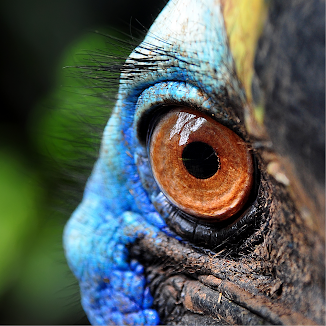
Cassowary, Casuariiformes
Wherever you are in the world, it is likely that you know your local birds. True, you may call them des Oiseaux, pássaros or uccelli — but you'll know their common names by heart.

You will also likely know their sounds. The tweets, chirps, hoots and caws of the species living in your backyard.

Birds come in all shapes and sizes and their brethren blanket the globe. It is amazing to think that they all sprang from the same lineage given the sheer variety. 

If you picture them, we have such a variety on the planet — parrots, finches, wee hummingbirds, long-legged waterbirds, waddling penguins and showy toucans. 

But whether they are a gull, hawk, cuckoo, hornbill, potoo or albatross, they are all cousins in the warm-blooded vertebrate class Aves. 

The defining features of the Aves are feathers, toothless beaked jaws, the laying of hard-shelled eggs, a high metabolic rate, a four-chambered heart, and a strong yet lightweight skeleton. The best features, their ability to dance, bounce and sing, are not listed, but it is how I see them in the world.

These modern dinosaurs live worldwide and range in size from the 5 cm (2 in) bee hummingbird to the 2.75 m (9 ft) ostrich. 

There are about ten thousand living species, more than half of which are passerine, or "perching" birds. Birds have wings whose development varies according to species; the only known groups without wings are the extinct moa and elephant birds.

Wings evolved from forelimbs giving birds the ability to fly
Wings, which evolved from forelimbs, gave birds the ability to fly, although further evolution has led to the loss of flight in some birds, including ratites, penguins, and diverse endemic island species. 

The digestive and respiratory systems of birds are also uniquely adapted for flight. Some bird species of aquatic environments, particularly seabirds and some waterbirds, have further evolved for swimming.

Wee Feathered Theropod Dinosaurs

We now know from fossil and biological evidence that birds are a specialized subgroup of theropod dinosaurs, and more specifically, they are members of Maniraptora, a group of theropods that includes dromaeosaurs and oviraptorids, amongst others. As palaeontologists discover more theropods closely related to birds, the previously clear distinction between non-birds and birds has become a bit muddy.

Recent discoveries in the Liaoning Province of northeast China, which include many small theropod feathered dinosaurs — and some excellent arty reproductions — contribute to this ambiguity. 

Still, other fossil specimens found here shed a light on the evolution of Aves. Confuciusornis sanctus, an Early Cretaceous bird from the Yixian and Jiufotang Formations of China is the oldest known bird to have a beak.

Like modern birds, Confuciusornis had a toothless beak, but close relatives of modern birds such as Hesperornis and Ichthyornis were toothed, telling us that the loss of teeth occurred convergently in Confuciusornis and living birds.

The consensus view in contemporary palaeontology is that the flying theropods, or avialans, are the closest relatives of the deinonychosaurs, which include dromaeosaurids and troodontids.

Together, these form a group called Paraves. Some basal members of this group, such as Microraptor, have features that may have enabled them to glide or fly. 

The most basal deinonychosaurs were wee little things. This raises the possibility that the ancestor of all paravians may have been arboreal, have been able to glide, or both. Unlike Archaeopteryx and the non-avialan feathered dinosaurs, who primarily ate meat, tummy contents from recent avialan studies suggest that the first avialans were omnivores. Even more intriguing...

Avialae, which translates to bird wings, are a clade of flying dinosaurs containing the only living dinosaurs, the birds. It is usually defined as all theropod dinosaurs more closely related to modern birds — Aves — than to deinonychosaurs, though alternative definitions are occasionally bantered back and forth.

The Earliest Avialan: Archaeopteryx lithographica

Archaeopteryx, bird-like dinosaur from the Late Jurassic
Archaeopteryx lithographica, from the late Jurassic Period Solnhofen Formation of Germany, is the earliest known avialan that may have had the capability of powered flight. 

However, several older avialans are known from the Late Jurassic Tiaojishan Formation of China, dating to about 160 million years ago.

The Late Jurassic Archaeopteryx is well-known as one of the first transitional fossils to be found, and it provided support for the theory of evolution in the late 19th century. 

Archaeopteryx was the first fossil to clearly display both traditional reptilian characteristics — teeth, clawed fingers, and a long, lizard-like tail—as well as wings with flight feathers similar to those of modern birds. It is not considered a direct ancestor of birds, though it is possibly closely related to the true ancestor.

Unlikely yet true, the closest living relatives of birds are the crocodilians. Birds are descendants of the primitive avialans — whose members include Archaeopteryx — which first appeared about 160 million years ago in China.

DNA evidence tells us that modern birds — Neornithes — evolved in the Middle to Late Cretaceous, and diversified dramatically around the time of the Cretaceous–Paleogene extinction event 66 mya, which killed off the pterosaurs and all non-avian dinosaurs.

In birds, the brain, especially the telencephalon, is remarkably developed, both in relative volume and complexity. Unlike most early‐branching sauropsids, the adults of birds and other archosaurs have a well‐ossified neurocranium. In contrast to most of their reptilian relatives, but similar to what we see in mammals, bird brains fit closely to the endocranial cavity so that major external features are reflected in the endocasts. What you see on the inside is what you see on the outside.

This makes birds an excellent group for palaeoneurological investigations. The first observation of the brain in a long‐extinct bird was made in the first quarter of the 19th century. However, it was not until the 2000s and the application of modern imaging technologies that avian palaeoneurology really took off.

Understanding how the mode of life is reflected in the external morphology of the brains of birds is but one of several future directions in which avian palaeoneurological research may extend.

Although the number of fossil specimens suitable for palaeoneurological explorations is considerably smaller in birds than in mammals and will very likely remain so, the coming years will certainly witness a momentous strengthening of this rapidly growing field of research at the overlap between ornithology, palaeontology, evolutionary biology and the neurosciences.

Reference: Cau, Andrea; Brougham, Tom; Naish, Darren (2015). "The phylogenetic affinities of the bizarre Late Cretaceous Romanian theropod Balaur bondoc (Dinosauria, Maniraptora): Dromaeosaurid or flightless bird?". PeerJ. 3: e1032. doi:10.7717/peerj.1032. PMC 4476167. PMID 26157616.

Reference: Ivanov, M., Hrdlickova, S. & Gregorova, R. (2001) The Complete Encyclopedia of Fossils. Rebo Publishers, Netherlands. p. 312.

Thursday, 6 August 2026

DRIFTWOOD CANYON FOSSIL BEDS

Puffbird similar to Fossil Birds found at Driftwood Canyon 
Driftwood Canyon Provincial Park 

Driftwood Canyon Provincial Park covers 23 hectares of the Bulkley River Valley, on the east side of Driftwood Creek, a tributary of the Bulkley River, 10 km northeast of the town of Smithers in northern British Columbia. 

Driftwood Canyon is recognized as one of the world’s most significant fossil beds. 

It provides park users with a fascinating opportunity to understand the area’s evolutionary processes of both geology and biology. The day-use area is open from May 15 to September 2. There is a short, wheelchair-accessible interpretative trail that leads from the parking are to the fossil beds. Pets are welcome on leash. Signs along the trail provide information on fossils and local history. 

Wet'suwet'en First Nation

The parklands are part of the Traditional Territory of the Wet'suwet'en First Nation which includes lands around the Bulkley River, Burns Lake, Broman Lake, and François Lake in the northwestern Central Interior of British Columbia. 

The Wetʼsuwetʼen are part of the Dakelh or Carrier First Nation, and in combination with the Babine First Nation are referred to as the Western Carrier. They speak Witsuwitʼen, a dialect of the Babine-Witsuwitʼen language which, like its sister language Carrier, is a member of the Athabaskan family.

Their oral history or kungax recounts a time when their ancestral village, Dizkle or Dzilke, once stood upstream from the Bulkley Canyon. This cluster of cedar houses on both sides of the river was said to be abandoned because of an omen of impending disaster. The exact location of the village has been lost but their stories live on. 

The neighbouring Gitxsan, collectively the People of Smooth Waters—the Gilseyhu Big Frog Clan, the Laksilyu Small Frog Clan, the Tsayu Beaver Clan, the Gitdumden Wolf and Bear Clan and the Laksamshu Fireweed and Owl Clan—each phratry or kinship group calling the Lax Yip home—33,000 km2 of land and water in northwestern ​British Columbia along the waters of the Skeena River and its tributaries—have a similar tale—though the village in their versions is referred to as Dimlahamid or Temlahan depending on which house group or wilp is sharing the tale—as well as where they are located as dialects differ. 

Gitksan speak Sim'algaxthe real or true language. Within the Gitxsan communities there are two slightly different dialects. The Gyeets (Downriver) dialect spoken in Gijigyukwhla (Gitsegukla), Gitwangax, and Gitanyow—and the Gigeenix (Upriver) dialect is spoken in Ansbayaxw (Kispiox), Sik-E-Dakh and Gitanmaax.

Driftwood Canyon Fossil Beds

Driftwood Canyon's Fossil Beds record life in the earlier portion of the Eocene when British Columbia — and indeed our world — was much warmer than it is today. This site was discovered in the beginning of the 20th century and is now recognized as containing significant fossil material. 

I was speaking this week with a friend and classmate recently from a Traditional Ecological Knowledge course through the University of Northern British Columbia, Jessy, about Driftwood Canyon and the fossil resources found here.

The fossils are tremendous—and their superb preservation—provide a fascinating opportunity to understand the area’s evolutionary processes of both geology and biology over the past fifty million years or so. The fossils themselves are 51.7 million years old and look remarkably like many of the species we recognize today. 

The fossil beds are on the east side of Driftwood Creek, C’ide’Yikwah in Witsuwit’en, which has its headwaters in the main, southwest facing basin of the Babine Mountains. The park that contains these beautiful fossils is fifty-seven years old. 

It was created in 1967 by the generosity of the late Gordon Harvey (1913–1976). He donated the land to protect fossil resources that he truly loved and wanted to see preserved. How Harvey came to be in a position to donate lands once part of a First Nation Traditional Territory will need to be explored deeper. I will share as I learn more about this as I learn more from locals and the local history museum in the coming weeks and months.

Metasequoia, the Dawn Redwood
Exploring the region today, we see a landscape dominated by conifers blanketing the area. 

Forests teem with the aromatic Western Red Cedar, Pacific Silver Fir with its many medicinal properties, the tall and lanky Subalpine Fir with its soft, brittle and quickly decaying wood, the slender scaly Lodgepole Pine, the graceful and slightly forlorn looking Western Hemlock. 

Across the landscape you see several species of Spruce, including the impressive Sitka, Picea sitchensis, the world's largest spruce tree who live up to an impressive 800 years. 

The stands of mature Sitka standing here today were just being established in this ground back in 1921 when Smithers was designated as the first incorporated village in British Columbia. They are slow to establish and get going, but once embedded are amongst the fastest growing trees we see on the western edge of Canada, colonizing glacial moraines with their cold resistant stock centuries ago when the glaciers that once covered this land eventually retreated.

Some of the tallest on view would have been mere seedlings, colonizing the glacial moraines centuries ago when the glaciers retreated. Collectively, these conifers tell the tale of the region's cool climate today. 

The Gitsan territory boasts seven of the 14 biogeoclimatic zones of the province—the Alpine Tundra, Spruce-Willow-Birch, Boreal White and Black Spruce, Sub-Boreal Pine-Spruce, Sub-Boreal Spruce, Engelmann Spruce-Subalpine Fir and Interior Cedar-Hemlock. 

The fossil material we find here speaks to a warmer climate in this region's past. We find fossil plants, fish—including specimens of salmon, suckerfish and bowfin, a type of air breathing fish—and insect fossil here—wasps and water striders—fossil plants including Metasequoia, the Dawn Redwood, alder—and interesting vertebrate material. Bird feathers are infrequently collected from the shales; however, two bird body fossils have been found here.

In 1968, a bird body fossil was collected in the Eocene shales of the Ootsa Lake Group in Driftwood Canyon Provincial Park by Pat Petley of Kamloops. 

Pat donated the specimen in 2000 to the Thompson Rivers University (TRU) palaeontology collections. This fossil bird specimen is tentatively identified as the puffbird, Piciformes bucconidae, of the genus Primobucco.

Primobucco is an extinct genus of bird placed in its own family, Primobucconidae. The type species, Primobucco mcgrewi, lived during the Lower Eocene of North America. It was initially described by American paleo-ornithologist Pierce Brodkorb in 1970, from a fossil right-wing, and thought to be an early puffbird. However, the discovery of a further 12 fossils in 2010 indicate that it is instead an early type of roller.

Related fossils from the European Messel deposits have been assigned to the two species P. perneri and P. frugilegus. Two specimens of P. frugilegus have been found with seeds in the area of their digestive tract, which suggests that these birds were more omnivorous than the exclusively predaceous modern rollers. The Driftwood specimen has never been thoroughly studied. If there is a grad student out there looking for a worthy thesis, head on down to the Thompson Rivers University where you'll find the specimen on display.

Another fossil bird, complete with feathers, was collected at Driftwood Canyon in 1970, This one was found by Margret and Albrecht Klöckner who were travelling from Germany. Theirs is a well-travelled specimen, having visited many sites in BC as they toured around, then to Germany and finally back to British Columbia when it was repatriated and donated to the Royal British Columbia Museum in Victoria. 

I am not sure if it is still on display or back in collections, but it was lovingly displayed back in 2008. There is a new grad student, Alexis, looking at Eocene bird feathers down at the RBCM, so perhaps it is once again doing the rounds. 

This second bird fossil is of a long-legged water bird and has been tentatively identified by Dr. Gareth Dyke of the University of Southampton as possibly from the order Charadriiformes, a diverse order of small to medium-ish water birds that include 350 species of gulls, plovers, sandpipers, terns, snipes, and waders. Hopefully, we'll hear more on this find in the future.

A Tapir showing off his prehensile nose trunk
Tapirs and Tiny Hedgehogs

The outcrops at Driftwood Canyon are also special because they record a record of some of the first fossil mammals ever to be found in British Columbia at this pivotal point in time. 

Wee proto-hedgehogs smaller than your thumb lived in the undergrowth of that fossil flora. They shared the forest floor with an extinct tapir-like herbivore in the genus Heptodon that looked remarkably similar to his modern, extant cousins (there is a rather cheeky fellow shown here so you get the idea) but lacked their pronounced snout (proboscis). I am guessing that omission made him the more fetching of his lineage.

In both cases, it was a fossilized jaw bone that was recovered from the mud, silt and volcanic ash outcrops in this ancient lakebed site. And these two cuties are significant— they are the very first fossil mammals we've ever found from the early Eocene south of the Arctic.

How can we be sure of the timing? The fossil outcrops here are found within an ancient lakebed. Volcanic eruptions 51 million years ago put loads of fine dust into the air that settled then sank to the bottom of the lake, preserving the specimens that found their way here — leaves, insects, birds, mammals.

As well as turning the lake into a fossil making machine—water, ash, loads of steady sediment to cover specimens and stave off predation—the volcanic ash contains the very chemically inert—resistant to mechanical weathering—mineral zircon which we can date with uranium/lead (U/Pb). 

The U/Pb isotopic dating technique is wonderfully accurate and mighty helpful in dating geologic events from volcanic eruptions, continental movements to mass extinctions. This means we know exactly when these lovelies were fossilized and, in turn, their significance.

Know Before You Go

If you fancy a visit to Driftwood Canyon Park, the park is accessible from Driftwood Road from Provincial Highway 16. You are welcome to view and photograph the fossils found here but collecting is strictly forbidden. 

Driftwood Canyon is recognized as one of the world’s most significant fossil beds. It provides park users with a fascinating opportunity to understand the area’s evolutionary processes of both geology and biology. The day-use area is open from May 15 to September 2. There is a short, wheelchair-accessible interpretative trail that leads from the parking are to the fossil beds. Pets are welcome on leash. Signs along the trail provide information on fossils and local history. 

Below a cliff face at the end of the trail is a viewing area that has interpretive information and viewing area overlooking Driftwood Creek.

This park proudly operated by Mark and Anais Drydyk
Email: kermodeparks@gmail.com / Tel: 1 250 877-1482 or 1 250 877-1782

Palaeo Coordinates: Latitude: 50° 51' 59" N / Longitude: 116° 27' 37" W
Lat/Long (dec): 50.86665,-116.46042 / GUID: d3a6bd3e-68d6-42cf-9b2c-d20a30576988

Driftwood Canyon Provincial Park Brochure: 
https://bcparks.ca/explore/parkpgs/driftwood_cyn/driftwood-canyon-brochure.pdf?v=1638723136455

Sheila Peters: Driftwood Creek – and the ways we cross it; here Sheila Peters shares a wonderful lived history which I have not had the pleasure to yet fully explore as of 09 February 2025. I do recommend you checking out her post as it contains information and photographs worthy of a newcomers visit to the area.
Link: https://sheilapeters.com/tag/peavine-harvey/
.