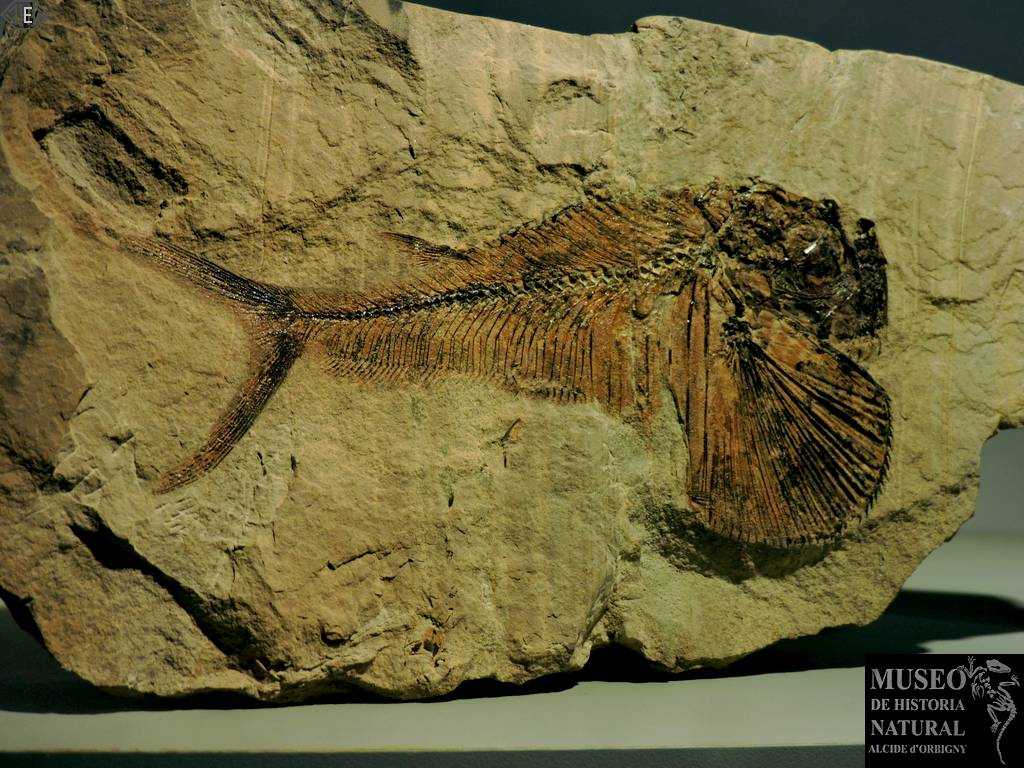
A stunning example of the Late Cretaceous fish, Gasteroclupea branisai, from Bolivia. This beauty is housed in the Natural History Museum Alcide d'Orbignay of Cochabamba.
Gasteroclupea is a genus of prehistoric clupeiform fish related to modern anchovies and herrings.
Clupeiformes are physostomes, which means that the gas bladder has a pneumatic duct connecting it to the gut. This handy little evolutionary feature lets them fill or empty the gas bladder via their mouth. They typically lack lateral lines but have nicely defined eyes, fins and scales. They are generally silvery fish with streamlined, spindle-shaped, bodies, and often found in schools. Most species eat plankton which they filter from the water with their gills.
Gasteroclupea date back to the Maastrichtian of the Late Cretaceous. We find fossils of the genus in the Yacoraite Formation of Argentina and in the El Molino Formation of Bolivia, as you see here. Photo credit: Gilberto Juárez Huarachi.
Sunday, 3 November 2019
Saturday, 2 November 2019
PHEASANT PHASIANUS
These playful lovelies are beautiful examples of the Common Pheasant, Phasianus Cholchicus.
We associate them with tweet shorn English aristocrats jauntily going about the hunt on horseback.
Pheasants build their nests on the ground and can fly for short distances. They spend their days searching the scrub in fields and around streams looking for tasty insects, seeds and grain.
Friday, 1 November 2019
ARMOURED AGNATHA
This lovely specimen, showing both the positive and negative of the fossil, is an armoured agnatha jawless bony fish, Victoraspis longicornualis, from Lower Devonian deposits of Podolia, Ukraine.
Victoraspis longicornualis was named by Anders Carlsson and Henning Bloom back in 2008. The new osteostracan genus and species were described based on material from Rakovets' present-day Ukraine. This new taxon shares characteristics with the two genera Stensiopelta (Denison, 1951) and Zychaspis (Javier, 1985).
Agnatha is a superclass of vertebrates. This fellow looks quite different from our modern Agnatha, which includes lamprey and hagfish. Ironically, hagfish are vertebrates that do not have vertebrae. Sometime in their evolution, they lost them as they adapted to their environment. Photo: Fossilero Fisherman
Victoraspis longicornualis was named by Anders Carlsson and Henning Bloom back in 2008. The new osteostracan genus and species were described based on material from Rakovets' present-day Ukraine. This new taxon shares characteristics with the two genera Stensiopelta (Denison, 1951) and Zychaspis (Javier, 1985).
Agnatha is a superclass of vertebrates. This fellow looks quite different from our modern Agnatha, which includes lamprey and hagfish. Ironically, hagfish are vertebrates that do not have vertebrae. Sometime in their evolution, they lost them as they adapted to their environment. Photo: Fossilero Fisherman
Thursday, 31 October 2019
Subscribe to:
Posts (Atom)


