Blue mussels live in intertidal areas and inlets attached to rocks and other hard substrates by strong, stretchy thread-like structures called byssal threads.
They are tasty, edible marine bivalves, molluscs, in the family Mytilidae and they've done well for themselves. Mussels have a range of over 4000 km in waters around the world.
Temperature, salinity and food supply are key factors in how mussels grow and have a huge impact on their shape. Environmental stressors cause curvatures to show up in mussel populations and can help us understand environmental changes happening in our local waters.
Tuesday, 12 November 2019
Monday, 11 November 2019
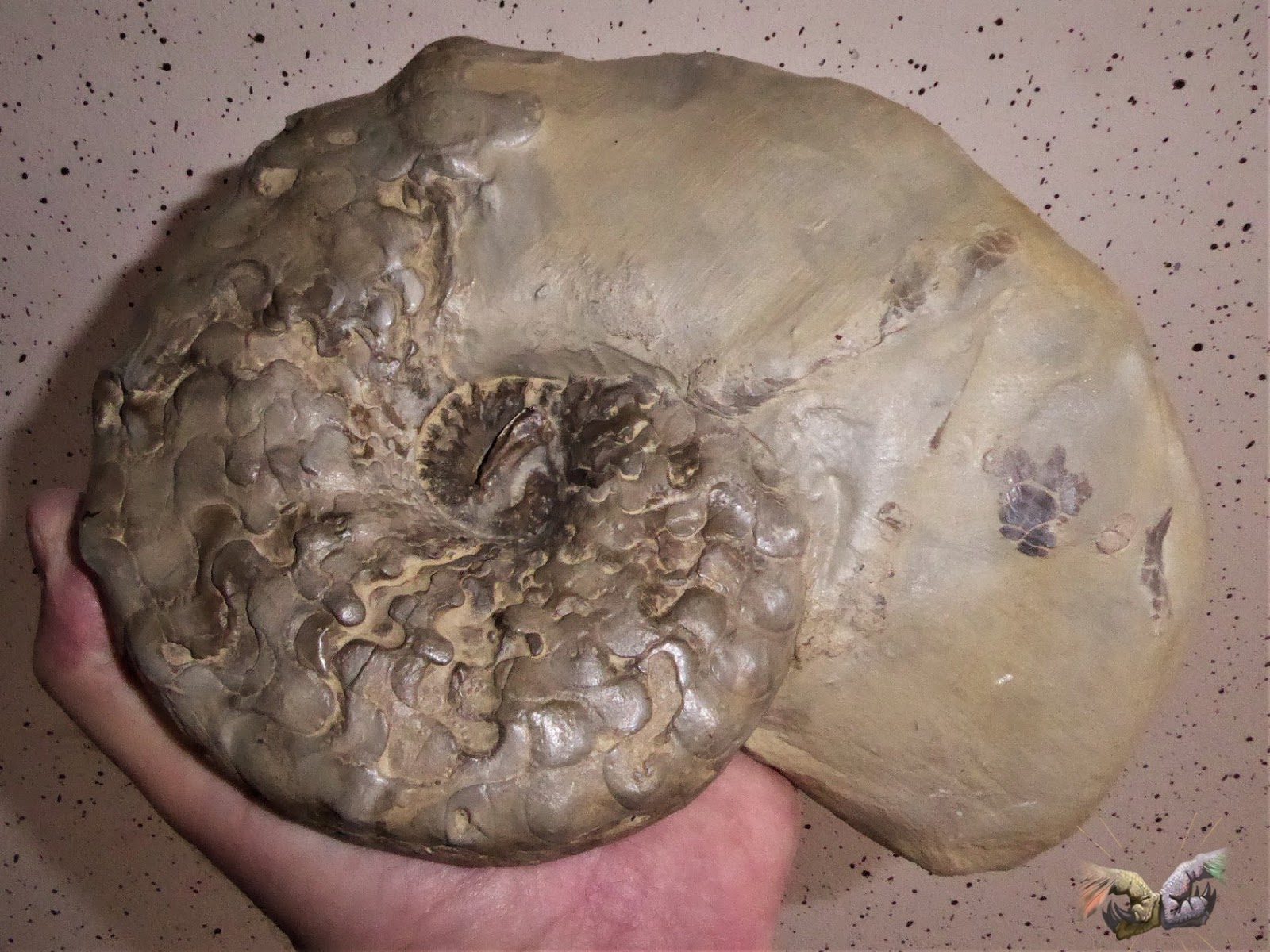
BEAKS AND FRILLY SADDLES
A lovely example of the ammonite, Cératites Nodosus, an extinct genus of nektonic marine carnivore from shell limestone superior deposits near Alsace on the Rhine River plain of northeastern France.
You can see the nice ceratitic suture pattern on this specimen with his smooth lobes and frilly saddles. The sutures would have increased the strength of the shell and allowed Ceratites (de Haan, 1825) to dive deeper, bearing the additional pressure of the sea in search of food.
Ammonite shells are made up predominantly of calcium carbonate in the form of aragonite and proteinaceous organic matrix or conchiolin arranged in layers: a thin outer prismatic layer, a nacreous layer and an inner lining of prismatic habitat. While their outer shells are generally aragonite, aptychus are distinct as they are composed of calcite.
The aptychus we see here, hard anatomical structures or curved shelly plates now understood to be part of the body of an ammonite, are often referred to as beaks. If you look closely at this specimen, you can see the beak of the ammonite, that wee pointed piece, near the centre.
These ammonites lived in open shallow, to subtidal and basinal environments some 247 to 221 million years ago. We've found them, thus far, in just over forty collections from nearly ninety fossil deposits around the globe. Fossils of species have been found in the Triassic of Austria, Canada, China, France, Germany, Hungary, India, Israel, Italy, Pakistan, Poland, Russia, Thailand, Turkey and the United States.
The parent taxon is Ceratitinae according to E. T. Tozer 1981. That's our own Tim Tozer, one of the great knights-errant of the Triassic timescale. It was Tim Tozer and Norm Silberling who published the classic milestones of the Triassic timescale, "Biostratigraphic Classification of the Marine Triassic in North America, Geological Society of America, Special Paper 110." The Global Triassic: Bulletin 41 from the New Mexico Museum of Natural History and Science by Lucas and Spielmann honours them in their work. Collection of Ange Mirabet, Strasbourg, France.
You can see the nice ceratitic suture pattern on this specimen with his smooth lobes and frilly saddles. The sutures would have increased the strength of the shell and allowed Ceratites (de Haan, 1825) to dive deeper, bearing the additional pressure of the sea in search of food.
Ammonite shells are made up predominantly of calcium carbonate in the form of aragonite and proteinaceous organic matrix or conchiolin arranged in layers: a thin outer prismatic layer, a nacreous layer and an inner lining of prismatic habitat. While their outer shells are generally aragonite, aptychus are distinct as they are composed of calcite.
The aptychus we see here, hard anatomical structures or curved shelly plates now understood to be part of the body of an ammonite, are often referred to as beaks. If you look closely at this specimen, you can see the beak of the ammonite, that wee pointed piece, near the centre.
These ammonites lived in open shallow, to subtidal and basinal environments some 247 to 221 million years ago. We've found them, thus far, in just over forty collections from nearly ninety fossil deposits around the globe. Fossils of species have been found in the Triassic of Austria, Canada, China, France, Germany, Hungary, India, Israel, Italy, Pakistan, Poland, Russia, Thailand, Turkey and the United States.
The parent taxon is Ceratitinae according to E. T. Tozer 1981. That's our own Tim Tozer, one of the great knights-errant of the Triassic timescale. It was Tim Tozer and Norm Silberling who published the classic milestones of the Triassic timescale, "Biostratigraphic Classification of the Marine Triassic in North America, Geological Society of America, Special Paper 110." The Global Triassic: Bulletin 41 from the New Mexico Museum of Natural History and Science by Lucas and Spielmann honours them in their work. Collection of Ange Mirabet, Strasbourg, France.
Sunday, 10 November 2019
SKOMER ISLAND PUFFIN
This lovely fellow with his distinctive colouring is an Atlantic Puffin or "Sea Parrot" from Skomer Island near Pembrokeshire in the southwest of Wales. Wales is bordered by Camarthenshire to the east and Ceredigion to the northeast with the sea bordering everything else. It is a fine place to do some birding if it's seabirds you are interested in.
These Atlantic Puffins are one of the most famous of all the seabirds and form the largest colony in Southern Britain. They live about 25 years making a living in our cold seas dining on herring, hake and sand eels. Some have been known to live to almost 40 years of age. They are good little swimmers as you might expect, but surprisingly they are great flyers, too! They are hindered by short wings, which makes flight challenging but still possible with effort. Once they get some speed on board, they can fly up to 88 km an hour.
Their sexy orange beaks (dead sexy, right?) shift from a dull grey to bright orange when it is time to attract a mate. While not strictly monogamous, most Puffins choose the same mate year upon year producing adorable chicks or pufflings (awe) from their mating efforts. Female Puffins produce one single white egg which the parents take turns to incubate over a course of about six weeks. Their dutiful parents share the honour of feeding the wee pufflings five to eight times a day until the chick is ready to fly. Towards the end of July, the fledgling Puffins begin to venture from the safety of their parents and dry land. Once they take to the seas, mom and dad are released from duty and the newest members of the colony are left to hunt and survive on their own.
These Atlantic Puffins are one of the most famous of all the seabirds and form the largest colony in Southern Britain. They live about 25 years making a living in our cold seas dining on herring, hake and sand eels. Some have been known to live to almost 40 years of age. They are good little swimmers as you might expect, but surprisingly they are great flyers, too! They are hindered by short wings, which makes flight challenging but still possible with effort. Once they get some speed on board, they can fly up to 88 km an hour.
Their sexy orange beaks (dead sexy, right?) shift from a dull grey to bright orange when it is time to attract a mate. While not strictly monogamous, most Puffins choose the same mate year upon year producing adorable chicks or pufflings (awe) from their mating efforts. Female Puffins produce one single white egg which the parents take turns to incubate over a course of about six weeks. Their dutiful parents share the honour of feeding the wee pufflings five to eight times a day until the chick is ready to fly. Towards the end of July, the fledgling Puffins begin to venture from the safety of their parents and dry land. Once they take to the seas, mom and dad are released from duty and the newest members of the colony are left to hunt and survive on their own.
Friday, 8 November 2019
YORKSHIRE ANDROGYNOCERAS
A stunning example of the ammonite Androgynoceras from the Yorkshire Coast, England.
The Geology of Yorkshire in northern England shows a very close relationship between the major topographical areas and the geological period in which their rocks were formed. The rocks of the Pennine chain of hills in the west are of Carboniferous origin whilst those of the central vale are Permo-Triassic.
The North York Moors in the north-east of the county are Jurassic in age while the Yorkshire Wolds to the southeast are Cretaceous chalk uplands. The plain of Holderness and the Humberhead levels both owe their present form to the Quaternary ice ages. The strata become gradually younger from west to east. Much of Yorkshire presents heavily glaciated scenery as few places escaped the direct or indirect impact of the great ice sheets as they first advanced and then retreated during the last ice age. This beauty is in the collection of the deeply awesome Harry Tabiner.
The Geology of Yorkshire in northern England shows a very close relationship between the major topographical areas and the geological period in which their rocks were formed. The rocks of the Pennine chain of hills in the west are of Carboniferous origin whilst those of the central vale are Permo-Triassic.
The North York Moors in the north-east of the county are Jurassic in age while the Yorkshire Wolds to the southeast are Cretaceous chalk uplands. The plain of Holderness and the Humberhead levels both owe their present form to the Quaternary ice ages. The strata become gradually younger from west to east. Much of Yorkshire presents heavily glaciated scenery as few places escaped the direct or indirect impact of the great ice sheets as they first advanced and then retreated during the last ice age. This beauty is in the collection of the deeply awesome Harry Tabiner.
Subscribe to:
Posts (Atom)