Tuesday, 21 January 2020

SONGS OF THE CETACEAN

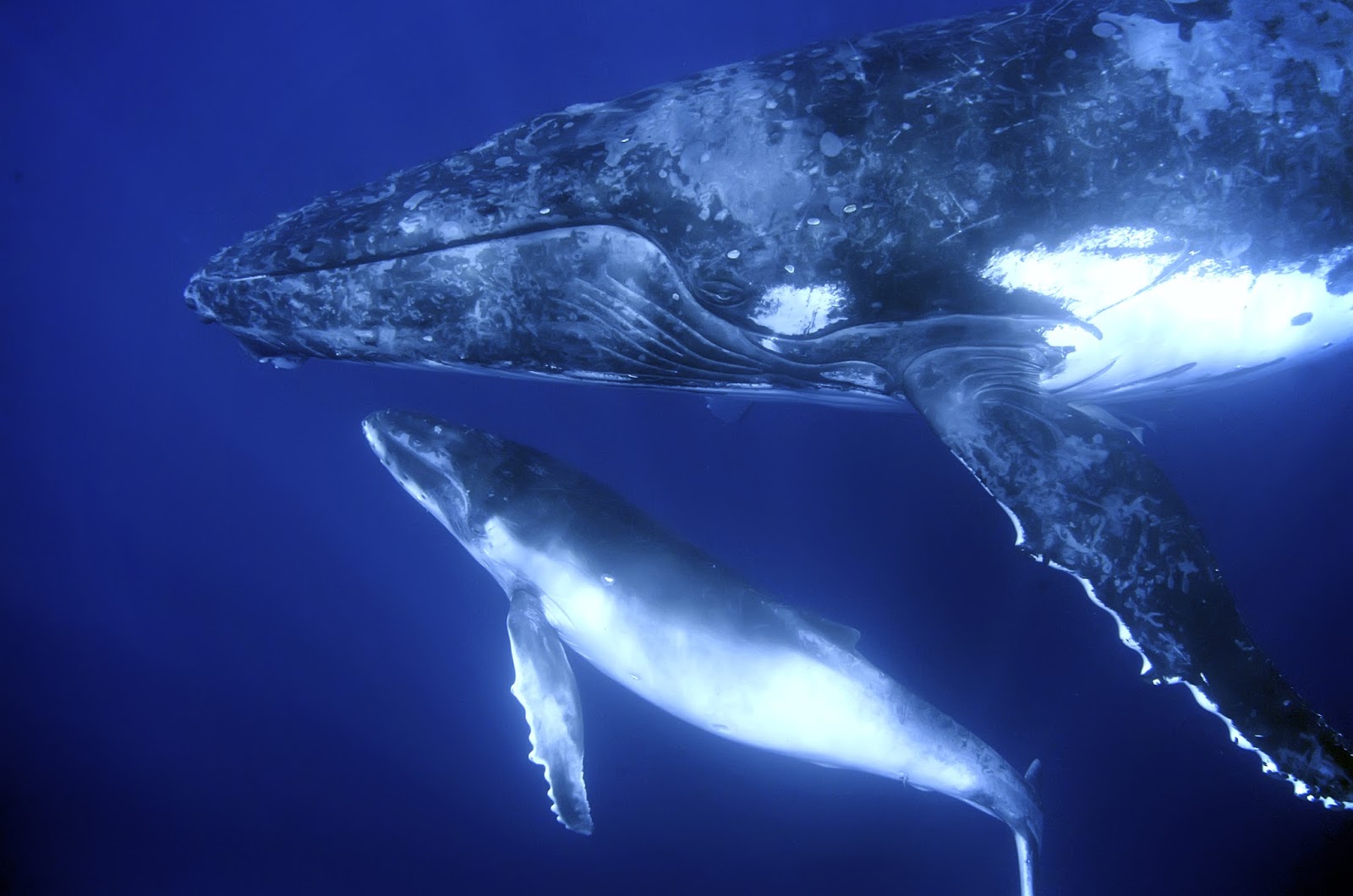
A mother humpback and her young charge. Mothers show a tremendous amount of affection and love to their young, often swimming so close together they touch noses.

The calves nurse for almost a year, growing slowly. Once nursed, they keep growing for another 8-10 years before reaching their full adult length. They grow up to 19 metres long and can weigh up to 40 tons (36 metric tons). 

Male humpbacks are known for their singing. They produce some of the most complex “songs” in the animal kingdom. We have recorded many of their high-pitched squeals, whistles and low, rumbling gurgles. Perhaps the males believe that those with the best vocal abilities attract the best mates. They certainly increase the connectedness of those living in their pod.

Humpback whales, Megaptera novaeangliae, are a species of baleen whale for whom I hold a special place in my heart. 

Baleens are whales who feed on plankton and other wee oceanic tasties that they consume through their baleens, a specialised filter of keratin that frames their mouths. There are fifteen species of baleen whales. They inhabit all major oceans, in a wide band running from the Antarctic ice edge to 81°N latitude.

In the Kwak̓wala language of the Kwakiutl or Kwakwaka'wakw, speakers of Kwak'wala, of the Pacific Northwest, whales are known as g̱wa̱'ya̱m. Both the California grey and the Humpback whale live on the coast. Only a small number of individuals in First Nation society had the right to harpoon a whale. It was generally only the Chief who was bestowed this great honour. 

Humpback whales like to feed close to shore and enter the local inlets. Around Vancouver Island and along the coast of British Columbia, this made them a welcome food source as the long days of winter passed into Spring.

Humpback whales are rorquals, members of the Balaenopteridae family that includes the blue, fin, Bryde's, sei and minke whales. The rorquals are believed to have diverged from the other families of the suborder Mysticeti during the middle Miocene. While cetaceans were historically thought to have descended from mesonychids— which would place them outside the order Artiodactyla— molecular evidence supports them as a clade of even-toed ungulates — our dear Artiodactyla. Baleen whales split from toothed whales, the Odontoceti, around 34 million years ago.

Monday, 20 January 2020

CETACEANS OF WASHINGTON STATE

Fossil Whale Bone
Oligocene Fossil Whale vertebrae from Majestic Beach, Olympic Peninsula, Washington State, USA.

These lovely water-worn specimens are difficult to ID to species with certainty but they likely hail from an early baleen whale. Found amongst the beach pebbles on the Olympic Peninsula, they are definitely cetacean and very likely baleen as this area is home to some of the earliest baleen whales in the Pacific Northwest.

In 1993, a twenty-seven million-year-old specimen was discovered in deposits nearby that represents a new species of early baleen whale. It is especially interesting as it is from a stage in the group’s evolutionary history when baleen whales transitioned from having teeth to filtering food with baleen bristles. Visiting researcher Carlos Mauricio Peredo studied the fossil whale remains, publishing his research to solidify Sitsqwayk cornishorum (pronounced sits-quake) in the annals of history.

Baby Gray Whale Eschrichtius robustus showing his baleen
The earliest baleen whales clearly had teeth, and clearly still used them. Modern baleen whales have no teeth and have instead evolved baleen plates for filter feeding. I've included a rather good close-up of a baby Gray Whale here that shows the baleen to good effect.

The baleen is the comb-like strainer that sits on the upper jaw of baleen whales and is used to filter food.

We have to ponder when this evolutionary change —moving from teeth to baleen — occurred and what factors might have caused it. Traditionally, we have sought answers about the evolution of baleen whales by turning to two extinct groups: the aetiocetids and the eomysticetids.

The aetiocetids are small baleen whales that still have teeth, but they are very small, and it remains uncertain whether or not they used their teeth. In contrast, the eomysticetids are about the size of an adult Minke Whale and seem to have been much more akin to modern baleen whales; though it’s not certain if they had baleen. Baleen typically does not preserve in the fossil record being soft tissue; generally, only hard tissue, bones & teeth, are fossilized.

Sunday, 19 January 2020

UNLIKELY RHINOCEROS

The Miocene pillow basalts from the Lake Roosevelt National Recreation Area of central Washington hold an unlikely fossil mould of a small rhinoceros, preserved by sheer chance as it's bloated carcass sunk to the bottom of a shallow lake just prior to a volcanic explosion.

We've known about this gem for a long while now. The fossil was discovered by hikers back in 1935 and later cast by the University of California paleontologists in 1948. These were the Dirty Thirties and those living in Washington state were experiencing the Great Depression along with the rest of the country and the world. Franklin D. Roosevelt was President of the United States, navigating the States away from laissez-faire economics. Charmingly, Roosevelt would have his good name honoured by this same park in April of 1946, a few years before researchers at Berkeley would rekindle interest in the site.

Both hiking and fossil collecting was a fine answer to these hard economic times and came with all the delights of discovery with no cost for natural entertainment. And so it was that two fossil enthusiast couples were out looking for petrified wood just south of Dry Falls on Blue Lake in Washington State. While searching the pillow basalt, the Frieles and Peabodys came across a large hole high up in a cave that had the distinctive shape of an upside-down rhinoceros.

This fossil is interesting in all sorts of ways. First, we so rarely see fossils in igneous rocks. As you might suspect, both magma and lava are very hot. Magma, or molten rock, glows a bright red/orange as it simmers at a toasty 700 °C to 1300 °C (or 1300 °F to 2400 °F) in hot chambers beneath the Earth's surface.

During the late Miocene and early Pliocene, repeated basaltic lava floods engulfed about 63,000 square miles of the Pacific Northwest over a period of ten to fifteen million years. After these repeated bathings the residual lava accumulated to more than 6,000 feet.

As the magma pushes up to the surface becoming lava, it cools to a nice deep black. In the case of our rhino friend, this is how this unlikely fellow became a fossil. Instead of vaporizing his remains, the lava cooled relatively quickly preserving his outline as a trace fossil and remarkably, a few of his teeth, jaw and bones. The lava was eventually buried then waters from the Spokane Floods eroded enough of the overburden to reveal the remains once more.

Diceratherium tridactylum (Marsh, 1875)
Diceratherium (Marsh, 1875) is known from over a hundred paleontological occurrences from eighty-seven collections.

While there are likely many more, we've found fossil remains of Diceratherium, an extinct genus of rhinoceros, in the Miocene of Canada in Saskatchewan, China, France, Portugal, Switzerland, and multiple sites in the United States.

He's also been found in the Oligocene of Canada in Saskatchewan, and twenty-five localities in the US, specifically in Arizona, Colorado, Florida, Nebraska, North Dakota, Oregon,  South Dakota, Washington and Wyoming. We know a bit about him. He roamed a much warmer, wetter Washington state some 15 million years ago. By then, the Cascades had arrived and we'd yet to see the volcanic eruptions that would entomb whole forests up near Vantage in the Takama Canyon of Washington state. Diceratherium was a scansorial insectivore with two horns and a fair bit of girth. He was a chunky fellow, weighing in at about one tonne (or 2,200 lbs).

You are welcome to go see his final resting site beside the lake but it is difficult to reach and comes with its own risks. Head to the north end of Blue Lake in Washington. Take a boat and search for openings in the cliff face. You'll know you're in the right place if you see a white "R" a couple hundred feed up inside the cliff. Inside the cave, look for a cache left by those who've explored here before you. Once you find the cache, look straight up. That hole above you is the outline of the rhino.

If you don't relish the thought of basalt caving, you can visit a cast of the rhino at the Burke Museum in Seattle, Washington. They have a great museum and are pretty sporting as they've built the cast hardy enough to let folk climb inside. The Burke Museum recently underwent a rather massive facelift and has re-opened its doors to the public. You can now explore their collections in the New Burke, a 113,000 sq.ft. building at 4300 15th Ave NE, Seattle, WA 98105, United States. Or visit them virtually, at https://www.burkemuseum.org/

Photo: Robert Bruce Horsfall - https://archive.org/details/ahistorylandmam00scotgoog, Public Domain, https://commons.wikimedia.org/w/index.php?curid=12805514

Reference: Prothero, Donald R. (2005). The Evolution of North American Rhinoceroses. Cambridge University Press. p. 228. ISBN 9780521832403.

Reference: O. C. Marsh. 1875. Notice of new Tertiary mammals, IV. American Journal of Science 9(51):239-250

Saturday, 18 January 2020

FOSSIL FAUNAS OF THE PACIFIC NORTHWEST

Some water-worn samples of the fossil bivalve Vertipecten fucanus from Lower Miocene deposits in the Clallam Formation.

These were collected on the foreshore near Clallam Bay, Olympic Peninsula, northwestern Washington. Range zones of pectinid bivalves provide a principal means of age determination and correlation of shallow-water, inshore facies for Washington state. Until Addicott's study from 1976, the area was considered middle Miocene. The new Lower Miocene designation can be credited in large part to the restricted stratigraphic range of Vertipecten fucanus (Dall) and the restricted and overlapping ranges of several other fossil mollusks collected from Alaska to California.

Neogene marine sediments of the West Coast of North America were deposited in a series of widely spaced basins that extended geographically from the western and northern Gulf of Alaska (60°N) to southern California (33°N). Rich molluscan faunas occur extensively throughout these deposits and form the basis for biostratigraphic schemes that are useful for correlating within and between individual basins.

Early biostratigraphic work was concerned with faunas from particular horizons and with the stratigraphic range of diverse taxa, such as Pecten and Turritella, without reference to other fossil groups. Succeeding work increasingly dealt with the relationships of molluscan zones to benthic and, later, planktonic foraminiferal stages. In recent years the age limits of Neogene molluscan stages have become better documented by reference to planktonic microfossils from dated DSDP cores and onshore faunas.

Neogene molluscan faunas from California, the Pacific Northwest states (Oregon and Washington), and southern Alaska have been treated separately due to differences in faunal composition and geographic isolation. As a result, a different biostratigraphic sequence has been described for each region.

Pacific Northwest stages have been formally named and defined, and their names are also used informally for Alaskan faunas. California Neogene stages were proposed early in this century, are in need of redescription, and their usage is informal. Precise correlations between the three regional sequences have not yet been achieved, due to the low number of co-occurring species and the general lack of planktonic microfossils in these largely shallow-water faunas. The objectives of ongoing research include the documentation of the faunas of California and Pacific Northwest stages; formal description of California stages; an improved correlation between regional stage sequences; refinement of age estimates for stage boundaries; and, the establishment of Neogene stages for Alaskan faunas.