Wednesday, 21 July 2021

MAMMUTUS PRIMIGENIUS: WOOLLY MAMMOTH

This fellow is Mammutus primigenius a Woolly Mammoth from the Pleistocene of Siberia, Russia. 

Mammoths have a wonderful display of mammoth teeth, the diagnostic flat enamel plates and the equally distinct pointy cusped molars of the mastodons. He was a true elephant, unlike his less robust cousins, the mastodons. Mammoths were bigger — both in girth and height — weighing in at a max of 13 tonnes. 

They are closely related to Asian elephants and were about the size of the African elephants you see roaming the grasslands of Africa today.

If you stood beside him and reached way up, you might be able to touch his tusks but likely not reach up to his mouth or even his eyes. He would have had a shaggy coat of light or dark coloured hair with long outer hair strands covering a dense thick undercoat. His oil glands would have worked overtime to secrete oils, giving him natural waterproofing.

Some of the hair strands we have recovered are more than a meter in length. These behemoth proboscideans boasted long, curved tusks, little ears, short tails and grazed on leaves, shrubs and grasses that would have been work to get at as much of the northern hemisphere was covered in ice and snow during his reign. It is often the teeth of mammoths like those you see in the photo here that we see displayed. 

Their molar teeth were large and have always struck me as looking like ink plates from a printing press. If they are allowed to dry out in collection, they fall apart into discreet plates that can be mistaken for mineralized or calcified rock and not the bits and pieces of mammoth molars that they indeed are. Their large surface area was perfect for grinding down the low nutrient, but for the most part, plentiful grasses that sustained them.

Mammoth Tusk, Wrangel Island, Chukotka Okrug, Russia
How did they use their tusks? Likely for displays of strength, protecting their delicate trunks, digging up ground vegetation and in dry riverbeds, digging holes to get at the precious life-giving water. 

It's a genius design, really. A bit like having a plough on the front of your skull. In the photo here you can see a tusk washed clean in a creek bed on Wrangel Island.

Their size offered protection against other predators once the mammoth was full grown. Sadly for the juveniles, they offered tasty prey to big cats like Homotherium who roamed those ancient grasslands alongside them.

They roamed widely in the Pliocene to Holocene, roaming much of Africa, Europe, Asia and North America. We see them first some 150,000 years ago from remains in Russia then expanding out from Spain to Alaska. They enjoyed a very long lifespan of 60-80 — up to 20 years longer than a mastodon and longer than modern elephants. 

They enjoyed the prime position as the Apex predator of the megafauna, then declined — partially because of the environment and food resources and partially because of their co-existence with humans. In places where the fossil record shows a preference for hunting smaller prey, humans and megafauna do better together. We see this in places like the Indian Subcontinent where primates and rodents made the menu more often than the large megafauna who roamed there. We also see this in present-day Africa, where the last of the large and lovely megafauna show remarkable resilience in the face of human co-existence.  

The woolly mammoths from the Ukrainian-Russian plains died out 15,000 years ago. This population was followed by woolly mammoths from St. Paul Island in Alaska who died out 5,600 years ago — and quite surprisingly, at least to me, the last mammoth died just 4,000 years ago in the frosty ice on the small island of Wrangel in the Arctic Ocean — their final days spent scratching out a dwindling existence of genetic mutations, howling winds, rain-darkened hills and subsistence on tough grasses grown in thin soil. 

Further reading: Laura Arppe, Juha A. Karhu, Sergey Vartanyan, Dorothée G. Drucker, Heli Etu-Sihvola, Hervé Bocherens. Thriving or surviving? The isotopic record of the Wrangel Island woolly mammoth population. Quaternary Science Reviews, 2019; 222: 105884 DOI: 10.1016/j.quascirev.2019.105884

Tuesday, 20 July 2021

COELACANTHS: LIVING FOSSILS

Coelacanths are members of a now-rare order of fish, the Coelacanthiformes, that includes two extant species in the genus Latimeria: the West Indian Ocean coelacanth — Latimeria chalumnae — primarily found near the Comoro Islands off the east coast of Africa and the Indonesian coelacanth — Latimeria menadoensis

The name originates from the Permian genus Coelacanthus, which means hollow spine and was published by Swiss-born American biologist and geologist Jean Louis Rodolphe Agassiz in 1839. 

The type species Coelacanthus granulatus was described from the Late Permian, Wuchiapingian of Kupferschiefer of Germany and England. Coelacanthus is primarily known from Late Permian and Early Triassic deposits in Europe and Canada, although the referred species C. welleri, known from Iowa, is of Late Devonian, Famennian age. They survived the Permian–Triassic extinction event, and one species, C. banffensis, is known from the Early Triassic.

Coelacanths belong to the subclass Actinistia, a group of lobed-finned fish related to lungfish and certain extinct Devonian fish such as osteolepiforms, porolepiforms, rhizodonts, and Panderichthys. The oldest known coelacanth fossils are over 410 million years old. Coelacanths were thought to have become extinct in the Late Cretaceous, around 66 million years ago, but were rediscovered in 1938 off the coast of South Africa.

Coelacanths follow the oldest-known living lineage of Sarcopterygii, lobe-finned fish and tetrapods, which makes them are more closely related to lungfish and tetrapods — which includes amphibians, reptiles, birds and mammals — than to ray-finned fish. They are found along the coastline of Indonesia and in the Indian Ocean. The West Indian Ocean coelacanth is a critically endangered species.

The coelacanth was long considered a living fossil because scientists thought it was the sole remaining member of a taxon otherwise known only from fossils, with no close relations alive, and that it evolved into roughly its current form approximately 400 million years ago. Several more recent studies have shown that coelacanth body shapes are much more diverse than previously thought.

Monday, 19 July 2021

CHELICERATA: EURYPTERIDS, SPIDERS AND HORSESHOE CRABS

Sanctacaris uncata
This lovely is Sanctacaris uncata — a wonderful example of Chelicerata.

We first see them emerge in our ancient oceans in the Middle Cambrian, some 508 million years ago, as the arthropod Sanctacaris uncata (Briggs & Collins, 1988) known from the Glossopleura Zone, Stephen Formation of Mount Stephen in the Burgess Shale, British Columbia, Canada. 

Sanctacaris is proof positive that chelicerates, although rare, were present in the Middle Cambrian sea. Even at this early stage of evolution, Sanctacaris had the number and type of head appendages found in modified form in the eurypterids and xiphosurids, the major Palaeozoic groups that succeeded it. Even more interesting is that Sanctacaris had all the characteristics of later chelicerates except chelicerae — placing this early arthropod in a primitive sister group of all other chelicerates.

An extinct marine creature half a billion years old may sound otherworldly, but you know some of their more well-known marine brethren — sea spiders, the sexy eurypterids, chasmataspidids and horseshoe crabs — and some of their terrestrial cousins — spiders, scorpions, harvestmen, mites and ticks. 

They are grouped together because, like all arthropods, they have a segmented body and segmented limbs and a thick chitinous cuticle called an exoskeleton. Add those characteristics to a body system with two body segments — a cephalothorax and an abdomen. 

Like all arthropods, chelicerates' bodies and appendages are covered with a tough cuticle made mainly of chitin and chemically hardened proteins. 

Since this cannot stretch, the animals must moult to grow. In other words, they grow new but still soft cuticles, then cast off the old one and wait for the new one to harden. 

Until the new cuticle hardens the animals are defenceless and almost immobilized.  This also helps to explain why you find so many cephalons or moulted head shields — or whatever else our good arthropod friends shed and regrow — in the field and far fewer body fossils of the whole animal.

Some chelicerate are predatory animals that patrol the warm waters near thermal vents. They can be found feeding upon other predators and fish. Although the group were originally solely predatory, they have diversified to use all sorts of feeding strategies: predation, parasitism, herbivory, scavenging and dining on bits of decaying organic matter. 

Although harvestmen can digest solid food it is more akin to a mashed pulp by the time they do. The guts of most modern chelicerates are too narrow to digest solid food, instead, they generally liquidize their chosen meal by grinding it with their chelicerae and pedipalps then flooding it with digestive enzymes. 

To conserve water, air-breathing chelicerates excrete waste as solids that are removed from their blood by Malpighian tubules, structures that also evolved independently in insects — another case of convergent evolution.

The evolutionary origins of chelicerates from the early arthropods have been debated for decades. And although there is considerable agreement about the relationships between most chelicerate sub-groups, the inclusion of the Pycnogonida in this taxon has recently been questioned and the exact position of scorpions is still controversial, though they were long considered the most primitive or basal of the arachnids. 

We still have much to explore to sort out their evolutionary origins and placement within the various lineages but we will get there with time.

Image One: Reconstruction of Sanctacaris uncata, a Cambrian Habeliidan arthropod (stem-Chelicerata: Habeliida). by Junnn11 @ni075; Image Two: Chelicerata by Fossil Huntress

Aria C, Caron JB (December 2017). "Mandibulate convergence in an armoured Cambrian stem chelicerate". BMC Evolutionary Biology. 17 (1): 261. doi:10.1186/s12862-017-1088-7. PMC 5738823. PMID 29262772.

Legg DA (December 2014). "Sanctacaris uncata: the oldest chelicerate (Arthropoda)". Die Naturwissenschaften. 101 (12): 1065–73. doi:10.1007/s00114-014-1245-4. PMID 25296691.

Briggs DE, Collins D (August 1988). "A Middle Cambrian chelicerate from Mount Stephen, British Columbia" (PDF). Palaeontology. 31 (3): 779–798. Archived from the original (PDF) on July 16, 2011. Retrieved April 4, 2010.

Briggs DE, Erwin DH, Collier FJ (1995). Fossils of the Burgess Shale. Washington: Smithsonian Institution Press. ISBN 1-56098-659-X. OCLC 231793738.

Sunday, 18 July 2021

HORSESHOE CRABS: WINNING THE SLOW RACE OF TIME

Horseshoe crabs are marine and brackish water arthropods of the order Xiphosura — a slowly evolving, conservative taxa.

Much like (slow) Water Striders (Aquarius remigis), (relatively sluggish) Coelacanth (Latimeria chalumnae) and (the current winner on really slow evolution) Elephant Sharks (Callorhinchus milii), these fellows have a long history in the fossil record with very few anatomical changes. 

But slow change provides loads of great information. It makes our new friend, Yunnanolimulus luoingensis, an especially interesting and excellent reference point for how this group evolved. 

We can examine their genome today and make comparisons all the way back to the Middle Triassic (with this new find) and other specimens from further back in the Ordovician — 445 million years ago. 

These living fossils have survived all five mass extinction events. They are generalists who can live in shallow or deep water and will eat pretty much anything they can find on the seafloor.

The oldest horseshoe crab fossil, Lunataspis aurora, is found in outcrops in Manitoba, Canada. Charmingly, the name means crescent moon shield of the dawn. It was palaeontologist Dave Rudkin and team who chose that romantic name. Finding them as fossils is quite remarkable as their shells are made of protein which does not mineralized like typical fossils.

Even so, the evolution of their exoskeleton is well-documented by fossils, but appendage and soft-tissue preservation are extremely rare. 

A new study analyzes details of the appendage and soft-tissue preservation in Yunnanolimulus luoingensis, a Middle Triassic (ca. 244 million years old) horseshoe crab from Yunnan Province, SW China. The remarkable anatomical preservation includes the chelicerae, five pairs of walking appendages, opisthosomal appendages with book gills, muscles, and fine setae permits comparison with extant horseshoe crabs.

The close anatomical similarity between the Middle Triassic horseshoe crabs and their recent analogues documents anatomical conservatism for over 240 million years, suggesting persistence of lifestyle.

The occurrence of Carcinoscorpius-type claspers on the first and second walking legs in male individuals of Y. luoingensis tells us that simple chelate claspers in males are plesiomorphic for horseshoe crabs, and the bulbous claspers in Tachypleus and Limulus are derived.

As an aside, if you hadn't seen an elephant shark before and were shown a photo, you would likely say, "that's no freaking shark." You would be wrong, of course, but it would be a very clever observation.

Callorhinchus milii look nothing like our Great White friends and they are not true sharks at all. Rather, they are ghost sharks that belong to the subclass Holocephali (chimaera), a group lovingly known as ratfish. They diverged from the shark lineage about 400 million years ago.

If you have a moment, do a search for Callorhinchus milii. The odd-looking fellow with the ironic name, kallos, which means beautiful in Greek, sports black blotches on a pale silver elongate body. And their special feature? It is the fishy equivalent of business in the front, party in the back, with a dangling trunk-like projection at the tip of their snout and well-developed rectal glands near the tail.

As another small point of interest with regards to horseshoe crabs, John McAllister collected several of these while working on his MSc to see if they had microstructures similar to trilobites (they do) and whether their cuticles were likewise calcified. He found no real calcification in their cuticles, in fact, he had a rather frustrating time getting anything measurable to dissolve in acid in his hunt for trace elements. 

Likewise, when looking at oxygen isotopes (16/18) to get a handle on water salinity and temperature, his contacts at the University of Waterloo had tons of fun getting anything at all to analyze. It made for some interesting findings. Sadly, for a number of reasons, he abandoned the work, but you can read his very interesting thesis here: https://dr.library.brocku.ca/handle/10464/1959

Ref: Hu, Shixue & Zhang, Qiyue & Feldmann, Rodney & Benton, Michael & Schweitzer, Carrie & Huang, Jinyuan & Wen, Wen & Zhou, Changyong & Xie, Tao & Lü, Tao & Hong, Shuigen. (2017). Exceptional appendage and soft-tissue preservation in a Middle Triassic horseshoe crab from SW China. Scientific Reports. 7. 10.1038/s41598-017-13319-x.

Saturday, 17 July 2021

CRUZIANA TRILOBITE AND ANCIENT FOSSIL TRACKWAYS

Trilobite and Sea Scorpion Fossil Trackways
This is a very interesting block with wee trace fossil trackways from our Mississippian seas some 359.2 million to 318.1 million years ago. 

It shows a nice combination of Cruziana fossil trilobite trackway and eurypterid (sea scorpion) or horseshoe crab trackway on the same matrix. 

When we use the term Cruziana, we are not referring to the trilobite species, but to the particular shape and form of the trackway. 

In this case, elongate, bilaterally symmetrical burrows preserved along the bedding plane with repeated striations that are mostly oblique to the long dimension. I like to picture a teeny, tiny painter or sculpture with a small putty knife making angled cuts along a line or a wave motion to create a small curved line. Very showy skate skiing is another good visual. Sadly, neither is the case. While a Cruziana trace fossil is most often associated with trilobites, it can be made by other arthropods. 

When we see trace fossils — preserved tracks or other signs of behaviour from our marine friends living on the seafloor — they are generally from their furrowing, resting, emerging, walking or striding. They provide a glimpse of how these ancient sea creatures moved about to make a living. 

Trilobite and Sea Scorpion Fossil Trackways
This busy 4 1/2" x 3 1/2" x 1 1/4" block hails from the Tar Springs Formation in Perry County, Indiana, USA, and is in the collections of the deeply awesome David Appleton.

The Tar Springs Formation is recognized on the surface from southwestern Orange County to the Ohio River and is known in the subsurface from central Martin County southwestward (Gray, 1970, 1986).

In Indiana, the Tar Springs Formation is primarily shale, but it also contains scattered thin beds of limestone and massive local lenses of sandstone that on outcrop are differentiated as the Tick Ridge Sandstone Member (Gray, 1986). The formation ranges in thickness from about 70 ft (21 m) to more than 150 ft (46 m) in central Posey County and in southwestern Gibson County (Droste and Keller, 1995). Commonly sandstone predominates in those areas where the Tar Springs is as much as 150 ft (46 m) thick (Droste and Keller, 1995).

Friday, 16 July 2021

TRILOBITES: DARLINGS OF THE FOSSIL RECORD

Trilobites are the darlings of most fossil collectors. These diverse beauties are an extinct group of marine arthropods that first appeared in the Early Cambrian. 

They left many beautifully preserved examples of their three-lobed exoskeletons in the fossil record.

Trilobites — in all their many wonderful forms — lived in our ancient oceans for more than 270 million years. The last of their lineage went extinct at the end of the Permian, 252 million years ago. 

Wednesday, 14 July 2021

EURYPTERIDS: ANCIENT MARINE ARTHROPODS

More commonly known as sea scorpions, the now-extinct eurypterids were arthropods that lived during the Paleozoic. 

We saw the first of their brethren during the Ordovician and the last of them during the End-Permian Mass Extinction Event. 

In between, they thrived and irradiated out to every niche within our ancient seas and many later forms survived and thrived in both brackish and freshwater. 

The group Arthropoda includes invertebrate animals with exoskeletons, segmented bodies, and paired joint appendages. Eurypterids had six sets of appendages. 

You can clearly see the segmented body on this cutie, which is one of the defining characteristics of arthropods. The first set was modified into pinchers which are used for feeding. The largest appendage visible in this fossil is a broad paddle that E. tetragonophthalmus used to swim.

This first eurypterid, Eurypterus remipes, was discovered in New York in 1818. It is an iconic fossil for this region and was chosen as the state's official fossil in 1984. An excellent choice as most of the productive eurypterid-bearing outcrops are within the state's boundaries. Most of the fossils we find from them, whether body fossils or trace fossils are from fossil sites in North America and Europe This is because the group lived primarily in the waters around and within the ancient supercontinent of Euramerica. 

Eurypterid Hunting Paleozoic Seas
Only a handful of eurypterid groups spread beyond the confines of Euramerica and a few genera, such as Adelophthalmus — the longest-lived of all known eurypterid genera — and the giant predatory Pterygotus, achieved a cosmopolitan distribution so we find their fossil remains worldwide today. 

Interestingly, the type species, Pterygotus anglicus, was first through to be the remains of a massive fish by Swiss naturalist Louis Agassiz who described it in 1839 — hence the poorly chosen name Pterygotus, which translates to winged fish. He did catch that embarrassing error five years later, but the name remains for all time.

Tuesday, 13 July 2021

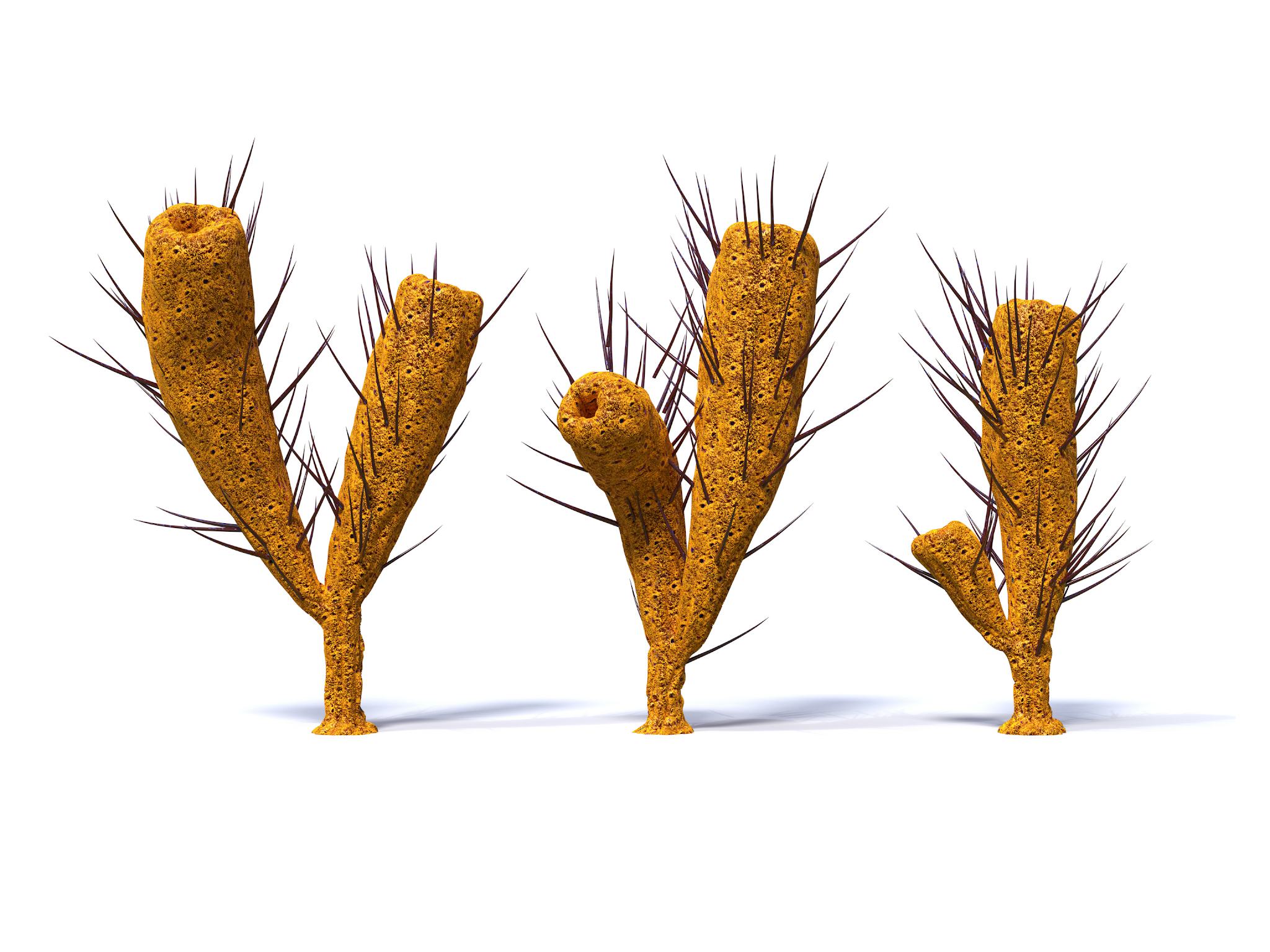
PIRANIA: MIDDLE CAMBRIAN SPONGE

Pirania
is an extinct genus of sea sponge from the Middle Cambrian Burgess Shale in the Canadian Rockies of British Columbia and the Ordovician Fezouata Formation of Morocco. 

We have sea sponges living in our oceans today. Sea Sponges are some of the simplest multicellular organisms alive. They do not have brains, digestive, circulatory or nervous systems and, once rooted, do not move. 

Sponge species are numerous and diverse. There are 8,550 living sponge species in the phylum Porifera, which is comprised of four distinct classes. 

Demospongiae is the most diverse, containing 76.2% of all living sponges. Desmospongiae form complex bodies with monoaxon or tetraxon spicules. They can live in both marine and freshwater.

Hexactinellida, the rare glass sponges; Calcarea which contains all the calcareous sponges; and, Homoscleromorpha, the rarest and simplest class with 117 species. Homoscleromorpha has only recently been recognized so perhaps we will find more examples as we explore the world's oceans.

They are very skilled at filtering water and can pass more than 20,000 times their volume through their systems in a single day. They greatly aid in the water quality of coral reef ecosystems, filtering bacteria along with the water they process. They also aid with carbon, nitrogen and phosphorus as they filter it through their bodies and put it back into the ecosystem via their excrement.

Pirania is named after Mount St. Piran, near the Bow River Valley, Banff National Park, Alberta, Canada. It was first described by Charles Doolittle Walcott in 1920 from 128 fossil specimens found within the Greater Phyllopod bed, the most famous fossil-bearing member of the 508 million-year-old Burgess Shale Fossil Lagerstätte in the Canadian Rockies of British Columbia. The type locality has exceptional preservation of soft-bodied animals from the Middle Cambrian.

Monday, 12 July 2021

ANCIENT MARINE REPTILES: ICHTHYOSAURS

During the early Triassic period, ichthyosaurs evolved from a group of unidentified land reptiles that returned to the sea. 

They were particularly abundant in the later Triassic and early Jurassic periods before being replaced as the premier aquatic predator by another marine reptilian group, the Plesiosauria, in the later Jurassic and Cretaceous periods.

They thrived during much of the Mesozoic era; based on fossil evidence, they first appeared around 250 million years ago and at least one species survived until about 90 million years ago into the Late Cretaceous.

While they resembled fish and dolphins, ichthyosaurs were large marine reptiles belonging to the order known as Ichthyosauria or Ichthyopterygia. In 2018, Benjamin Kear and his team were able to study ichthyosaur remains at the molecular level, Their findings suggest ichthyosaurs had skin and blubber quite similar to our modern dolphins.

While ichthyosaurs evolved from land-dwelling, lung-breathing reptiles, they returned to our ancient seas and evolved into the fish-shaped creatures we find in the fossil record today.

Their limbs fully transformed into flippers, sometimes containing a very large number of digits and phalanges. Their flippers tell us they were entirely aquatic as they were not well-designed for use on land. And it was their flippers that first gave us the clue that they gave birth to live young; a find later confirmed by fossil embryo and wee baby ichy finds.

Sunday, 11 July 2021

J.A. JELETZKY (1915-1988): CONTRIBUTIONS TO PALAEONTOLOGY

Homage to Palaeontologist Jeletzky — many of us who have done palaeontological fieldwork or studies have huge respect for the work of Jurij Alexandrovich Jeletzky. 

Jeletzky — Jura to his family and Russian friends, and George to the international English-speaking geological community — was born in Pensa, Russia, on June 18, 1915, and died December 4, 1988. 

His father was a physician, Alexander Grigorievich Romanov, and his mother was Halina Nicolayevna (Romanova) Jeletzky.

During his high school years, which he finished in Saratov in 1932, he developed an active interest in Mesozoic stratigraphy and palaeontology while visiting the classical Upper Jurassic sections along the Volga River. 

You will undoubtedly recall that the Volga is that region that offers up the spectacular oil-in-water coloured ammonite specimens like Quenstedtoceras (Lamberticeras) lamberti, Eboraciceras, Peltoceras, Kosmoceras, Grossouvria, Proriceras, Cadoceras and Rursiceras — inspirational indeed. 

He graduated with honours from the Geological and Geophysical Faculty of the State University at Kyiv in 1938 and completed graduate studies in palaeontology and stratigraphy at the Institute of Geological Sciences of the Ukrainian Academy of Sciences, Kyiv, in 1941. His Candidate of Geological Sciences (equivalent to a PhD) thesis was devoted to the stratigraphy and belemnite fauna of the Boreal Upper Cretaceous of northern Eurasia. 

On June 22, 1941, the day Germany invaded the USSR, he married a physician, Tamara Fedorovna, the daughter of the distinguished professor F. P. Bohatirchuk and had four children together — Alex, Olga, Theodore, and Halina. 

Jurij was in Kyiv when the city fell to the German armies in September 1941, and he continued working there as a palaeontologist in the Institute of Geological Sciences of the Ukrainian Academy of Sciences, until, on the return of the Red Army in 1943, he moved his family west to Poland and Germany. He left Berlin and reached Bayreuth, Bavaria, crossing the narrow strip between the advancing lines of the Allied and Soviet armies.

Throughout those difficult years, in which he worked as a librarian and finally as a translator in the U .S.-occupied zone of Germany, Jurij managed to keep his family together and to save some of his personal belongings. In 1948, he moved to Canada, where he became a research scientist for the Geological Survey of Canada. He held that title until 1982 when he was awarded emeritus status.

Jurij’s first paper, published in 1938, dealt with Pleistocene gastropods, but the bulk of the nearly 150 papers published in his lifetime were devoted to Mesozoic palaeontology and stratigraphy, especially from western and northern Canada; Cretaceous stratigraphy and belemnite faunas of northern Eurasia; as well as palaeogeography and paleobiogeography.

He worked on Vancouver Island initially, producing geologic maps and structural and stratigraphic reports, and this work was followed up with studies of correlative strata in southern British Columbia. His second major area of study was the northern Yukon where he elucidated the stratigraphy, structure, and palaeontology of Mesozoic rocks. His outstanding contribution to the work of the Geological Survey of Canada was sustained research on the Cretaceous stratigraphy and fossils of Canada.

George was a prolific writer and made major contributions to palaeontology, particularly the study of Cretaceous ammonoids, the bivalve Buchia, and the Mesozoic coleoids, particularly belemnites on which he began his paleontological career. Indeed, George was engaged in the production of the volume on coleoids for the Treatise on Invertebrate Paleontology when he died. 

He was a great champion of the role that fossils play in biochronology and the development of the Phanerozoic time scale. George had broad interests that impacted many aspects of geology, including palaeogeography, tectonics, and eustacy.

In 1955, on completion of stratigraphic studies on Vancouver Island, Jurij began a long-range project in the Mackenzie District of northwestern Canada. He said he was searching “for the most nearly continuous and largely or entirely open-marine section of Upper Jurassic-Low er Cretaceous rocks.” 

He believed that such a section was badly needed to correlate and order sequentially what were then the scattered Early Cretaceous and Late Jurassic marine invertebrate faunas from western and Arctic Canada. His extensive field research, which began by canoe and on foot in the company of an Indigenous guide and a cook in inaccessible and unpopulated areas of the northern Yukon, was conducted between 1955 and 1975. Numerous publications and shelves of detailed field notebooks document the complete Upper Jurassic-Lower Cretaceous sequence for which he searched.

This project led to his studies on the systematics and biostratigraphy of the bivalve Buchia, used in the final synthesis of his ideas about the Jurassic/Cretaceous boundary (1984, Geological Survey of Canada Special Paper 27). That paper, he said, meant a lot to him: it summarized nearly a lifetime’s work on the Jurassic/Cretaceous boundary beds, and he intended for it to be his final word on the subject. 

In that work, as in most others related to boreal biostratigraphy, a thorough analysis of the subject was facilitated by his Russian background and his knowledge of several other Slavic languages, as well as German and French.

In the 1960s, Jurij became coordinator and principal author of the Coleoidea volume of the Treatise on Invertebrate Paleontology, after the editors had agreed that the usual compilation of the volume should be preceded by a thorough revision of morphology, taxonomy, and phylogeny. This implied the reappraisal of all principal morphologic features of the Belemnitida and included the study of all type collections available worldwide. 

Only an individual with Jurij’s determination and intellectual and working capacity could have faced such a staggering enterprise. He thus amassed an enormous amount of information and became the world’s leading authority on the subject. 

A number of papers were published, including his extensively documented work on the comparative morphology, phylogeny, and classification of the fossil Coleoidea (1966, University of Kansas Paleontological Contribution No. 7). Meanwhile, he tended to his official duties for the Survey with his habitual thoroughness. This work included the study of large collections made by other geologists, as well as provincial surveys and research by oil and mining companies, and resulted in a large number of papers and unpublished reports.

However, it slowed the preparation of the Treatise final manuscript. He could have shortened some parts and compiled others, but Jurij felt that as a conscientious scientist he could not agree to publish any results that he considered either wrong or substandard.

Thus, several papers remain unpublished, including a 331-page manuscript, finished in 1978, on early and middle Liassic Belemnite faunas of England in relation to coeval faunas of northern Eurasia.

Jurij was a Fellow of the Geological Society of America and of the Royal Society of Canada. He received the Willet G. Miller Medal of the Royal Society of Canada in 1969 for outstanding basic research in geology (palaeontology and stratigraphy), and the Elkanah Billings Medal of the Geological Association of Canada (1978) for his research on Canadian palaeontology. He was also honoured, together with Ralph Imlay of the U.S.

Geological Survey, with a Special Symposium on the Jurassic-Cretaceous biochronology and palaeogeography of North America, during the Third North American Paleontological Convention in Montreal in 1982 (see Westermann, G., ed., 1984, Geological Association of Canada Special Paper 27).

Jurij Jeletzky worked for many years to the limit of his physical endurance, although he realized the danger to his health. From 1984 until his death in 1988, suffering from cancer, he worked to the limit of his failing strength to publish an important monograph on ammonites of the boreal regions, and to finish the Coleoidea volume of the Treatise and a large synthesis on the Yukon area. 

At his death, the first paper (co-written with E. Kemper, Geological Survey of Canada Bulletin 377) was already published; Jurij was still correcting the last version of the Yukon manuscript, and the Treatise manuscript was 80 to 90 per cent complete. In the last week of his life, he forced himself to correct, in his hospital bed, the proof pages of a paper on the relation of the Neuburg Formation of Germany to the sub-boreal Volgian of the Russian platform, thus completing the circle that brought him to geology during his high school years. 

A true earth scientist, Jurij based all his interpretations and theoretical discussions on facts, and as a committed, responsible, and independent-minded researcher, he challenged any hypothesis, even the most popular one, if it did not fit his data. Thus, in 1962 (Royal Society of Canada Transactions, v. 56), he opposed the prevailing views on the Cordilleran geosyncline in relation to northern Yukon, and in 1984 (Geological Survey of Canada Special Paper 27), he rejected the existence of large-scale north-south movements of “ allochthonous terranes” in western North America and Alaska after the Middle Jurassic. 

Instead, he adhered to the expanding Earth hypothesis rather than to orthodox plate tectonics. He held that palaeontology was the only basis for practical geochronology (1956, American Association of Petroleum Geologists Bulletin, v. 40), discussed the abuse of quantification in palaeontology and biochronological correlation (1965, Journal of Paleontology, v. 39), and the overestimation of eustatic compared to vertical tectonic movements in controlling large-scale transgressions and regressions (1978, Geological Survey of Canada Paper 77-18), and he vindicated the value of molluscs with respect to foraminifers for age and depositional interpretation of Tertiary rocks in British Columbia (1973, Canadian Journal of Earth Sciences, v. 10). 

He also thought that his data from extensive collections of Late Jurassic-Early Cretaceous Buchia and Late Cretaceous Inoceramus were in conflict with the “punctuated equilibrium” hypothesis. Whenever he became involved in scientific controversy, it was based on his deep belief that a scientist’s duty is to express openly his doubts whenever his data are challenged. Thus, he was always ready to stand up for his beliefs without being pompous; on the contrary, he was a very modest man.

Jurij never refused to give advice, when asked, especially to a junior colleague, or to write a detailed review of a thesis or manuscript. Even in the last weeks of his life, he completed a review, knowing that time was short and precious. He was extremely loyal to his profession—his love—and to the institution for which he worked.

He loved life, every hour of it. In his private life, he was a kind and generous person, always ready to give help to a colleague or friend. He never showed the strains of a personal life full of hardships.

Jura (George) Jeletzky will be missed by all those who believe that personal freedom, independence of thought, respect for facts, and a straightforward attitude in upholding fundamental principles as the hallmarks of a valuable human and scientific life.

A.C. Riccardi, Museum de Ciencias Naturalas, Universidad Nactional de La Plata, Argentina wrote a wonderful memorial to Jeletzky as did Godfrey Nowland, Chief Paleontologist, Geological Survey of Canada. Much of what they shared is included here. 

https://www.cambridge.org/core/services/aop-cambridge-core/content/view/BF4C5A14713639CE54B473408D4406E6/S0022336000019776a.pdf/div-class-title-j-a-jeletzky-1915-1988-div.pdf

Saturday, 10 July 2021

SPINY HETEROMORPH AMMONITE: INDEX FOSSILS

Ammonites, like this gorgeous spiny heteromorph, were prolific breeders that evolved rapidly. If you could cast a fishing line into our ancient seas, it is likely that you would hook an ammonite, not a fish.

We find ammonite fossils, and plenty of them, in sedimentary rock from all over the world. In some cases, we find rock beds where we can see evidence of a new species that evolved, lived and died out in such a short time span that we can walk through time, following the course of evolution using ammonites as a window into the past. For this reason, they make excellent index fossils. 

An index fossil is a species that allows us to link a particular rock formation, layered in time with a particular species or genus found there. Generally, deeper is older, so we use the sedimentary layers of rock to match up to specific geologic time periods, rather like the way we use tree rings to date trees.

Friday, 9 July 2021

TRILOBITES: HIGHLY SUCCESSFUL ANCIENT ARTHROPODS

Trilobites are an extinct group of marine arthropods that first appeared in the Early Cambrian. They left many beautifully preserved examples of their three-lobed exoskeletons in the fossil record. Trilobites — in all their many wonderful forms — lived in our ancient oceans for more than 270 million years. The last of their lineage went extinct at the end of the Permian, 252 million years ago.