Wednesday, 23 December 2015

FOSSILS BENEATH THE MOSS: THE OLYMPIC PENINSULA

Third Beach in La Push, Washington
This is the view of low tide exposing the coastal rocks and sea stacks at Third Beach in La Push, Olympic Peninsula in Washington State.

If you’ve ever set foot on Washington’s Olympic Peninsula, you know it feels like walking into awe inspiring nature—towering evergreens breathing fog, lush moss, the surf lapping at her shores and rivers that coil like dragons guarding secrets. 

What most visitors don’t know is that beneath all that soft green wizardry lies one of the wildest geologic patchwork quilts on the continent, stitched together from bits of wandering seafloor, ancient islands, and the sorts of rocks that only a subduction zone could love.

Let’s start with the big mover and shaker: the Juan de Fuca Plate, Earth’s most polite tectonic dinner guest, eternally slipping under North America with the quiet persistence of someone trying not to disturb the table. 

For millions of years, the seafloor has been bulldozed downward, its sediments scraped off, rolled up, smushed, and plastered onto the edge of the continent. 

This collection of recycled deep-ocean debris—sandstones, shales, basalts, the occasional volcano gone rogue—forms the Olympic Subduction Complex, a name that sounds like a niche gymnastics event but is, in fact, the bedrock of the peninsula.

Musashia, Lower Miocene, Clallam Formation
Now here’s where it gets juicy: among all that tectonic tumbleweed lie fossils. Unexpected fossils. Delightful fossils. 

Fossils that survived a one-way trip toward the mantle and still managed to hang on long enough for you to admire them.

Take the Makah Formation along the peninsula’s rugged northwest edge—a dramatic stretch where Eocene-age marine rocks (think 35–40 million years old) preserve the remains of ancient deep-water creatures. 

Here you can find the ghostly traces of prehistoric whales, fish, and even the occasional bird that took one wrong turn over the Pacific. 

These fossils are often so beautifully preserved that they look like they’ve been waiting under the waves for their close-up. Look at the amazing preservation in the picture perfect gastropod, Musashia, a type of fossil snail or gastropod, belonging to the subgenus Fulgoraria (Musashia) and are part of the larger family Volutidae. The beauty in my hand here is from the Clallam Formation as is the slightly calcified nautiloid, Arturia angustata, though these lovelies are also found in a few other localities along the Olympic Peninsula. 

The Lower Miocene nautiloid Arturia angustata
Adjacent to it lies the Hoshialeah Formation—a rock unit full of deep-sea turbidites, which are basically underwater avalanches that helpfully sorted fine sediments into perfect fossil-pressing layers. 

These rocks carry delicate impressions of fish scales, plankton, and mysterious organic wisps that paleontologists politely argue about at conferences.

Then there’s the Clallam Formation, where 15–20 million-year-old marine fossils swirl through the beds: clams, scallops, barnacles, sea lions, and whales. It’s like stumbling into a Miocene farmers’ market, except everything is stone and nobody is selling artisanal kelp jam.

And we mustn’t forget the Olympic hotshot of insect fossils, the Quinault Formation, which holds rare impressions of long-lost bugs—those six-legged pioneers of ancient Washington who never got the memo about the coming Ice Ages.

Neah Bay, Washington State
All of this—all this turmoil, uplift, squish, scrape, and tectonic origami—has created the spectacular mountains we see today. 

The Olympics are not volcanoes like their shouty cousins to the east. They’re a colossal jumble of once-submerged strata, hoisted skyward by subduction and then sculpted by glaciers into the moody, mist-laden peaks you hike now.

The delightful part? Because the rocks started underwater, much of the peninsula’s geology reads like a deep-sea diary. Even 7,000-foot peaks contain sedimentary layers that formed far offshore. 

Imagine standing on Hurricane Ridge, a mountain meadow full of wildflowers and marmots, knowing the rocks under your boots once lay on a cold ocean floor full of strange fish and drifting plankton. It’s an excellent perspective check—and a great excuse to tell your hiking companions dramatic stories about continental accretion until they pretend they need to stop for granola.

But here’s the real charm of the Olympic Peninsula: the sense of transformation. Every fossil here survived unimaginable pressure, heat, tectonic shoving, and glacial erosion—yet remains as a whisper from worlds long gone. Their presence is a quiet reminder that resilience is baked into the natural world. Even the humblest shell or fish scale becomes, given enough time and a few kilometres of uplift, a monument to endurance.

Whale Vertebrae from Majestic Beach, Washington
If you happen to be wandering the driftwood-strewn beaches near Neah Bay or tracing the tide lines near Clallam Bay, know that you’re standing on the upturned archives of ancient oceans. 

Somewhere beneath your feet, a whale vertebra or clam shell from 20 million years ago is patiently waiting for erosion—and your curiosity—to set it free.

And that, dear fellow rock-romantic, is the Olympic Peninsula: part rainforest, part mountain kingdom, part fossil cabinet, part tectonic balancing act. 

A place where the past is always underfoot, the present is draped in moss, and the future will probably require rain boots.

Lead Image: Low tide at Third Beach in La Push reveals coastal rocks and sea stacks along the Olympic Peninsula in Washington State by Nick Fox


Monday, 21 December 2015

Sunday, 20 December 2015

THE GREAT FINGER FIASCO: HERMANN AND CUVIER

Johann Hermann's Pterodactylus, 1800
In the grand annals of science, few discoveries have flapped into history with quite as much confusion as the poor Pterodactylus

It began, as many great scientific mix-ups do, with an enthusiastic man, a misplaced fossil, and a few patriotic misunderstandings.

Back in March of 1800, Johann Hermann — a German-slash-French scientist (depending on which invading army was in town that week) — became convinced that an odd fossil described by Collini held the key to something extraordinary. 

Without actually seeing the specimen, Hermann took a bold scientific leap: he announced that the animal used its absurdly long fourth finger to support a wing membrane.

This, in hindsight, was rather brilliant — and also rather lucky. Hermann mailed off a letter (and a sketch) to the great French naturalist Georges Cuvier, suggesting that the fossil might even have been war booty, plundered by Napoleon’s scientifically curious troops and whisked off to Paris. After all, France’s armies were busily collecting everything from priceless art to interesting bones at the time — science’s version of a clearance sale.

In his letter, Hermann proposed that this mysterious creature was a mammal. Yes, a furry, bat-like, possibly adorable flying thing. He imagined it with soft pelage, wings stretching elegantly from its fourth finger to its ankle, and a fashionable membrane connecting neck to wrist — the very portrait of prehistoric glamour.

Cuvier, intrigued and perhaps unwilling to admit he didn’t have the fossil in question, agreed with the wing idea but drew the line at “fuzzy mammal.” In December 1800, he published a short note, adopting Hermann’s winged interpretation but firmly declaring, “Non, monsieur — this thing is definitely a reptile.

Meanwhile, the fossil — allegedly stolen, possibly missing, and definitely not in Paris — turned up safe and sound in Munich. It had been spared confiscation thanks to one Baron von Moll, who managed to secure an “exemption from French enthusiasm.”

By 1809, Cuvier revisited the mystery, producing a longer and more confident description. He called it Petro-Dactyle (a typo he later fixed to Ptéro-Dactyle), thereby cementing both his reputation and a new spelling headache for future generations of palaeontologists.

He also took the time to dunk on his colleague Johann Friedrich Blumenbach, who had suggested the fossil might belong to a shore bird. Cuvier’s rebuttal was deliciously dry:

“It is not possible to doubt that the long finger served to support a membrane that, by lengthening the anterior extremity of this animal, formed a good wing.”

And with that, science had its first flying reptile — a creature born not only from stone but from a glorious mix of imagination, rivalry, and a few well-placed postal misunderstandings.

If you ever feel unqualified to make a bold scientific claim, remember Johann Hermann — who identified a whole new order of life without even seeing the fossil. Sometimes, a good guess (and a long finger) can take you far as history shows here in the The Great Finger Fiasco: How Johann Hermann and Georges Cuvier Accidentally Invented the Flying Reptile. 

Saturday, 19 December 2015

Saturday, 21 November 2015

PLAYFUL SEALS: MIGWAT

Seals—those sleek, playful creatures that glide through our oceans and lounge on rocky shores—are part of a remarkable evolutionary story stretching back millions of years. 

Though we often see them today basking on beaches or popping their heads above the waves, their journey through the fossil record reveals a dramatic tale of land-to-sea adaptation and ancient global wanderings.

Seals belong to a group of marine mammals called pinnipeds, which also includes sea lions and walruses. 

All pinnipeds share a common ancestry with terrestrial carnivores, and their closest living relatives today are bears and mustelids (like otters and weasels). 

While it may seem unlikely, their ancestors walked on land before evolving to thrive in marine environments. It takes many adaptations for life at sea and these lovelies have adapted well. 

The fossil record suggests that pinnipeds first emerged during the Oligocene, around 33 to 23 million years ago. 

These early proto-seals likely lived along coastal environments, where they gradually adapted to life in the water. Over time, their limbs transformed into flippers, their bodies streamlined, and their reliance on the sea for food and movement became complete.

In Kwak'wala, the language of the Kwakwaka'wakw First Nations of the Pacific Northwest, seals are known as migwat, and fur seals are referred to as xa'wa.

Friday, 20 November 2015

Sunday, 15 November 2015

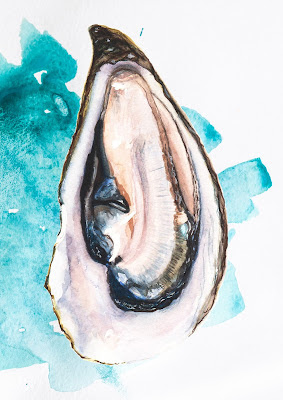
FIRST NATION MIDDENS: WEST COAST OYSTERS

One of the now rare species of oysters in the Pacific Northwest is the Olympia oyster, Ostrea lurida, (Carpenter, 1864).  

While rare today, these are British Columbia’s only native oyster. 

Had you been dining on their brethren in the 1800s or earlier, it would have been this species you were consuming. Middens from Port Hardy to California are built from Ostrea lurida.

These wonderful invertebrates bare their souls with every bite. Have they lived in cold water, deep beneath the sea, protected from the sun's rays and heat? Are they the rough and tumble beach denizens whose thick shells tell us of a life spent withstanding the relentless pounding of the sea? Is the oyster in your mouth thin and slimy having just done the nasty—spurred by the warming waters of Spring? 

Is this oyster a local or was it shipped to your current local and, if asked, would greet you with "Kon'nichiwa?" Not if the beauty on your plate is indeed Ostrea lurida

Oyster in Kwak'wala is t̕łox̱t̕łox̱
We have been cultivating, indeed maximizing the influx of invasive species to the cold waters of the Salish Sea for many years. 

But in the wild waters off the coast of British Columbia is the last natural abundant habitat of the tasty Ostrea lurida in the pristine waters of  Nootka Sound. 

The area is home to the Nuu-chah-nulth First Nations who have consumed this species boiled or steamed for thousands of years. Here these ancient oysters not only survive but thrive — building reefs and providing habitat for crab, anemones and small marine animals. 

Oysters are in the family Ostreidae — the true oysters. Their lineage evolved in the Early Triassic — 251 - 247 million years ago. 

In the Kwak̓wala language of the Kwakwaka'wakw, speakers of Kwak'wala, of the Pacific Northwest and my family, an oyster is known as t̕łox̱t̕łox̱

I am curious to learn if any of the Nuu-chah-nulth have a different word for an oyster. If you happen to know, I would be grateful to learn.

Tuesday, 10 November 2015

Wednesday, 4 November 2015

Wednesday, 21 October 2015

FOSSILS OF EGYPT: LIMESTONE AND LIFE

Spinosaurus, Fukui Prefectural Dinosaur Museum
Egypt is often celebrated for its pyramids and pharaohs, but beneath those golden sands lies a much older and equally astonishing legacy — the fossil record of a land that has shifted from lush tropical forests to inland seas and back again.

From the Western Desert to the Fayum Depression and Wadi Al-Hitan (the Valley of the Whales), Egypt’s rocks preserve nearly 100 million years of life on Earth, from the Cretaceous dinosaurs that roamed its river plains to the Eocene whales that swam through the Tethys Ocean.

Over the past few posts, we've looked at the geological wonders of Egypt. Here is a deeper look at some of the many interesting fossil species to be found in this rich paleontological playground.

Petrified Wood — A Forest Turned to Stone

Across Egypt’s deserts, the ground often glitters with fossilized trees. The Petrified Wood Protectorate near New Cairo, along the Cairo–Suez road, and wide stretches of the Western Desert are carpeted in ancient trunks and branches turned to stone.

These fossil forests are vivid evidence that much of Egypt was once a humid, tropical landscape, rich with vegetation. The trees, buried in sediments and permineralized over millions of years, became exquisitely preserved in silica. Today, their polished cross-sections shimmer with bands of reds, browns, and golds — a striking reminder of the region’s deep ecological transformations.

Reptiles of the Fayum — Turtles, Crocodiles, and Giants — The Fayum Depression has yielded a wealth of Eocene reptile fossils that speak of a warm, watery world teeming with life. Land tortoises like Testudo ammon roamed the ancient floodplains, while river turtles such as Podocnemis blanckenhorni and Stereogenys pelomedusa swam through slow-moving channels. 

Even more dramatic are the remains of Gigantophis, one of the largest snakes ever discovered, and Tomistoma, a crocodile-like predator from the Qasr al-Sagha Formation. These reptiles hint at an ecosystem that blended mangroves, lagoons, and river deltas — a mosaic of habitats where both freshwater and marine species thrived.

Birds of an Ancient Delta — The Fayum’s fossil beds also record an impressive diversity of Eocene and Oligocene birdlife. The ancient wetlands once supported ospreys (Pandionidae), flamingos (Phoenicopteridae), herons, cranes (Gruidae), cormorants (Phalacrocoracidae), and even the massive shoebilled stork (Balaenicipitidae).

These avian fossils, comparable to species found today around Lake Victoria and the Upper Nile, suggest a vibrant, subtropical ecosystem rich in lakes and marshes — a far cry from the arid desert we see today.

Mammals of the Fayum — Whales, Elephants, and Early Primates

The mammalian fossils of Egypt are among the most extraordinary in the world. In the Fayum Depression and at Wadi Al-Hitan, paleontologists have uncovered a sweeping record of evolution from land to sea and from primitive mammals to the ancestors of modern species.

At Wadi Al-Hitan, skeletons of early whales — Basilosaurus isis, Dorudon atrox, and Phiomicetus — preserve a pivotal evolutionary moment when whales transitioned from walking on land to swimming in the sea. Their long, streamlined bodies and tiny hind limbs are beautiful testaments to nature’s adaptability.

Meanwhile, the terrestrial Fayum deposits reveal a menagerie of early mammals:

  • Arsinoitherium, a massive, rhinoceros-like creature with twin horns;
  • Moeritherium, a semi-aquatic ancestor of elephants and manatees;
  • Palaeomastodon and Phioma, early proboscideans bridging the gap to modern elephants;
  • and Megalohyrax, a giant relative of today’s small hyrax.

Carnivorous mammals also prowled these Eocene landscapes — species like Apterodon, Pterodon, and Hyaenodon, formidable predators of their time.

The Fayum Primates — Our Ancient Cousins — Among the Fayum’s most scientifically valuable discoveries are the fossils of early primates, bridging the gap between ancient prosimians and modern monkeys and apes.

From the lower sequence, we find forms like Oligopithecus savagei and Qatrania wingi, while the upper sequence preserves Catopithecus browni, Proteopithecus sylvia, and the well-known Apidium and Parapithecus species.

Perhaps most famous is Aegyptopithecus zeuxis, a small tree-dwelling primate with forward-facing eyes and a relatively large brain. It is often cited as one of the earliest known ancestors of modern Old World monkeys and apes — and, by extension, of humans.

These fossils from the Jebel Qatrani Formation provide an unparalleled window into primate evolution roughly 35 to 30 million years ago, when Africa’s tropical forests were home to our distant kin.

Dinosaurs of the Cretaceous Desert — Long before the whales and primates, Egypt’s landscape was dominated by Cretaceous dinosaurs. The Bahariya Formation and Nubian Sandstone have yielded fossils of immense sauropods and ferocious theropods, painting a vivid picture of life 95 million years ago.

Among the stars of this ancient cast are:

  • The long-necked Aegyptosaurus and Paralititan, massive plant-eating sauropods;
  • The sleek, predatory Bahariasaurus, Carcharodontosaurus, and Deltadromeus;
  • The semi-aquatic Spinosaurus, with its iconic sail-backed spine — perhaps one of the most famous dinosaurs to ever emerge from African rock; and Mansourasaurus, a titanosaur discovered more recently, helping to link Africa’s late Cretaceous fauna with those of Europe and Asia.

These finds demonstrate that Egypt was once a fertile delta world of rivers and floodplains, where dinosaurs thrived long before the Sahara turned to sand.

Egypt’s Fossil Sites — Portals Through Time — Key fossil localities across the country continue to reveal Egypt’s ancient ecosystems:

  • Wadi Al-Hitan — Eocene marine fossils, including whales and sea cows.
  • Fayum Depression — rich terrestrial and freshwater deposits with early mammals and primates.
  • Bahariya Formation — famous for Cretaceous dinosaurs and early vertebrates.
  • Jebel Qatrani Formation — Oligocene primates and proboscideans.
  • Qasr el Sagha Formation — reptiles, turtles, and early crocodilians.
  • Upper Cretaceous Phosphates and Variegated Shale — marine invertebrates and early fish.
  • Moghra Oasis — Miocene fossils bridging the gap between ancient and modern fauna.
  • Queseir Formation — Upper Cretaceous (Campanian) deposit in the Kharga oasis of the Southwestern Desert where the first side-necked turtle Khargachelys caironensis can be found

Egypt’s fossils offer a spectacular narrative of evolution, climate, and change — from swampy Cretaceous river deltas to lush Eocene seas and forests, to the deserts we see today. 

Each discovery connects the story of Earth’s deep past with the land of the Pharaohs, revealing that Egypt’s most enduring monuments are not her pyramids, nor her simple blocks of stone, but the fossils buried them

Image Credit: Spinosaurus at the special exhibit of Fukui Prefectural Dinosaur Museum by Palaeotaku CC BY 4.0

Thursday, 15 October 2015

TYLOSTOME TUMIDUM

This lovely big fellow is Tylostoma tumidum, an epifaunal grazing Lower Cretaceous Gastropod from the Goodland Formation near Fort Worth, Texas, USA. (171.6 to 58.7 Ma)

Thursday, 8 October 2015

PALM TRUNK MOULD

George Mustoe of the Burke Museum preparing to make a mould of a palm trunk that once gew in the wetlands that bordered an ancient river.

Sunday, 20 September 2015

ERBENOCHILE ERBENI

A spectacular specimen of the trilobite Erbenochile erbeni. This impressive fossil arthropod shows unusual schizochroal eyes characteristic of the genus.

Family Odontopleuridae, Odontopleurid trilobite from the Lower Devonian, Emsian, 408 to 393 MYA, Bou Tiskaouine Formation, Hamar l”Aghdad Limestones, Taharajat, Oufaten, Djebel Issoumour