Thursday, 21 January 2021

LOTUS FLOWER FRUIT

Lotus Flower Fruit, Nelumbo
This beauty is the fruit of the lotus, Nelumbo. This specimen was found by Green River Stone (GRS) in early Eocene outcrops of the Fossil Lake Member of the Green River Formation. 

The awesome possums from GRS are based out of North Logan, Utah, USA and have unearthed some world-class specimens. They've found Nelumbo leaves over the years but this is their first fossil specimen of the fruit.

And what a specimen it is! The spectacularly preserved fruit measures 6-1/2" round. Here you can see both the part and counterpart in fine detail. Doug Miller of Green River Stone sent copies to me this past summer and a copy to the deeply awesome Kirk Johnson, resident palaeontologist over at the Smithsonian Institute, to confirm the identification.

There is another spectacular specimen from Fossil Butte National Monument. They shared photos of a Nelumbo just yesterday. Nelumbo is a genus of aquatic plants in the order Proteales found living in freshwater ponds. You'll recognize them as the emblem of India, Vietnam and many wellness centres.

Nelumbo Fruit, Green River Formation
There is residual disagreement over which family the genus should be placed in. Traditional classification systems recognized Nelumbo as part of the Nymphaeaceae, but traditional taxonomists were likely misled by convergent evolution associated with an evolutionary shift from a terrestrial to an aquatic lifestyle. 

In the older classification systems, it was recognized under the biological order Nymphaeales or Nelumbonales. Nelumbo is currently recognized as the only living genus in Nelumbonaceae, one of several distinctive families in the eudicot order of the Proteales. Its closest living relatives, the (Proteaceae and Platanaceae), are shrubs or trees.

Interestingly, these lovelies can thermoregulate, producing heat. Nelumbo uses the alternative oxidase pathway (AOX) to exchange electrons. Instead of using the typical cytochrome complex pathway most plants use to power mitochondria, they instead use their cyanide-resistant alternative. 

This is perhaps to generate a wee bit more scent in their blooms and attract more pollinators. The use of this thermogenic feature would have also allowed thermo-sensitive pollinators to seek out the plants at night and possibly use the cover of darkness to linger and mate.

So they functioned a bit little like a romantic evening meeting spot for lovers and a wee bit like the scent diffuser in your home. This lovely has an old lineage with fossil species in Eurasia and North America going back to the Cretaceous and represented in the Paleogene and Neogene. Photo Two: Doug Miller of Green River Stone Company

Wednesday, 20 January 2021

SAFFRON GOLD: CROCUS BLOSSOMS

Crocus — the plural of which is crocuses or croci — is a genus of flowering plants in the iris family comprising 90 species of perennials growing from corms. Many are cultivated for their flowers appearing in autumn, winter, or spring. The spice saffron is obtained from the stigmas of Crocus sativus, an autumn-blooming species.

Each crocus flower plucked gently by hand yields three vivid strands of saffron with an acre of laborious work producing only a few pounds.

The challenge of harvesting saffron from crocus and it's high market value dates back to 2100-1600 BC as the Egyptians, Greeks, and the Minoans of Crete all cultivated crocus not as a spice, but as a dye. Roman women used saffron to dye their hair and textiles yellow. The crocus corm has a history of trade throughout Europe that a few pounds of corms served as a loan of gold or jewels. It made it's way into the writing of the Greeks as early as 300 BC where it originated. The precious flower travelled to Turkey and then all the way to Great Britain in the 1500s before making it's way to the rest of the world.

Tuesday, 19 January 2021

INDIGO: NATURAL DYES

Natural dyes are dyes or colourants derived from plants, invertebrates, or minerals. The majority of natural dyes are vegetable dyes from plant sources — roots, berries, bark, leaves, and wood — and other biological sources such as fungi and lichens.

Archaeologists have found evidence of textile dyeing dating back to the Neolithic period. In China, dyeing with plants, barks and insects has been traced back more than 5,000 years and looks to be our first attempt at the practice of chemistry.

The essential process of dyeing changed little over time. Typically, the dye material is put in a pot of water and then the textiles to be dyed are added to the pot, which is heated and stirred until the colour is transferred. Sometimes, we use workers with stout marching legs to mix this up.

Traditional dye works still operate in many parts of the world. There is a revival of using natural indigo in modern Egypt — although their indigo dye is mostly imported. The same is true further south in Sudan. They've been importing cloth from Upper Egypt as far back as we have written records and continue the practice of the cloth and dye imports today. Clean white cotton is more the style of western Sudan and Chad, but they still like to throw in a bit of colour.

Traditional Dye Vats
So do the folk living in North Africa. Years ago, I was travelling in Marrakesh and saw many men with noticeably orange, blueish or purplish legs. It wasn't one or two but dozens of men and I'd wondered why this was.

My guide took me to the top of a building so I could look down on rows and rows of coloured vats. In every other one was a man marching in place to work the dye into the wool. Their legs took on the colour from their daily march in place in huge tubs of liquid dye and sheared wool. This wool would be considered textile fibre dyed before spinning — dyed in the wool — but most textiles are yarn-dyed or piece-dyed after weaving.

Many natural dyes require the use of chemicals called mordants to bind the dye to the textile fibres; tannin from oak galls, salt, natural alum, vinegar, and ammonia from stale urine were staples of the early dyers.

Many mordants and some dyes themselves produce strong odours. Urine is a bit stinky. Not surprisingly, large-scale dyeworks were often isolated in their own districts.

Woad, Isatis tinctoria
Plant-based dyes such as Woad, Isatis tinctoria, indigo, saffron, and madder were raised commercially and were important trade goods in the economies of Asia and Europe. Across Asia and Africa, patterned fabrics were produced using resist dyeing techniques to control the absorption of colour in piece-dyed cloth.

Dyes such as cochineal and logwood, Haematoxylum campechianum, were brought to Europe by the Spanish treasure fleets, and the dyestuffs of Europe were carried by colonists to America.

Throughout history, people have dyed their textiles using common, locally available materials, but scarce dyestuffs that produced brilliant and permanent colours such as the natural invertebrate dyes. Crimson kermes became highly prized luxury items in the ancient and medieval world. Red, yellow and orange shades were fairly easy to procure as they exist as common colourants of plants. It was blue that people sought most of all and purple even more so.

Indigofera tinctoria, a member of the legume or bean family proved just the trick. This lovely plant —  named by the famous Swedish botanist Carl Linneaus, the father of formalized binomial nomenclature — grows in tropical to temperate Asia and subtropical regions, including parts of Africa.

The plants contain the glycoside indican, a molecule that contains a nitrogenous indoxyl molecule with some glucose playing piggyback. Indigo dye is a product of the reaction of indoxyl by a mild oxidizing agent, usually just good old oxygen.

To make the lovely blue and purple dyes, we harvest the plants and ferment them in vats with urine and ash. The fermentation splits off the glucose, a wee bit of oxygen mixes in with the air (with those sturdy legs helping) and we get indigotin — the happy luxury dye of royalty, emperors and kings.

While much of our early dye came from plants — now it is mostly synthesized — other critters played a role. Members of the large and varied taxonomic family of predatory sea snails, marine gastropod mollusks, commonly known as murex snails were harvested by the Phoenicians for the vivid dye known as Tyrian purple.

While the extant specimens maintained their royal lineage for quite some time; at least until we were able to manufacture synthetic dyes, it was their fossil brethren that first captured my attention. There are about 1,200 fossil species in the family Muricidae. They first appear in the fossil record during the Aptian of the Cretaceous.

Their ornate shells fossilize beautifully. I'd first read about them in Addicott's Miocene Gastropods and Biostratigraphy of the Kern River Area, California. It's a wonderful survey of 182 early and middle Miocene gastropod taxa.

References:

George E.Radwin and Anthony D'Attilio: The Murex shells of the World, Stanford University press, 1976, ISBN 0-8047-0897-5

Pappalardo P., Rodríguez-Serrano E. & Fernández M. (2014). "Correlated Evolution between Mode of Larval Development and Habitat in Muricid Gastropods". PLoS ONE 9(4): e94104. doi:10.1371/journal.pone.0094104

Miocene Gastropods and Biostratigraphy of the Kern River Area, California; United States Geological Survey Professional Paper 642  This article incorporates text from this source, which is in the public domain.

Sunday, 17 January 2021

GONDWANA: DEEP TIME

550 million years ago, the relentless movement of the Earth's tectonic plates pushed the landmasses to come together in the supercontinent of Gondwana. 

Gondwana was a supercontinent that existed from the Neoproterozoic (about 550 million years ago) and began to break up during the Jurassic (about 180 million years ago), with the final stages of a breakup, including the opening of the Drake Passage separating South America and Antarctica occurring during the Eocene. 

Gondwana was not considered a supercontinent by the earliest definition, since the landmasses of Baltica, Laurentia, and Siberia were separated from it. Gondwana dominated the southern hemisphere for more than 400 million years. It took until 1861 for us to recognize the clues in our modern placement of rocks and fossils

Saturday, 16 January 2021

OIL IN WATER BEAUTY

Sheer beauty — a beautiful Euhoplites ammonite from Folkstone, UK. I've been really enjoying looking at all oil-in-water colouring and chunkiness of these ammonites.

Euhoplites is an extinct ammonoid cephalopod from the Lower Cretaceous, characterized by strongly ribbed, more or less evolute, compressed to inflated shells with flat or concave ribs, typically with a deep narrow groove running down the middle.

In some, ribs seem to zigzag between umbilical tubercles and parallel ventrolateral clavi. In others, the ribs are flexious and curve forward from the umbilical shoulder and lap onto either side of the venter.

Its shell is covered in the lovely lumps and bumps we associate with the genus. The function of these adornments are unknown. I wonder if they gave them greater strength to go deeper into the ocean to hunt for food. 

They look to have been a source of hydrodynamic drag, likely preventing Euhoplites from swimming at speed. Studying them may give some insight into the lifestyle of this ancient marine predator. Euhoplites had shells ranging in size up to a 5-6cm. 

We find them in Lower Cretaceous, middle to upper Albian age strata. Euhoplites has been found in Middle and Upper Albian beds in France where it is associated respectively with Hoplites and Anahoplites, and Pleurohoplites, Puzosia, and Desmoceras; in the Middle Albian of Brazil with Anahoplites and Turrilites; and in the Cenomanian of Texas.

This species is the most common ammonite from the Folkstone Fossil Beds in southeastern England where a variety of species are found, including this 37mm beauty from the collections of José Juárez Ruiz.

Friday, 15 January 2021

FOLKSTONE GAULT CLAY AMMONITES

This lovely wee 2.6 cm ammonite is Anahoplites planns from the Cretaceous Folkstone Gault Clay, county of Kent, southeast England. Joining him on this bit of matrix is a 3.2 cm section of Hamites sp

This matrix you see here is the Gault Clay, known locally as the Blue Slipper. This fine muddy clay was deposited 105-110 million years ago during the Lower Cretaceous (Upper and Middle Albian) in a calm, fairly deep-water continental shelf that covered what is now southern England and northern France.

Lack of brackish or freshwater fossils indicates that the gault was laid down in open marine environments away from estuaries. The maximum depth of the Gault is estimated 40-60m a figure which has been reached by the presence of Borings made by specialist Algal-grazing gastropods and supported by a study made by Khan in 1950 using Foraminifera. Estimates of the surface water temperatures in the Gault are between 20-22°c and 17-19°c on the seafloor. These estimates have been reached by bulk analysis of sediments which probably register the sea surface temperature for calcareous nanofossils.

It is responsible for many of the major landslides around Ventnor and Blackgang the Gault is famous for its diverse fossils, mainly from mainland sites such as Folkestone in Kent.

Folkestone, Kent is the type locality for the Gault clay yielding an abundance of ammonites, the same cannot be said for the Isle of Wight Gault, however, the south-east coast of the island has proved to be fossiliferous in a variety of ammonites, in particular, the Genus Hoplites, Paranahoplites and Beudanticeras.

While the Gault is less fossiliferous here on the island it can still produce lovely marine fossils, mainly ammonites and fish remains from these muddy mid-Cretaceous seas. The Gault clay marine fossils include the ammonites (such as Hoplites, Hamites, Euhoplites, Anahoplites, and Dimorphoplites), belemnites (such as Neohibolites), bivalves (notably Birostrina and Pectinucula), gastropods (including the lovely Anchura), solitary corals, fish remains (including shark teeth), scattered crinoid remains, and crustaceans (look for the crab Notopocorystes).

Occasional fragments of fossil wood may also be found. The lovely ammonite you see here is from the Gault Clays of Folkstone. Not all who name her would split the genus Euhoplites. There’s a reasonable argument for viewing this beauty as a very thick form of E. loricatus with Proeuhoplites being a synonym of Euhoplites

Jack Wonfor shared a wealth of information on the Gault and has many lovely examples of the ammonites found here in his collections. If you wish to know more about the Gault clay a publication by the Palaeontological Association called 'Fossils of the Gault clay' by Andrew S. Gale is available in Dinosaur Isle's gift shop.

There is a very good website maintained by Fred Clouter you can look at for reference. It also contains many handy links to some of the best fossil books on the Gault Clay and Folkstone Fossil Beds. Check it out here: http://www.gaultammonite.co.uk/

Thursday, 14 January 2021

NAOMICHELYS SPECIOSA OF THE HASLAM

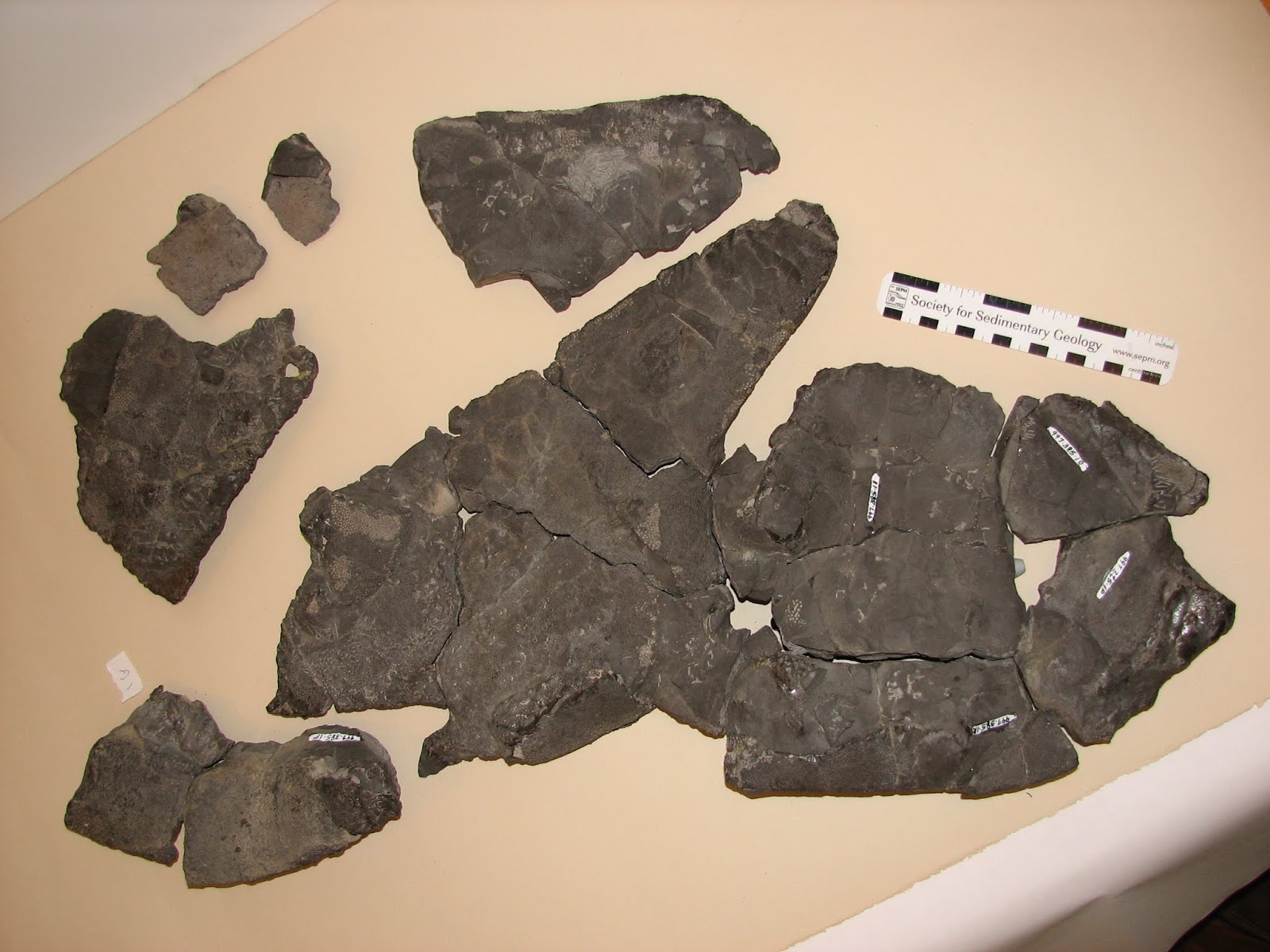
Naomichelys speciosa, a new Helochelydrid turtle from the Trent River
The Trent River near Courtenay, British Columbia is a hotbed of 85-million-year-old fossil fauna immortalized in stone. 

What is even more remarkable is that we find both marine and terrestrial specimens mere feet from one another.  

Helochelydrids are a group of poorly known turtles from Late Jurassic to Late Cretaceous deposits in North America and Europe. It is the only known North American member of Helochelydridae.

Naomichelys is known from numerous specimens throughout western North America, most notably the holotype partial shell from the Early Cretaceous Cloverly Formation of Montana and a complete skeleton from the Antlers Formation of Texas.

The Cloverly Formation includes a number of vertebrate fossils including a diverse assemblage of dinosaur fossils. the site was designated as a National Natural Landmark by the National Park Service in 1973.

Naomichelys is a member of the family Helochelydridae. We find their fossilized remains in Late Jurassic to Late Cretaceous deposits in North America and Europe. Within North America, only the species Naomichelys speciosa is known from relatively complete material which makes comparisons between specimens from other localities challenging. Phil Currie along with co-authors Matthew J. Vavrek, Derek W. Larson, Donald B. Brinkman and Joe Morin described a new species of Helochelydrid terrestrial turtle found on the Trent River near Courtenay, British Columbia.

The new genus and species of helochelydrid turtle were based on a relatively complete shell from the marine Haslam Formation (Santonian) of Vancouver Island, British Columbia, Canada.

The new species is characterized by several distinctive shell features, notably a forward curving process on the anterior portion of the hyoplastra, strongly distinguishing it from N. speciosa. The shell is relatively small but does appear to be from a fully grown individual, suggesting that the species was generally much smaller than other known helochelydrids.

Previously most records of helochelydrids in North America had been assigned to N. speciosa, regardless of actual diagnosable characters. The presence of an additional species of helochelydrid from North America indicates that a greater diversity of the taxon was present than was previously recognized. While the interspecific relationships of helochelydrids remain difficult to fully assess, due to the lack of well-preserved specimens, this new species provides additional geographic and phylogenetic data that aids our understanding of this enigmatic group.

Monday, 11 January 2021

Sunday, 10 January 2021

SWIMMING TRIASSIC SEAS: ALBERTONIA

Triassic Fossil Fish, Albertonia sp. 
Just look at these fabulous fins. I can picture this lovely sailing through Early Triassic seas with her graceful sail-like fins. She is a ganoid fish, Albertonia sp., an extinct bony fish from the East Kootenay Rockies of British Columbia, Canada.

Specimens of this beauty have been found in the Vega-Phroso Siltstone Member of the Sulphur Mountain Formation near Wapiti Lake in British Columbia and the Lower Triassic Montney Formation of Alberta.

Early Triassic fish have been described from several outcrops in the Western Canada Sedimentary Basin of the Rocky Mountains. The best known and most prolific of these are from sites near Wapiti Lake in northeastern British Columbia. Here specimens of bony fish with their heavy ganoid and cosmoid scales are beautifully preserved. Four genera of Early Triassic fishes — the ray-finned actinopterygians Albertonia, Bobasatrania, Boreosomus, and the lobe-finned coelacanth (sarcopterygian), Whiteia — are found in abundance in the Wapiti Lake exposures.

This particular species is one of my favourites. Albertonia is a member of the ganoid fish family Parasemionotidae, which is amongst the most advanced and abundant of Triassic subholostean families of fish. The preservation here really shows the beauty of form of this species who likely died and was preserved in sediment at the bottom of an ocean with an anoxic environment.

These fellows lived in deep marine waters, dining on plankton & other small organisms. Most specimens are 35-40cm in length. They have a large, sail-shaped dorsal fin and rather smallish ventral fins. Their pectoral fins were incredibly long compared to the rest of the body, and they too resembled sails. The preservation here is quite remarkable with each square-shaped scale preserved in minute detail.

Richard Carr, a grad student at Fort Hays State University mentioned to me that there is a great fish taphonomy paper based on these specimens. The Sulphur Mountain Formation also has some other incredible fish fossils including 3-D articulated hybodont and eugeneodont skeletons. The latter are also among the youngest members of their order. 

Friday, 8 January 2021

Thursday, 7 January 2021

NORTH SEA DOLPHIN VERT

A lovely 12 cm creamy orange Bottlenose Dolphin, Tursiops sp. lumbar vertebrae found in the Brown Bank area of the North Sea, one of the busiest seaways in the world.

Bottlenose dolphins first appeared during the Miocene and swam the shallow seas of this region. We still find them today in warm and temperate seas worldwide though unlike narwhal, beluga and bowhead whales, Bottlenose dolphins avoid the Arctic and Antarctic Circle regions. 

Their name derives from the Latin tursio (dolphin) and truncatus for their characteristic truncated teeth

We find their remains in the sediments of the North Sea. There are two known fossil species from Italy that include Tursiops osennae (late Miocene to early Pliocene) from the Piacenzian coastal mudstone, and Tursiops miocaenus (Miocene) from the Burdigalian marine sandstone.

Many waterworn vertebrae from the Harbour Porpoise Phocoena sp., (Cuvier, 1816), Bottlenose dolphin Tursiops sp. (Gervais, 1855), and Beluga Whale, Delphinapterus sp. (Lacépède‎, 1804‎) are found by fishermen as they dredge the bottom of the Brown Bank, one of the deepest sections of the North Sea.  

The North Sea is a sea of the Atlantic Ocean located between the United Kingdom, Denmark, Norway, Germany, the Netherlands, Belgium and France. An epeiric sea on the European continental shelf, it connects to the ocean through the English Channel in the south and the Norwegian Sea in the north.

The fishermen use small mesh trawl nets that tend to scoop up harder bits from the bottom. This technique is one of the only ways this Pleistocene and other more recent material is recovered from the seabed, making them relatively uncommon. The most profitable region for fossil mammal material is in the Brown Bank area of the North Sea. I've circled this area on the map below to give you an idea of the region.

Brown Bank, North Sea, Pleistocene Dredging Area
In May 2019, an 11-day expedition by European scientists from Belgium and the United Kingdom was undertaken to explore three sites of potential geologic and archaeologic interest in the southern North Sea. 

It has long been suspected that the southern North Sea plain may have been home to thousands of people, and chance finds by fishermen over many decades support this theory. 

A concentration of archaeological material, including worked bone, stone and human remains, has been found within the area around the Brown Bank, roughly 100 km due east from Great Yarmouth and 80 km west of the Dutch coast. The quantities of material strongly suggest the presence of a prehistoric settlement. As such the Brown Bank provides archaeologists with a unique opportunity to locate a prehistoric settlement in the deeper and more remote areas of the North Sea, known today as Doggerland.

Until sea levels rose at the end of the last Ice Age, between 8-10,000 years ago, an area of land connected Great Britain to Scandinavia and the continent.  It has long been suspected that the southern North Sea plain was home to thousands of people, and chance finds by fishermen over many decades support this theory. 

Over the past decades a concentration of archaeological material, including worked bone, stone and human remains, has been found within the area around the Brown Bank, roughly 100 km due east from Great Yarmouth and 80 km west of the Dutch coast. 

The quantities of material strongly suggest the presence of a prehistoric settlement. 

As such the Brown Bank provides archaeologists with a unique opportunity to locate a prehistoric settlement in the deeper and more remote areas of the North Sea, known today as Doggerland.

Prospecting for such a settlement within the North Sea is a challenging activity.  Multiple utilities cross the area, bad weather is frequent, and visibility underwater is often limited.  Given these challenging conditions, researchers on the Belgian vessel, RV Belgica, used acoustic techniques and physical sampling of the seabed to unravel the topography and history of the areas chosen for the survey.  

During the survey, the team used a novel parametric echosounder from the Flanders Marine Institute (VLIZ). This uses sonar technology to obtain images of the sub-bottom with the highest possible resolution and was combined with the more traditional “sparker” seismic source to explore deeper sediments.  On the Brown Bank, the Belgica also deployed a grab and a Gilson dredge for sampling near-surface stratigraphy. Video footage was collated using VLIZ’s dedicated video frame and a simpler GoPro mounted on the Gilson dredge. A video showing the equipment in operation on the expedition can be seen at https://youtu.be/sGKfyrDCtmw

Additional reading: http://www.vliz.be/en/press-release/update-research-prehistoric-settlements-North-Sea

Wednesday, 6 January 2021

PREDATORY OLIGOCENE DOLPHIN

Back in the 1880s, a large fragmentary skull of an ancient toothed dolphin was described that would later be known as Ankylorhiza tiedemani

The newly named genus Ankylorhiza is derived from the Greek word "ankylo" meaning bound, stiff, or fused, and "rhiza", meaning root — meaning fused roots, and referring to the mostly single-rooted condition of the teeth — a surprisingly toothy grin for an early dolphin. 

We think of dolphins as the gentle, squeaky darlings of the ocean but back in the Oligocene, they were formidable predators. Picture a mug full of sharp teeth and a body designed for speed. Ankylorhiza tiedemani was the largest member of the Odontoceti, a parvorder or suborder of cetaceans that includes dolphins, porpoise and our toothed whale friends and includes all the whales which eat prey larger than plankton. This toothy group includes sperm whales, beaked whales, river and oceanic dolphins, pilot whales and their cetacean brethren with teeth rather than the baleens we find in Mysticeti whales.

More bits and pieces of this brute were unearthed in the 1970s and 1990s. We usually find just the skulls of our aquatic friends but the nearly complete skeleton that found its way to the Mace Brown Museum of Natural History at the College of Charleston included a well-preserved skull, the ribcage, most of the vertebral column and a lone flipper. These additional bits of the skeleton provided the information necessary to truly tease out this ancient tale. Together, the bones tell the story of a 4.8 m predator who would have diverged from baleen whales — but continued to evolve convergent similarities — about 35-36 million years ago. 

This beast of a dolphin hunted our ancient seas some 24 million years ago. He was a fast swimmer with a narrow tailstock, some added tail vertebra and a shorter humorous — upper arm bone — in his flippers. Some dolphins can exceed speeds of 50 km/h, a feat accomplished by thrusting the flukes while adjusting attack angle with their flippers. These movements are driven by robust axial musculature anchored to a relatively rigid torso consisting of numerous short vertebrae and controlled by hydrofoil-like flippers. 

Eocene skeletons of whales illustrate the transition from semiaquatic to aquatic locomotion, including the development of a fusiform body and reduction of hindlimbs, but the rarity of Oligocene whale skeletons has hampered efforts to understand the evolution of fluke-powered, but forelimb-controlled, locomotion. Modern whales and dolphins are superbly adapted for marine life, with tail flukes being a key innovation shared by all extant species. Did ancient dolphins have these modifications for speed? Most thought not. We have the benefit of modern species to make tentative comparisons but need ancient specimens to confirm the hypothesis. 

Kudos to Robert Boessnecker and team for their paper in the journal Current Biology. In it, they report a nearly complete skeleton of the extinct large dolphin Ankylorhiza tiedemani comb. n. from the Oligocene of South Carolina, previously known only from a partial rostrum. Its forelimb is intermediate in morphology between stem cetaceans and extant taxa, whereas its axial skeleton displays incipient rigidity at the base of the tail with a flexible lumbar region. 

The position of Ankylorhiza near the base of the odontocete radiation implies that several postcranial specializations of extant cetaceans, including a shortened humerus, narrow peduncle, and loss of radial tuberosity, evolved convergently in odontocetes and mysticetes. Craniodental morphology, tooth wear, torso vertebral morphology, and body size all suggest that Ankylorhiza was a macrophagous predator that could swim relatively fast, indicating that it was one of the few extinct cetaceans to occupy a niche similar to that of killer whales.

If you fancy a read, here's the reference:

Robert W. Boessenecker et al. Convergent Evolution of Swimming Adaptations in Modern Whales Revealed by a Large Macrophagous Dolphin from the Oligocene of South Carolina. Current Biology, published online July 9, 2020; doi: 10.1016/j.cub.2020.06.012