Thursday, 2 September 2021
ABALONE: GWA'LIT'SA
Tuesday, 31 August 2021
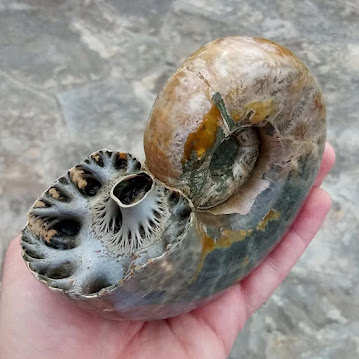
AIOLOCERAS BESAIRIEI: VIPS COLLECTION
![]() |
| Aioloceras besairiei (Collingnon, 1949) |
This is specimen #00783B in the collections of the Vancouver Palaeontological Society, (VIPS). The chambers have a wonderful calcite filling best viewed by carefully slicing these specimens in two.
There is a small imperfection near the centre that renders this ammonite its signature mark of perfection. This lovely is in my care as a study specimen.
Madagascar is an island country is about 400 kilometres off the coast of East Africa in the Indian Ocean and a wonderful place to explore off the beaten track. Exotic, beautiful and geologically interesting — it remains high on my bucket list to explore.
Madagascar has some of the most pleasing of all the fossil specimens I have ever seen. This beauty is no exception. The shell has a generally small umbilicus, arched to acute centre and falcoid ribs that spring in pairs from the umbilical tubercles then disappear on the outer whorls. Take that magical body plan with its pleasing symmetry and add an infilling with spectacular calcite — spectacular!
It is rightfully Aioloceras besairiei — and correctly labelled as such by the VIPS — but some specimens I have looked at earlier were marked as a Cleoniceras besairiei. This is impossible, of course, as Cleoniceras and Grycia are not present in Madagascar. This lovely, seen in cross-section, is now far from home and in my collection to enjoy for a time before returning to Courtenay on Vancouver Island.
Aioloceras besairiei are within beudanticeratinae. Cleoniceras and Grycia are the boreal genera. If you would like to see — or argue — the rationale on the name, consider reading Riccardi and Medina's riveting work from back in 2002, or Collingnon from 1949.
The beauty you see here measures in at a whopping 23 cm. It hails from the youngest or uppermost subdivision of the Lower Cretaceous. I had originally thought this locality was older, but dating reveals it to be from the Lower Albian, approximately 113.0 ± 1.0 Ma to 100.5 ± 0.9 Ma. This locality produces ammonites that are beyond measure in their singular beauty.
Aioloceras are found in the Cretaceous of Madagascar at geo coordinates 16.5° S, 45.9° E: paleo-coordinates 40.5° S, 29.3° E.; and in four localities in South Africa: at locality 36, near the Mzinene River at 28.0° S, 32.3° E: paleo-coordinates 48.6° S, 7.6° E.
We find them near the Mziene River, at a second locality north of Hluhluwe where the Mzinene Formation overlies the Aptian-Albian Makatini Formation at 28.0° S, 32.3° E: paleo-coordinates 48.6° S, 7.6° E; and at Haughton Z18, on the Pongola River in the Albian III, Tegoceras mosense beds at 27.3° S, 32.2° E: paleo-coordinates 48.0° S, 7.8° E.
If you happen to be trekking to Madagascar, know that it's big. It is 592,800 square kilometres (or 226,917 square miles), making it the fourth-largest island on the planet — bigger than Spain, Thailand, Sweden and Germany. So, enjoy your time and wear comfortable shoes.
If you are interested in learning more about this species, check out the Treatise on Invertebrate Paleontology, Part L (Ammonoidea). R.C. Moore (ed). Geological Soc of America and Univ. Kansas Press (1957), p L394. Or head over to look at the 2002 paper from Riccardi and Medina. 2002. Riccardi, A., C. & Medina, F., A. The Beudanticeratinae and Cleoniceratinae (Ammonitina) from the Lower Albian of Patagonia in Revue de Paléobiologie - 21(1) - Muséum d’Histoire Naturelle de la ville de Genève, p 313-314 (=Aioloceras besairiei (COLLIGNON, 1949). You have Bertrand Matrion to thank for the naming correction. Good to have friends in geeky places!
Collignon, M., 1933, Fossiles cenomaniens d’Antmahavelona (Province d’ Analalave, Madagascar), Ann. Geol. Serv. Min. Madagascar, III, 1934 Les Cephalopods du Trias inferieur de Madagascar, Ann. Paleont. XXII 3 and 4, XXII 1.
Besairie, H., 1971, Geologie de Madagascar, 1. Les terrains sedimentaires, Ann. Geol. Madagascar, 35, p. 463.
J. Boast A. and E. M. Nairn collaborated on a chapter in An Outline of the Geology of Madagascar, that is very readable and cites most of the available geologic research papers. It is an excellent place to begin a paleo exploration of the island.
If you happen to parle français, check out: Madagascar ammonites: http://www.ammonites.fr/Geo/Madagascar.htm
Sunday, 29 August 2021
BLUE DRAGON SEA SLUG
By any name, they are a very pleasing addition to our planet. Glaucus atlanticus are a species of small, blue sea slug, a pelagic aeolid nudibranch — a shell-less gastropod mollusc in the family Glaucidae.
Nudibranchs likely date back as far as the Early Jurassic, some180 million years ago. This was around the time that the supercontinent of Pangea was breaking apart to form the modern continents and the Atlantic and Indian Oceans. The date is an estimate built upon the evolutionary lineages of their closest relatives, in part because the soft-bodied nature of nudibranchs means they do not fossilize well.
These sea slugs are pelagic — they float upside down by using the surface tension of the water to stay up near the surface where they drift along, carried by the winds and ocean currents. Glaucus atlanticus makes use of countershading: the blue side of their body faces upwards, blending in with the blue of the water. The silver/grey side of the sea slugs faces downwards, blending in with the sunlight reflecting on the ocean's surface when viewed facing upwards underwater, helping them avoid becoming a tasty snack.
Glaucus atlanticus feed on other pelagic creatures, including the Portuguese man o' war and other venomous siphonophores. This sea slug stores stinging nematocysts from the siphonophores within its own tissues as a defence against predators. Humans handling the slug may receive a very painful and potentially dangerous sting. Good on you little Dragon!
Saturday, 28 August 2021
SERENE SIRENIA
They shared a cousin in the Steller's sea cow, Hydrodamalis gigas, but that piece of their lineage was hunted to extinction by our species in the 18th century.
Dugongs have tail flukes with pointed tips — similar to whales — and manatees have paddle-shaped tails, similar to a Canadian Beaver.
Both of these lovelies from the order Sirenia went from terrestrial to marine, taking to the water in search of more prosperous pastures, as it were.
We find dugongs today in waters near northern Australia and parts of the Indian and Pacific Oceans.
They inhabit rivers and shallow coastal waters, making the best use of their fusiform bodies that lack dorsal fins and hind limbs. I have been thinking about them in the context of some of the primitive armoured fish we find in the Chengjiang biota of China, specifically those primitive species that were also fusiform.
They favour locations where seagrass, their food of choice, grows plentiful and they eat it roots and all. While seagrass low in fibre, high in nitrogen, and easily digestible is preferred, dugongs will also dine on lower grade seagrass, algae, and invertebrates should the opportunity arise. They have been known to eat jellyfish, sea squirts, and shellfish over the course of their long lives.
Some of the oldest dugongs have been known to live 70+ years, which is another statistic I find surprising. They are large, passive, have poor eyesight, and look pretty tasty floating in the water; a defenceless floating buffet. Their population is in decline and yet they live on.
Friday, 27 August 2021
ICE AGE MANATEES
Interestingly, we have recently found fossil evidence for manatees along the Texas coast dating back to the most recent ice age.
The discovery raises questions about whether manatees have been visiting for thousands of years, or if an ancient population of ice age manatees once called Texas home.
The findings were published in Palaeontologia Electronica by lead author Christopher Bell, a professor at the UT Jackson School of Geosciences with co-authors Sam Houston State University Natural History Collections curator William Godwin and SHSU alumna Kelsey Jenkins — now a graduate student at Yale University — and SHSU Professor Patrick Lewis.
The eight fossils described in the paper include manatee jawbones and rib fragments from the Pleistocene, the geological epoch of the last ice age. Most of the bones were collected from McFaddin Beach near Port Arthur and Caplen Beach near Galveston during the past 50 years by amateur fossil collectors who donated their finds to the SHSU collections.
The Jackson Museum of Earth History at UT holds two of the specimens. A lower jawbone fossil, which was donated to the SHSU collections by amateur collector Joe Liggio, jumpstarted the research.
Manatee jawbones have a distinct S-shaped curve that immediately caught Godwin's eye. But Godwin said he was met with scepticism when he sought other manatee fossils for comparison. He recalls reaching out to a local fossil enthusiast who told him point-blank, "there are no Pleistocene manatees in Texas."
But an examination of the fossils by Bell and Lewis proved otherwise. The bones belonged to the same species of manatee that visits the Texas coast today, Trichechus manatus. An upper jawbone donated by U.S. Rep. Brian Babin was found to belong to an extinct form of the manatee, Trichechus manatus bakerorum.
The age of the manatee fossils is based on their association with better-known ice age fossils and paleo-Indian artefacts that have been found on the same beaches.
It is assumed that the cooler ice age climate would have made Texas waters even less hospitable to manatees than they are today. But the fact that manatees were in Texas — whether as visitors or residents — raises questions about the ancient environment and ancient manatees. The Texas coast stretched much farther into the Gulf of Mexico and hosted wider river outlets during the ice age than it does today. Either the coastal climate was warmer than is generally thought, or ice age manatees were more resilient to cooler temperatures than manatees of today.
Subsurface imaging of the now flooded modern continental shelf reveals both a greater number of coastal embayments and the presence of significantly wider channels during ice age times.
If there was a population of ice age manatees in Texas, it is entirely plausible that they would have ridden out winters in these warmer river outlets similar to how they do today in Florida and Mexico.
Reference: Christopher Bell, William Godwin, Kelsey Jenkins, Patrick Lewis. First fossil manatees in Texas: Trichechus manatus bakerorum in the Pleistocene fauna from beach deposits along the Texas Coast of the Gulf of Mexico. Palaeontologia Electronica, 2020; DOI: 10.26879/1006
Wednesday, 25 August 2021
SHORE CRAB: CARCINUS MAENAS / KU'MIS
![]() |
| European Green Shore Crab / Carcinus maenas |
They make a living off the seafloor, dining on worms, molluscs, small crustaceans and any number of bits and pieces that fall their way.
Shore Crabs are euryhaline, meaning they can tolerate a wide range of salinities (4 to 52 %), and survive in temperatures of zero to 30 °C (32 to 86 °F). This adaptability gives them a very wide range and competitive edge. This fellow is from the chilly waters of central Norway. The ability to eat pretty near anything and survive in extremely cold climates means he'll do quite well beneath the ice this winter.
Tuesday, 24 August 2021
GULLS: TSIK'WI
![]() |
| A gull cries in protest at not getting his share of a meal |
Sunday, 22 August 2021
CAVE BEAR: URSUS URALENSIS
Both the cave bear and the brown bear are thought to be descended from the Plio-Pleistocene Etruscan bear, Ursus etruscus, that lived about 5.3 Mya to 100,000 years ago.
The last common ancestor of cave bears and brown bears lived between 1.2–1.4 Mya. The immediate precursor of the cave bear was probably Ursus deningeri, the Deninger's bear — a species restricted to Pleistocene Europe about 1.8 Mya to 100,000 years ago.
The transition between Deninger's bear and the cave bear is given as the last interglacial, although the boundary between these forms is arbitrary, and intermediate or transitional taxa have been proposed, Ursus spelaeus deningeroides, while other authorities consider both taxa to be chronological variants of the same species.
Cave bears found in different regions vary in age, thus facilitating investigations into evolutionary trends. The three anterior premolars were gradually reduced, then disappeared, possibly in response to a largely vegetarian diet.
In a fourth of the skulls found in the Conturines, the third premolar is still present, while more derived specimens elsewhere lack it. The last remaining premolar became conjugated with the true molars, enlarging the crown and granting it more cusps and cutting borders. This phenomenon, called molarization, improved the mastication capacities of the molars, facilitating the processing of tough vegetation. This allowed the cave bear to gain more energy for hibernation while eating less than its ancestors.
![]() |
| A lone Grizzly Bear / Na̱ndzi |
The procedure used genomic DNA extracted from one of the animal's teeth. Sequencing the DNA directly (rather than first replicating it with the polymerase chain reaction), the scientists recovered 21 cave bear genes from remains that did not yield significant amounts of DNA with traditional techniques.
This study confirmed and built on results from a previous study using mitochondrial DNA extracted from cave bear remains ranging from 20,000 to 130,000 years old.
Both show that the cave bear was more closely related to the brown bear and polar bear than it was to the American black bear, but had split from the brown bear lineage before the distinct eastern and western brown bear lineages diversified and before the split of brown bears and polar bears. The divergence date estimate of cave bears and brown bears is about 1.2–1.4 Mya. However, a recent study showed that both species had some hybridization between them.
We are blessed to have them living amongst us today on the rugged west coast of British Columbia. In the Kwak'wala language of the Kwakiutl First Nations of the Pacific Northwest, this big fellow is na̱ndzi — a lovely, large peaceful bear.
Saturday, 21 August 2021
MUSKOX: CAPRINAE
As a member of the subfamily Caprinae of the family Bovidae, the muskox is more closely related to sheep and goats than to oxen. It has been placed in its own genus, Ovibos — Latin for sheep-ox. It is one of the two largest extant members of Caprinae, along with the similarly sized takin.
While the takin and muskox were once considered possibly closely related, the takin lacks common ovibovine features, such as the muskox's specialized horn morphology, and genetic analysis shows that their lineages actually separated early in caprine evolution.
Instead, the muskox's closest living relatives appear to be the gorals of the genus Naemorhedus, nowadays common in many countries of central and east Asia. The vague similarity between takin and muskox must therefore be considered an example of convergent evolution.
The modern muskox is the last member of a line of ovibovines that first evolved in temperate regions of Asia and adapted to a cold tundra environment late in its evolutionary history. They lived alongside our lovely Mammoths and would have competed for the same plant resources as those much larger beasts.
Muskox ancestors with sheep-like high-positioned horns — horn cores being mostly over the plane of the frontal bones, rather than below them as in modern muskoxen — first left the temperate forests for the developing grasslands of Central Asia during the Pliocene, expanding into Siberia and the rest of northern Eurasia.
Later migration waves of Asian ungulates, including the high-horned muskox, reached Europe and North America during the first half of the Pleistocene. The first well-known muskox, the "shrub-ox" Euceratherium, crossed to North America over an early version of the Bering Land Bridge two million years ago and prospered in the American southwest and Mexico. Euceratherium was larger yet more lightly built than modern muskoxen, resembling a giant sheep with massive horns, and preferred hilly grasslands.
A genus with intermediate horns, Soergelia, inhabited Eurasia in the early Pleistocene, from Spain to Siberia, and crossed to North America during the Irvingtonian (1.8 million years to 240,000 years ago), soon after Euceratherium. Unlike Euceratherium, which survived in America until the Pleistocene-Holocene extinction event, Soergelia was a lowland dweller that disappeared fairly early, displaced by more advanced ungulates, such as the "giant muskox" Praeovibos (literally "before Ovibos").
The low-horned Praeovibos was present in Europe and the Mediterranean 1.5 million years ago, colonized Alaska and the Yukon one million years ago and disappeared half a million years ago. Praeovibos was a highly adaptable animal that appears associated with cold tundra (reindeer) and temperate woodland (red deer) faunas alike.
During the Mindel glaciation 500,000 years ago, Praeovibos was present in the Kolyma river area in eastern Siberia in association with many Ice Age megafauna that would later coexist with Ovibos, in the Kolyma itself and elsewhere, including wild horses, reindeer, woolly mammoth and stag-moose.
It is debated, however, if Praeovibos was directly ancestral to Ovibos, or both genera descended from a common ancestor since the two occurred together during the middle Pleistocene. Defenders of ancestry from Praeovibos have proposed that Praeovibos evolved into Ovibos in one region during a period of isolation and expanded later, replacing the remaining populations of Praeovibos.
Two more Praeovibos-like genera were named in America in the 19th century, Bootherium and Symbos, which are now identified as the male and female forms of a single, sexually dimorphic species, the "woodland muskox", Bootherium bombifrons. Bootherium inhabited open woodland areas of North America during the Late Pleistocene, from Alaska to Texas and maybe even Mexico, but was most common in the Southern United States, while Ovibos replaced it in the tundra-steppe to the north, immediately south of the Laurentian ice sheet.
Modern Ovibos appeared in Germany almost one million years ago and were common in the region through the Pleistocene. Muskoxen had also reached the British Isles. Both Germany and Britain were just south of the Scandinavian ice sheet and covered in the tundra during cold periods, but Pleistocene muskoxen are also rarely recorded in more benign and wooded areas to the south like France and Green Spain, where they coexisted with temperate ungulates like red deer and aurochs. Likewise, the muskox is known to have survived in Britain during warm interglacial periods.
Today's muskoxen are descended from others believed to have migrated from Siberia to North America between 200,000 and 90,000 years ago, having previously occupied Alaska (at the time united to Siberia and isolated periodically from the rest of North America by the union of the Laurentide and Cordilleran Ice Sheets during colder periods) between 250,000 and 150,000 years ago.
After migrating south during one of the warmer periods of the Illinoian glaciation, non-Alaskan American muskoxen would be isolated from the rest in the colder periods. The muskox was already present in its current stronghold of Banks Island 34,000 years ago, but the existence of other ice-free areas in the Canadian Arctic Archipelago at the time is disputed.
Along with the bison and the pronghorn, the muskox was one of a few species of Pleistocene megafauna in North America to survive the Pleistocene/Holocene extinction event and live to the present day. The muskox is thought to have been able to survive the last glacial period by finding ice-free areas (refugia) away from prehistoric peoples.
Fossil DNA evidence suggests that muskoxen were not only more geographically widespread during the Pleistocene, but also more genetically diverse. During that time, other populations of muskoxen lived across the Arctic, from the Ural Mountains to Greenland. By contrast, the current genetic makeup of the species is more homogenous. Climate fluctuation may have affected this shift in genetic diversity: research indicates colder periods in Earth's history are correlated with more diversity and warmer periods with more homogeneity.
Friday, 20 August 2021
ORIGINS OF THE WOOLLY MAMMOTHS
Over time, their body size shrank and their teeth and tusks evolved to take advantage of the tough vegetation available to those few animals who could chew their way through ice and snow and work these tundra grasses into a digestible form.
The enamel plates of their cheek teeth multiplied while the enamel itself became thinner. Tusks slowly took on more of a curved to act as ploughs for the snow.Those smaller than their predecessors, they were still formidable. Their size offered protection against predators once full grown. Sadly for the juveniles, they offered tasty prey to big cats like Homotherium who roamed these ancient grasslands alongside them.
The Mammoths of the Steppe spread to the northern areas of Eurasia, down through Europe, into the British Isles to Spain and crossed over to populate North America via the Bering Isthmus. It was the lowered sea levels during the last Ice Age that exposed dry land between Asia and the Americas. Here in this flat, grassy treeless plain known as the Bering Land Bridge or Isthmus, animals, including humans, could migrate from Europe west into North America.
The woolly mammoth coexisted with our ancestors who made good use of their bones and tusks for tools, housing, art and food. The last of their lineage died out relatively recently on Wrangel Island until 4,000 years ago — a time when we were making our first harps and flutes in Egypt, dams, canals and stone sculptures in Sumer, using numbers for the first time and using tin to make tools.
Thursday, 19 August 2021
DUGONG: SEA COW
It is one of four living species of the order Sirenia, which also includes three species of manatees — their large, fully aquatic, mostly herbivorous marine mammal cousins.
The closest living relatives of sirenians are elephants. Manatees evolved from the same land animals as elephants over 50 million years ago.
If not for natural selection, we might have a much more diverse showing of the Sirenia as their fossil lineage shows a much more diverse group of sirenians back in the Eocene than we have today. It is the only living representative of the once-diverse family Dugongidae; its closest modern relative, Steller's sea cow, was hunted to extinction in the 18th century.
While only one species of the dugong is alive today – a second, the Steller's sea cow only left this Earth a few years ago. Sadly, it was hunted to extinction within 27 years of its discovery – about 30 species have been recovered in the fossil record
The first appearance of sirenians in the fossil record was during the early Eocene, and by the late Eocene, sirenians had significantly diversified. Inhabitants of rivers, estuaries, and nearshore marine waters, they were able to spread rapidly.
The most primitive sirenian known to date, Prorastomus, was found in Jamaica, not the Old World; however, more recently the contemporary Sobrarbesiren has been recovered from Spain. The first known quadrupedal sirenian was Pezosiren from the early Eocene.The earliest known sea cows, of the families Prorastomidae and Protosirenidae, are both confined to the Eocene and were about the size of a pig, four-legged amphibious creatures.
By the time the Eocene drew to a close, the Dugongidae had arrived; sirenians had acquired their familiar fully aquatic streamlined body with flipper-like front legs with no hind limbs, powerful tail with horizontal caudal fin, with up and down movements which move them through the water, like cetaceans.
The last of the sirenian families to appear, Trichechidae, apparently arose from early dugongids in the late Eocene or early Oligocene. The current fossil record documents all major stages in hindlimb and pelvic reduction to the extreme reduction in the modern manatee pelvis, providing an example of dramatic morphological change among fossil vertebrates.
Since sirenians first evolved, they have been herbivores, depending on seagrasses and aquatic angiosperms, tasty flowering plants of the sea, for food. To the present, almost all have remained tropical — with the notable exception of Steller's Sea Cow — marine, and angiosperm consumers. Sea cows are shallow divers with large lungs. They have heavy skeletons to help them stay submerged; the bones are pachyostotic (swollen) and osteosclerotic (dense), especially the ribs which are often found as fossils.
Eocene sirenians, like Mesozoic mammals but in contrast to other Cenozoic ones, have five instead of four premolars, giving them a 3.1.5.3 dental formula. Whether this condition is truly primitive retention in sirenians is still under debate.
Although cheek teeth are relied on for identifying species in other mammals, they do not vary to a significant degree among sirenians in their morphology but are almost always low-crowned —brachyodont — with two rows of large, rounded cusps — bunobilophodont. The most easily identifiable parts of sirenian skeletons are the skull and mandible, especially the frontal and other skull bones. With the exception of a pair of tusk-like first upper incisors present in most species, front teeth — incisors and canines — are lacking in all, except the earliest sirenians.
Wednesday, 18 August 2021
TITANITES: THE FERNIE AMMONITE
![]() |
| Titanites occidentalis, Fernie Ammonite |
This beauty is the remains of a carnivorous cephalopod within the family Dorsoplanitidae that lived and died in a shallow sea some 150 million years ago.
If you would like to get off the beaten track and hike up to see this ancient beauty, you will want to head to the town of Fernie in British Columbia close to the Alberta border.
There was some active logging along the hillside in 2021, so if you are looking at older directions on how to get to the site be mindful that many of the trailheads have been altered and a fair bit of bushwhacking will be necessary to get to the fossil site proper. That being said, the loggers did give the ammonite a wide berth and have left it intact.
Driving to the trail base is along an easy access road just east of town along Fernie Coal Road. There are some nice exposures of Cretaceous plant material on the north side (left-hand side) of the road as you head from Fernie towards Coal Creek. I recently drove up to Fernie to look at Cretaceous plant material and locate the access point to the now infamous Late Jurassic (Tithonian) Titanites (S.S. Buckman, 1921) site. While the drive out of town is on an easy, well-maintained road, the slog up to the ammonite site is a steep 3-hour push.
![]() |
| Fernie, British Columbia, Canada |
Titanites occidentalis, the Western Giant, is the second known specimen of this extinct fossil species. The first was discovered in 1947 in nearby Coal Creek by a British Columbia Geophysical Society mapping team. When they first discovered this marine fossil high up on the hillside, they could not believe their eyes — both because it is clearly marine at the top of a mountain and the sheer size of this ancient beauty.
In the summer of 1947, a field crew was mapping coal outcrops for the BC Geological Survey east of Fernie. One of the students reported finding “a fossil truck tire.” Fair enough. The similarity of size and optics are pretty close to your average Goodridge.
A few years later, GSC Paleontologist Hans Frebold described and named the fossil Titanites occidentalis after the large Jurassic ammonites from Dorset, England. The name comes from Greek mythology. Tithonus, as you may recall, was the Prince of Troy. He fell in love with Eos, the Greek Goddess of the Dawn. Eos begged Zeus to make her mortal lover immortal. Zeus granted her wish but did not grant Tithonus eternal youth. He did indeed live forever — ageing hideously. Ah, Zeus, you old trickster. It is a clever play on time placement. Dawn is the beginning of the day and the Tithonian being the latest age of the Late Jurassic. Clever Hans!
HIKING TO THE FERNIE AMMONITE
From the town of Fernie, British Columbia, head east along Coal Creek Road towards Coal Creek. The site is 3.81 km from the base of Coal Creek Road to the trailhead as the crow flies. I have mapped it here for you in yellow and added the wee purple GPS marker for the ammonite site proper. There is a nice, dark grey to black roadcut exposure of Cretaceous plants on the north side of the dirt road that is your cue to pull over and park.
You access what is left of the trailhead on the south side of the road. You will need to cross the creek to begin your ascent. There is no easy way across the creek and you'll want to tackle this one with a friend when the water level is low.
The beginning of the trail is not clear but a bit of searching will reveal the trailhead with its telltale signs of previous hikers. This is a 1-2 hour moderate 6.3-kilometre hike up & back bushwhacking through scrub and fallen trees. Heading up, you will make about a 246-metre elevation gain. You will likely not have a cellular signal up here but if you download the Google Map to your mobile, you will have GPS to guide you. The area has been recently logged so much of the original trail has been destroyed. There may now be easier vehicle access up the logging roads but I have not driven them since the logging and new road construction.
If you are coming in from out of town, the closest airport is Cranbrook. Then it is about an hour and change to Fernie and another 15-minutes or so to park near the site.
You will want to leave your hammers with your vehicle (no need to carry the weight) as this site is best enjoyed with a camera.This is a site you will want to wear hiking boots to access. Know that these will get wet as you cross the creek.
If you would like to see the ammonite but are not keen on the hike, a cast has been made by fossil preparator Rod Bartlett is on display at the Courtenay Museum in Courtenay, Vancouver Island, Canada.
As your feet move up the hillside, you can imagine this land 10,000 years ago, rising above great glaciers. Where footfalls trace the steps of those that came before you. This land has been home to the Ktunaxa or Kukin ʔamakis First Nations whose oral history have them living here since time immemorial. Like them, take only what you need and no more than the land offers — packing out anything that you packed in.
Fernie Ammonite Palaeo Coordinates: 49°29'04"N 115°00'49"W
Tuesday, 17 August 2021
AMMONITE: INDEX FOSSILS AS TIME KEEPERS
![]() |
| Argonauticeras besairei, José Juárez Ruiz |
Ammonites were predatory, squidlike creatures that lived inside coil-shaped shells.
Like other cephalopods, ammonites had sharp, beak-like jaws inside a ring of squid-like tentacles that extended from their shells.
They used these tentacles to snare prey, — plankton, vegetation, fish and crustaceans — similar to the way a squid or octopus hunt today.
Catching a fish with your hands is no easy feat, as I am sure you know. But the Ammonites were skilled and successful hunters. They caught their prey while swimming and floating in the water column.
Within their shells, they had a number of chambers, called septa, filled with gas or fluid that were interconnected by a wee air tube. By pushing air in or out, they were able to control their buoyancy in the water column.
They lived in the last chamber of their shells, continuously building new shell material as they grew. As each new chamber was added, the squid-like body of the ammonite would move down to occupy the final outside chamber.
They were a group of extinct marine mollusc animals in the subclass Ammonoidea of the class Cephalopoda.These molluscs, commonly referred to as ammonites, are more closely related to living coleoids — octopuses, squid, and cuttlefish) than they are to shelled nautiloids such as the living Nautilus species.
The Ammonoidea can be divided into six orders:
- Agoniatitida, Lower Devonian - Middle Devonian
- Clymeniida, Upper Devonian
- Goniatitida, Middle Devonian - Upper Permian
- Prolecanitida, Upper Devonian - Upper Triassic
- Ceratitida, Upper Permian - Upper Triassic
- Ammonitida, Lower Jurassic - Upper Cretaceous
Ammonites have intricate and complex patterns on their shells called sutures. The suture patterns differ across species and tell us what time period the ammonite is from. If they are geometric with numerous undivided lobes and saddles and eight lobes around the conch, we refer to their pattern as goniatitic, a characteristic of Paleozoic ammonites.
If they are ceratitic with lobes that have subdivided tips; giving them a saw-toothed appearance and rounded undivided saddles, they are likely Triassic. For some lovely Triassic ammonites, take a look at the specimens that come out of Hallstatt, Austria and from the outcrops in the Humboldt Mountains of Nevada.
![]() |
| Hoplites bennettiana (Sowby, 1826) Christophe Marot |
One of my favourite Cretaceous ammonites is the ammonite, Hoplites bennettiana (Sowby, 1826). This beauty is from Albian deposits near Carrière de Courcelles, Villemoyenne, near la région de Troyes (Aube) Champagne in northeastern France.
At the time that this fellow was swimming in our oceans, ankylosaurs were strolling about Mongolia and stomping through the foliage in Utah, Kansas and Texas. Bony fish were swimming over what would become the strata making up Canada, the Czech Republic and Australia. Cartilaginous fish were prowling the western interior seaway of North America and a strange extinct herbivorous mammal, Eobaatar, was snuffling through Mongolia, Spain and England.
In some classifications, these are left as suborders, included in only three orders: Goniatitida, Ceratitida, and Ammonitida. Once you get to know them, ammonites in their various shapes and suturing patterns make it much easier to date an ammonite and the rock formation where it is found.
Ammonites first appeared about 240 million years ago, though they descended from straight-shelled cephalopods called bacrites that date back to the Devonian, about 415 million years ago, and the last species vanished in the Cretaceous–Paleogene extinction event.
They were prolific breeders that evolved rapidly. If you could cast a fishing line into our ancient seas, it is likely that you would hook an ammonite, not a fish. They were prolific back in the day, living (and sometimes dying) in schools in oceans around the globe. We find ammonite fossils (and plenty of them) in sedimentary rock from all over the world.
In some cases, we find rock beds where we can see evidence of a new species that evolved, lived and died out in such a short time span that we can walk through time, following the course of evolution using ammonites as a window into the past.For this reason, they make excellent index fossils. An index fossil is a species that allows us to link a particular rock formation, layered in time with a particular species or genus found there.
Generally, deeper is older, so we use the sedimentary layers of rock to match up to specific geologic time periods, rather like the way we use tree rings to date trees. A handy way to compare fossils and date strata across the globe.
References: Inoue, S., Kondo, S. Suture pattern formation in ammonites and the unknown rear mantle structure. Sci Rep 6, 33689 (2016). https://doi.org/10.1038/srep33689
https://www.nature.com/articles/srep33689?fbclid=IwAR1BhBrDqhv8LDjqF60EXdfLR7wPE4zDivwGORTUEgCd2GghD5W7KOfg6Co#citeas
Photos: Argonauticeras besairei from the awesome José Juárez Ruiz.
Photo: Hoplites bennettiana from near Troyes, France. Collection de Christophe Marot


