![]() |
| Lytoceras sp. Photo: Craig Chivers |
![]() |
| The concretion prior to prep |
![]() |
| Lytoceras sp. Photo: Craig Chivers |
![]() |
| The concretion prior to prep |
With shells for drums and sunlight for spotlight, they turn survival into play, joy into power. Tiny jesters of the ocean, yet fierce enough to hold an entire ecosystem in their grasp.
Sea otters (Enhydra lutris) are more than just charismatic charmers of the Pacific Coast; they are living links to an ancient evolutionary journey. Their playful demeanor hides a lineage that stretches back millions of years, into a fossil record that tells a story of transformation from river to sea.
The tale begins with their ancestors in the family Mustelidae—the same diverse group that gave us weasels, badgers, martens, and wolverines. The earliest otter-like mustelids appeared around 18 million years ago in the Miocene. Among them was Enhydriodon, a giant otter that roamed rivers and wetlands of Eurasia and Africa, weighing over 200 pounds—far larger than today’s sea otters.
By the late Miocene to early Pliocene, otter evolution was branching out. Fossils of Enhydra, the direct ancestor of modern sea otters, show up in the North Pacific around 5 million years ago. Unlike their freshwater kin, these otters were already well adapted to marine life: short, robust limbs for swimming, strong jaws for crushing mollusks, and teeth built for a diet of hard-shelled prey.
By the Pleistocene (2.6 million to 11,700 years ago), sea otters had fully taken to the sea. They developed one of nature’s thickest pelts—up to a million hairs per square inch—allowing them to survive frigid northern waters without relying on the blubber used by seals and whales. Fossil remains and genetic studies suggest that their range was once broader than it is today, extending along vast stretches of the North Pacific Rim.
These adaptations made sea otters not only survivors but keystone species. By preying on sea urchins, they keep kelp forests thriving, shaping entire marine ecosystems with their appetites. Without them, underwater forests collapse into barren urchin wastelands. With them, the kelp sways tall and green, sheltering fish, seabirds, and countless invertebrates.
It is a joy to watch them crack open a clam on its belly or twirl through kelp in a flurry of bubbles.From Miocene rivers to Pleistocene shores, for me sea otters embody resilience and adaptation, carrying forward the legacy of their fossil kin.
Sea otters are tender and attentive parents, especially the mothers who cradle their pups on their bellies as they float in the swells.
A newborn pup’s fur is so dense and buoyant that it cannot dive, so the mother becomes both raft and refuge.
She grooms the pup constantly, blowing air into its coat to keep it dry and warm, and when she needs to forage, she may wrap her young in strands of kelp to keep it from drifting away.
This intimate bond, played out on the rolling surface of the sea, is one of the most endearing sights in the animal kingdom—proof that even in the wild’s ceaseless struggle for survival, tenderness finds its place.
We call these playful relatives, ḵ̓asa, in Kwak'wala, the language of the Kwakwakaʼwakw (those who speak Kwak'wala), First Nations along the Pacific Northwest Coast.
![]() |
| Nootka Fossil Field Trip. Photo: John Fam |
Just off the shores of Vancouver Island, east of Gold River and south of Tahsis is the picturesque and remote Nootka Island.
This is the land of the proud and thriving Nuu-chah-nulth First Nations who have lived here always.
Always is a long time, but we know from oral history and archaeological evidence that the Mowachaht and Muchalaht peoples lived here, along with many others, for many thousands of years — a time span much like always.
While we know this area as Nootka Sound and the land we explore for fossils as Nootka Island, these names stem from a wee misunderstanding.
Just four years after the 1774 visit by Spanish explorer Juan Pérez — and only a year before the Spanish established a military and fur trading post on the site of Yuquot — the Nuu-chah-nulth met the Englishman, James Cook.
Captain Cook sailed to the village of Yuquot just west of Vancouver Island to a very warm welcome. He and his crew stayed on for a month of storytelling, trading and ship repairs. Friendly, but not familiar with the local language, he misunderstood the name for both the people and land to be Nootka. In actual fact, Nootka means, go around, go around.
Two hundred years later, in 1978, the Nuu-chah-nulth chose the collective term Nuu-chah-nulth — nuučaan̓uł, meaning all along the mountains and sea or along the outside (of Vancouver Island) — to describe themselves.It is a term now used to describe several First Nations people living along western Vancouver Island, British Columbia.
It is similar in a way to the use of the United Kingdom to refer to the lands of England, Scotland and Wales — though using United Kingdom-ers would be odd. Bless the Nuu-chah-nulth for their grace in choosing this collective name.
An older term for this group of peoples was Aht, which means people in their language and is a component in all the names of their subgroups, and of some locations — Yuquot, Mowachaht, Kyuquot, Opitsaht. While collectively, they are the Nuu-chah-nulth, be interested in their more regional name should you meet them.
But why does it matter? If you have ever mistakenly referred to someone from New Zealand as an Aussie or someone from Scotland as English, you have likely been schooled by an immediate — sometimes forceful, sometimes gracious — correction of your ways. The best answer to why it matters is because it matters.
Each of the subgroups of the Nuu-chah-nulth viewed their lands and seasonal migration within them (though not outside of them) from a viewpoint of inside and outside. Kla'a or outside is the term for their coastal environment and hilstis for their inside or inland environment.
It is to their kla'a that I was most keen to explore. Here, the lovely Late Eocene and Early Miocene exposures offer up fossil crab, mostly the species Raninid, along with fossil gastropods, bivalves, pine cones and spectacularly — a singular seed pod. These wonderfully preserved specimens are found in concretion along the foreshore where time and tide erode them out each year.
Five years after Spanish explorer Juan Pérez's first visit, the Spanish built and maintained a military post at Yuquot where they tore down the local houses to build their own structures and set up what would become a significant fur trade port for the Northwest Coast — with the local Chief Maquinna's blessing and his warriors acting as middlemen to other First Nations.
Following reports of Cook's exploration British traders began to use the harbour of Nootka (Friendly Cove) as a base for a promising trade with China in sea-otter pelts but became embroiled with the Spanish who claimed (albeit erroneously) sovereignty over the Pacific Ocean.
![]() |
| Dan Bowen searching an outcrop. Photo: John Fam |
George Vancouver on his subsequent exploration in 1792 circumnavigated the island and charted much of the coastline. His meeting with the Spanish captain Bodega y Quadra at Nootka was friendly but did not accomplish the expected formal ceding of land by the Spanish to the British.
It resulted however in his vain naming the island "Vancouver and Quadra." The Spanish captain's name was later dropped and given to the island on the east side of Discovery Strait. Again, another vain and unearned title that persists to this day.
Early settlement of the island was carried out mainly under the sponsorship of the Hudson's Bay Company whose lease from the Crown amounted to 7 shillings per year — that's roughly equal to £100.00 or $174 CDN today. Victoria, the capital of British Columbia, was founded in 1843 as Fort Victoria on the southern end of Vancouver Island by the Hudson's Bay Company's Chief Factor, Sir James Douglas.
With Douglas's help, the Hudson's Bay Company established Fort Rupert on the north end of Vancouver Island in 1849. Both became centres of fur trade and trade between First Nations and solidified the Hudson's Bay Company's trading monopoly in the Pacific Northwest.The settlement of Fort Victoria on the southern tip of Vancouver Island — handily south of the 49th parallel — greatly aided British negotiators to retain all of the islands when a line was finally set to mark the northern boundary of the United States with the signing of the Oregon Boundary Treaty of 1846. Vancouver Island became a separate British colony in 1858. British Columbia, exclusive of the island, was made a colony in 1858 and in 1866 the two colonies were joined into one — becoming a province of Canada in 1871 with Victoria as the capital.
Dan Bowen, Chair of the Vancouver Island Palaeontological Society (VIPS) did a truly splendid talk on the Fossils of Nootka Sound. With his permission, I have uploaded the talk to the ARCHEA YouTube Channel for all to enjoy. Do take a boo, he is a great presenter. Dan also graciously provided the photos you see here. The last of the photos you see here is from the August 2021 Nootka Fossil Field Trip. Photo: John Fam, Vice-Chair, Vancouver Paleontological Society (VanPS).
Know Before You Go — Nootka Trail
The Nootka Trail passes through the traditional lands of the Mowachaht/Muchalat First Nations who have lived here since always. They share this area with humpback and Gray whales, orcas, seals, sea lions, black bears, wolves, cougars, eagles, ravens, sea birds, river otters, insects and the many colourful intertidal creatures that you'll want to photograph.
This is a remote West Coast wilderness experience. Getting to Nootka Island requires some planning as you'll need to take a seaplane or water taxi to reach the trailhead. The trail takes 4-8 days to cover the 37 km year-round hike. The peak season is July to September. Permits are not required for the hike.
Access via: Air Nootka floatplane, water taxi, or MV Uchuck III
Though we often see them today basking on beaches or popping their heads above the waves, their journey through the fossil record reveals a dramatic tale of land-to-sea adaptation and ancient global wanderings.
Seals belong to a group of marine mammals called pinnipeds, which also includes sea lions and walruses. All pinnipeds share a common ancestry with terrestrial carnivores, and their closest living relatives today are bears and mustelids (like otters and weasels). Their ancestors walked on land before evolving to thrive in marine environments.
The fossil record suggests that pinnipeds first emerged during the Oligocene epoch, around 33 to 23 million years ago. These early proto-seals likely lived along coastal environments, where they gradually adapted to life in the water. Over time, their limbs transformed into flippers, their bodies streamlined, and their reliance on the sea for food and movement became complete.
In Kwak'wala, the language of the Kwakwaka'wakw of the Pacific Northwest, seals are known as migwat, and fur seals are referred to as xa'wa.
A cautious fur seal lifts its head from the surf, nostrils flaring, eyes bright and unblinking — the true heirs of this desolate shore.
Cradled between three natural harbours on the west side of Stromness Bay, this bleak outpost is far more than a scattering of ruins. It was once the last lifeline for Sir Ernest Shackleton and his men in 1916 — a place where survival and history collided.
The story begins in a less noble chapter. In 1907, a floating factory anchored in Stromness Harbour, followed by a permanent land station in 1912. From then until 1931, Stromness was alive with the grim industry of whaling — the hiss of steam, the gut-wrenching stench of blubber boiling in great iron vats, and the cries of seabirds feasting on discarded scraps.
After the decline of whaling, the station limped on as a ship repair yard, machine shop, and foundry until 1961, when it closed for good. The ocean winds and glaciers began their slow reclamation, while fur seals, elephant seals, and penguins turned the place into their own unruly kingdom.
Yet Stromness is etched into human memory not for its industry, but for Shackleton’s desperate gamble.
His dream: to cross the Antarctic continent from sea to sea. His reality: a voyage into the most terrifying ocean on Earth, where waves rise like moving mountains and winds scream like banshees.
On 5 December 1914, Shackleton and his crew set out aboard the Endurance. By January 1915, deep in the Weddell Sea, the ship was trapped fast in the ice. The men camped on the shifting floes until the vessel was crushed and abandoned. For months, they drifted at the mercy of the pack ice, surviving on penguin and seal meat, their beards iced, their bodies wasted.
Shackleton made a choice: salvation lay 800 miles away across the stormy Southern Ocean. With Frank Worsley and Tom Crean, he boarded the tiny lifeboat James Caird — just 22 feet long (6.7 m). Launched on 24 April 1916, they battled hurricane winds, ice-cold spray, and waves tall enough to swallow ships whole. Their world was endless gray: salt-stung eyes, frozen fingers, and the unrelenting stink of wet wool and despair.
For fifteen days the Caird clawed its way across the most dangerous waters on Earth. By 8 May, the jagged cliffs of South Georgia appeared through the fog. Hope. Yet hurricane-force winds barred any landing. Shackleton’s men clung to life offshore, the boat threatening to dash to splinters against black rock. Only after the seas relented did they stagger ashore, frostbitten, skeletal, and shaking.
Landing was only the beginning. Stromness lay on the opposite side of the island — across mountains no man had crossed before. For 36 hours, Shackleton, Crean, and Worsley pushed across glaciers and jagged peaks, their clothes stiff with salt, their bodies burning with exhaustion. At last, they stumbled into Stromness, collapsing at the door of the manager’s house — the so-called “Villa,” a modest dwelling that seemed palatial compared to the wreck of their journey.
![]() |
| Ernest Shackleton |
Three times, sea ice turned him back. Finally, with the help of the Chilean government, Shackleton secured the tug Yelcho, commanded by Captain Luis Pardo. On 30 August 1916 — four and a half months after Shackleton had left — every last man was rescued. Not one life lost.
Today, Stromness lies silent beneath the shriek of gulls and the thunder of surf. Its corrugated-iron buildings are collapsing, their skeletal frames streaked orange with rust.
The air carries the sharp tang of sea spray, mingled with the faint ghost of oil and smoke. A small whalers’ cemetery nearby holds just fourteen markers, mute reminders of another era.
In recent years, efforts have been made to stabilize the Villa and clear dangerous debris, allowing visitors to tread safely where Shackleton once staggered.
Standing here, amidst ruin reclaimed by seals and snow, you feel the weight of history. Stromness is more than an abandoned station — it is a monument to human endurance against an unforgiving ocean that has swallowed countless ships and men whole.
![]() |
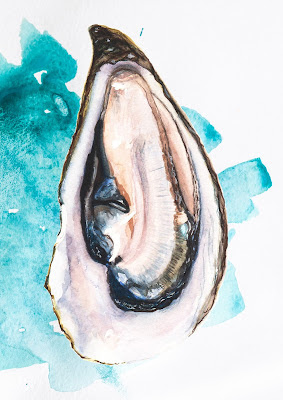
While rare today, these are British Columbia’s only native oyster.
Had you been dining on their brethren in the 1800s or earlier, it would have been this species you were consuming. Middens from Port Hardy to California are built from Ostrea lurida.
These wonderful invertebrates bare their souls with every bite. Have they lived in cold water, deep beneath the sea, protected from the sun's rays and heat? Are they the rough and tumble beach denizens whose thick shells tell us of a life spent withstanding the relentless pounding of the sea? Is the oyster in your mouth thin and slimy having just done the nasty—spurred by the warming waters of Spring?
Is this oyster a local or was it shipped to your current local and, if asked, would greet you with "Kon'nichiwa?" Not if the beauty on your plate is indeed Ostrea lurida.
![]() |
| Oyster in Kwak'wala is t̕łox̱t̕łox̱ |
The area is home to the Nuu-chah-nulth First Nations who have consumed this species boiled or steamed for thousands of years. Here these ancient oysters not only survive but thrive — building reefs and providing habitat for crab, anemones and small marine animals.
Oysters are in the family Ostreidae — the true oysters. Their lineage evolved in the Early Triassic — 251 - 247 million years ago.
In the Kwak̓wala language of the Kwakwaka'wakw, speakers of Kwak'wala, of the Pacific Northwest and my family, an oyster is known as t̕łox̱t̕łox̱.
I am curious to learn if any of the Nuu-chah-nulth have a different word for an oyster. If you happen to know, I would be grateful to learn.
Bison move across the prairie like living storms, vast and steady, with the weight of centuries in their stride.
Their dark eyes hold a quiet, unwavering depth—as if they’ve looked into the heart of time itself and carry its secrets in silence. Look into the eyes of this fellow and tell me you do not see his deep intelligence as he gives the camera a knowing look.
Shaggy fur ripples in the wind, rich and earthy, brushed by sun and shadow, a cloak woven from wilderness. When they breathe, clouds rise in the cold air, soft and ephemeral, like whispered promises that vanish but leave warmth behind.
There is something profoundly romantic in their presence: strength wrapped in gentleness, endurance softened by grace. To watch them is to feel the wild itself lean closer, reminding us of a love as vast as the horizon, as eternal as the ground beneath our feet.
When we think of bison today, images of great herds roaming the North American plains come to mind—dark, shaggy shapes against sweeping prairies. But the story of bison goes back far deeper in time.
These massive grazers are part of a lineage that stretches millions of years into the past, their fossil record preserving the tale of their rise, spread, and survival.
Bison belong to the genus Bison, within the cattle family (Bovidae). Their story begins in Eurasia during the late Pliocene, around 2.6 million years ago, when the first true bison evolved from earlier wild cattle (Bos-like ancestors).
Fossils suggest they descended from large bovids that roamed open grasslands of Eurasia as forests retreated and cooler, drier climates expanded.
The earliest known species, Bison priscus, or the Steppe Bison, was a giant compared to modern bison, sporting long horns that could span over six feet tip to tip. These animals thrived across Europe, Asia, and eventually crossed into North America via the Bering Land Bridge during the Pleistocene Ice Age.
The fossil record of bison stretches back about 2 million years in Eurasia and at least 200,000 years in North America, where they became one of the most successful large herbivores of the Ice Age. Fossil evidence shows that at least seven different species of bison once lived in North America, including the iconic Bison latifrons with its massive horns, and Bison antiquus, which is considered the direct ancestor of the modern American bison (Bison bison).
Some of the richest fossil bison deposits come from Siberia and Eastern Europe – home to abundant Bison priscus fossils, often preserved in permafrost with soft tissues intact. They are also found in Alaska, USA and in Canada's Yukon region – where Ice Age bison fossils are found alongside mammoth, horse, and muskox remains.
The Great Plains of the United States and Canada are rich in Bison antiquus and later species, often in mass bone beds where entire herds perished. We also find their remains in California and the American Southwest at sites like the La Brea Tar Pits. La Brea preserves bison remains from the Late Pleistocene and their museum of the same name has a truly wonderful display of Pleistocene wolves. Definitely worthy of a trip!
One particularly famous fossil site is the Hudson-Meng Bison Kill Site in Nebraska, where remains of over 600 Bison antiquus dating to about 10,000 years ago provide a window into Ice Age hunting practices and herd behavior.
By the end of the Ice Age, many megafauna species disappeared, but bison endured. Bison antiquus gradually gave rise to the modern American bison (Bison bison), which still carries echoes of its Ice Age ancestors. Though smaller than their Pleistocene relatives, today’s bison remain the largest land mammals in North America.
![]() |
| Aturia angustata, Lower Miocene, WA |
There are seven living nautiloid species in two genera: Nautilus pompilius, N. macromphalus, N. stenomphalus, N. belauensis, and the three new species being described from Samoa, Fiji, and Vanuatu (Ward et al.).
We have specimens of fossil nautiloids dating to the Turonian of California, and possibly the Cenomanian of Australia. There has also been a discovery of what might be the only known fossil of Allonautilus (Ward and Saunders, 1997), from the Nanaimo Group of British Columbia, Canada.
![]() |
| Aturia in the Collection of Rick Ross, VIPS |
Aturia lived in cooler water in the Cenozoic, preferring it over the warmer waters chosen by their cousins. Aturia, are commonly found as fossils from Eocene and Miocene outcrops.
That record ends with their extinction in the late Miocene. This was a fierce little beast with jaws packed with piranha-like teeth. They grew at least twice that of the largest known Nautilus living today.
Aturia is characterized by a smooth, highly involute, discoidal shell with a complex suture and subdorsal siphuncle. The shell of Aturia is rounded ventrally and flattened laterally; the dorsum is deeply impressed. The suture is one of the most complex within the subclass Nautiloidea. Of all the nautiloids, he may have been able to go deeper than his brethren.
Nautiloids are known for their simple suturing in comparison to their ammonite cousins. This simplicity of design limited their abilities in terms of withstanding the water pressure experienced when several atmospheres below the sea. Nautiloids were not able to compete with their ammonite cousins in this regard.
Instead of elaborate and complex sutures capable of withstanding the pressures of the deep, nautiloids have simpler sutures that would have them enfold on themselves and crush at depth.
![]() |
| Aturia angustata; Rick Ross Collection |
The siphuncle is moderate in size and located subdorsally in the adapical dorsal flexure of the septum. Based on the feeding and hunting behaviours of living nautiluses, Aturia most likely preyed upon small fish and crustaceans.
I have found a few of these specimens along the beaches of Clallam Bay and nearby in a local clay quarry. I've also seen calcified and chalcedony — microcrystalline quartz — agatized beauties of this species collected from river sites within the Olympic Peninsula range. In the bottom photos, you can see Aturia from Washington state and one (on the stand on the left) from Oregon, USA. These beauties are in the collections of the deeply awesome Rick Ross, Vancouver Island Palaeontological Society.
References: Ward, P; Haggart, J; Ross, R; Trask, P; Beard, G; Nautilus and Allonautilus in the Nanaimo Group, and in the modern oceans; 12th British Columbia Paleontological Symposium, 2018, Courtenay, abstracts; 2018 p. 10-11
![]() |
| Humpback Whale, Megaptera novaeangliae |
![]() |
| Modern Whale Vertebrae |
Thick layers of sandstone and conglomerate preserve a rich assemblage of marine fossils. Local collectors have long explored these beaches, spotting fossilized ribs and vertebrae protruding from the cliffs.
My first trip here was back in the mid 1990s with the Vancouver Paleontological Society. It is a regular haunt for the Victoria Paleontological Society and other regional fossil collecting groups.
It’s a place where the modern Pacific feels timeless—but buried in the cliffs are the remains of creatures that swam here more than 25 million years ago.
They are whales, yes, but not quite the whales we know today. Their bones tell the story of an ocean in transition and of whales caught mid-evolution—halfway between toothed predators and the filter-feeders that now dominate the seas.
Southern Vancouver Island’s fossil-bearing rocks belong largely to the Sooke Formation, a marine deposit dating to the late Oligocene (around 25–23 million years ago). At that time, much of the region lay beneath shallow coastal waters. Sediments settled over the remains of sea creatures, entombing shells, bird bones, shark teeth, and occasionally the massive bones of early whales.
These are not fossils of the gigantic blue whales or humpbacks we know today, but their ancestors—smaller, stranger, and crucial to the story of whale evolution.
One of the most remarkable finds from Vancouver Island is Aetiocetus, a small whale that lived during the late Oligocene. Aetiocetus is a classic “transitional fossil”—a whale that still had teeth, yet also shows evidence of developing baleen. This makes it a key player in understanding how modern filter-feeding whales (like gray whales and blue whales) evolved from their toothed ancestors.
Imagine a creature about 3–4 meters long, sleek like a dolphin but with a skull showing both sharp teeth and grooves that hint at primitive baleen plates. It likely hunted fish and squid but may have supplemented its diet by gulping in small prey from the water column.
Fossils of Aetiocetus have been found in Oregon and Japan, but southern Vancouver Island provides some of the northernmost evidence of this important lineage.
Alongside these early baleen whales, researchers have also found evidence of primitive odontocetes—the group that includes dolphins, porpoises, and sperm whales. These small, agile predators were experimenting with echolocation, the same sonar-like ability modern toothed whales use to hunt in dark or murky waters.
The whales preserved on southern Vancouver Island belong to a lineage with an extraordinary backstory. Around 50 million years ago, in what is now Pakistan and India, the ancestors of whales were land-dwelling, hoofed mammals (related to early hippos). Over millions of years, these animals waded into rivers and seas, evolving into the fully aquatic forms we recognize as whales.
By the time the Sooke Formation was laid down, whales had already colonized oceans worldwide. But the fossils here capture them in the middle of another transformation—the split between toothed whales (odontocetes) and baleen whales (mysticetes). Vancouver Island’s cliffs are, in a sense, a library shelf containing one of evolution’s most important chapters.
![]() |
| Fossil Gastropods, Photo: John Fam |
That continuity of life—millions of years stretching unbroken from fossil Aetiocetus to the humpback breaching offshore—gives southern Vancouver Island a special place in the story of the Pacific.
The cliffs of Muir Creek and other fossil sites are constantly eroding, revealing new fossils—but also destroying them. Without careful collection and preservation, many specimens are lost to the sea.
It is for this reason that we encourage citizen scientists to report significant finds rather than attempt to remove them — and in the case of the Muir Creek fossil site, to avoid collecting from the cliffs.
Fossils are protected under British Columbia’s Heritage Conservation Act, meaning they belong to the province and its people.
Next time you stand on those windswept cliffs, watching an orca’s dorsal fin slice through the surf, remember: you are standing on an ancient whale highway. Beneath your feet, locked in stone, are the bones of their ancestors—whales that swam here long before the Salish Sea had a name.
![]() |
| GREAT BEAR NA̱N |
Both bear families descend from a common ancestor, Ursavus, a bear-dog the size of a raccoon who lived more than 20 million years ago. Seems an implausible lineage given the size of their very large descendants.
An average Grizzly weighs in around 800 lbs (363 kg), but a recent find in Alaska tops the charts at 1600 lbs (726 kg).
This mighty beast stood 12' 6' high at the shoulder, 14' to the top of his head and is one of the largest grizzlies ever recorded — a na̱ndzi.
Adult bears tend to live solo except during mating season. Those looking for love congregate from May to July in the hopes of finding a mate. Through adaptation to shifting seasons, the females' reproductive system delays the implantation of fertilized eggs — blastocysts —until November or December to ensure her healthy pups arrive during hibernation. If food resources were slim that year, the newly formed embryo will not catch or attach itself to her uterine wall and she'll try again next year.
Females reach mating maturity at 4-5 years of age. They give birth to a single or up to four cubs (though usually just two) in January or February. The newborn cubs are cute little nuggets — tiny, hairless, and helpless — weighing in at 2-3 kilograms or 4-8 pounds. They feast on their mother’s nutrient-dense milk for the first two months of life. The cubs stay with their mamma for 18 months or more. Once fully grown, they can run 56 km an hour, are good at climbing trees and swimming and live 20-25 years in the wild.
First Nation Lore and Language
In the Kwak'wala language of the Kwakiutl First Nations of the Pacific Northwest — or Kwakwaka'wakw, speakers of Kwak'wala — a Grizzly bear is known as na̱n.
The ornamental carved Grizzly bear headdress was worn by the comic Dluwalakha Grizzly Bear Dancers, Once more from Heaven, in the Grizzly Bear Dance or Gaga̱lalał, is known as na̱ng̱a̱mł.
The Dluwalakha dancers were given supernatural treasures or dloogwi which they passed down from generation to generation.
In the Hamat'sa Grizzly bear dance, Nanes Bakbakwalanooksiwae, no mask was worn. Instead, the dancers painted their faces red and wore a costume of bearskin or t̓ła̱ntsa̱m and long wooden claws attached to their hands. You can imagine how impressive that sight is lit by the warm flickering flames of firelight during a Winter Dance ceremony.
Smoke of the World / Speaking of the Ancestors — Na̱wiła
![]() |
| Kwaguʼł Winter Dancers — Qagyuhl |
To tell stories of the ancestors is na̱wiła. Each of these ancestors took off their masks to become human and founded the many groups that are now bound together by language and culture as Kwakwaka’wakw.
The four First Nations who collectively make up the Kwakiutl are the Kwakiutl (Kwágu7lh), K’umk’utis/Komkiutis, Kwixa/Kweeha (Komoyoi) and Walas Kwakiutl (Lakwilala) First Nations.
There is likely blood of the Lawit’sis in there, too, as they inhabited the village site at Tsax̱is/T'sakis, Fort Rupert before the Kwakiutl First Nations made it a permanent home. It was here that I grew up and learned to greet my ancestors.
Not all Kwakwaka'wakw dance the Gaga̱lalał, but their ancestors likely attended feasts where the great bear was celebrated. To speak or tell stories of the ancestors is na̱wiła — and Grizzly bear as an ancestor is na̱n helus.
Visiting British Columbia's Great Bears
If you are interested in viewing British Columbia's Great Bears, do check out Indigenous Tourism BC's wonderfully informative website and the culturally-rich wildlife experiences on offer. You will discover travel ideas and resources to plan your next soul-powered adventure. To learn more about British Columbia's Great Bears and the continuing legacy of First Nation stewardship, visit:
Indigenous Tourism BC: https://www.indigenousbc.com
Great Bear Lodge has been offering tours to view the majestic animals of the Pacific Northwest. They keep both the guests' and the animals' comfort and protection in mind. I highly recommend their hospitality and expertise. To see their offerings, visit: www.greatbeartours.com
Image: Group of Winter Dancers--Qagyuhl; Curtis, Edward S., 1868-1952, https://lccn.loc.gov/2003652753.
Note: The Qagyuhl in the title of this photograph refers to the First Nation group, not the dancers themselves. I think our dear Edward was trying to spell Kwaguʼł and came as close as he was able. In Kwak'wala, the language of the Kwaguʼł or Kwakwakaʼwakw, speakers of Kwak'wala, the Head Winter Dancer is called t̕seḵa̱me' — and to call someone a really good dancer, you would use ya̱'winux̱w.
Charmingly, when Edward S. Curtis was visiting Tsaxis/T'sakis, he was challenged to a wrestling competition with a Giant Pacific Octopus, Enteroctopus dofleini. George Hunt (1854-1933) my great great grandfather's elder brother had issued the challenge and laughed himself senseless when Edward got himself completely wrapped up in tentacles and was unable to move. Edward was soon untangled and went on to take many more photos of the First Nations of the Pacific Northwest. Things did not go as well for the octopus or ta̱ḵ̕wa. It was later served for dinner or dzaḵwax̱stala, as it seemed calamari was destined for that night's menu.
![]() |
| Diplomoceras sp. |